
AP Precalculus -1.7 Rational Functions and End Behavior- MCQ Exam Style Questions - Effective Fall 2023
AP Precalculus -1.7 Rational Functions and End Behavior- MCQ Exam Style Questions – Effective Fall 2023
AP Precalculus -1.7 Rational Functions and End Behavior- MCQ Exam Style Questions – AP Precalculus- per latest AP Precalculus Syllabus.
Question
(B) \( x = 0 \) and \( x = -2 \)
(C) \( x = 0 \) and \( y = 5x + 10 \)
(D) \( x = 0 \) and \( y = x + 10 \)
▶️ Answer/Explanation
Factor denominator: \( x^2 + 2x = x(x+2) \). Zeros of denominator: \( x = 0 \) and \( x = -2 \).
Numerator zeros: \( x = -1, -2, -5 \).
Cancel \( x+2 \) (common factor) → hole at \( x = -2 \), not a vertical asymptote.
Vertical asymptote only at \( x = 0 \).
Degree numerator (after cancel) = 2, degree denominator = 1 ⇒ slant asymptote.
Perform division: \( \frac{x^2 + 7x + 5}{x} = x + 7 + \frac{5}{x} \) or redo original before cancel: Divide \( x^3 + 8x^2 + 17x + 10 \) by \( x^2 + 2x \) → quotient \( x + 6 \), remainder \( 5x + 10 \).
Thus slant asymptote: \( y = x + 6 \).
✅ Answer: (A)
Question
(B) \( \lim_{x \to \infty} f(x) = -\infty \)
(C) \( \lim_{x \to -\infty} f(x) = \infty \)
(D) \( \lim_{x \to -\infty} f(x) = -\infty \)
▶️ Answer/Explanation
Leading term: \( -2x^7 \), degree 7 (odd), coefficient negative.
For odd degree with negative leading coefficient:
As \( x \to \infty \), \( f(x) \to -\infty \).
As \( x \to -\infty \), \( f(x) \to \infty \).
The question asks for behavior as \( x \to \infty \).
✅ Answer: (B)
Question
(B) \( \lim_{x \to -\infty} f(x) = \infty \) and \( \lim_{x \to \infty} f(x) = \infty \)
(C) \( \lim_{x \to -\infty} f(x) = -\infty \) and \( \lim_{x \to \infty} f(x) = \infty \)
(D) \( \lim_{x \to -\infty} f(x) = \infty \) and \( \lim_{x \to \infty} f(x) = -\infty \)
▶️ Answer/Explanation
Leading term: \( 5x^6 \), degree 6 (even), coefficient positive.
For even degree with positive leading coefficient:
\( \lim_{x \to \pm\infty} f(x) = \infty \).
✅ Answer: (B)
Question
(B) 3
(C) 4
(D) 5
▶️ Answer/Explanation
The numerator is \( x^k(x-1)(x+3) \).
The degree of the numerator = \( k + 1 + 1 = k+2 \).
The denominator \( x^5 + 2x – 5 \) has degree \( 5 \).
Horizontal asymptote at \( y = 0 \) occurs when degree of denominator > degree of numerator.
So \( 5 > k+2 \) ⇒ \( k < 3 \).
Given \( k \) positive integer: possible \( k = 1 \) or \( 2 \).
Among choices, only \( k = 2 \) satisfies.
✅ Answer: (A) 2
Question
(B) The degree of \( p \) is greater than the degree of \( q \), and \( \lim_{x \to \infty} r(x) = \infty \).
(C) The degree of \( p \) is equal to the degree of \( q \), and \( \lim_{x \to \infty} r(x) = 0 \).
(D) The degree of \( p \) is equal to the degree of \( q \), and \( \lim_{x \to \infty} r(x) = \frac{1}{3} \).
▶️ Answer/Explanation
Numerator \( p(x) = (2x-3)(x-4)(x-2) \):
Leading term: \( 2x \cdot x \cdot x = 2x^3 \), degree 3.
Denominator \( q(x) = (3x-1)(2x+1)(x-1) \):
Leading term: \( 3x \cdot 2x \cdot x = 6x^3 \), degree 3.
Thus degree of \( p \) = degree of \( q \) = 3.
For large \( x \), \( r(x) \approx \frac{2x^3}{6x^3} = \frac{1}{3} \).
So \( \lim_{x \to \infty} r(x) = \frac{1}{3} \).
✅ Answer: (D)
Question
(B) \( g \) has degree 2 with leading coefficient 12.
(C) \( g \) has degree 3 with leading coefficient 3.
(D) \( g \) has degree 4 with leading coefficient 12.
▶️ Answer/Explanation
A rational function has a slant (oblique) asymptote when the degree of the numerator is exactly one more than the degree of the denominator.
Given \( f \) is degree 3, so \( g \) must be degree 2.
Slant asymptote \( y = 2x – 1 \) is the quotient from polynomial long division.
Leading term of \( f \) is \( 6x^3 \), leading term of \( g \) is \( ax^2 \).
\( \frac{6x^3}{ax^2} = \frac{6}{a}x \), which equals \( 2x \) (from \( 2x – 1 \)).
So \( \frac{6}{a} = 2 \) ⇒ \( a = 3 \).
Thus \( g \) has degree 2, leading coefficient 3.
✅ Answer: (A)
Question
(B) As \( x \) increases without bound, \( h(x) \) increases without bound, and as \( x \) decreases without bound, \( h(x) \) increases without bound.
(C) As \( x \) increases without bound, \( h(x) \) decreases without bound, and as \( x \) decreases without bound, \( h(x) \) increases without bound.
(D) As \( x \) increases without bound, \( h(x) \) decreases without bound, and as \( x \) decreases without bound, \( h(x) \) decreases without bound.
▶️ Answer/Explanation
Degree of numerator: 5, degree of denominator: 2.
Since numerator degree > denominator degree, no horizontal asymptote; end behavior ≈ \( \frac{2x^5}{3x^2} = \frac{2}{3}x^3 \).
Cubic \( \frac{2}{3}x^3 \) has positive leading coefficient.
For large positive \( x \), \( x^3 \) → +∞ ⇒ \( h(x) \) → +∞.
For large negative \( x \), \( x^3 \) → −∞ ⇒ \( h(x) \) → −∞.
Thus: as \( x \to +\infty \), \( h(x) \to +\infty \); as \( x \to -\infty \), \( h(x) \to -\infty \).
✅ Answer: (A)
Question
(B) The graph of \( h \) has a horizontal asymptote at \( y = a \), where \( a > 0 \).
(C) The graph of \( h \) has a horizontal asymptote at \( y = a \), where \( a < 0 \).
(D) The graph of \( h \) has no horizontal asymptote.
▶️ Answer/Explanation
\( p \) has three distinct zeros, each multiplicity 1 ⇒ degree \( p \) = 3, leading coefficient positive.
\( q \) has exactly one zero with multiplicity 3 ⇒ degree \( q \) = 3, leading coefficient negative.
Thus degree of numerator = degree of denominator = 3.
Horizontal asymptote exists at \( y = \frac{\text{leading coefficient of } p}{\text{leading coefficient of } q} \).
Let leading coefficient of \( p \) be \( A > 0 \), of \( q \) be \( B < 0 \).
Then \( a = \frac{A}{B} < 0 \).
So horizontal asymptote is \( y = a \) where \( a < 0 \).
✅ Answer: (C)
Question
▶️ Answer/Explanation
Identify the leading terms in the numerator and denominator.
The numerator’s leading term is $-x^8$ and the denominator’s is $2x^8$.
Since the degrees are equal ($8 = 8$), the horizontal asymptote is the ratio of leading coefficients.
The limit as $x \to -\infty$ is determined by $\frac{-1}{2}$.
Therefore, $\lim_{x \to -\infty} f(x) = -1/2$.
This matches option b.
Question
▶️ Answer/Explanation
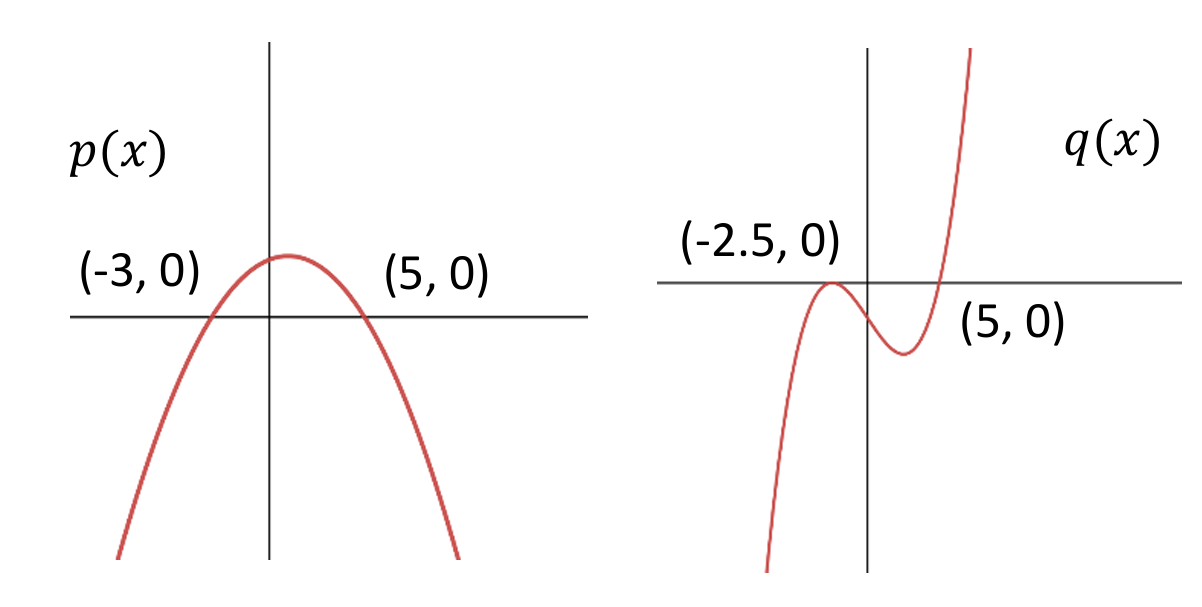
From the graphs, $p(x)$ has roots at $x = -3$ and $x = 5$, so $p(x) = a(x + 3)(x – 5)$ with $a < 0$.
The graph of $q(x)$ shows a bounce at $x = -2.5$ and a cross at $x = 5$, so $q(x) = b(x + 2.5)^2(x – 5)$ with $b > 0$.
The function $f(x) = \frac{a(x + 3)(x – 5)}{b(x + 2.5)^2(x – 5)} = \frac{a(x + 3)}{b(x + 2.5)^2}$ for $x \neq 5$.
At $x = -2.5$, the denominator $(x + 2.5)^2$ is always positive as $x \to -2.5$ from either side.
The numerator $a(x + 3)$ is negative because $a < 0$ and $(-2.5 + 3) = 0.5 > 0$.
Thus, $f(x) \to \frac{\text{negative}}{\text{positive } \to 0} = -\infty$ as $x \to -2.5$.
Therefore, $\lim_{x \to -\frac{5}{2}^-} f(x) = -\infty$ is correct.
Correct Option: a
Question
▶️ Answer/Explanation
The correct option is (B).
To find the slant asymptote, we divide the numerator by the denominator:
1. We represent the function as \(h(x) = \frac{x^2 – 6x + 7}{x – 2}\).
2. Perform polynomial long division: Divide \(x^2\) by \(x\) to get \(x\). Multiply \(x(x – 2) = x^2 – 2x\).
3. Subtract \((x^2 – 6x) – (x^2 – 2x)\) to result in \(-4x\). Bring down the \(+7\).
4. Divide \(-4x\) by \(x\) to get \(-4\). Multiply \(-4(x – 2) = -4x + 8\).
5. Subtract \((-4x + 7) – (-4x + 8)\) to get a remainder of \(-1\).
6. The function can be written as \(h(x) = (x – 4) – \frac{1}{x – 2}\).
7. As \(x \rightarrow \infty\), the remainder fraction approaches 0, leaving the slant asymptote \(y = x – 4\).
Question
(B) \( 7 \)
(C) \( 4 \)
(D) \( \frac{5}{3} \)
▶️ Answer/Explanation
To find the horizontal asymptote, compare the degrees of the numerator and denominator; since both are 2, the asymptote is \( y = \frac{1}{1} = 1 \), so \( b = 1 \).
Set the function equal to the asymptote to find the intersection: \( \frac{x^2 – 4}{x^2 – 2x + 2} = 1 \).
Multiply across and simplify: \( x^2 – 4 = x^2 – 2x + 2 \).
Subtract \( x^2 \) from both sides to get \( -4 = -2x + 2 \).
Solve for \( x \): \( 2x = 6 \Rightarrow x = 3 \), so \( a = 3 \).
Finally, calculate the sum: \( a + b = 3 + 1 = 4 \).
Therefore, the correct option is (C).
Question
▶️ Answer/Explanation
The correct option is (B).
First, simplify the function by factoring out \(x\) from both the numerator and denominator: \(f(x) = \frac{x(x^2 – x – 4)}{x(x – 4)}\).
Cancel the common factor \(x\) (for \(x \neq 0\)) to get the simplified form: \(f(x) = \frac{x^2 – x – 4}{x – 4}\).
To find the slant asymptote, perform polynomial long division of the numerator \((x^2 – x – 4)\) by the denominator \((x – 4)\).
Divide the leading term \(x^2\) by \(x\) to get the first term of the quotient, which is \(x\).
Multiply \(x(x – 4) = x^2 – 4x\) and subtract from the numerator: \((x^2 – x) – (x^2 – 4x) = 3x\).
Divide the remaining \(3x\) by \(x\) to get the second term of the quotient, which is \(+3\).
The quotient represents the slant asymptote: \(y = x + 3\).
The equation is in the form \(y = mx + c\), so the slope \(m\) is \(1\).
Question
▶️ Answer/Explanation
Question
(B) $y = -2x + 1$
(C) $y = -2x + 9$
(D) $y = 2x + 9$
▶️ Answer/Explanation
To find the slant asymptote, divide $f(x) = -2x^2 + 3x – 8$ by $g(x) = x + 3$.
Using synthetic division with the root $x = -3$:
The coefficients are $-2$, $3$, and $-8$.
Bring down $-2$, then multiply $-3 \times -2 = 6$.
Add $3 + 6 = 9$ to get the second coefficient of the quotient.
The resulting quotient is $-2x + 9$.
As $x \to \infty$, the remainder term $\frac{-35}{x+3}$ approaches $0$.
Thus, the equation of the slant asymptote is $y = -2x + 9$.
The correct option is (C).
Question
▶️ Answer/Explanation
Question
▶️ Answer/Explanation
(A) \( 2 \)
A rational function has a horizontal asymptote at \( y = 0 \) when the degree of the numerator is strictly less than the degree of the denominator.
The numerator has degree \( k + 2 \) and the denominator has degree \( 5 \).
For a horizontal asymptote at \( y = 0 \), we require \( k + 2 < 5 \), which gives \( k < 3 \).
Since \( k \) is a positive integer and the given options are \( 2,3,4,5 \), the only possible value is \( k = 2 \).
1. Degree of numerator \( = k + 2 \) because \( x^{k}(x-1)(x+3) \) expands to highest power \( x^{k+2} \).
2. Degree of denominator \( = 5 \) since highest power in \( x^{5}+2x-5 \) is \( 5 \).
3. Horizontal asymptote \( y = 0 \) occurs when numerator degree \( < \) denominator degree.
4. Thus \( k + 2 < 5 \).
5. Solving gives \( k < 3 \).
6. Since \( k \) is a positive integer, possible values are \( 1,2 \).
7. From the given options, only \( k = 2 \) satisfies the condition.
8. Therefore, the correct answer is \( \boxed{2} \).
Question
▶️ Answer/Explanation
To find the degree of the numerator \( p(x) \), we multiply the leading terms of its factors: \( (2x)(x)(x) = 2x^3 \), so the degree is 3.
To find the degree of the denominator \( q(x) \), we multiply the leading terms of its factors: \( (3x)(2x)(x) = 6x^3 \), so the degree is 3.
Comparing the two, the degree of \( p \) is equal to the degree of \( q \).
Since the degrees are equal, the horizontal asymptote (limit as \( x \to \infty \)) is the ratio of the leading coefficients.
The limit is calculated as \( \displaystyle \lim_{x\to\infty} r(x) = \frac{2}{6} = \frac{1}{3} \).
Therefore, statement (D) corresponds to these findings.
Question
▶️ Answer/Explanation
1. The common denominator of \( \frac{2x^3}{x+3} \) and \( \frac{4}{x-1} \) is \( (x+3)(x-1) = x^2 + 2x – 3 \).
2. Rewrite: \( \frac{2x^3}{x+3} = \frac{2x^3(x-1)}{(x+3)(x-1)} = \frac{2x^4 – 2x^3}{x^2+2x-3} \).
3. Rewrite: \( \frac{4}{x-1} = \frac{4(x+3)}{(x+3)(x-1)} = \frac{4x + 12}{x^2+2x-3} \).
4. Subtract numerators: \( 2x^4 – 2x^3 – (4x+12) \).
5. Thus \( h(x) = \frac{2x^4 – 2x^3 – 4x – 12}{x^2+2x-3} \).
6. For end behavior, compare leading terms: \( \frac{2x^4}{x^2} = 2x^2 \).
7. Therefore, \( h(x) \) has the same end behavior as \( y = 2x^2 \).
8. Hence, option (A) is correct.
Question
▶️ Answer/Explanation
(A) \( g \) has degree \(2\) with leading coefficient \(3\).
A slant (oblique) asymptote occurs when the degree of the numerator is exactly one greater than the degree of the denominator. Since \( \deg f = 3 \), we must have \( \deg g = 2 \). The slant asymptote equals the quotient obtained from polynomial division. Comparing leading terms: \[ \frac{6x^3}{ax^2} = \frac{6}{a}x. \] Given the asymptote is \(2x – 1\), we require \[ \frac{6}{a} = 2 \Rightarrow a = 3. \] Thus \( g \) has degree \(2\) with leading coefficient \(3\).
1. Since \( \deg f = 3 \) and a slant asymptote exists, \( \deg g = 2 \).
2. Let the leading term of \( g(x) \) be \( ax^2 \).
3. The leading term of the quotient is \( \dfrac{6x^3}{ax^2} = \dfrac{6}{a}x \).
4. The slant asymptote is \( 2x – 1 \), so \( \dfrac{6}{a} = 2 \).
5. Solving gives \( a = 3 \).
6. Therefore, \( g \) is degree \(2\) with leading coefficient \(3\).
Question
▶️ Answer/Explanation
(A)
To determine end behavior, compare the highest-degree terms in the numerator and denominator.
The leading term of the numerator is \(2x^{5}\) and the leading term of the denominator is \(3x^{2}\).
Thus, for large \(|x|\), \[ h(x) \sim \frac{2x^{5}}{3x^{2}} = \frac{2}{3}x^{3}. \]
Since \(\frac{2}{3}x^{3}\) is a cubic with positive leading coefficient:
As \(x \to +\infty\), \(h(x) \to +\infty\).
As \(x \to -\infty\), \(h(x) \to -\infty\).
1. Highest power in numerator: \(2x^{5}\).
2. Highest power in denominator: \(3x^{2}\).
3. Dominant behavior: \(\frac{2x^{5}}{3x^{2}}=\frac{2}{3}x^{3}\).
4. Degree difference \(=5-2=3\), so behavior is cubic.
5. Leading coefficient \(\frac{2}{3} > 0\).
6. Therefore \(h(x)\to +\infty\) as \(x\to +\infty\).
7. And \(h(x)\to -\infty\) as \(x\to -\infty\).
Question
▶️ Answer/Explanation
The degree of polynomial \(p\) is determined by its zeros: 3 zeros \(\times\) multiplicity 1 = degree 3.
The degree of polynomial \(q\) is determined by its zeros: 1 zero \(\times\) multiplicity 3 = degree 3.
For the rational function \(h(x) = \frac{p(x)}{q(x)}\), the numerator and denominator have equal degrees.
Therefore, the horizontal asymptote is the ratio of the leading coefficients: \(y = \frac{\text{leading coefficient of } p}{\text{leading coefficient of } q}\).
Since the leading coefficient of \(p\) is positive and \(q\) is negative, their ratio \(a\) must be negative (\(a < 0\)).
Thus, the graph has a horizontal asymptote at \(y = a\), where \(a < 0\).
Correct Option: (C)
Question
▶️ Answer/Explanation
Answer: (C) 3
Step 1: Factor numerator and denominator: \[ f(x) = \frac{x(x^2 – x – 4)}{x(x-4)} = \frac{x^2 – x – 4}{x-4}, \quad x \neq 0. \]
Step 2: Perform polynomial long division of \(x^2 – x – 4\) by \(x – 4\): \[ x^2 – x – 4 \div (x-4) = x + 3 + \frac{8}{x-4}. \]
Step 3: As \(x \to \infty\), the term \(\frac{8}{x-4} \to 0\), so the slant asymptote is \[ y = x + 3. \]
Step 4: The slope of the slant asymptote is the coefficient of \(x\): \[ m = 1. \]
Step 5: Double-check: Division confirms the slope is correct, and the asymptote is linear.
Note: The slope of the slant asymptote is determined only by the highest degree terms in the numerator and denominator, and matches the coefficient from the long division.