
▶️ Answer/Explanation
(A)(i) Find \( h(3) \)
The function is defined as \( h(x) = g(f(x)) \).
First, we find the value of the inner function, \( f(3) \).
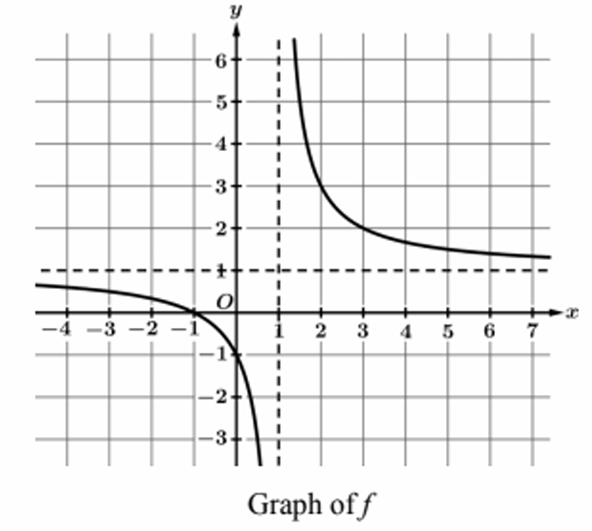
According to the problem text and graph, the point \( (3, 2) \) lies on the graph of \( f \). Therefore, \( f(3) = 2 \).
Now, substitute this value into the outer function \( g(x) \):
\( h(3) = g(2) \)
Using the definition \( g(x) = 2 + 3\ln x \):
\( g(2) = 2 + 3\ln(2) \)
Using a calculator to approximate \( \ln(2) \approx 0.693 \):
\( g(2) = 2 + 3(0.6931…) \approx 2 + 2.079 = 4.079 \)
Answer: \( h(3) \approx 4.079 \)
(A)(ii) Find real zeros of \( f \)
A real zero of a function occurs where the graph intersects the x-axis (where \( f(x) = 0 \)).
Looking at the provided graph, the curve intersects the x-axis at \( x = -1 \).
The problem text confirms the point \( (-1, 0) \) is on the graph.
There are no other intersections with the x-axis shown.
Answer: \( x = -1 \)
(B)(i) Find \( x \) for \( g(x) = e \)
Set up the equation:
\( 2 + 3\ln x = e \)
Subtract 2 from both sides:
\( 3\ln x = e – 2 \)
Divide by 3:
\( \ln x = \frac{e – 2}{3} \)
Convert from logarithmic to exponential form to solve for \( x \):
\( x = e^{\left(\frac{e – 2}{3}\right)} \)
Approximating the value (using \( e \approx 2.718 \)):
\( x \approx e^{0.2394} \)
Answer: \( x \approx 1.271 \)
(B)(ii) End behavior of \( g \)
We need to evaluate the limit as \( x \to \infty \) for \( g(x) = 2 + 3\ln x \).
As \( x \) increases without bound (\( x \to \infty \)), the natural logarithm function \( \ln x \) also increases without bound (\( \ln x \to \infty \)).
Multiplying by 3 and adding 2 does not change the unbounded nature.
Answer: \( \lim_{x \to \infty} g(x) = \infty \)
(C)(i) Is \( f \) invertible?
Answer: Yes, \( f \) is invertible.
(C)(ii) Reason
A function is invertible if and only if it is one-to-one. This can be verified visually using the Horizontal Line Test.
Looking at the graph of \( f(x) \):
1. The function is strictly decreasing on both branches of its domain (\( x < 1 \) and \( x > 1 \)).
2. The range of the left branch appears to be \( (-\infty, 1) \) and the range of the right branch appears to be \( (1, \infty) \).
Because the y-values do not repeat (no horizontal line intersects the graph more than once), the function is one-to-one.
Therefore, \( f \) has an inverse.