

▶️ Answer/Explanation
(A) (i)
First, evaluate the inner function \(f(5)\) using the table: \(f(5) = 34\).
Next, substitute this value into \(g(x)\) to find \(h(5) = g(34)\).
\(g(34) = \frac{34^3 – 14(34) – 27}{34 + 2}\)
\(g(34) = \frac{39304 – 476 – 27}{36} = \frac{38801}{36}\)
\(h(5) \approx 1077.806\)
(A) (ii)
To find \(f^{-1}(4)\), we look for the input value \(x\) in the table that produces an output of \(4\).
The table shows that \(f(3) = 4\).
Therefore, \(f^{-1}(4) = 3\).
(B) (i)
Set \(g(x) = 3\) and solve for \(x\):
\(\frac{x^3 – 14x – 27}{x + 2} = 3\)
Multiply both sides by \((x+2)\): \(x^3 – 14x – 27 = 3(x + 2)\)
Simplify: \(x^3 – 14x – 27 = 3x + 6\)
Rearrange into polynomial form: \(x^3 – 17x – 33 = 0\)
Using a graphing calculator to find the zero of this polynomial:
\(x \approx 4.879\)
(B) (ii)
We evaluate the limit as \(x \to -\infty\) for \(g(x)\).
\(\lim_{x \to -\infty} \frac{x^3 – 14x – 27}{x + 2}\)
By examining the leading terms, the function behaves like \(\frac{x^3}{x} = x^2\) for large absolute values of \(x\).
As \(x \to -\infty\), \(x^2 \to \infty\).
\(\lim_{x \to -\infty} g(x) = \infty\)
(C) (i)
Calculate the first differences of \(f(x)\): \((-5) – (-10) = 5\), \(4 – (-5) = 9\), \(17 – 4 = 13\), \(34 – 17 = 17\).
Calculate the second differences: \(9 – 5 = 4\), \(13 – 9 = 4\), \(17 – 13 = 4\).
Since the second differences are constant, \(f\) is best modeled by a quadratic function.
(C) (ii)
The model is quadratic because for equal intervals of the input values \(x\) (step size of \(1\)), the rate of change of the output values increases by a constant amount (constant second difference of \(4\)).
Question
Most-appropriate topic codes (AP Precalculus CED):
• 1.8: Rational Functions and Zeros — parts (A)(ii) and (B)(i)
• 1.7: Rational Functions and End Behavior — part (B)(ii)
• 2.8: Inverse Functions — parts (C)(i) and (C)(ii)
▶️ Answer/Explanation
(A)
(i) Value of \( h(6) \)
The composition is \( h(6) = g(f(6)) \).
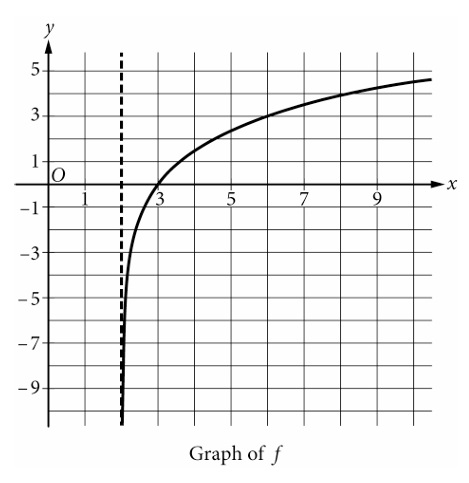
From the graph, the point \( (6, 3) \) is on \( f \), so \( f(6) = 3 \).
Then \( h(6) = g(3) = \frac{9}{(3-3)} = \frac{9}{0} \), which is undefined.
✅ Answer: \( \boxed{\text{Not defined}} \)
(ii) Real zeros of \( f \)
A zero of \( f \) is an \( x \)-value such that \( f(x) = 0 \).
From the given information, the point \( (3, 0) \) is on the graph of \( f \). Therefore, \( f(3) = 0 \).
✅ Answer: \( \boxed{3} \)
(B)
(i) Solving \( g(x) = -5.8 \)
Set \( g(x) = \frac{9}{x-3} = -5.8 \).
Solve for \( x \):
\( 9 = -5.8(x – 3) \)
\( 9 = -5.8x + 17.4 \)
\( -8.4 = -5.8x \)
\( x = \frac{-8.4}{-5.8} \approx 1.448275… \)
✅ Answer (decimal approximation): \( \boxed{1.448} \)
(ii) End behavior as \( x \) decreases without bound
For \( g(x) = \frac{9}{x-3} \), as \( x \to -\infty \), the denominator \( x-3 \to -\infty \).
A constant numerator divided by a value approaching \(-\infty\) approaches 0.
✅ Answer (limit notation): \( \boxed{\lim_{x \to -\infty} g(x) = 0} \)
(C)
(i) & (ii) Invertibility of \( f \)
A function is invertible if and only if it is one-to-one (each output comes from exactly one input).
The problem states that \( f \) is increasing on its entire domain \( x > 2 \). An increasing function is always one-to-one, because if \( a \neq b \), then either \( a < b \) (so \( f(a) < f(b) \)) or \( a > b \) (so \( f(a) > f(b) \)), meaning \( f(a) \neq f(b) \).
Since \( f \) is one-to-one on its domain, it is invertible.
✅ Answer: \( \boxed{\text{Yes}} \)
▶️ Answer/Explanation
(A)(i) Find \( h(3) \)
The function is defined as \( h(x) = g(f(x)) \).
First, we find the value of the inner function, \( f(3) \).
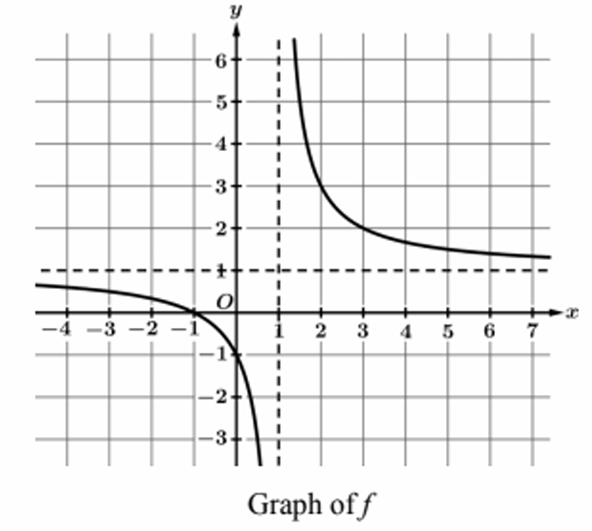
According to the problem text and graph, the point \( (3, 2) \) lies on the graph of \( f \). Therefore, \( f(3) = 2 \).
Now, substitute this value into the outer function \( g(x) \):
\( h(3) = g(2) \)
Using the definition \( g(x) = 2 + 3\ln x \):
\( g(2) = 2 + 3\ln(2) \)
Using a calculator to approximate \( \ln(2) \approx 0.693 \):
\( g(2) = 2 + 3(0.6931…) \approx 2 + 2.079 = 4.079 \)
Answer: \( h(3) \approx 4.079 \)
(A)(ii) Find real zeros of \( f \)
A real zero of a function occurs where the graph intersects the x-axis (where \( f(x) = 0 \)).
Looking at the provided graph, the curve intersects the x-axis at \( x = -1 \).
The problem text confirms the point \( (-1, 0) \) is on the graph.
There are no other intersections with the x-axis shown.
Answer: \( x = -1 \)
(B)(i) Find \( x \) for \( g(x) = e \)
Set up the equation:
\( 2 + 3\ln x = e \)
Subtract 2 from both sides:
\( 3\ln x = e – 2 \)
Divide by 3:
\( \ln x = \frac{e – 2}{3} \)
Convert from logarithmic to exponential form to solve for \( x \):
\( x = e^{\left(\frac{e – 2}{3}\right)} \)
Approximating the value (using \( e \approx 2.718 \)):
\( x \approx e^{0.2394} \)
Answer: \( x \approx 1.271 \)
(B)(ii) End behavior of \( g \)
We need to evaluate the limit as \( x \to \infty \) for \( g(x) = 2 + 3\ln x \).
As \( x \) increases without bound (\( x \to \infty \)), the natural logarithm function \( \ln x \) also increases without bound (\( \ln x \to \infty \)).
Multiplying by 3 and adding 2 does not change the unbounded nature.
Answer: \( \lim_{x \to \infty} g(x) = \infty \)
(C)(i) Is \( f \) invertible?
Answer: Yes, \( f \) is invertible.
(C)(ii) Reason
A function is invertible if and only if it is one-to-one. This can be verified visually using the Horizontal Line Test.
Looking at the graph of \( f(x) \):
1. The function is strictly decreasing on both branches of its domain (\( x < 1 \) and \( x > 1 \)).
2. The range of the left branch appears to be \( (-\infty, 1) \) and the range of the right branch appears to be \( (1, \infty) \).
Because the y-values do not repeat (no horizontal line intersects the graph more than once), the function is one-to-one.
Therefore, \( f \) has an inverse.