
Real Zeros of Rational Functions
Let a rational function be written as
\( r(x) = \dfrac{p(x)}{q(x)} \)
where \( p(x) \) and \( q(x) \) are polynomial functions and \( q(x) \ne 0 \).
The real zeros of a rational function are the real input values for which the output value is zero.
Since a rational function equals zero only when its numerator equals zero, the real zeros of the rational function correspond to the real zeros of the numerator, provided those values are in the domain of the function.
Mathematically:
\( r(x) = 0 \iff p(x) = 0 \text{ and } q(x) \ne 0 \)
Each real zero corresponds to an x-intercept of the graph of the rational function.
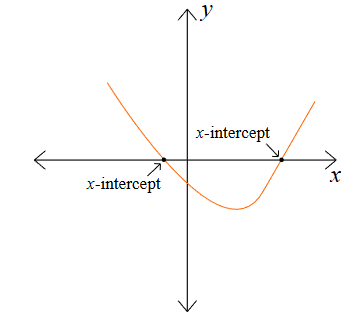
If a factor cancels between the numerator and denominator, the corresponding value is not a zero of the rational function, because it is not included in the domain.
Example:
Find the real zeros of the rational function
\( r(x) = \dfrac{x^2 – 4}{x + 1} \)
▶️ Answer/Explanation
Set the numerator equal to zero.
\( x^2 – 4 = 0 \)
Factor:
\( (x – 2)(x + 2) = 0 \)
So \( x = -2 \) and \( x = 2 \).
Check the denominator: \( x + 1 \ne 0 \) for both values.
Conclusion
The real zeros are \( x = -2 \) and \( x = 2 \), which are the x-intercepts of the graph.
Example:
Determine the real zeros of
\( f(x) = \dfrac{(x – 3)(x + 1)}{x – 3} \)
▶️ Answer/Explanation
The factor \( x – 3 \) appears in both the numerator and denominator.
This factor cancels, but \( x = 3 \) is excluded from the domain.
After simplification, the numerator is zero when
\( x + 1 = 0 \Rightarrow x = -1 \)
Conclusion
The only real zero of the rational function is \( x = -1 \).
The value \( x = 3 \) is not a zero because it is not in the domain.
Rational Function Inequalities and Critical Values
Let a rational function be written as
\( r(x) = \dfrac{p(x)}{q(x)} \)
where \( p(x) \) and \( q(x) \) are polynomial functions and \( q(x) \ne 0 \).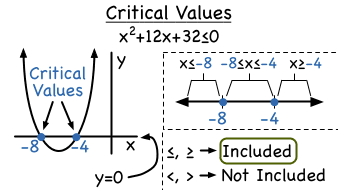
The real zeros of both polynomial functions play a key role when solving rational function inequalities such as
\( r(x) \ge 0 \)
\( r(x) \le 0 \)
Specifically:
Real zeros of the numerator are endpoints of solution intervals.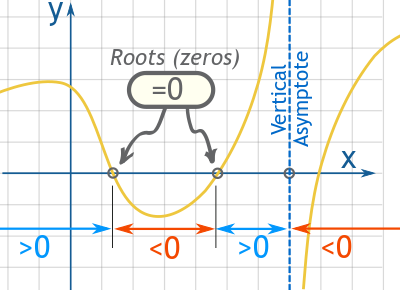
Real zeros of the denominator are vertical asymptotes and separate intervals, but are never included in the solution set.
Together, the real zeros of the numerator and denominator divide the real number line into intervals.
On each interval, the rational function is either entirely positive or entirely negative.
By testing one value in each interval, we can determine which intervals satisfy the given inequality.
Example:
Solve the inequality
\( r(x) = \dfrac{x – 2}{x + 1} \ge 0 \)
▶️ Answer/Explanation
Step 1: Find critical values
Numerator zero: \( x – 2 = 0 \Rightarrow x = 2 \)
Denominator zero: \( x + 1 = 0 \Rightarrow x = -1 \)
Step 2: Test intervals
\( (-\infty, -1) \): positive
\( (-1, 2) \): negative
\( (2, \infty) \): positive
Step 3: Include endpoints
Include \( x = 2 \) because it makes the numerator zero.
Exclude \( x = -1 \) because it is not in the domain.
Final answer
\( (-\infty, -1) \cup [2, \infty) \)
Example:
Solve the inequality
\( \dfrac{x(x – 3)}{x – 1} \le 0 \)
▶️ Answer/Explanation
Step 1: Find critical values
Numerator zeros: \( x = 0 \), \( x = 3 \)
Denominator zero: \( x = 1 \)
Step 2: Test intervals
\( (-\infty, 0) \): negative
\( (0, 1) \): positive
\( (1, 3) \): negative
\( (3, \infty) \): positive
Step 3: Include or exclude endpoints
Include \( x = 0 \) and \( x = 3 \).
Exclude \( x = 1 \).
Final answer
\( (-\infty, 0] \cup (1, 3] \)