Home / AP® Exam / AP® PreCalculus / AP® Precalculus

AP Precalculus -1.9 Rational Functions and Vertical Asymptotes- FRQ Exam Style Questions - Effective Fall 2023

AP Precalculus -1.9 Rational Functions and Vertical Asymptotes- FRQ Exam Style Questions – Effective Fall 2023

AP Precalculus -1.9 Rational Functions and Vertical Asymptotes- FRQ Exam Style Questions – AP Precalculus- per latest AP Precalculus Syllabus.

AP Precalculus – FRQ Exam Style Questions- All Topics

Question 

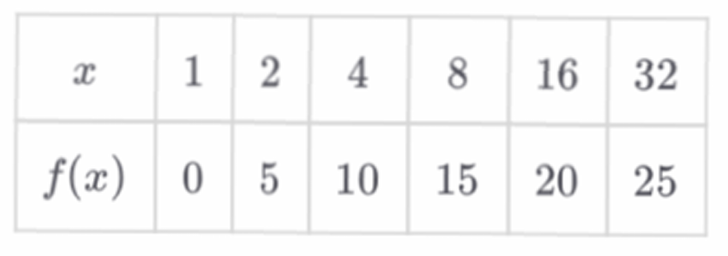
Let $f$ be an increasing function defined for $x > 0$. The table gives values for $f(x)$ at selected values of $x$. The function $g$ is given by $g(x) = 0.25x^3 – 9.5x^2 + 110x – 399$.
Part A
(i) The function $h$ is defined by $h(x) = (g \circ f)(x) = g(f(x))$. Find the value of $h(8)$ as a decimal approximation, or indicate that it is not defined.
(ii) Find the value of $f^{-1}(20)$, or indicate that it is not defined.
Part B
(i) Find all values of $x$, as decimal approximations, for which $g(x) = -45$, or indicate there are no such values.
(ii) Determine the end behavior of $g$ as $x$ increases without bound. Express your answer using the mathematical notation of a limit.
Part C
(i) Use the table of values of $f(x)$ to determine if $f$ is best modeled by a linear, quadratic, exponential, or logarithmic function.
(ii) Give a reason for your answer based on the relationship between the change in the output values of $f$ and the change in the input values of $f$.
▶️ Answer/Explanation
Detailed solution

Part A

(i) From the table, we find $f(8) = 15$.

Substitute $15$ into the function $g(x)$: $h(8) = g(15) = 0.25(15)^3 – 9.5(15)^2 + 110(15) – 399$.

$h(8) = 0.25(3375) – 9.5(225) + 1650 – 399$.

$h(8) = 843.75 – 2137.5 + 1650 – 399$.

$h(8) = -42.75$.

(ii) To find $f^{-1}(20)$, we look for the $x$ value where $f(x) = 20$.

From the table, $f(16) = 20$.

Therefore, $f^{-1}(20) = 16$.

Part B

(i) We solve the equation $0.25x^3 – 9.5x^2 + 110x – 399 = -45$.

Set the equation to zero: $0.25x^3 – 9.5x^2 + 110x – 354 = 0$.

Using numerical methods or a graphing calculator, the real solutions are approximately:

$x \approx 5.242$

$x \approx 12.188$

$x \approx 20.570$

(ii) The end behavior of a polynomial is determined by its leading term, $0.25x^3$.

Since the leading coefficient is positive and the degree is odd, as $x \to \infty$, $g(x) \to \infty$.

The limit notation is $\lim_{x \to \infty} g(x) = \infty$.

Part C

(i) The function $f$ is best modeled by a logarithmic function.

(ii) In a logarithmic model, constant changes in the output values correspond to proportional changes in the input values.

As the output $f(x)$ increases by a constant $5$ ($0, 5, 10, 15 \dots$),

The input $x$ values are multiplied by a constant factor of $2$ ($1, 2, 4, 8 \dots$).

This constant ratio of inputs for constant additions of outputs is the hallmark of logarithmic growth.

Scroll to Top