
AP Precalculus -1.9 Rational Functions and Vertical Asymptotes- MCQ Exam Style Questions - Effective Fall 2023
AP Precalculus -Link- MCQ Exam Style Questions – Effective Fall 2023
AP Precalculus -Link- MCQ Exam Style Questions – AP Precalculus- per latest AP Precalculus Syllabus.
Question
(B) \( \frac{(x+1)^2(x-4)^2}{(x+1)^2(4-x)^3} \)
(C) \( \frac{(x+1)^2(x-4)^3}{(x+1)^2(4-x)^3} \)
(D) \( \frac{(x+1)^2(x-4)^2}{(4x+4)^2(4+x)^3} \)
▶️ Answer/Explanation
We need \( f \) to have a vertical asymptote at \( x = 4 \), not a hole.
For that, \( x = 4 \) must be a zero of the denominator with higher multiplicity than in the numerator.
Note \( 4 – x = -(x – 4) \), so \( (4-x)^3 = [-(x-4)]^3 = -(x-4)^3 \) up to a constant factor.
Check each option:
(A) Numerator: \( (x-4)^2 \) (multiplicity 2). Denominator: \( (4-x)^3 = -(x-4)^3 \) (multiplicity 3 in \( x-4 \) factor). → Denominator exponent 3 > numerator exponent 2 → vertical asymptote at \( x = 4 \). ✓
(B) Same as (A) in listing, probably mislabeled duplicate in original.
(C) Numerator: \( (x-4)^3 \) (multiplicity 3). Denominator: same \( (4-x)^3 \) → same multiplicity → no asymptote (hole if factors match exactly after simplification).
(D) Denominator does not have \( x-4 \) factor, so \( x = 4 \) not a vertical asymptote.
✅ Answer: (A)
Question
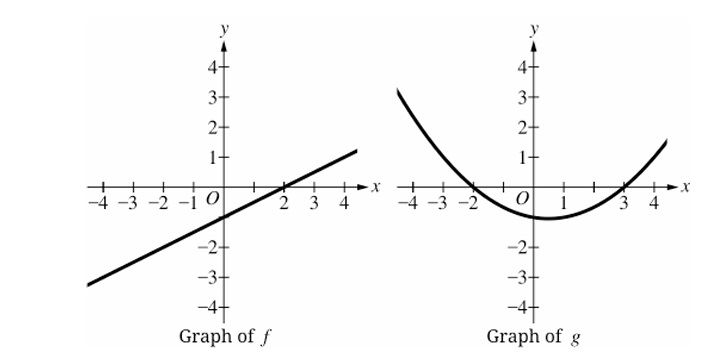
(B) \( x = 3 \) only
(C) \( x = -2 \) and \( x = 3 \) only
(D) \( x = -2, x = 2, \) and \( x = 3 \)
▶️ Answer/Explanation
Vertical asymptotes of \( h(x) = \frac{f(x)}{g(x)} \) occur at real zeros of \( g(x) \) that are not also zeros of \( f(x) \) with at least the same multiplicity.
From the given answer reasoning: zeros of \( g \) are \( x = -2 \) and \( x = 3 \).
Check \( f(x) \): If \( f \) does not have zeros at \( x = -2 \) or \( x = 3 \), or has them with lower multiplicity, then vertical asymptotes exist there.
Given answer: \( x = -2 \) and \( x = 3 \) only ⇒ not \( x = 2 \), meaning \( g \) does not have a zero at \( x = 2 \) or \( f \) cancels it.
✅ Answer: (C) \( x = -2 \) and \( x = 3 \) only
Question
(B) \( \frac{(x-4)(x+5)}{(x-1)(x+5)} \)
(C) \( \frac{(x+1)(x+5)}{(x-5)(x+2)} \)
(D) \( \frac{(x-5)(x-3)}{(x-3)(x+5)} \)
▶️ Answer/Explanation
Vertical asymptote at \( x = -5 \) means denominator has zero at \( x=-5 \) that is not canceled by numerator.
Check each:
(A) Denominator \( 2(x-5) \) → zero at \( x=5 \) only ⇒ no asymptote at \( x=-5 \).
(B) Factor \( (x+5) \) cancels ⇒ hole, not asymptote.
(C) Denominator zero at \( x=5 \) and \( x=-2 \), not \( x=-5 \) ⇒ no asymptote at \( x=-5 \).
(D) Denominator zero at \( x=3 \) and \( x=-5 \); \( x=3 \) cancels, \( x=-5 \) remains ⇒ vertical asymptote at \( x=-5 \).
✅ Answer: (D)
Question
| \(x\) | -5.1 | -5.01 | -5.001 | -5 | -4.999 | -4.99 | -4.9 |
|---|---|---|---|---|---|---|---|
| \(f(x)\) | -10 | -100 | -1000 | undefined | 1000 | 100 | 10 |
(B) The graph of \(f\) has a hole at \(x=-5\)
(C) The graph of \(f\) has a vertical asymptote at \(x=-5\).
(D) The graph of \(f\) has a horizontal asymptote at \(y=-5\).
▶️ Answer/Explanation
1. Analyze the limits at -5:
As \(x \to -5^-\) (approaching from the left), \(f(x)\) decreases without bound (\(-10 \to -100 \to -1000\)).
As \(x \to -5^+\) (approaching from the right), \(f(x)\) increases without bound (\(10 \to 100 \to 1000\)).
2. Interpret the behavior:
When the limit of the absolute value of a function approaches infinity as \(x\) approaches a constant \(c\), the graph has a vertical asymptote at \(x=c\).
✅ Answer: (C)
Question
(B) \( \displaystyle \frac{(x-4)(x+5)}{(x-1)(x+5)} \)
(C) \( \displaystyle \frac{(x+1)(x+5)}{(x-5)(x+2)} \)
(D) \( \displaystyle \frac{(x-5)(x-3)}{(x-3)(x+5)} \)
▶️ Answer/Explanation
A vertical asymptote occurs where the denominator is zero but the numerator is not zero (after canceling any common factors).
We want \( x = -5 \) to be a vertical asymptote, so \( (x+5) \) must be a factor of the denominator and not cancel completely with the numerator.
Check each option:
(A) Factor \( (x+5) \) in numerator, \( (x-5) \) in denominator — no factor \( (x+5) \) in denominator. So no asymptote at \( x=-5 \).
(B) Factor \( (x+5) \) appears in numerator and denominator — cancels, giving a hole at \( x=-5 \), not an asymptote.
(C) Factor \( (x+5) \) in numerator, denominator factors are \( (x-5) \) and \( (x+2) \) — no \( (x+5) \) in denominator, so no asymptote at \( x=-5 \).
(D) Factor \( (x+5) \) appears only in denominator (numerator has \( (x-5)(x-3) \)), so \( x=-5 \) makes denominator zero but numerator nonzero. This gives a vertical asymptote at \( x=-5 \).
✅ Answer: (D)
Question
▶️ Answer/Explanation
The variable $x$ represents the percent of pure water expressed as a decimal ($1 = 100\%$).
The limit $\lim_{x \to 1^-}$ indicates $x$ is approaching $1$ ($100\%$ pure water) from the left.
As $x$ approaches $1$, the denominator $(x – 1)$ approaches $0$, causing the cost $C(x)$ to approach $\infty$.
The result $\infty$ means the cost increases rapidly without bound as purity nears $100\%$.
An infinite limit implies a vertical asymptote, meaning $x$ can never actually reach $1$.
Therefore, the cost to achieve absolute $100\%$ purity is physically and economically impossible.
This matches Option b, which correctly identifies $x$ as pure water and notes the impossibility of $100\%$.
Question
▶️ Answer/Explanation
To find the domain, we must determine for which values of \( x \) the denominator is zero.
Set the denominator equal to zero: \( x^3 + 10x^2 + 16x = 0 \).
Factor out the common term \( x \): \( x(x^2 + 10x + 16) = 0 \).
Factor the quadratic expression: \( x(x + 8)(x + 2) = 0 \).
Solve for \( x \): \( x = 0 \), \( x + 8 = 0 \Rightarrow x = -8 \), or \( x + 2 = 0 \Rightarrow x = -2 \).
The function is undefined at these values, so the domain is all real numbers except \( 0, -8, \) and \( -2 \).
Correct Option: (C)
Question
▶️ Answer/Explanation
Question
▶️ Answer/Explanation
We are analyzing the limit of \( f(x) \) as \( x \to 1 \) from the right (since \( x > 1 \)).
First, evaluate the numerator at \( x = 1 \): \( -2(1+3) = -2(4) = -8 \).
Next, consider the denominator \( (x-1) \). As \( x \) approaches 1 from the right, \( (x-1) \) is a very small positive number.
We are dividing a negative constant (\( -8 \)) by a positive number approaching zero (\( 0^+ \)).
The result will be a negative number with an infinitely large magnitude.
Mathematically, \( \lim_{x \to 1^+} \frac{-8}{x-1} = -\infty \).
Therefore, the output values decrease without bound.
Correct Option: (A)
Question
▶️ Answer/Explanation
A vertical asymptote occurs when the denominator equals zero and the factor does not completely cancel with the numerator. Since \(4 – x = -(x – 4)\), we rewrite: \[ (4-x)^3 = -(x-4)^3 \] For option (A), simplifying gives: \[ f(x) = -\frac{x+1}{x-4} \] Because a factor of \((x-4)\) remains in the denominator, there is a vertical asymptote at \(x = 4\).
1. A vertical asymptote occurs where the denominator is zero after simplification.
2. Note that \(4-x = -(x-4)\).
3. In (A), cancel \((x+1)^2\) and simplify powers of \((x-4)\).
4. This gives \(f(x) = -\frac{x+1}{x-4}\).
5. Since \((x-4)\) remains in the denominator, it does not fully cancel.
6. Therefore, \(x=4\) is a vertical asymptote.
7. In (B) and (C), \((x-4)\) cancels completely → hole, not asymptote.
8. In (D), denominator is zero at \(x=-4\), not \(x=4\).
Question
▶️ Answer/Explanation
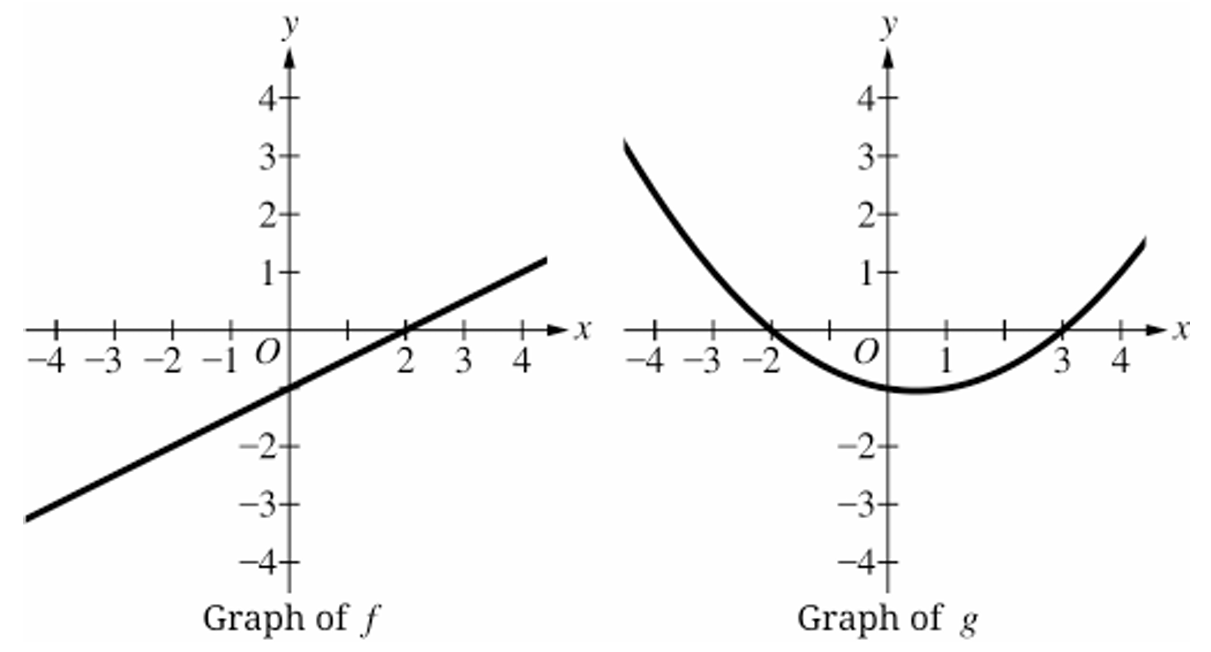
The correct answer is (C).
A vertical asymptote for a rational function \(h(x) = \frac{f(x)}{g(x)}\) occurs where the denominator \(g(x)\) is zero and the numerator \(f(x)\) is non-zero.
From the graph of \(g\), the curve intersects the x-axis at \(x = -2\) and \(x = 3\), so \(g(-2) = 0\) and \(g(3) = 0\).
From the graph of \(f\), at these x-values, the function is non-zero: \(f(-2) \neq 0\) (negative) and \(f(3) \neq 0\) (positive).
Since the denominator is zero and the numerator is non-zero at \(x = -2\) and \(x = 3\), both lines are vertical asymptotes.
Note that at \(x = 2\), \(f(2) = 0\) but \(g(2) \neq 0\), which results in an x-intercept for \(h(x)\), not an asymptote.
Question
▶️ Answer/Explanation
2. The numerator is already factored: \((x+10)(x^2 – 10x + 100)\).
3. The common factor \((x+10)\) cancels, so \(g(x) = \frac{x^2 – 10x + 100}{x-10}\), where \(x \neq -10\).
4. Since the factor cancels, \(x = -10\) creates a removable discontinuity (hole).
5. The remaining denominator \(x-10 = 0\) gives a vertical asymptote at \(x = 10\).
6. Therefore, the graph has a hole at \(x = -10\), so option (B) is correct.
Question
▶️ Answer/Explanation
Explanation:
A vertical asymptote occurs where the denominator equals zero and the factor does not cancel with the numerator.
1. A vertical asymptote at \(x=-5\) requires a factor \((x+5)\) in the denominator.
2. In (A), \((x-5)\) cancels, leaving \( \frac{x+5}{2} \); no asymptote at \(x=-5\).
3. In (B), \((x+5)\) cancels completely, creating a hole at \(x=-5\), not an asymptote.
4. In (C), the denominator does not contain \((x+5)\); no asymptote at \(x=-5\).
5. In (D), \((x-3)\) cancels, leaving \( \frac{x-5}{x+5} \).
6. Since \((x+5)\) remains in the denominator, \(x=-5\) gives a vertical asymptote.