
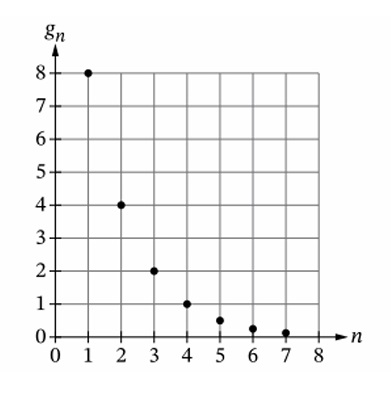
▶️ Answer/Explanation
From the graph, likely \( g_1 = 8 \), \( g_2 = 4 \), so common ratio \( r = \frac{4}{8} = \frac{1}{2} \).
General form: \( g_n = g_1 \cdot r^{\,n-1} = 8 \cdot \left( \frac{1}{2} \right)^{n-1} \).
But none match exactly — check options:
(A) \( 4 \left( \frac{1}{2} \right)^{n-2} = 4 \cdot \left( \frac{1}{2} \right)^{n-2} = 8 \cdot \left( \frac{1}{2} \right)^{n-1} \), yes, because \( 4 \cdot \left( \frac{1}{2} \right)^{-1} = 4 \cdot 2 = 8 \).
So (A) is equivalent to the standard form.
✅ Answer: (A)
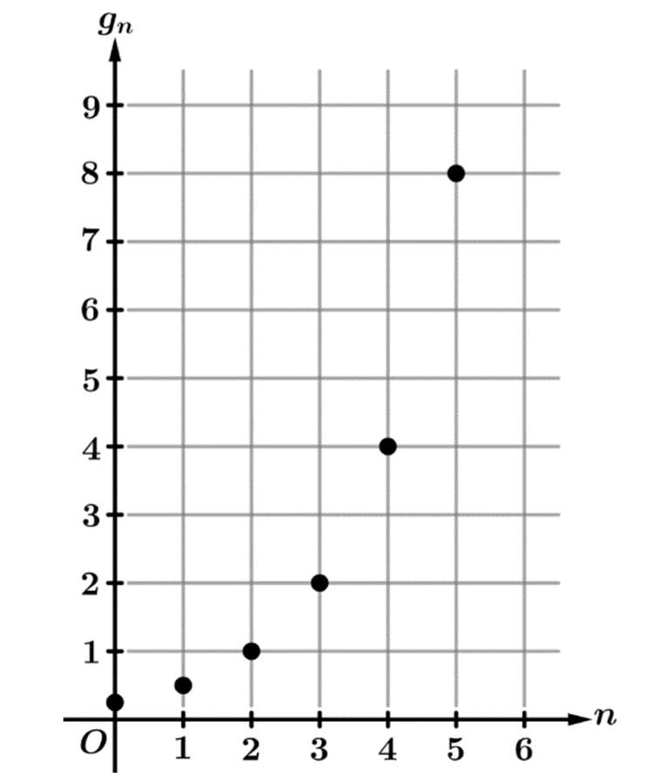
▶️ Answer/Explanation
From the graph, we observe the points: \( (2, 1) \), \( (3, 2) \), \( (4, 4) \), and \( (5, 8) \).
This shows a geometric sequence with a common ratio of \( 2 \) (e.g., \( \frac{4}{2} = 2 \)).
We test the options by substituting \( n = 2 \), knowing that \( g_2 \) must equal \( 1 \):
(A) \( \frac{1}{4}\left(\frac{1}{2}\right)^2 = \frac{1}{4} \cdot \frac{1}{4} = \frac{1}{16} \) (Incorrect)
(B) \( \frac{1}{2} \cdot 2^2 = \frac{1}{2} \cdot 4 = 2 \) (Incorrect)
(C) \( (2)^{2-1} = 2^1 = 2 \) (Incorrect)
(D) \( 4(2)^{2-4} = 4(2)^{-2} = 4\left(\frac{1}{4}\right) = 1 \) (Correct)
Therefore, the correct expression is \( 4(2)^{n-4} \).
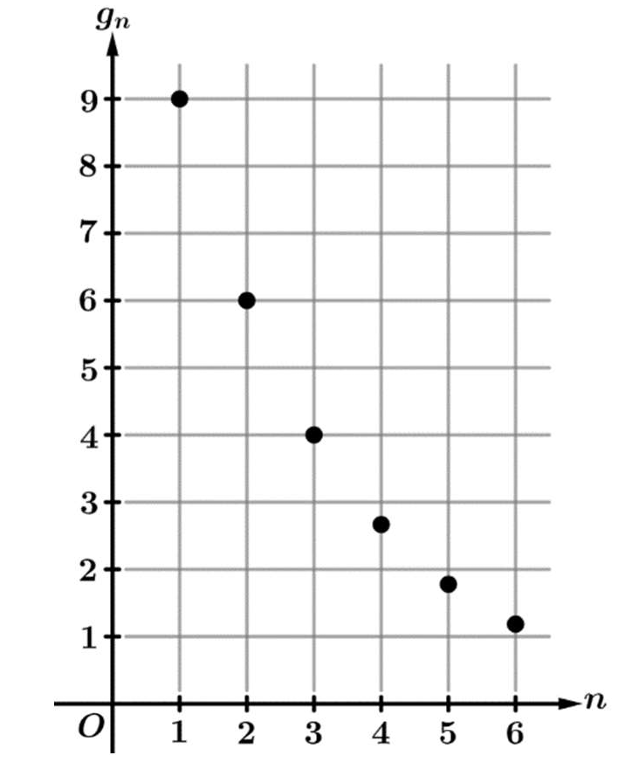
▶️ Answer/Explanation
From the graph, we can identify the coordinates of the first few terms: \((1, 9)\), \((2, 6)\), and \((3, 4)\).
This gives us the first term \(a_1 = 9\) and the second term \(a_2 = 6\).
Calculate the common ratio \(r\) of the geometric sequence: \(r = \frac{a_2}{a_1} = \frac{6}{9} = \frac{2}{3}\).
The standard formula for the \(n\)th term is \(g_n = a_1 \cdot r^{n-1}\), which gives \(g_n = 9\left(\frac{2}{3}\right)^{n-1}\).
To find the matching option, we can substitute a known point like \(n=3\) (where \(g_3 = 4\)) into the choices.
Checking Option (D): \(4\left(\frac{2}{3}\right)^{3-3} = 4\left(\frac{2}{3}\right)^0 = 4(1) = 4\). This matches the graph perfectly.
Algebraically, we can also rewrite the standard formula to match Option (D): \(9\left(\frac{2}{3}\right)^{n-1} = 9\left(\frac{2}{3}\right)^2 \left(\frac{2}{3}\right)^{n-3} = 9 \cdot \frac{4}{9} \cdot \left(\frac{2}{3}\right)^{n-3} = 4\left(\frac{2}{3}\right)^{n-3}\).
Thus, the correct expression is (D).
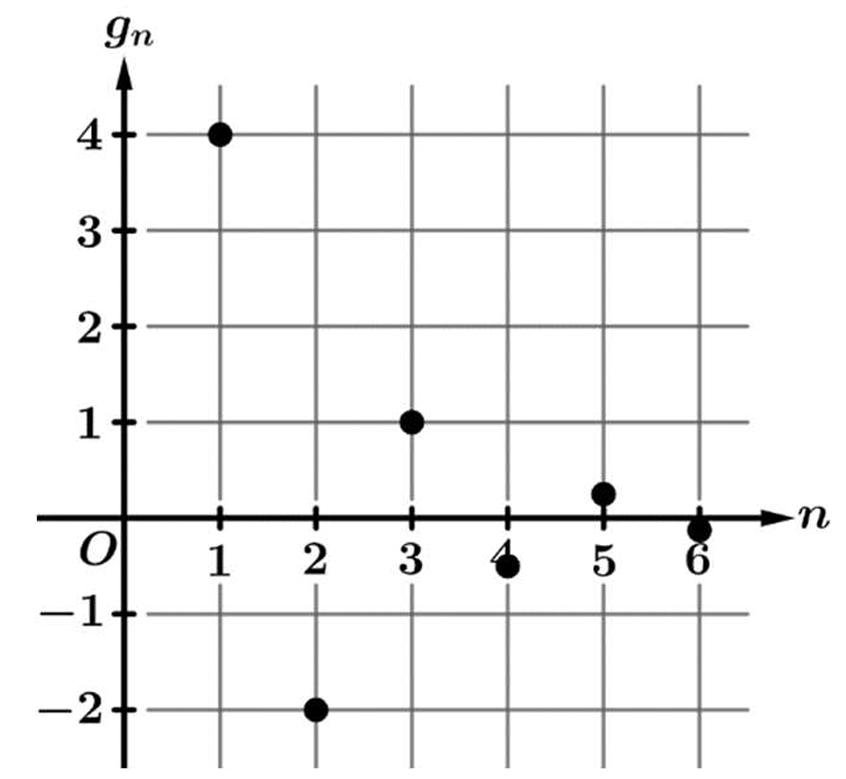
▶️ Answer/Explanation
From the graph, we identify the coordinates of the first few terms as \((1, 4)\), \((2, -2)\), and \((3, 1)\).
The first term of the sequence is \(g_1 = 4\).
We find the common ratio \(r\) by dividing the second term by the first: \(r = \frac{g_2}{g_1} = \frac{-2}{4} = -\frac{1}{2}\).
Verifying with the third term: \(g_3 = -2 \times (-\frac{1}{2}) = 1\), which matches the graph.
The general formula for a geometric sequence is \(g_n = a_1 \cdot r^{n-1}\).
Substituting our values, we get \(g_n = 4 \cdot {\left(-\frac{1}{2}\right)}^{n-1}\).
Comparing this result with the options, it matches option (B).
Correct Answer: (B)
▶️ Answer/Explanation
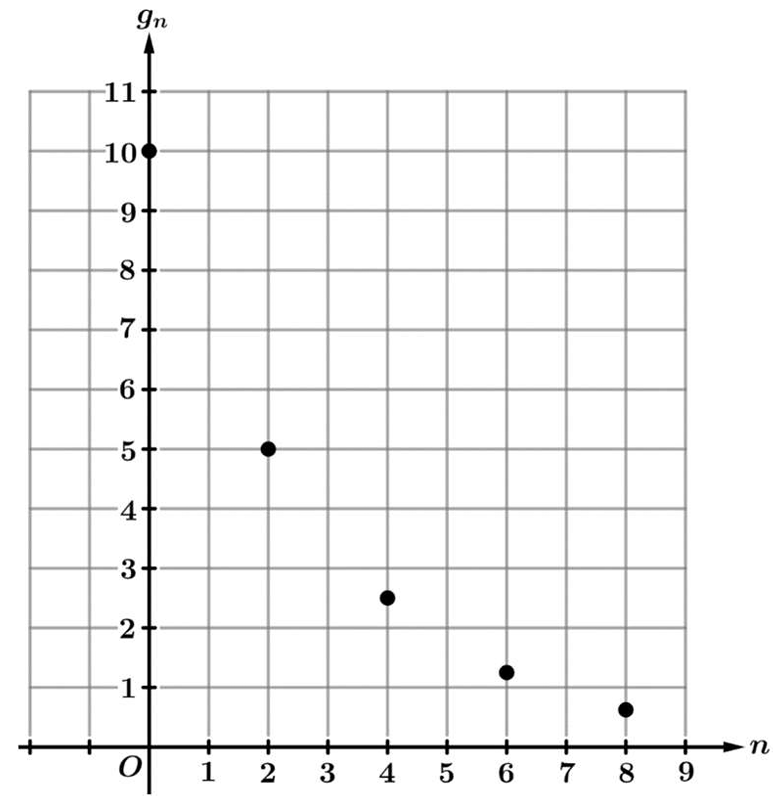
From the graph, we identify two key points: \( (0, 10) \) and \( (2, 5) \). This means \( g_0 = 10 \) and \( g_2 = 5 \).
We test each option by substituting \( n = 0 \) first to check the initial value:
(A) \( n=0 \to 5(1/2)^0 = 5 \). Incorrect, as \( g_0 \neq 10 \).
(B) \( n=0 \to 5(1/2)^{-2} = 5(4) = 20 \). Incorrect, as \( g_0 \neq 10 \).
(C) \( n=0 \to 10(1/2)^0 = 10 \). Correct. Now check \( n=2 \to 10(1/2)^1 = 5 \). Correct.
(D) \( n=0 \to 10(1/2)^0 = 10 \). Correct. Now check \( n=2 \to 10(1/2)^4 = 10/16 \neq 5 \). Incorrect.
Thus, the correct expression matches the graph values in option (C).
▶️ Answer/Explanation
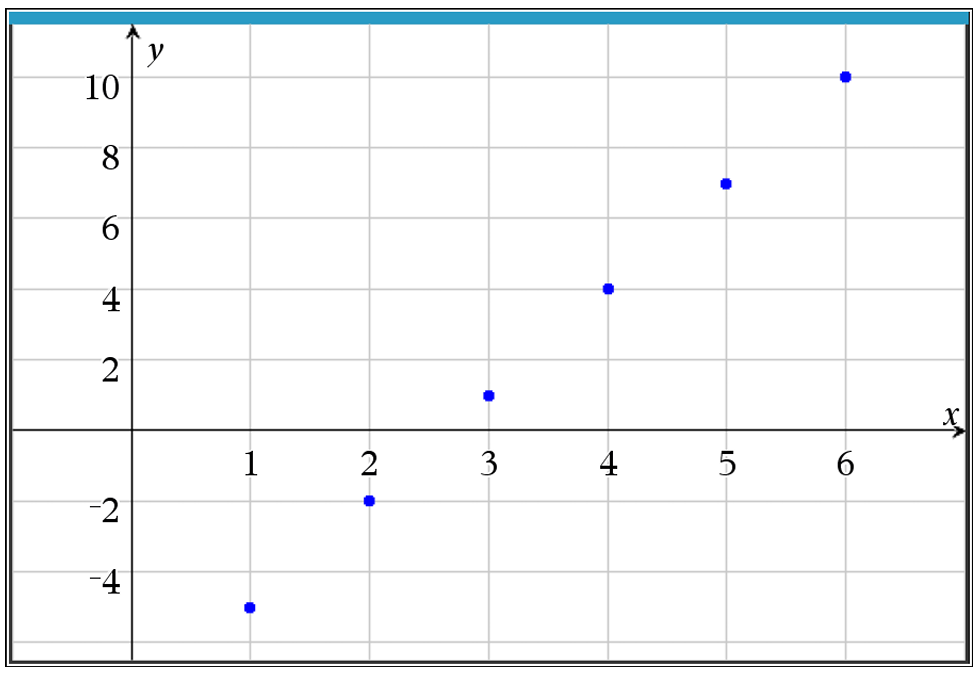
Identify the first term $a_1$ from the graph at $n = 1$, which is $-5$.
Find the common difference $d$ by calculating the change between terms, such as $a_2 – a_1 = -2 – (-5) = 3$.
Recall the general formula for an arithmetic sequence: $a_n = a_1 + d(n – 1)$.
Substitute the identified values $a_1 = -5$ and $d = 3$ into the formula.
The resulting expression is $a_n = -5 + 3(n – 1)$.
Compare this result to the given options to find the match.
The correct option is (B).
▶️ Answer/Explanation
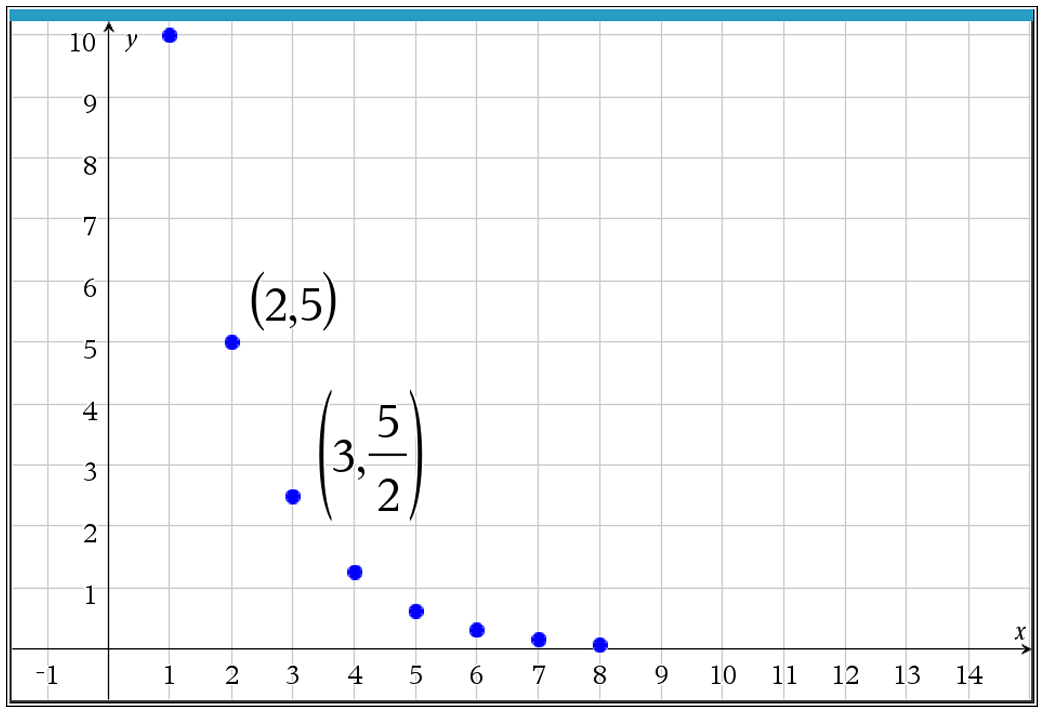
Identify two consecutive terms from the graph: $g_2 = 5$ and $g_3 = \frac{5}{2}$.
Calculate the common ratio $r$ using $r = \frac{g_3}{g_2} = \frac{5/2}{5} = \frac{1}{2}$ or $0.5$.
The general formula for the $n^{th}$ term is $g_n = g_2 \cdot r^{n-2}$.
Substitute the values to find $g_6$: $g_6 = 5 \cdot (0.5)^{6-2}$.
Calculate the power: $g_6 = 5 \cdot (0.5)^4 = 5 \cdot 0.0625$.
Final calculation: $g_6 = 0.3125$.
The correct option is (B).
▶️ Answer/Explanation
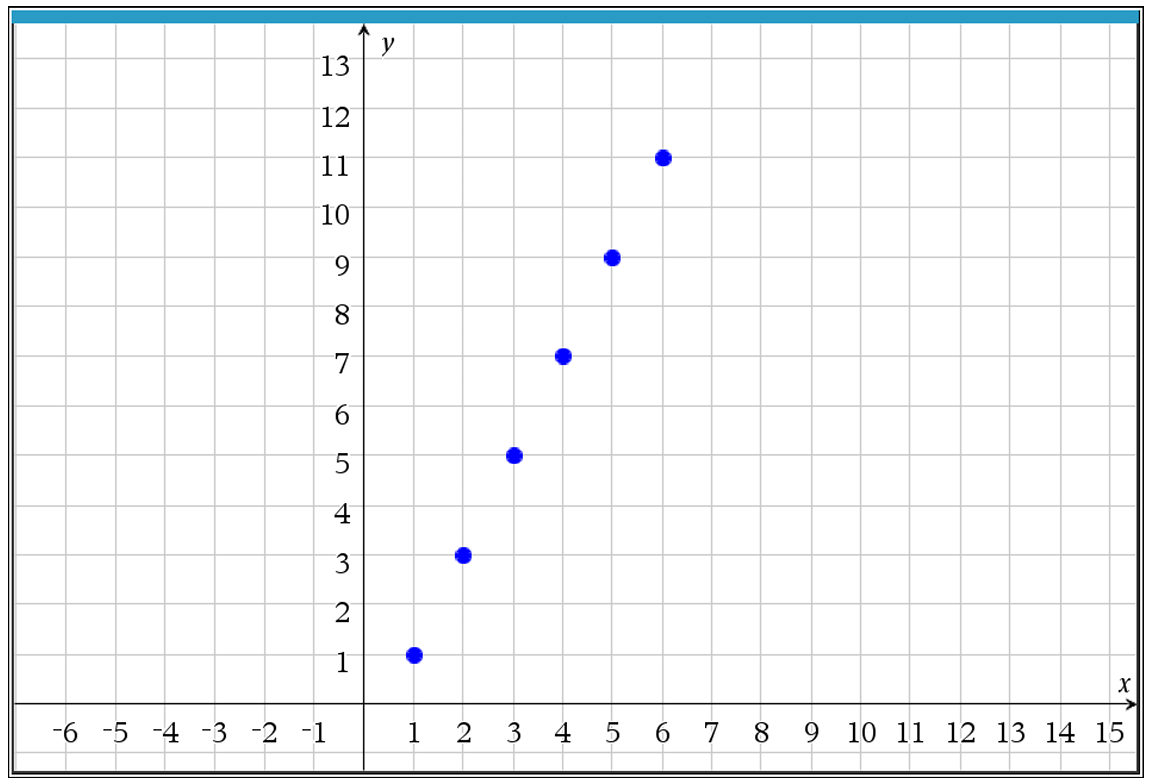
Identify two points from the graph: $(1, 1)$ and $(2, 3)$.
Calculate the common difference (slope) using $d = \frac{a_2 – a_1}{2 – 1} = \frac{3 – 1}{1} = 2$.
Locate the value of the sequence at $k = 3$, which is the point $(3, 5)$, so $a_3 = 5$.
Substitute $a_k = 5$, $d = 2$, and $k = 3$ into the formula $f(x) = a_k + d(x – k)$.
The resulting linear function is $f(x) = 5 + 2(x – 3)$.
Comparing this to the given choices, the correct option is (A).