
Sequences as Functions with Discrete Graphs
A sequence is a special type of function whose domain is the set of whole numbers (or positive integers) and whose outputs are real numbers.
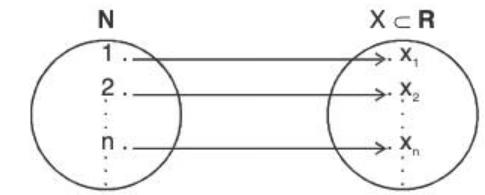
A sequence is often written using subscript notation, such as \( \mathrm{a_n} \), where \( \mathrm{n} \) represents the position (or index) of the term in the sequence.
Analytically, a sequence can be written as
\( \mathrm{ \displaystyle a_n = f(n), \; n \in \{1,2,3,\dots\} } \)
Because the input values are restricted to whole numbers, the graph of a sequence consists of discrete points, not a continuous curve.
Each point on the graph corresponds to a single term of the sequence and has coordinates \( \mathrm{(n, a_n)} \).
This distinguishes sequences from continuous functions, which are defined for all real input values in an interval.
Example
Consider the sequence defined by
\( \mathrm{ \displaystyle a_n = 2n } \)
List the first four terms and describe the graph.
▶️ Answer/Explanation
Substitute whole-number values of \( \mathrm{n} \):
\( \mathrm{ a_1 = 2(1) = 2 } \)
\( \mathrm{ a_2 = 2(2) = 4 } \)
\( \mathrm{ a_3 = 2(3) = 6 } \)
\( \mathrm{ a_4 = 2(4) = 8 } \)
The graph consists of the discrete points
\( \mathrm{ (1,2), (2,4), (3,6), (4,8) } \)
Conclusion
The points lie along a straight line, but the graph is not continuous because only whole-number inputs are allowed.
Example
A sequence is defined by
\( \mathrm{ \displaystyle a_n = n^2 } \)
Explain why its graph consists of discrete points.
▶️ Answer/Explanation
The input variable \( \mathrm{n} \) only takes whole-number values.
Each term corresponds to a point \( \mathrm{(n, n^2)} \).
Although \( \mathrm{y = x^2} \) is a continuous curve, the sequence only includes selected points from that curve.
Conclusion
The graph is discrete because the domain is restricted to whole numbers.
Arithmetic Sequences and Constant Rate of Change
An arithmetic sequence is a sequence in which the difference between successive terms is constant.
This constant difference represents a constant rate of change from one term to the next.
If \( \mathrm{a_n} \) represents the \( \mathrm{n} \)-th term of an arithmetic sequence, then the common difference is
\( \mathrm{ \displaystyle d = a_{n+1} – a_n } \)
Because the rate of change is constant, the graph of an arithmetic sequence consists of points that lie on a straight line when plotted.
However, the graph remains discrete because the domain consists only of whole numbers.
An arithmetic sequence can be written explicitly as
\( \mathrm{ \displaystyle a_n = a_1 + (n – 1)d } \)
where \( \mathrm{a_1} \) is the first term and \( \mathrm{d} \) is the common difference.
Example
Consider the sequence
\( \mathrm{ \displaystyle 3,\; 7,\; 11,\; 15,\; \dots } \)
Identify the common difference and write an explicit formula.
▶️ Answer/Explanation
Subtract consecutive terms:
\( \mathrm{ 7 – 3 = 4 } \)
\( \mathrm{ 11 – 7 = 4 } \)
The common difference is \( \mathrm{d = 4} \).
The explicit formula is
\( \mathrm{ \displaystyle a_n = 3 + (n – 1)4 } \)
Conclusion
Each term increases by 4, showing a constant rate of change.
Example
A savings account starts with ₹1,000 and increases by ₹250 each month.
Let \( \mathrm{a_n} \) represent the balance after \( \mathrm{n} \) months.
▶️ Answer/Explanation
The common difference is \( \mathrm{d = 250} \).
The arithmetic model is
\( \mathrm{ \displaystyle a_n = 1000 + (n – 1)250 } \)
Conclusion
The balance increases by a constant amount each month, so an arithmetic sequence is appropriate.
General Term of an Arithmetic Sequence
An arithmetic sequence is a sequence in which each term differs from the previous term by a constant value called the common difference.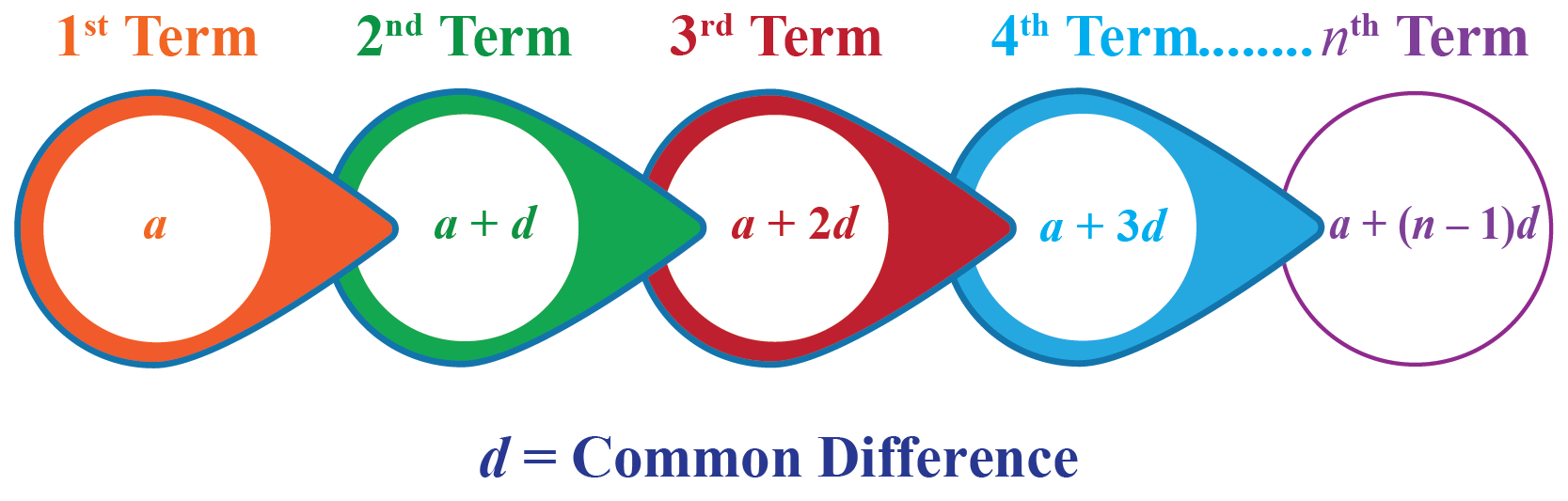
The general term of an arithmetic sequence is denoted by \( \mathrm{a_n} \).
If \( \mathrm{a_0} \) represents the initial value (the term when \( \mathrm{n = 0} \)), then the general term is given by
\( \mathrm{ \displaystyle a_n = a_0 + dn } \)
Alternatively, if a known term \( \mathrm{a_k} \) is given, the general term can be written as
\( \mathrm{ \displaystyle a_n = a_k + d(n – k) } \)
Both formulas describe the same sequence and allow any term to be found using a starting value and the common difference.
Example
An arithmetic sequence has an initial value of \( \mathrm{a_0 = 5} \) and a common difference of \( \mathrm{d = 3} \).
Find a formula for \( \mathrm{a_n} \).
▶️ Answer/Explanation
Use the general formula
\( \mathrm{ \displaystyle a_n = a_0 + dn } \)
Substitute the given values:
\( \mathrm{ \displaystyle a_n = 5 + 3n } \)
Conclusion
This formula generates the arithmetic sequence starting at 5 with a constant increase of 3.
Example
An arithmetic sequence has a common difference of \( \mathrm{d = 4} \), and the 6th term is \( \mathrm{a_6 = 20} \).
Write the general term.
▶️ Answer/Explanation
Use the formula
\( \mathrm{ \displaystyle a_n = a_k + d(n – k) } \)
Substitute \( \mathrm{k = 6} \), \( \mathrm{a_6 = 20} \), and \( \mathrm{d = 4} \):
\( \mathrm{ \displaystyle a_n = 20 + 4(n – 6) } \)
Conclusion
This formula generates all terms of the sequence using a known term and the common difference.
Geometric Sequences and Constant Proportional Change
A geometric sequence is a sequence in which each term is obtained by multiplying the previous term by a constant value called the common ratio.
This common ratio represents a constant proportional change from one term to the next.
If \( \mathrm{a_n} \) represents the \( \mathrm{n} \)-th term of a geometric sequence, then the common ratio is
\( \mathrm{ \displaystyle r = \dfrac{a_{n+1}}{a_n} } \)
Because each term is multiplied by the same factor, geometric sequences model situations involving exponential growth or exponential decay.
When graphed, a geometric sequence consists of discrete points that follow an exponential pattern.
An explicit formula for a geometric sequence is
\( \mathrm{ \displaystyle a_n = a_0 r^n } \)
where \( \mathrm{a_0} \) is the initial value and \( \mathrm{r} \) is the common ratio.
Example
Consider the sequence
\( \mathrm{ \displaystyle 2,\; 6,\; 18,\; 54,\; \dots } \)
Identify the common ratio and write an explicit formula.
▶️ Answer/Explanation
Divide consecutive terms:
\( \mathrm{ 6 \div 2 = 3 } \)
\( \mathrm{ 18 \div 6 = 3 } \)
The common ratio is \( \mathrm{r = 3} \).
The explicit formula is
\( \mathrm{ \displaystyle a_n = 2 \cdot 3^n } \)
Conclusion
Each term is three times the previous term, showing constant proportional growth.
Example
A population of bacteria decreases by 20% each hour.
Let \( \mathrm{a_n} \) represent the population after \( \mathrm{n} \) hours.
▶️ Answer/Explanation
A 20% decrease means each term is multiplied by \( \mathrm{0.8} \).
The common ratio is \( \mathrm{r = 0.8} \).
If the initial population is 5,000, the model is
\( \mathrm{ \displaystyle a_n = 5000(0.8)^n } \)
Conclusion
The constant proportional decrease confirms that a geometric sequence is appropriate.
General Term of a Geometric Sequence
A geometric sequence is a sequence in which each term is obtained by multiplying the previous term by a constant value called the common ratio.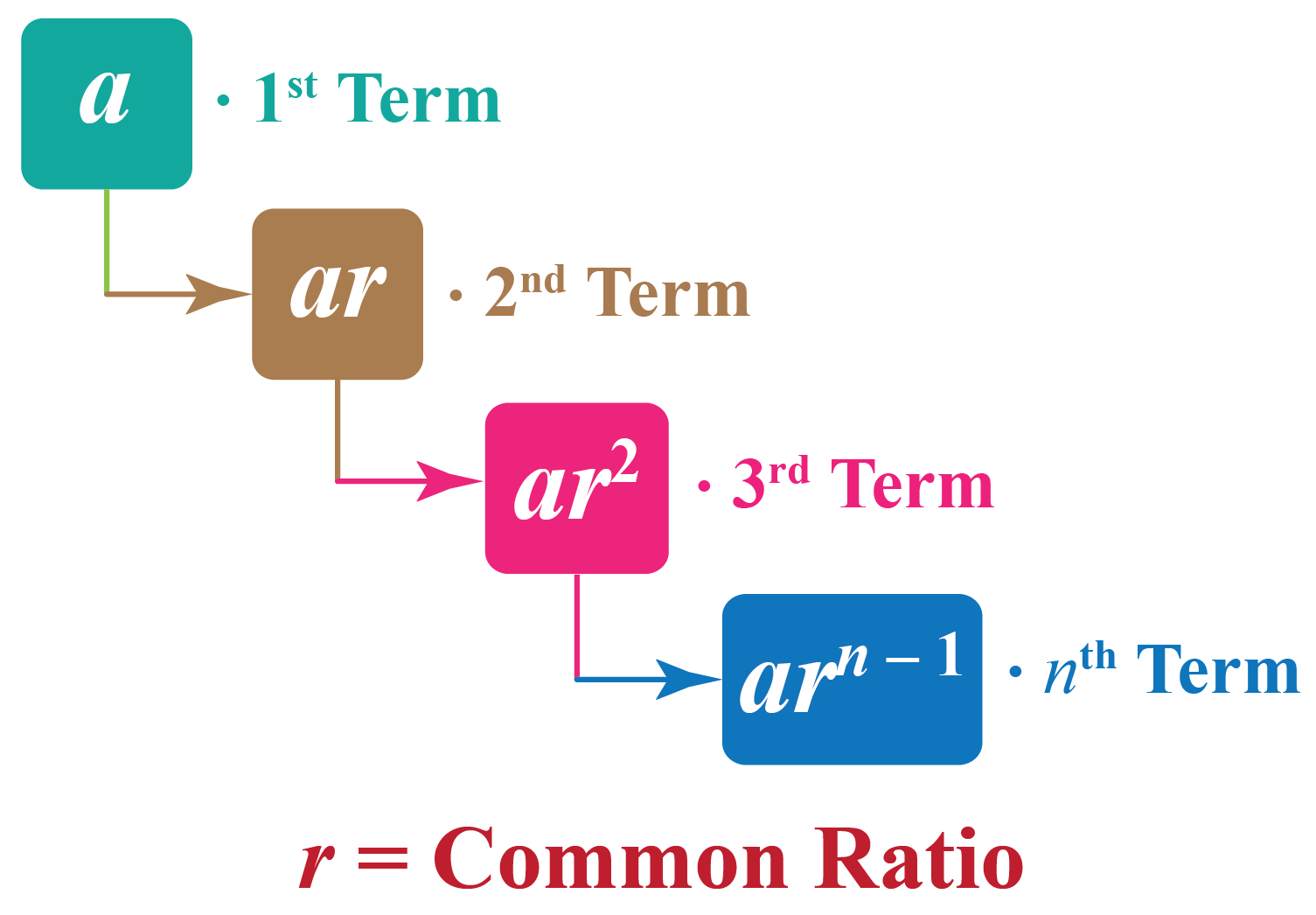
The general term of a geometric sequence is denoted by \( \mathrm{g_n} \).
If \( \mathrm{g_0} \) represents the initial value (the term when \( \mathrm{n = 0} \)), then the general term is given by
\( \mathrm{ \displaystyle g_n = g_0 r^n } \)
Alternatively, if a known term \( \mathrm{g_k} \) is given, the general term can be written as
\( \mathrm{ \displaystyle g_n = g_k r^{(n – k)} } \)
Both formulas describe the same sequence and allow any term to be found using a starting value and the common ratio.
Geometric sequences model situations involving constant proportional growth or decay.
Example
A geometric sequence has an initial value of \( \mathrm{g_0 = 3} \) and a common ratio of \( \mathrm{r = 2} \).
Find a formula for \( \mathrm{g_n} \).
▶️ Answer/Explanation
Use the general formula
\( \mathrm{ \displaystyle g_n = g_0 r^n } \)
Substitute the given values:
\( \mathrm{ \displaystyle g_n = 3 \cdot 2^n } \)
Conclusion
This formula generates the geometric sequence starting at 3 and doubling each term.
Example
A geometric sequence has a common ratio of \( \mathrm{r = \tfrac{1}{2}} \), and the 4th term is \( \mathrm{g_4 = 20} \).
Write the general term of the sequence.
▶️ Answer/Explanation
Use the formula
\( \mathrm{ \displaystyle g_n = g_k r^{(n – k)} } \)
Substitute \( \mathrm{k = 4} \), \( \mathrm{g_4 = 20} \), and \( \mathrm{r = \tfrac{1}{2}} \):
\( \mathrm{ \displaystyle g_n = 20\left(\tfrac{1}{2}\right)^{(n – 4)} } \)
Conclusion
This formula generates all terms of the sequence using a known term and the common ratio.
Comparing Increasing Arithmetic and Geometric Sequences
Both arithmetic and geometric sequences can be increasing, but they increase in fundamentally different ways.
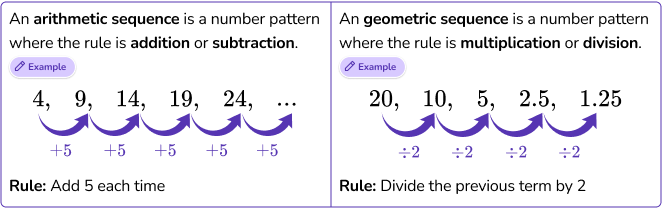
An increasing arithmetic sequence increases by the same fixed amount at each step.
If \( \mathrm{a_n} \) is an arithmetic sequence with common difference \( \mathrm{d > 0} \), then
\( \mathrm{ \displaystyle a_{n+1} – a_n = d } \)
This means the sequence increases equally from one term to the next.
In contrast, an increasing geometric sequence increases by a constant factor, not a constant amount.
If \( \mathrm{g_n} \) is a geometric sequence with common ratio \( \mathrm{r > 1} \), then
\( \mathrm{ \displaystyle \dfrac{g_{n+1}}{g_n} = r } \)
As a result, the amount of increase becomes larger with each successive step.
This distinction explains why geometric growth eventually outpaces arithmetic growth.
Example
Consider the arithmetic sequence
\( \mathrm{ \displaystyle 2,\; 5,\; 8,\; 11,\; \dots } \)
Describe how the sequence increases.
▶️ Answer/Explanation
Compute successive differences:
\( \mathrm{ 5 – 2 = 3 } \)
\( \mathrm{ 8 – 5 = 3 } \)
Each term increases by the same amount.
Conclusion
This is an increasing arithmetic sequence with equal increases of 3.
Example
Consider the geometric sequence
\( \mathrm{ \displaystyle 2,\; 4,\; 8,\; 16,\; \dots } \)
Explain how the increase changes from term to term.
▶️ Answer/Explanation
Each term is multiplied by 2.
The increases are:
\( \mathrm{ 4 – 2 = 2 } \)
\( \mathrm{ 8 – 4 = 4 } \)
\( \mathrm{ 16 – 8 = 8 } \)
Conclusion
The amount of increase grows larger with each step, which is characteristic of an increasing geometric sequence.