
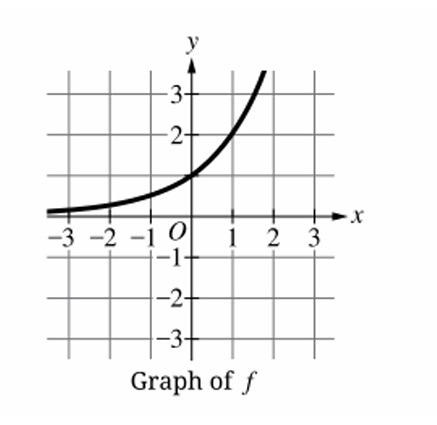
▶️ Answer/Explanation
From the graph, \( f \) appears to be \( f(x) = 2^x \).
Then \( f^{-1}(x) = \log_2 x \).
Check values: \( f^{-1}(32) = \log_2 32 = 5 \), \( f^{-1}(4) = \log_2 4 = 2 \).
So table should be \( (32, 5) \) and \( (4, 2) \), which matches option (C).
✅ Answer: (C)
▶️ Answer/Explanation
The correct option is (D).
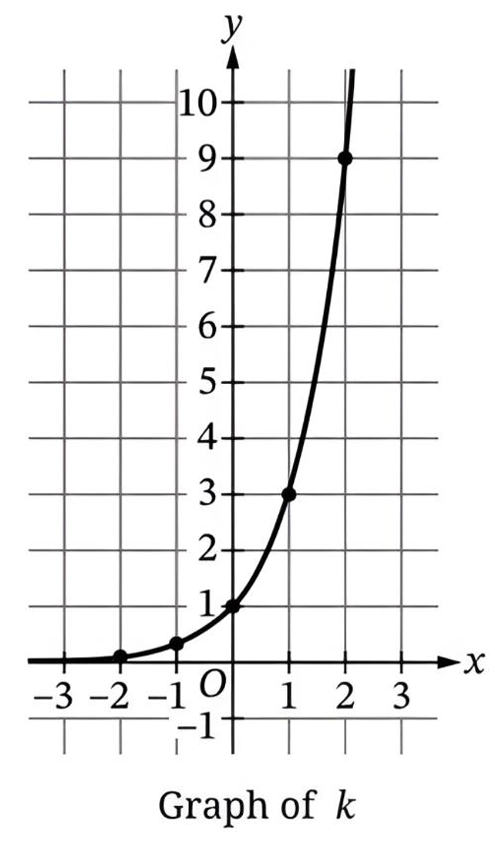
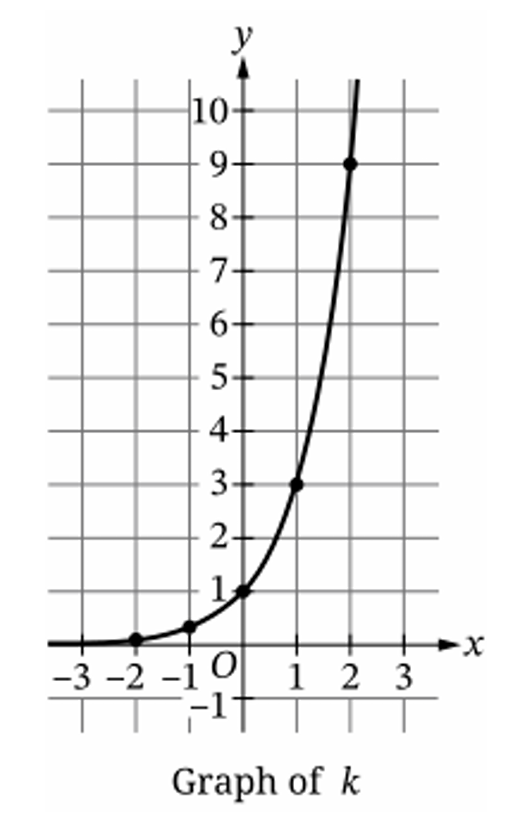
1. First, identify the base \(b\) of the exponential function \(k(x) = b^x\) using points from the graph.
2. The graph passes through the point \((1, 3)\). Substituting this into the equation gives \(3 = b^1\), so \(b = 3\).
3. The function \(h\) is defined as \(h(x) = \log_b x\), which becomes \(h(x) = \log_3 x\).
4. Since logarithmic and exponential functions are inverses, if \((x, y)\) is on the graph of \(k\), then \((y, x)\) is on the graph of \(h\).
5. The graph of \(k\) contains the points \((1, 3)\) and \((2, 9)\).
6. Swapping the coordinates to find points on \(h\), we get \((3, 1)\) and \((9, 2)\).
7. We can verify this algebraically: \(h(3) = \log_3(3) = 1\) and \(h(9) = \log_3(9) = 2\).
▶️ Answer/Explanation
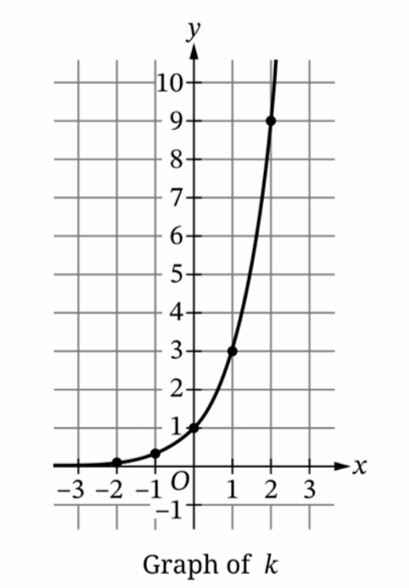
First, identify the base \(b\) using a clear point on the graph of \(k(x) = b^x\).
The graph passes through the point \((1, 3)\). Substituting this into the equation gives \(3 = b^1\), so \(b = 3\).
Therefore, the exponential function is \(k(x) = 3^x\), and the logarithmic function is its inverse, \(h(x) = \log_3 x\).
Since \(k\) and \(h\) are inverses, if a point \((x, y)\) is on \(k\), then \((y, x)\) is on \(h\).
The graph of \(k\) clearly passes through \((1, 3)\) and \((2, 9)\).
Thus, the graph of \(h\) must contain the points \((3, 1)\) and \((9, 2)\).
Checking the options, \((3, 1)\) and \((9, 2)\) correspond to option (D).
▶️ Answer/Explanation
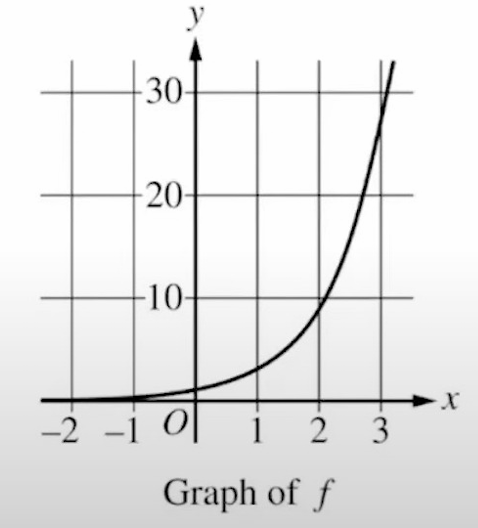
The correct option is (D).
Step 1: Analyze the given points on the graph to identify the function \(f(x)\). The points are \((1, 3)\), \((2, 9)\), and \((3, 27)\).
Step 2: Observe the exponential pattern: \(3^1 = 3\), \(3^2 = 9\), and \(3^3 = 27\). This indicates that the function is \(f(x) = 3^x\). This function has the \(x\)-axis as a horizontal asymptote.
Step 3: To find the inverse function, let \(y = f(x)\), so we have \(y = 3^x\).
Step 4: Interchange the variables \(x\) and \(y\) to solve for the inverse: \(x = 3^y\).
Step 5: Convert the exponential equation into logarithmic form. By definition, \(x = 3^y\) is equivalent to \(y = \log_3 x\).
Step 6: Therefore, the inverse function is \(f^{-1}(x) = \log_3 x\).
▶️ Answer/Explanation
The correct option is (D).
1. First, identify the base \(b\) using a clear point on the graph of \(k(x)\). The graph passes through the point \((1, 3)\).
2. Substitute these coordinates into the exponential equation \(y = b^x\): \(3 = b^1\), which implies \(b = 3\).
3. The logarithmic function \(h(x) = \log_b x\) is the inverse of the exponential function \(k(x) = b^x\).
4. Since they are inverse functions, if a point \((x, y)\) lies on the graph of \(k\), then the point \((y, x)\) must lie on the graph of \(h\).
5. From the graph of \(k\), we can identify the points \((1, 3)\) and \((2, 9)\) because \(3^1 = 3\) and \(3^2 = 9\).
6. Swapping the coordinates for the inverse function \(h\), the corresponding points are \((3, 1)\) and \((9, 2)\).
7. Checking option (D): \(h(3) = \log_3(3) = 1\) and \(h(9) = \log_3(9) = 2\). These matches the points derived.
▶️ Answer/Explanation
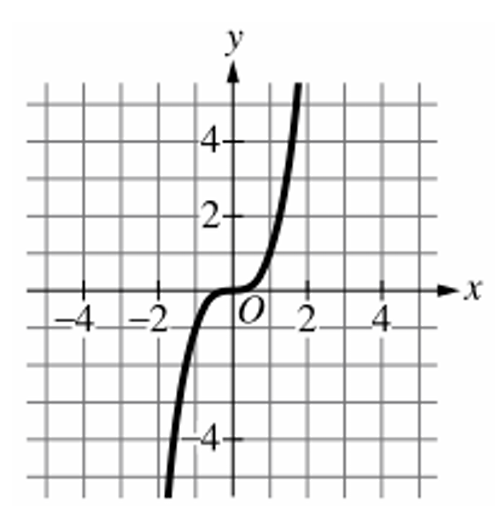
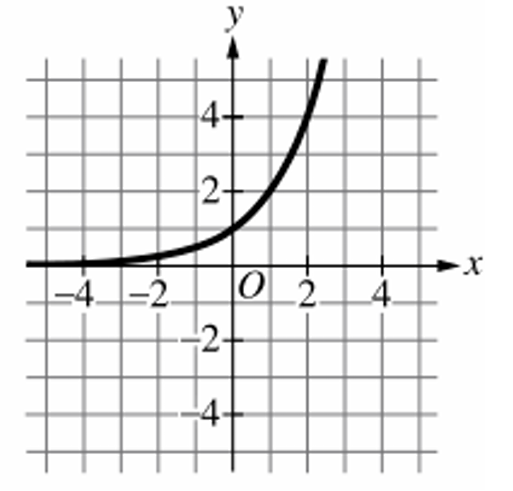
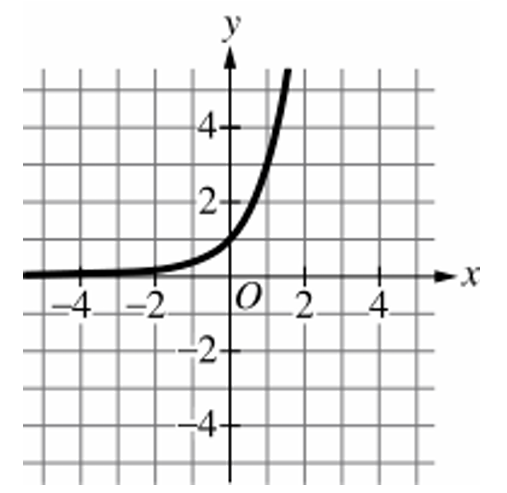
The inverse of the logarithmic function $f(x) = \log_{3} x$ is found by switching $x$ and $y$, resulting in $y = 3^x$.
The graph of $y = 3^x$ must be an exponential growth curve that stays strictly above the $x$-axis.
The $y$-intercept occurs at $(0, 1)$ since $3^0 = 1$.
The graph must pass through the point $(1, 3)$ since $3^1 = 3$.
Graph B passes through $(0, 1)$ but appears to pass through $(1, 2)$, suggesting the function $y = 2^x$.
Graph C passes through $(0, 1)$ and reaches $y = 3$ when $x = 1$, matching the function $y = 3^x$.
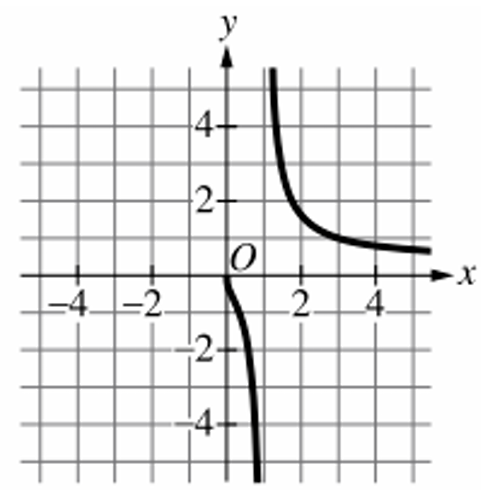
Graph A represents a cubic-style function, and Graph D shows a reciprocal-style function.
Therefore, the correct choice is (C).