AP Precalculus -2.11 Logarithmic Functions- FRQ Exam Style Questions - Effective Fall 2023
AP Precalculus -2.11 Logarithmic Functions- FRQ Exam Style Questions – Effective Fall 2023
AP Precalculus -2.11 Logarithmic Functions- FRQ Exam Style Questions – AP Precalculus- per latest AP Precalculus Syllabus.
Question

▶️ Answer/Explanation
Part A
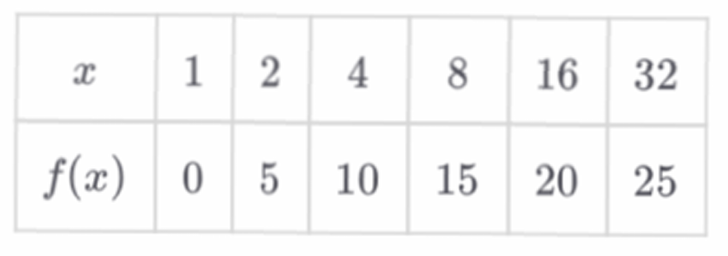
(i) From the table, we find $f(8) = 15$.
Substitute $15$ into the function $g(x)$: $h(8) = g(15) = 0.25(15)^3 – 9.5(15)^2 + 110(15) – 399$.
$h(8) = 0.25(3375) – 9.5(225) + 1650 – 399$.
$h(8) = 843.75 – 2137.5 + 1650 – 399$.
$h(8) = -42.75$.
(ii) To find $f^{-1}(20)$, we look for the $x$ value where $f(x) = 20$.
From the table, $f(16) = 20$.
Therefore, $f^{-1}(20) = 16$.
Part B
(i) We solve the equation $0.25x^3 – 9.5x^2 + 110x – 399 = -45$.
Set the equation to zero: $0.25x^3 – 9.5x^2 + 110x – 354 = 0$.
Using numerical methods or a graphing calculator, the real solutions are approximately:
$x \approx 5.242$
$x \approx 12.188$
$x \approx 20.570$
(ii) The end behavior of a polynomial is determined by its leading term, $0.25x^3$.
Since the leading coefficient is positive and the degree is odd, as $x \to \infty$, $g(x) \to \infty$.
The limit notation is $\lim_{x \to \infty} g(x) = \infty$.
Part C
(i) The function $f$ is best modeled by a logarithmic function.
(ii) In a logarithmic model, constant changes in the output values correspond to proportional changes in the input values.
As the output $f(x)$ increases by a constant $5$ ($0, 5, 10, 15 \dots$),
The input $x$ values are multiplied by a constant factor of $2$ ($1, 2, 4, 8 \dots$).
This constant ratio of inputs for constant additions of outputs is the hallmark of logarithmic growth.
Question
Directions:
- Unless otherwise specified, the domain of a function \( f \) is assumed to be the set of all real numbers \( x \) for which \( f(x) \) is a real number. Angle measures for trigonometric functions are assumed to be in radians.
- Solutions to equations must be real numbers. Determine the exact value of any expression that can be obtained without a calculator. For example, \( \log_2 8 \), \( \cos(\frac{\pi}{2}) \), and \( \sin^{-1}(1) \) can be evaluated without a calculator.
- Unless otherwise specified, combine terms using algebraic methods and rules for exponents and logarithms, where applicable. For example, \( 2x + 3x \), \( 5^2 \cdot 5^3 \), \( \frac{x^5}{x^2} \), and \( \ln 3 + \ln 5 \) should be rewritten in equivalent forms.
- For each part of the question, show the work that leads to your answers.
Part A
The functions \( g \) and \( h \) are given by
\( h(x) = \sin^{-1}(8x) \)
Part B
The functions \( j \) and \( k \) are given by
\( k(x) = \frac{(16^{3x}) \cdot 4^x}{2} \)
Part C
The function \( m \) is given by
▶️ Answer/Explanation
Part A
(i) Solve \( g(x) = 3 \)
Start with the given equation:
\( \log_5(4x – 2) = 3 \)
Convert the logarithmic equation to exponential form (\( y = \log_b x \iff x = b^y \)):
\( 4x – 2 = 5^3 \)
Evaluate the exponent:
\( 4x – 2 = 125 \)
Add 2 to both sides:
\( 4x = 127 \)
Divide by 4:
\( x = \frac{127}{4} \)
(ii) Solve \( h(x) = \frac{\pi}{4} \)
Start with the given equation:
\( \sin^{-1}(8x) = \frac{\pi}{4} \)
Take the sine of both sides to isolate the argument:
\( 8x = \sin\left(\frac{\pi}{4}\right) \)
Substitute the exact value of \( \sin\left(\frac{\pi}{4}\right) \):
\( 8x = \frac{\sqrt{2}}{2} \)
Divide by 8:
\( x = \frac{\sqrt{2}}{16} \)
Part B
(i) Rewrite \( j(x) \)
Start with the function definition:
\( j(x) = (\sec x)(\cot x) \)
Substitute the reciprocal and quotient identities (\( \sec x = \frac{1}{\cos x} \) and \( \cot x = \frac{\cos x}{\sin x} \)):
\( j(x) = \left(\frac{1}{\cos x}\right) \left(\frac{\cos x}{\sin x}\right) \)
Cancel the \( \cos x \) terms:
\( j(x) = \frac{1}{\sin x} \)
(ii) Rewrite \( k(x) \)
Start with the function definition:
\( k(x) = \frac{(16^{3x}) \cdot 4^x}{2} \)
To write in the form \( 4^{(ax+b)} \), convert bases 16 and 2 to base 4.
Since \( 16 = 4^2 \) and \( 2 = \sqrt{4} = 4^{1/2} = 4^{0.5} \):
\( k(x) = \frac{(4^2)^{3x} \cdot 4^x}{4^{0.5}} \)
Apply the power of a power rule (\( (a^m)^n = a^{mn} \)):
\( k(x) = \frac{4^{6x} \cdot 4^x}{4^{0.5}} \)
Apply the product rule for exponents (\( a^m \cdot a^n = a^{m+n} \)) in the numerator:
\( k(x) = \frac{4^{6x + x}}{4^{0.5}} = \frac{4^{7x}}{4^{0.5}} \)
Apply the quotient rule for exponents (\( \frac{a^m}{a^n} = a^{m-n} \)):
\( k(x) = 4^{7x – 0.5} \) (or \( 4^{7x – \frac{1}{2}} \))
Thus, \( a = 7 \) and \( b = -0.5 \).
Part C
Find values where \( m(x) = 1 \)
Set the function equal to 1:
\( \sqrt{3}\tan\left(x + \frac{\pi}{2}\right) = 1 \)
Isolate the tangent function by dividing by \( \sqrt{3} \):
\( \tan\left(x + \frac{\pi}{2}\right) = \frac{1}{\sqrt{3}} \)
Determine the reference angle. We know that \( \tan\left(\frac{\pi}{6}\right) = \frac{1}{\sqrt{3}} \).
Set up the general solution for tangent (\( \theta = \text{ref} + n\pi \)):
\( x + \frac{\pi}{2} = \frac{\pi}{6} + n\pi \), where \( n \) is any integer.
Solve for \( x \) by subtracting \( \frac{\pi}{2} \) from both sides:
\( x = \frac{\pi}{6} – \frac{\pi}{2} + n\pi \)
Find a common denominator (6) to combine fractions:
\( x = \frac{\pi}{6} – \frac{3\pi}{6} + n\pi \)
\( x = -\frac{2\pi}{6} + n\pi \)
Simplify the fraction:
\( x = -\frac{\pi}{3} + n\pi \)
Question

▶️ Answer/Explanation
(A)(i) Find \( h(3) \)
The function is defined as \( h(x) = g(f(x)) \).
First, we find the value of the inner function, \( f(3) \).
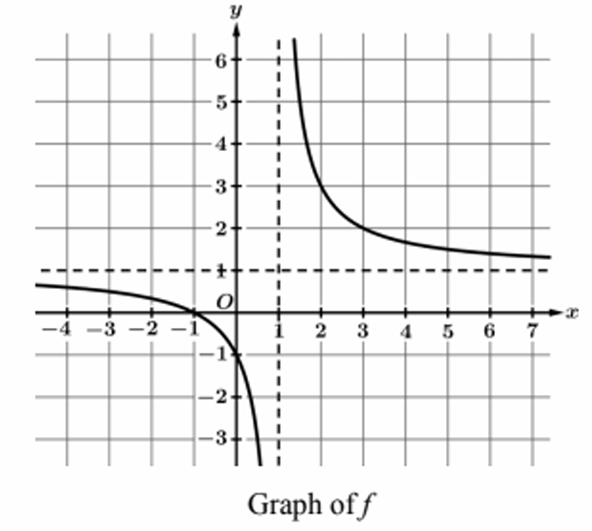
According to the problem text and graph, the point \( (3, 2) \) lies on the graph of \( f \). Therefore, \( f(3) = 2 \).
Now, substitute this value into the outer function \( g(x) \):
\( h(3) = g(2) \)
Using the definition \( g(x) = 2 + 3\ln x \):
\( g(2) = 2 + 3\ln(2) \)
Using a calculator to approximate \( \ln(2) \approx 0.693 \):
\( g(2) = 2 + 3(0.6931…) \approx 2 + 2.079 = 4.079 \)
Answer: \( h(3) \approx 4.079 \)
(A)(ii) Find real zeros of \( f \)
A real zero of a function occurs where the graph intersects the x-axis (where \( f(x) = 0 \)).
Looking at the provided graph, the curve intersects the x-axis at \( x = -1 \).
The problem text confirms the point \( (-1, 0) \) is on the graph.
There are no other intersections with the x-axis shown.
Answer: \( x = -1 \)
(B)(i) Find \( x \) for \( g(x) = e \)
Set up the equation:
\( 2 + 3\ln x = e \)
Subtract 2 from both sides:
\( 3\ln x = e – 2 \)
Divide by 3:
\( \ln x = \frac{e – 2}{3} \)
Convert from logarithmic to exponential form to solve for \( x \):
\( x = e^{\left(\frac{e – 2}{3}\right)} \)
Approximating the value (using \( e \approx 2.718 \)):
\( x \approx e^{0.2394} \)
Answer: \( x \approx 1.271 \)
(B)(ii) End behavior of \( g \)
We need to evaluate the limit as \( x \to \infty \) for \( g(x) = 2 + 3\ln x \).
As \( x \) increases without bound (\( x \to \infty \)), the natural logarithm function \( \ln x \) also increases without bound (\( \ln x \to \infty \)).
Multiplying by 3 and adding 2 does not change the unbounded nature.
Answer: \( \lim_{x \to \infty} g(x) = \infty \)
(C)(i) Is \( f \) invertible?
Answer: Yes, \( f \) is invertible.
(C)(ii) Reason
A function is invertible if and only if it is one-to-one. This can be verified visually using the Horizontal Line Test.
Looking at the graph of \( f(x) \):
1. The function is strictly decreasing on both branches of its domain (\( x < 1 \) and \( x > 1 \)).
2. The range of the left branch appears to be \( (-\infty, 1) \) and the range of the right branch appears to be \( (1, \infty) \).
Because the y-values do not repeat (no horizontal line intersects the graph more than once), the function is one-to-one.
Therefore, \( f \) has an inverse.
