
Question
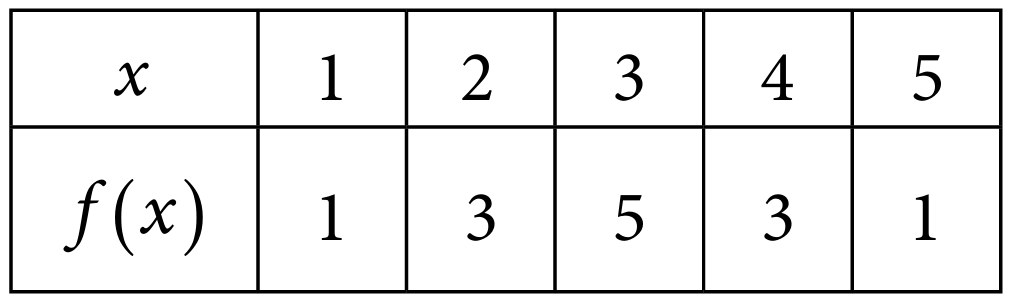
(i) The function $h$ is defined by $h(x)=(g \circ f)(x)=g(f(x))$. Find the value of $h(4)$ as a decimal approximation, or indicate that it is not defined.
(ii) Find all values of $x$ for which $f(x)=3$, or indicate there are no such values.
(i) Find all values of $x$, as decimal approximations, for which $g(x)=3$, or indicate there are no such values.
(ii) Determine the end behavior of $g$ as $x$ increases without bound. Express your answer using the mathematical notation of a limit.
(i) Determine if $f$ has an inverse function.
(ii) Give a reason for your answer based on the definition of a function and the table of values of $f(x)$.
Most-appropriate topic codes (AP Precalculus CED):
• 2.8: Inverse Functions – part A(ii), C
• 2.11: Logarithmic Functions – part B(ii)
• 2.13: Exponential and Logarithmic Equations and Inequalities – part B(i)
▶️ Answer/Explanation
A (i)
We need to find $h(4)=g(f(4))$.
From the table, the output for input $4$ is $f(4)=3$.
Substitute this into $g(x)$: $g(3)=2 \ln 3$.
Using a calculator, $2 \ln 3 \approx 2.197$.
✅ Answer: $\boxed{2.197}$
A (ii)
We are looking for the inputs where the output is 3.
From the table, $f(x)=3$ when $x=2$ and $x=4$.
✅ Answer: $\boxed{x=2, x=4}$
B (i)
Set the equation: $g(x)=3 \implies 2 \ln x=3$.
Isolate the natural log: $\ln x=1.5$.
Exponentiate both sides to solve for $x$: $x=e^{1.5} \approx 4.482$.
✅ Answer: $\boxed{4.482}$
B (ii)
The function $g$ is an increasing logarithmic function. As $x$ increases without bound, the natural log function grows slowly but infinitely, so $g(x)$ increases without bound.
Therefore, $\lim_{x \to \infty} g(x) = \infty$.
✅ Answer: $\boxed{\lim_{x \to \infty} g(x) = \infty}$
C (i)
$f$ does not have an inverse function on its domain of the five real numbers 1, 2, 3, 4, and 5.
✅ Answer: $\boxed{\text{No inverse function}}$
C (ii)
Reasoning: There are output values of $f$ that are not mapped from unique input values (the function $f$ is not one-to-one). Because $f(1)=1$ and $f(5)=1$, the inverse function on this domain does not exist. Note: Stating only that it “fails the horizontal line test” without referencing specific data values is generally insufficient for full credit.

▶️ Answer/Explanation
(A) i. \(g(f^{-1}(1))\)
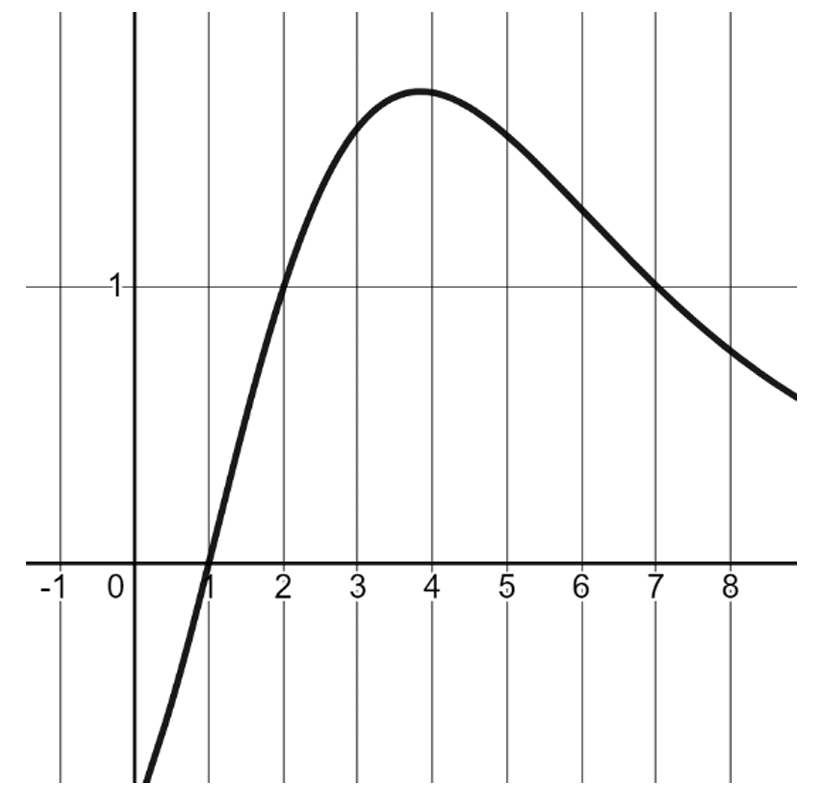
- From the graph of \(f(x)\), \(f^{-1}(1)\) means find \(x\) such that \(f(x) = 1\).
- From the graph, \(f(x) = 1\) at approximately \(x \approx 2.5\). So \(f^{-1}(1) \approx 2.5\).
- From the table, \(g(2) = 1\), \(g(4) = 2\). Since \(g\) is increasing and continuous, by linear interpolation for \(x \approx 2.5\): \(g(2.5) \approx 1 + \frac{2.5-2}{4-2} \cdot (2-1) = 1 + 0.25 = 1.25\).
- Thus, \(g(f^{-1}(1)) \approx 1.25\).
(A) ii. \(h(x) = \frac{g(x)}{f(x)}\), \(x > 0\)
- Discontinuities occur where \(f(x) = 0\) or where \(f\) is undefined (but \(f\) appears continuous from the graph for \(x>0\)).
- From the graph, \(f(x) = 0\) at \(x \approx 1.5\) (where graph crosses x-axis). That is the only zero of \(f\) for \(x>0\).
- At \(x \approx 1.5\), \(g(x) \neq 0\) (since \(g\) is about 0.5 between \(g(1)=0\) and \(g(2)=1\)).
- Thus, \(h(x)\) has a vertical asymptote at \(x \approx 1.5\) because denominator → 0, numerator nonzero → \(h(x) \to \pm\infty\).
- Type: infinite discontinuity (vertical asymptote).
(B) i. End behavior of \(j(x) = \frac{1}{4.998} \ln(x) \cdot e^{2\sin(\sqrt{x})}\) as \(x \to \infty\)
- As \(x \to \infty\), \(\ln(x) \to \infty\).
- The factor \(e^{2\sin(\sqrt{x})}\) oscillates between \(e^{-2}\) and \(e^{2}\) because \(\sin(\sqrt{x})\) oscillates in \([-1,1]\).
- Thus \(j(x)\) oscillates with amplitude growing like \(\ln(x)\). The limit does not exist because oscillations persist and amplitude grows without bound.
- Limit expression: \(\lim_{x \to \infty} j(x)\) does not exist.
(B) ii. Vertical asymptote as \(x \to 0^+\)
- As \(x \to 0^+\), \(\ln(x) \to -\infty\).
- The factor \(e^{2\sin(\sqrt{x})} \to e^{0} = 1\) (since \(\sqrt{x} \to 0\), \(\sin(\sqrt{x}) \to 0\)).
- Thus \(j(x) \to -\infty\).
- Limit expression: \(\lim_{x \to 0^+} j(x) = -\infty\). So vertical asymptote at \(x=0\).
(C) Best model for \(g(x)\) from the table:
- Check changes in \(g(x)\) as \(x\) doubles:
- From \(x=0.5\) to \(x=1\), \(\Delta g = 1\).
- From \(x=1\) to \(x=2\), \(\Delta g = 1\).
- From \(x=2\) to \(x=4\), \(\Delta g = 1\).
- From \(x=4\) to \(x=8\), \(\Delta g = 1\).
- Each time \(x\) doubles, \(g(x)\) increases by about 1. This suggests a logarithmic relationship: \(g(x) \approx a + b \ln(x)\).
- Thus, \(g(x)\) is best modeled by a logarithmic function.
Question
\[ g(x) = 2 \log_3 x \quad]
[\quad h(x) = 4 \cos^2 x. \]
(i) Solve \( g(x) = 4 \) for values of \( x \) in the domain of \( g \).
(ii) Solve \( h(x) = 3 \) for values of \( x \) in the interval \([0, \frac{\pi}{2})\).
\[ j(x) = \log_2 x + 3 \log_2 2 \quad \text{and} \quad k(x) = \frac{6}{\tan x (\csc^2 x – 1)}. \]
(i) Rewrite \( j(x) \) as a single logarithm base 2 without negative exponents in any part of the expression. Your result should be of the form \( \log_2 (\text{expression}) \).
(ii) Rewrite \( k(x) \) as an expression in which \( \tan x \) appears exactly once and no other trigonometric functions are involved.
Most-appropriate topic codes (AP Precalculus CED):
• 2.13: Exponential and Logarithmic Equations and Inequalities — part A(i), C
• 3.9: Trigonometric Equations and Inequalities — part A(ii)
• 3.4: Trigonometric Identities — part B(ii)
▶️ Answer/Explanation
A. (i) Solving \( g(x) = 4 \):
Given \( g(x) = 2\log_3 x \). Set \( g(x) = 4 \): \[ 2\log_3 x = 4 \] Divide both sides by 2: \[ \log_3 x = 2 \] Convert to exponential form: \[ x = 3^2 = 9 \] Check domain: \( x > 0 \), so \( x = 9 \) is valid. ✅ Answer: \(\boxed{x = 9}\)
A. (ii) Solving \( h(x) = 3 \) on \( [0, \frac{\pi}{2}) \):
Given \( h(x) = 4\cos^2 x \). Set \( h(x) = 3 \): \[ 4\cos^2 x = 3 \] Divide both sides by 4: \[ \cos^2 x = \frac{3}{4} \] Take square root: \[ \cos x = \pm \frac{\sqrt{3}}{2} \] On \( [0, \frac{\pi}{2}) \), cosine is positive, so \[ \cos x = \frac{\sqrt{3}}{2} \implies x = \frac{\pi}{6} \] ✅ Answer: \(\boxed{x = \frac{\pi}{6}}\)
B. (i) Rewriting \( j(x) \) as a single logarithm:
Given \( j(x) = \log_2 x + 3\log_2 2 \).
Use power rule: \( 3\log_2 2 = \log_2 (2^3) = \log_2 8 \).
Use product rule: \[ j(x) = \log_2 x + \log_2 8 = \log_2 (8x) \] ✅ Answer: \(\boxed{\log_2(8x)}\)
B. (ii) Rewriting \( k(x) \) in terms of \( \tan x \) only:
Given \( k(x) = \dfrac{6}{\tan x (\csc^2 x – 1)} \).
Use Pythagorean identity: \( \csc^2 x – 1 = \cot^2 x \).
Thus, \[ k(x) = \frac{6}{\tan x \cdot \cot^2 x} \] Since \( \cot x = \frac{1}{\tan x} \), we have \( \cot^2 x = \frac{1}{\tan^2 x} \).
Substitute: \[ k(x) = \frac{6}{\tan x \cdot \frac{1}{\tan^2 x}} = \frac{6}{\frac{\tan x}{\tan^2 x}} = \frac{6}{\frac{1}{\tan x}} = 6 \tan x \] ✅ Answer: \(\boxed{6 \tan x}\)
C. Solving \( m(x) = 0 \):
Given \( m(x) = e^{2x} – e^x – 12 \).
Set \( m(x) = 0 \): \[ e^{2x} – e^x – 12 = 0 \] Let \( y = e^x \). Then \( e^{2x} = (e^x)^2 = y^2 \).
Substitute: \[ y^2 – y – 12 = 0 \] Factor: \[ (y – 4)(y + 3) = 0 \] Thus \( y = 4 \) or \( y = -3 \).
Since \( y = e^x > 0 \), discard \( y = -3 \).
So \( e^x = 4 \).
Take natural log: \( x = \ln 4 \).
✅ Answer: \(\boxed{x = \ln 4}\)
▶️ Answer/Explanation
Part A
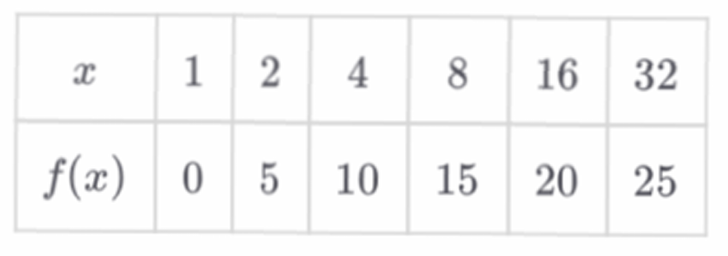
(i) From the table, we find $f(8) = 15$.
Substitute $15$ into the function $g(x)$: $h(8) = g(15) = 0.25(15)^3 – 9.5(15)^2 + 110(15) – 399$.
$h(8) = 0.25(3375) – 9.5(225) + 1650 – 399$.
$h(8) = 843.75 – 2137.5 + 1650 – 399$.
$h(8) = -42.75$.
(ii) To find $f^{-1}(20)$, we look for the $x$ value where $f(x) = 20$.
From the table, $f(16) = 20$.
Therefore, $f^{-1}(20) = 16$.
Part B
(i) We solve the equation $0.25x^3 – 9.5x^2 + 110x – 399 = -45$.
Set the equation to zero: $0.25x^3 – 9.5x^2 + 110x – 354 = 0$.
Using numerical methods or a graphing calculator, the real solutions are approximately:
$x \approx 5.242$
$x \approx 12.188$
$x \approx 20.570$
(ii) The end behavior of a polynomial is determined by its leading term, $0.25x^3$.
Since the leading coefficient is positive and the degree is odd, as $x \to \infty$, $g(x) \to \infty$.
The limit notation is $\lim_{x \to \infty} g(x) = \infty$.
Part C
(i) The function $f$ is best modeled by a logarithmic function.
(ii) In a logarithmic model, constant changes in the output values correspond to proportional changes in the input values.
As the output $f(x)$ increases by a constant $5$ ($0, 5, 10, 15 \dots$),
The input $x$ values are multiplied by a constant factor of $2$ ($1, 2, 4, 8 \dots$).
This constant ratio of inputs for constant additions of outputs is the hallmark of logarithmic growth.
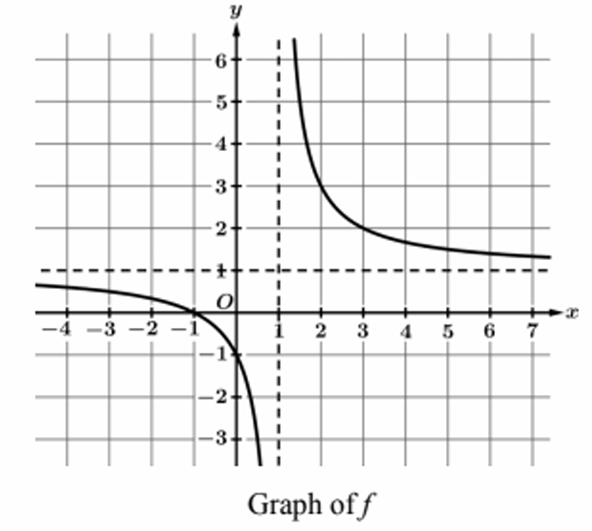
▶️ Answer/Explanation
(A)(i) Find \( h(3) \)
The function is defined as \( h(x) = g(f(x)) \).
First, we find the value of the inner function, \( f(3) \).
According to the problem text and graph, the point \( (3, 2) \) lies on the graph of \( f \). Therefore, \( f(3) = 2 \).
Now, substitute this value into the outer function \( g(x) \):
\( h(3) = g(2) \)
Using the definition \( g(x) = 2 + 3\ln x \):
\( g(2) = 2 + 3\ln(2) \)
Using a calculator to approximate \( \ln(2) \approx 0.693 \):
\( g(2) = 2 + 3(0.6931…) \approx 2 + 2.079 = 4.079 \)
Answer: \( h(3) \approx 4.079 \)
(A)(ii) Find real zeros of \( f \)
A real zero of a function occurs where the graph intersects the x-axis (where \( f(x) = 0 \)).
Looking at the provided graph, the curve intersects the x-axis at \( x = -1 \).
The problem text confirms the point \( (-1, 0) \) is on the graph.
There are no other intersections with the x-axis shown.
Answer: \( x = -1 \)
(B)(i) Find \( x \) for \( g(x) = e \)
Set up the equation:
\( 2 + 3\ln x = e \)
Subtract 2 from both sides:
\( 3\ln x = e – 2 \)
Divide by 3:
\( \ln x = \frac{e – 2}{3} \)
Convert from logarithmic to exponential form to solve for \( x \):
\( x = e^{\left(\frac{e – 2}{3}\right)} \)
Approximating the value (using \( e \approx 2.718 \)):
\( x \approx e^{0.2394} \)
Answer: \( x \approx 1.271 \)
(B)(ii) End behavior of \( g \)
We need to evaluate the limit as \( x \to \infty \) for \( g(x) = 2 + 3\ln x \).
As \( x \) increases without bound (\( x \to \infty \)), the natural logarithm function \( \ln x \) also increases without bound (\( \ln x \to \infty \)).
Multiplying by 3 and adding 2 does not change the unbounded nature.
Answer: \( \lim_{x \to \infty} g(x) = \infty \)
(C)(i) Is \( f \) invertible?
Answer: Yes, \( f \) is invertible.
(C)(ii) Reason
A function is invertible if and only if it is one-to-one. This can be verified visually using the Horizontal Line Test.
Looking at the graph of \( f(x) \):
1. The function is strictly decreasing on both branches of its domain (\( x < 1 \) and \( x > 1 \)).
2. The range of the left branch appears to be \( (-\infty, 1) \) and the range of the right branch appears to be \( (1, \infty) \).
Because the y-values do not repeat (no horizontal line intersects the graph more than once), the function is one-to-one.
Therefore, \( f \) has an inverse.