
▶️ Answer/Explanation
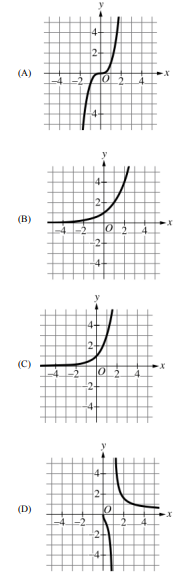
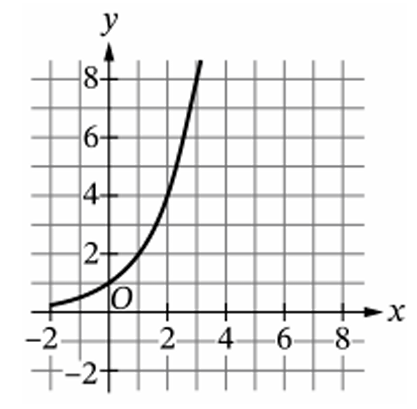
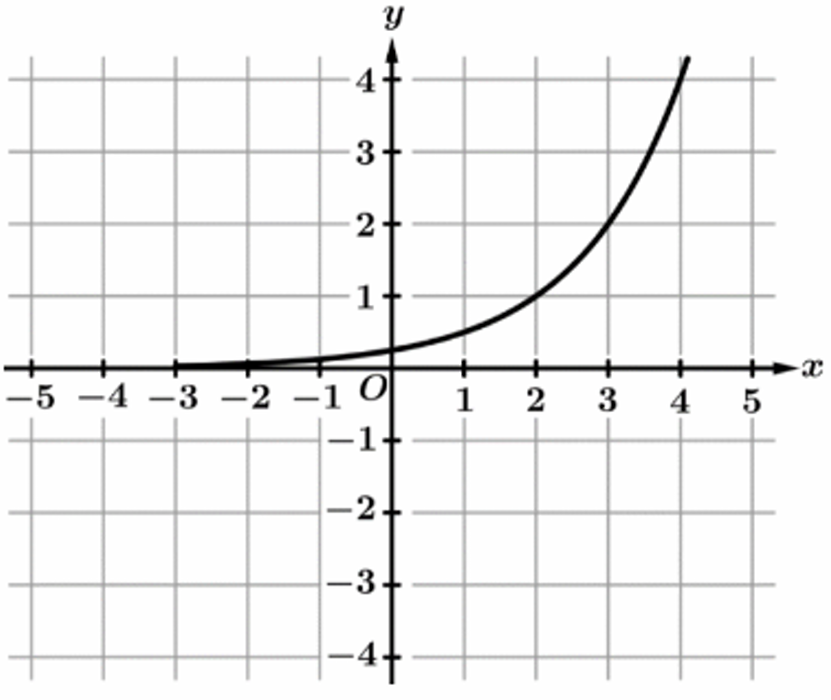
\( f^{-1}(x) = 3^x \), which is an exponential function with base >1.
It passes through (0,1), increases, and has a horizontal asymptote at \( y=0 \) as \( x \to -\infty \).
Only one of the graphs matches this exponential shape.
✅ Answer: (C)
▶️ Answer/Explanation
The property describes logarithmic behavior:
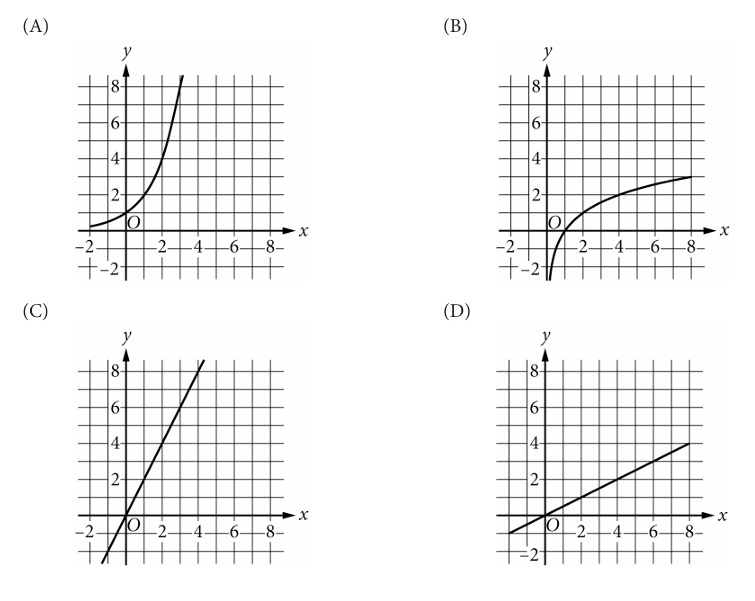
If input doubles (\( x \to 2x \)), output increases by 1 (\( g(2x) = g(x) + 1 \)).
This matches \( g(x) = \log_2 x \) because:
\[ \log_2(2x) = \log_2 2 + \log_2 x = 1 + \log_2 x = 1 + g(x) \]
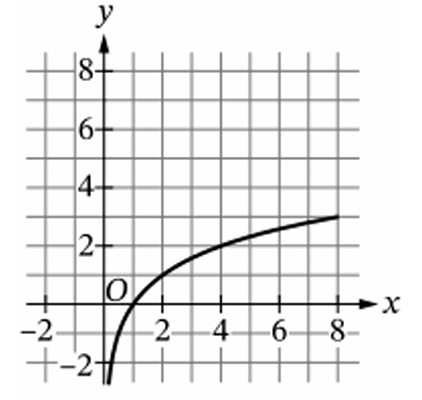
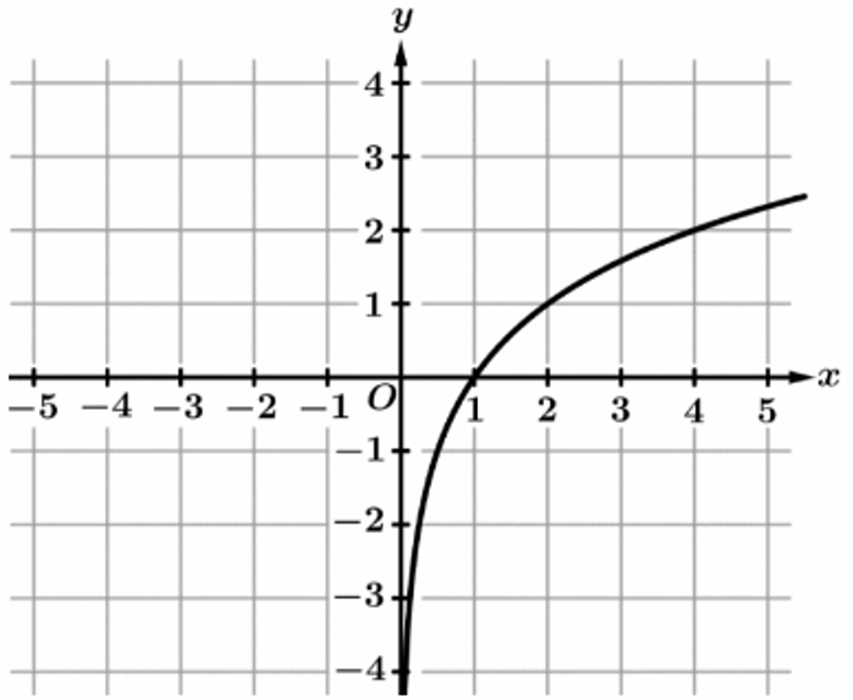
So \( g \) is logarithmic, with a slowly increasing curve, domain \( x > 0 \), and passes through \((1,0)\), \((2,1)\), \((4,2)\), etc.
✅ Answer: (B)
▶️ Answer/Explanation
The problem describes a function property: when input \( x \) doubles (\( x \rightarrow 2x \)), the output increases by 1 (\( g(x) \rightarrow g(x) + 1 \)).
This relationship is written as \( g(2x) = g(x) + 1 \), which is characteristic of a logarithmic function \( g(x) = \log_2(x) \).
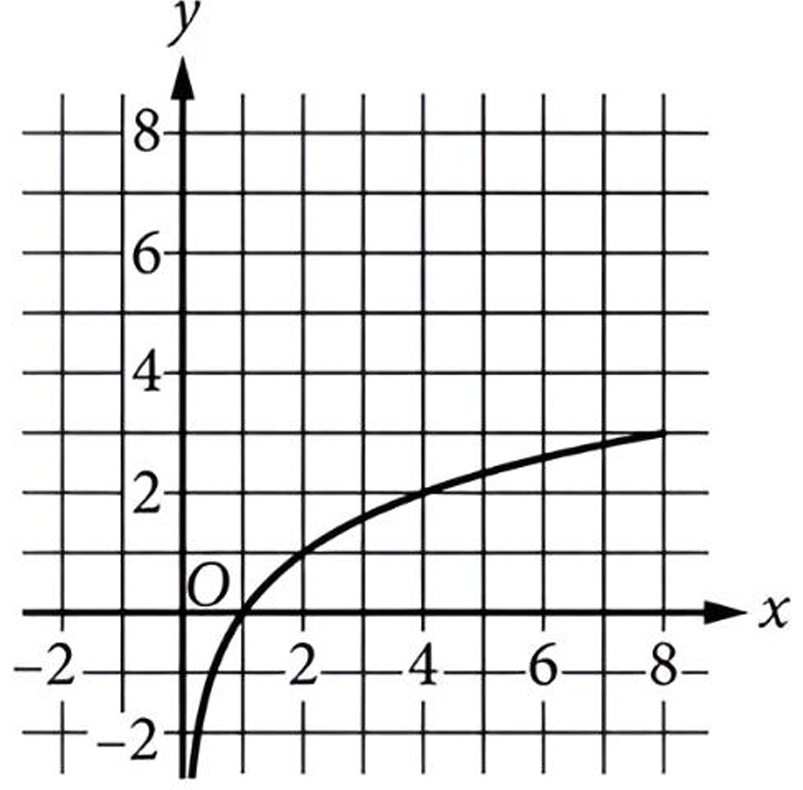
Let’s test the points on Graph (B) to verify this:
• At \( x = 1 \), \( y = 0 \).
• At \( x = 2 \) (doubled), \( y = 1 \). The increase is \( 1 – 0 = 1 \).
• At \( x = 4 \) (doubled), \( y = 2 \). The increase is \( 2 – 1 = 1 \).
• At \( x = 8 \) (doubled), \( y = 3 \). The increase is \( 3 – 2 = 1 \).
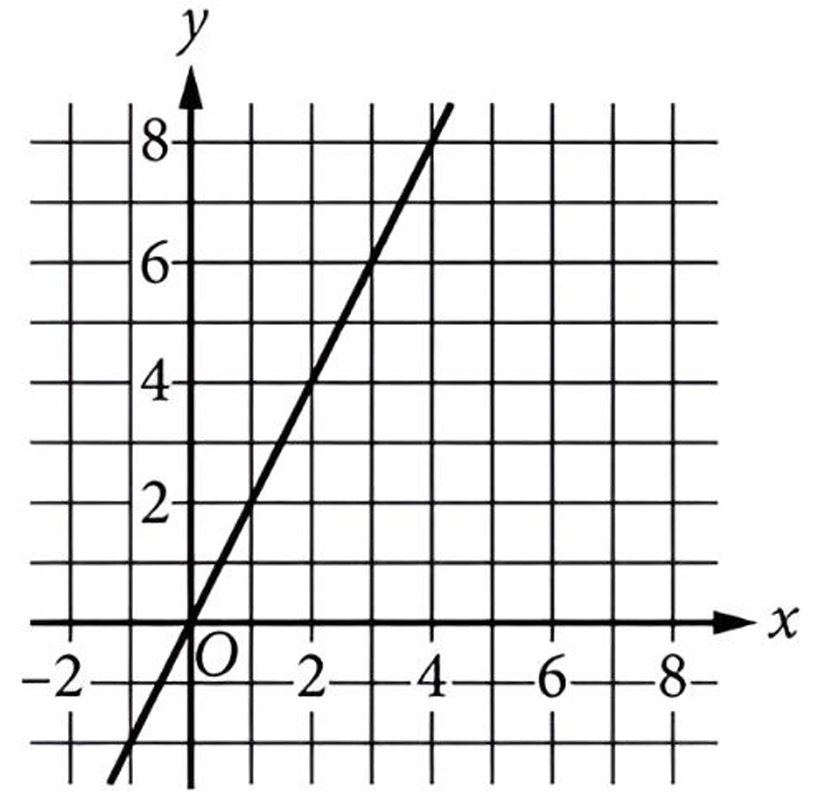
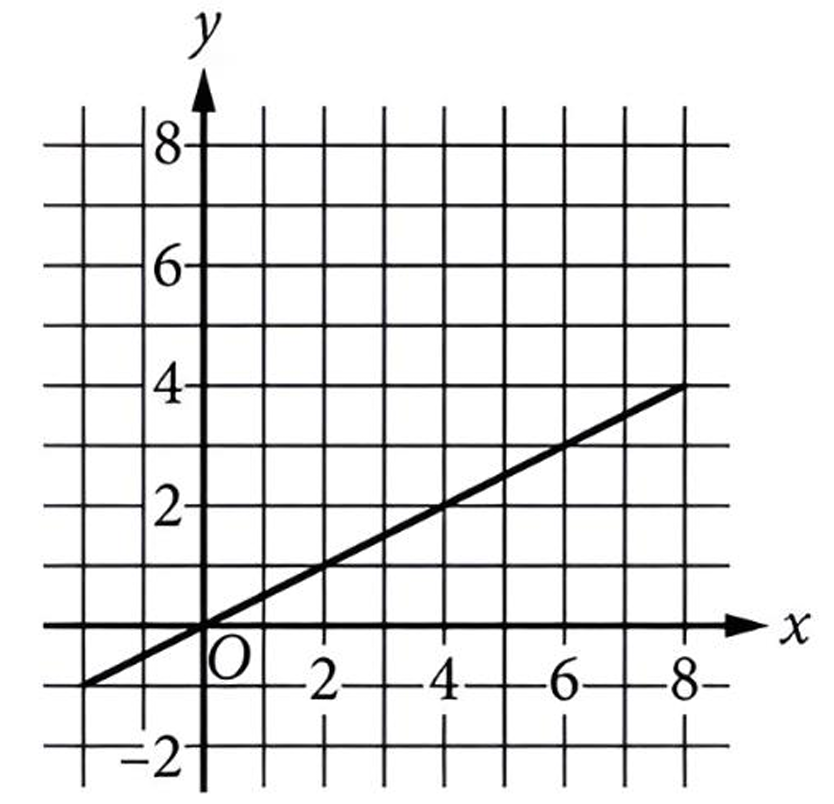
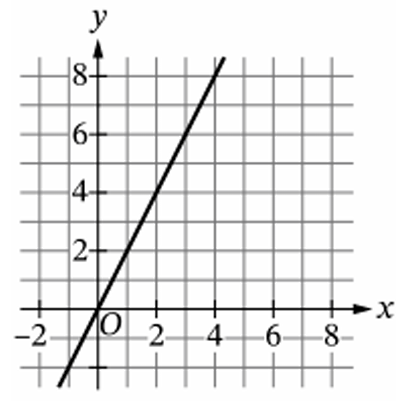
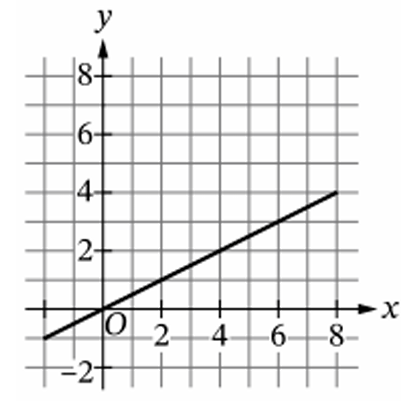
Graphs (C) and (D) represent linear functions passing through the origin, where doubling input doubles the output.
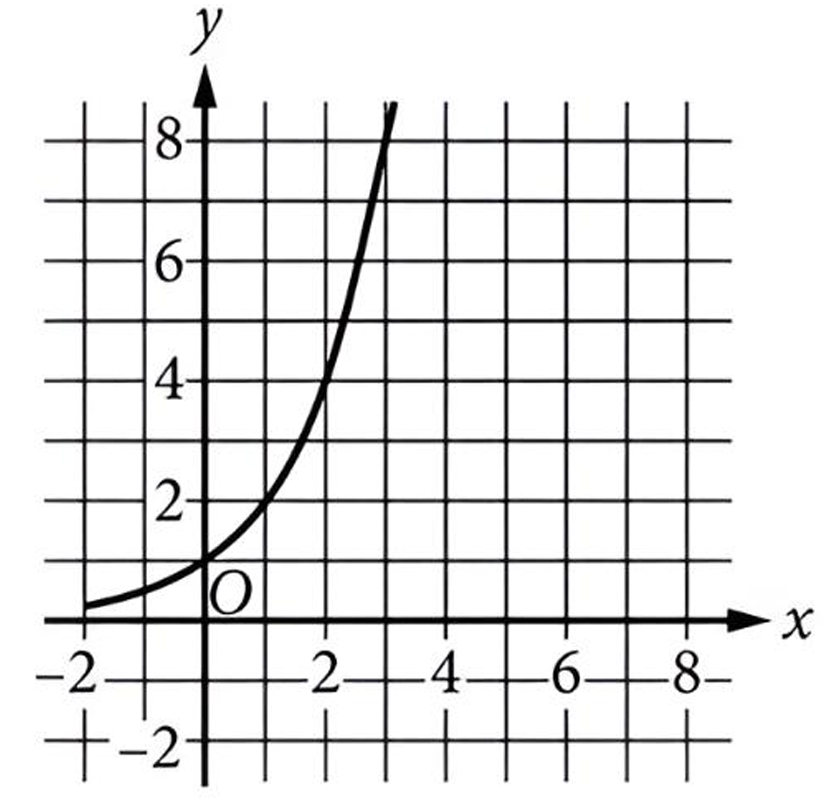
Graph (A) represents an exponential function, which grows much faster than the required condition.
Therefore, Graph (B) is the correct answer.
▶️ Answer/Explanation
The given property $g(2x) = g(x) + 1$ defines a logarithmic function base $2$.
In graph (B), when the input $x$ is $1$, the output $y$ is $0$.
Doubling the input to $x = 2$ results in an output of $y = 1$ (an increase of $1$).
Doubling the input again to $x = 4$ results in an output of $y = 2$ (an increase of $1$).
Doubling the input once more to $x = 8$ results in an output of $y = 3$ (an increase of $1$).
This constant arithmetic increase for a geometric change in input is unique to logarithmic curves.
Graphs (C) and (D) are linear, where output increases by a constant amount for a constant addition to the input.
Graph (A) is exponential, which is the inverse relationship where input increases by $1$ as output doubles.
The correct choice is (B).
▶️ Answer/Explanation
The correct graph is (B).
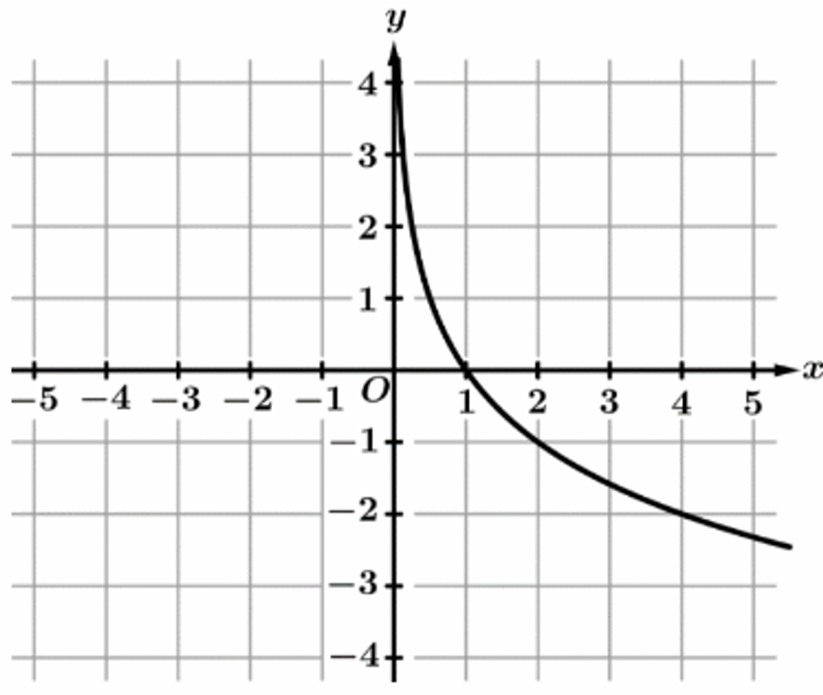
As $x \to \infty$, the output $h(x) \to \infty$, which is shown by the graph rising on the right.
As $x \to 0^+$, the output $h(x) \to -\infty$, indicating a vertical asymptote at $x = 0$.
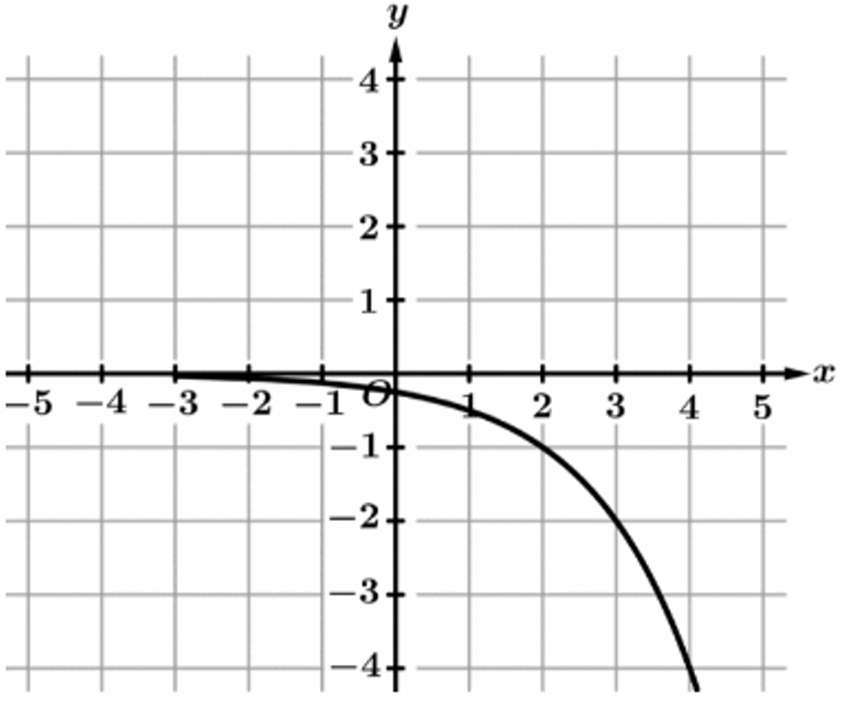
Graph (A) represents an exponential growth function where $h(x) \to 0$ as $x \to -\infty$.
Graph (C) shows $h(x)$ decreasing as $x$ increases, contradicting the first condition.
Graph (D) shows $h(x) \to -\infty$ as $x \to \infty$, which also contradicts the prompt.
Only graph (B), typical of a logarithmic function $\log_b(x)$ where $b > 1$, fits both criteria.