
Product Property for Logarithms and Transformations
The product property for logarithms states that the logarithm of a product can be written as the sum of two logarithms.
\( \mathrm{ \displaystyle \log_b(xy)=\log_b x+\log_b y } \)
This property is valid when \( \mathrm{x>0} \), \( \mathrm{y>0} \), \( \mathrm{b>0} \), and \( \mathrm{b\ne1} \).
Using this property, a logarithmic function with a multiplicative factor inside the argument can be rewritten in an equivalent form.
For example:
\( \mathrm{ \displaystyle f(x)=\log_b(kx) } \)
can be rewritten using the product property as
\( \mathrm{ \displaystyle f(x)=\log_b k+\log_b x } \)
Let
\( \mathrm{ \displaystyle a=\log_b k } \)
Then the function becomes
\( \mathrm{ \displaystyle f(x)=a+\log_b x } \)
Graphical Interpretation
This shows that a horizontal dilation of a logarithmic function is equivalent to a vertical translation.
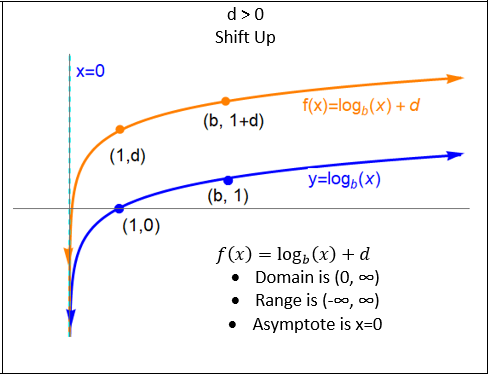
• Multiplying the input by \( \mathrm{k} \) shifts the graph vertically
• The vertical shift amount is \( \mathrm{\log_b k} \)
Example
Rewrite the function in the form \( \mathrm{a+\log_b x} \):
\( \mathrm{ \displaystyle f(x)=\log_2(4x) } \)
▶️ Answer/Explanation
Apply the product property:
\( \mathrm{ \displaystyle \log_2(4x)=\log_2 4+\log_2 x } \)
Since \( \mathrm{\log_2 4=2} \), the function becomes
\( \mathrm{ \displaystyle f(x)=2+\log_2 x } \)
Conclusion
The graph of \( \mathrm{\log_2(4x)} \) is the graph of \( \mathrm{\log_2 x} \) shifted upward by 2 units.
Example
Describe the transformation of the graph:
\( \mathrm{ \displaystyle f(x)=\log_{10}(0.1x) } \)
▶️ Answer/Explanation
Rewrite using the product property:
\( \mathrm{ \displaystyle \log_{10}(0.1x)=\log_{10}0.1+\log_{10}x } \)
Since \( \mathrm{\log_{10}0.1=-1} \),
\( \mathrm{ \displaystyle f(x)=\log_{10}x-1 } \)
Conclusion
The graph is shifted downward by 1 unit compared to \( \mathrm{y=\log_{10}x} \).
Power Property for Logarithms and Vertical Dilations
The power property for logarithms states that a logarithm of a power can be rewritten by moving the exponent outside as a multiplier.
\( \mathrm{ \displaystyle \log_b(x^n)=n\log_b x } \)
This property is valid for \( \mathrm{x>0} \), \( \mathrm{b>0} \), and \( \mathrm{b\ne1} \).
Using this property, a logarithmic function with a power applied to the input can be rewritten in an equivalent form.
If
\( \mathrm{ \displaystyle f(x)=\log_b(x^k) } \)
then
\( \mathrm{ \displaystyle f(x)=k\log_b x } \)
Graphical Interpretation
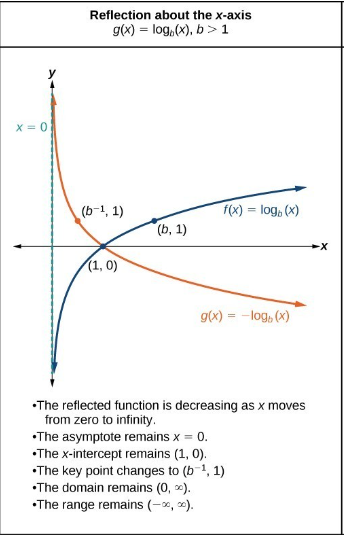
This shows that raising the input of a logarithmic function to a power results in a vertical dilation of the graph.
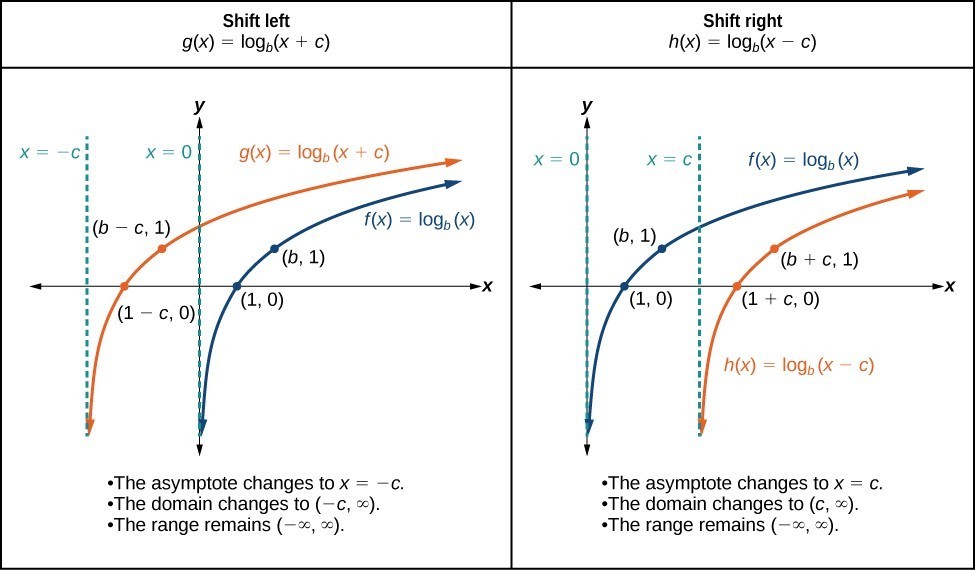
• If \( \mathrm{k>1} \), the graph is vertically stretched
• If \( \mathrm{0<k<1} \), the graph is vertically compressed
• If \( \mathrm{k<0} \), the graph is reflected across the x-axis
Example
Rewrite the function in equivalent form and describe the transformation:
\( \mathrm{ \displaystyle f(x)=\log_3(x^4) } \)
▶️ Answer/Explanation
Apply the power property:
\( \mathrm{ \displaystyle \log_3(x^4)=4\log_3 x } \)
Conclusion
The graph is a vertical stretch of \( \mathrm{y=\log_3 x} \) by a factor of 4.
Example
Describe the effect of the exponent in the function
\( \mathrm{ \displaystyle f(x)=\log_{10}(x^{1/2}) } \)
▶️ Answer/Explanation
Rewrite using the power property:
\( \mathrm{ \displaystyle \log_{10}(x^{1/2})=\dfrac12\log_{10}x } \)
Conclusion
The graph is vertically compressed by a factor of \( \mathrm{\dfrac12} \) compared to \( \mathrm{y=\log_{10}x} \).
Change of Base Property for Logarithms
The change of base property for logarithms allows a logarithm with any base to be rewritten using a different base.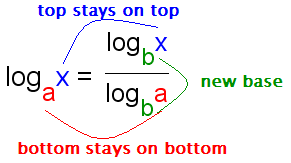
\( \mathrm{ \displaystyle \log_b x=\dfrac{\log_a x}{\log_a b} } \)
where \( \mathrm{a>0} \) and \( \mathrm{a\ne1} \).
A common choice is \( \mathrm{a=10} \) or \( \mathrm{a=e} \), which allows logarithmic values to be computed using calculators or technology.
Graphical Interpretation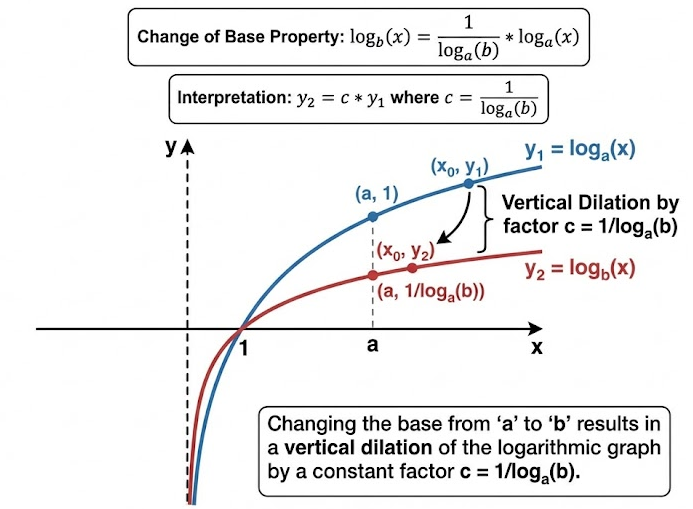
Using the change of base property,
\( \mathrm{ \displaystyle \log_b x=\dfrac{1}{\log_a b}\log_a x } \)
This shows that changing the base of a logarithm results in a vertical dilation of the logarithmic graph.
• The factor \( \mathrm{\dfrac{1}{\log_a b}} \) controls the vertical stretch or compression
• The domain \( \mathrm{x>0} \) and vertical asymptote \( \mathrm{x=0} \) remain unchanged
Therefore, all logarithmic functions are vertical dilations of one another.
Example
Rewrite the logarithm using base 10:
\( \mathrm{ \displaystyle \log_3 x } \)
▶️ Answer/Explanation
Apply the change of base formula:
\( \mathrm{ \displaystyle \log_3 x=\dfrac{\log x}{\log 3} } \)
Conclusion
The graph of \( \mathrm{y=\log_3 x} \) is a vertical stretch of \( \mathrm{y=\log x} \) by a factor of \( \mathrm{\dfrac{1}{\log 3}} \).
Example
Explain how the graphs of \( \mathrm{y=\log_2 x} \) and \( \mathrm{y=\log_{10} x} \) are related.
▶️ Answer/Explanation
Using change of base,
\( \mathrm{ \displaystyle \log_2 x=\dfrac{\log x}{\log 2} } \)
This shows that \( \mathrm{y=\log_2 x} \) is a vertical stretch of \( \mathrm{y=\log x} \) by a factor of \( \mathrm{\dfrac{1}{\log 2}} \).
Conclusion
Changing the base changes only the vertical scale of the graph, not its overall shape or domain.
The Natural Logarithmic Function
The natural logarithmic function is a logarithmic function whose base is the number \( \mathrm{e} \).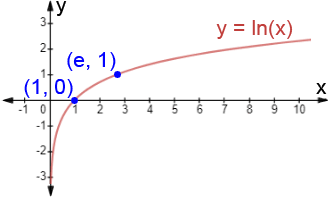
It is written as
\( \mathrm{ \displaystyle f(x)=\ln x } \)
and is defined by the equivalence
\( \mathrm{ \displaystyle \ln x=\log_e x } \)
The number \( \mathrm{e} \) is an irrational constant approximately equal to \( \mathrm{2.718} \) and arises naturally in many growth and decay processes.
Key Properties of \( \mathrm{\ln x} \)
• Domain: \( \mathrm{x>0} \)
• Range: all real numbers
• Vertical asymptote: \( \mathrm{x=0} \)
• Inverse of the exponential function \( \mathrm{y=e^x} \)
Like all logarithmic functions with base greater than 1, \( \mathrm{\ln x} \) is always increasing and concave down.
Example
Evaluate the natural logarithm
\( \mathrm{ \displaystyle \ln e^4 } \)
▶️ Answer/Explanation
Since logarithms and exponentials with the same base are inverses:
\( \mathrm{ \displaystyle \ln(e^4)=4 } \)
Example
Rewrite the logarithm using natural logarithms:
\( \mathrm{ \displaystyle \log_5 x } \)
▶️ Answer/Explanation
Apply the change of base formula with base \( \mathrm{e} \):
\( \mathrm{ \displaystyle \log_5 x=\dfrac{\ln x}{\ln 5} } \)
Conclusion
Natural logarithms allow logarithms with any base to be expressed in terms of \( \mathrm{e} \).