AP Precalculus -2.13 Exponential and Logarithmic Equations and Inequalities- FRQ Exam Style Questions - Effective Fall 2023
AP Precalculus -2.13 Exponential and Logarithmic Equations and Inequalities- FRQ Exam Style Questions – Effective Fall 2023
AP Precalculus -2.13 Exponential and Logarithmic Equations and Inequalities- FRQ Exam Style Questions – AP Precalculus- per latest AP Precalculus Syllabus.
Question

(A) The function \(g\) and \(h\) are given by
\(g(x) = 3 \ln x – \frac{1}{2} \ln x\)
\(h(x) = \frac{\sin^2 x – 1}{\cos x}\)
(i) Rewrite \(g(x)\) as a single natural logarithm without negative exponents in any part of the expression. Your result should be of the form \(\ln(\text{expression})\).
(ii) Rewrite \(h(x)\) as an expression in which \(\cos x\) appears once and no other trigonometric functions are involved.
(B) The functions \(j\) and \(k\) are given by
\(j(x) = 2(\sin x)(\cos x)\)
\(k(x) = 8e^{(3x)} – e\)
(i) Solve \(j(x) = 0\) for values of \(x\) in the interval \(\left[0, \frac{\pi}{2}\right]\).
(ii) Solve \(k(x) = 3e\) for values of \(x\) in the domain of \(k\).
(C) The function \(m\) is given by
\(m(x) = \cos(2x) + 4\)
Find all input values in the domain of \(m\) that yield an output of \(\frac{9}{2}\).
Most-appropriate topic codes (AP Precalculus CED):
• 3.12: Equivalent Representations of Trigonometric Functions – part A(ii)
• 3.10: Trigonometric Equations and Inequalities – part B(i), part C
• 2.13: Exponential and Logarithmic Equations and Inequalities – part B(ii)
▶️ Answer/Explanation
(A)(i) Rewrite \(g(x)\)
The function is given by \(g(x) = 3 \ln x – \frac{1}{2} \ln x\).
Combine the like terms:
\(g(x) = \left(3 – \frac{1}{2}\right) \ln x\)
\(g(x) = \frac{5}{2} \ln x\)
Apply the power property of logarithms, \(a \ln b = \ln(b^a)\):
\(g(x) = \ln\left(x^{5/2}\right)\)
(A)(ii) Rewrite \(h(x)\)
The function is given by \(h(x) = \frac{\sin^2 x – 1}{\cos x}\).
Recall the Pythagorean identity: \(\sin^2 x + \cos^2 x = 1\).
Rearrange the identity to isolate the numerator expression: \(\sin^2 x – 1 = -\cos^2 x\).
Substitute this into the function:
\(h(x) = \frac{-\cos^2 x}{\cos x}\)
Simplify the expression by canceling one \(\cos x\) term:
\(h(x) = -\cos x\)
(B)(i) Solve \(j(x) = 0\)
Set the function equal to zero: \(2(\sin x)(\cos x) = 0\).
Divide both sides by 2:
\(\sin x \cos x = 0\)
By the zero product property, either \(\sin x = 0\) or \(\cos x = 0\).
Case 1: \(\sin x = 0\). In the interval \(\left[0, \frac{\pi}{2}\right]\), \(x = 0\).
Case 2: \(\cos x = 0\). In the interval \(\left[0, \frac{\pi}{2}\right]\), \(x = \frac{\pi}{2}\).
The solutions are \(x = 0\) and \(x = \frac{\pi}{2}\).
(B)(ii) Solve \(k(x) = 3e\)
Set the function equal to \(3e\):
\(8e^{(3x)} – e = 3e\)
Add \(e\) to both sides:
\(8e^{(3x)} = 4e\)
Divide both sides by 8:
\(e^{(3x)} = \frac{4e}{8}\)
\(e^{(3x)} = \frac{e}{2}\)
Take the natural logarithm (\(\ln\)) of both sides:
\(\ln\left(e^{3x}\right) = \ln\left(\frac{e}{2}\right)\)
Use logarithm properties to simplify (\(\ln(e^a) = a\) and \(\ln(a/b) = \ln a – \ln b\)):
\(3x = \ln e – \ln 2\)
Since \(\ln e = 1\):
\(3x = 1 – \ln 2\)
Divide by 3:
\(x = \frac{1 – \ln 2}{3}\)
(C) Find input values for \(m(x) = \frac{9}{2}\)
Set the function equal to \(\frac{9}{2}\):
\(\cos(2x) + 4 = \frac{9}{2}\)
Subtract 4 from both sides (note that \(4 = \frac{8}{2}\)):
\(\cos(2x) = \frac{9}{2} – \frac{8}{2}\)
\(\cos(2x) = \frac{1}{2}\)
The reference angle for cosine equal to \(\frac{1}{2}\) is \(\frac{\pi}{3}\).
The general solution for \(2x\) is:
\(2x = \frac{\pi}{3} + 2\pi n\) or \(2x = -\frac{\pi}{3} + 2\pi n\) (where \(n\) is an integer).
Solve for \(x\) by dividing by 2:
\(x = \frac{\pi}{6} + \pi n\) or \(x = -\frac{\pi}{6} + \pi n\)
Combining these, the input values are \(x = \pm \frac{\pi}{6} + \pi n\) for any integer \(n\).
Question
(i) Solve $g(x)=3$ for values of $x$ in the domain of $g$.
(ii) Solve $h(x)=e^{1/2}$ for values of $x$ in the domain of $h$.
(i) Rewrite $j(x)$ as a single logarithm base 10 without negative exponents in any part of the expression. Your result should be of the form $\log_{10}(\text{expression})$.
(ii) Rewrite $k(x)$ as a product involving $\tan x$ and $\sin x$ and no other trigonometric functions.
Find all input values in the domain of $m$ that yield an output value of $\sin^{-1}\left(\frac{\sqrt{3}}{2}\right)$.
Most-appropriate topic codes (AP Precalculus CED):
• 2.12: Logarithmic Function Manipulation – part B(i)
• 3.12: Equivalent Representations of Trigonometric Functions – part B(ii)
• 3.9: Inverse Trigonometric Functions – part C
▶️ Answer/Explanation
A (i)
$g(x)=3 \implies \log_4(2x)=3$.
Convert from logarithmic to exponential form: $4^3=2x$.
$64=2x \implies x=\frac{64}{2}=32$.
✅ Answer: $\boxed{x=32}$
A (ii)
$h(x)=e^{1/2} \implies \frac{e^{5x}}{e^{1/4}}=e^{1/2}$.
Using exponent rules: $e^{5x – 1/4} = e^{1/2}$.
Equate the exponents: $5x – \frac{1}{4} = \frac{1}{2}$.
$5x = \frac{1}{2} + \frac{1}{4} = \frac{3}{4} \implies x=\frac{3}{20}$.
✅ Answer: $\boxed{x=\frac{3}{20}}$
B (i)
Apply logarithmic power and product/quotient properties:
$j(x)=\log_{10}(x+1) – \log_{10}(2-x)^5 + \log_{10}3$.
$j(x)=\log_{10}\left(\frac{3(x+1)}{(2-x)^5}\right)$.
✅ Answer: $\boxed{\log_{10}\left(\frac{3(x+1)}{(2-x)^5}\right)}$
B (ii)
Convert secant to cosine: $k(x)=\frac{1}{\cos x} – \cos x$.
Find a common denominator: $k(x)=\frac{1-\cos^2 x}{\cos x}$.
Use the Pythagorean identity: $k(x)=\frac{\sin^2 x}{\cos x}$.
Factor the fraction: $\left(\frac{\sin x}{\cos x}\right) \cdot \sin x = \tan x \sin x$.
✅ Answer: $\boxed{\tan x \sin x}$
C
First evaluate the target output: $\sin^{-1}\left(\frac{\sqrt{3}}{2}\right)=\frac{\pi}{3}$.
Set up the equation: $2 \tan^{-1}(\sqrt{3}\pi x) = \frac{\pi}{3}$.
Divide by 2: $\tan^{-1}(\sqrt{3}\pi x) = \frac{\pi}{6}$.
Take the tangent of both sides: $\sqrt{3}\pi x = \tan\left(\frac{\pi}{6}\right)$.
Since $\tan\left(\frac{\pi}{6}\right) = \frac{1}{\sqrt{3}}$, we get $\sqrt{3}\pi x = \frac{1}{\sqrt{3}}$.
Divide to isolate $x$: $x = \frac{1}{3\pi}$.
✅ Answer: $\boxed{x=\frac{1}{3\pi}}$
Question
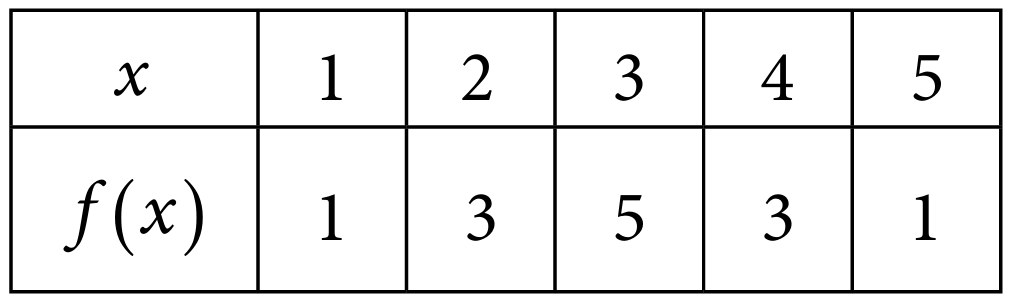
(i) The function $h$ is defined by $h(x)=(g \circ f)(x)=g(f(x))$. Find the value of $h(4)$ as a decimal approximation, or indicate that it is not defined.
(ii) Find all values of $x$ for which $f(x)=3$, or indicate there are no such values.
(i) Find all values of $x$, as decimal approximations, for which $g(x)=3$, or indicate there are no such values.
(ii) Determine the end behavior of $g$ as $x$ increases without bound. Express your answer using the mathematical notation of a limit.
(i) Determine if $f$ has an inverse function.
(ii) Give a reason for your answer based on the definition of a function and the table of values of $f(x)$.
Most-appropriate topic codes (AP Precalculus CED):
• 2.8: Inverse Functions – part A(ii), C
• 2.11: Logarithmic Functions – part B(ii)
• 2.13: Exponential and Logarithmic Equations and Inequalities – part B(i)
▶️ Answer/Explanation
A (i)
We need to find $h(4)=g(f(4))$.
From the table, the output for input $4$ is $f(4)=3$.
Substitute this into $g(x)$: $g(3)=2 \ln 3$.
Using a calculator, $2 \ln 3 \approx 2.197$.
✅ Answer: $\boxed{2.197}$
A (ii)
We are looking for the inputs where the output is 3.
From the table, $f(x)=3$ when $x=2$ and $x=4$.
✅ Answer: $\boxed{x=2, x=4}$
B (i)
Set the equation: $g(x)=3 \implies 2 \ln x=3$.
Isolate the natural log: $\ln x=1.5$.
Exponentiate both sides to solve for $x$: $x=e^{1.5} \approx 4.482$.
✅ Answer: $\boxed{4.482}$
B (ii)
The function $g$ is an increasing logarithmic function. As $x$ increases without bound, the natural log function grows slowly but infinitely, so $g(x)$ increases without bound.
Therefore, $\lim_{x \to \infty} g(x) = \infty$.
✅ Answer: $\boxed{\lim_{x \to \infty} g(x) = \infty}$
C (i)
$f$ does not have an inverse function on its domain of the five real numbers 1, 2, 3, 4, and 5.
✅ Answer: $\boxed{\text{No inverse function}}$
C (ii)
Reasoning: There are output values of $f$ that are not mapped from unique input values (the function $f$ is not one-to-one). Because $f(1)=1$ and $f(5)=1$, the inverse function on this domain does not exist. Note: Stating only that it “fails the horizontal line test” without referencing specific data values is generally insufficient for full credit.
Question
\[g(x) = 2 \log a – 3 \log b + \frac{\log a}{2} + \log_{100} c\]
\[h(x) = \cot x \sec^2 x – \tan x\]
\[j(x) = 3 \cot^2 \theta + 3 \csc \theta\]
\[k(x) = 7e^{7-2x} + 9\]
(ii) Solve \( k(x) = 86 \) for all values of \( x \) in the domain of \( k \)
\[a(x) = 3 – 3 \csc 3\theta\]
\[b(x) = -1 + \csc 3\theta\]
Most-appropriate topic codes (AP Precalculus CED):
• 3.12: Equivalent Representations of Trigonometric Functions – part A(ii)
• 3.10: Trigonometric Equations and Inequalities – part B(i)
• 2.13: Exponential and Logarithmic Equations and Inequalities – part B(ii)
• 3.10: Trigonometric Equations and Inequalities – part C
▶️ Answer/Explanation
Step 1: Write all logs in base 10 Assume \( \log \) means \( \log_{10} \). Given: \[ g(x) = 2 \log a – 3 \log b + \frac{\log a}{2} + \log_{100} c \] Note: \( \log_{100} c = \frac{\log_{10} c}{\log_{10} 100} = \frac{\log c}{2} \). So: \[ g(x) = 2\log a – 3\log b + \frac{\log a}{2} + \frac{\log c}{2} \] Step 2: Combine like terms Terms with \( \log a \): \( 2\log a + \frac{\log a}{2} = \frac{4\log a}{2} + \frac{\log a}{2} = \frac{5\log a}{2} \). Other terms: \( -3\log b + \frac{\log c}{2} \). Thus: \[ g(x) = \frac{5}{2} \log a – 3\log b + \frac{1}{2} \log c \] Step 3: Express as a single logarithm \[ g(x) = \log\left( a^{5/2} \right) + \log\left( b^{-3} \right) + \log\left( c^{1/2} \right) \] \[ = \log\left( a^{5/2} \cdot b^{-3} \cdot c^{1/2} \right) \] \[ = \log\left( \frac{a^{5/2} c^{1/2}}{b^3} \right) \] \[ = \log\left( \frac{\sqrt{a^5} \sqrt{c}}{b^3} \right) = \log\left( \frac{\sqrt{a^5 c}}{b^3} \right) \] Step 4: Without negative exponents The expression inside log is \( \frac{a^{5/2} c^{1/2}}{b^3} \). No negative exponents inside — all exponents positive in numerator, denominator exponent positive as well (it’s \( b^3 \)). Final: \[ g(x) = \log\left( \frac{a^{5/2} c^{1/2}}{b^3} \right) \quad \text{or} \quad \log\left( \frac{\sqrt{a^5 c}}{b^3} \right) \]
Given: \[ h(x) = \cot x \sec^2 x – \tan x \] Step 1: Write in sines and cosines \[ \cot x = \frac{\cos x}{\sin x}, \quad \sec^2 x = \frac{1}{\cos^2 x}, \quad \tan x = \frac{\sin x}{\cos x} \] So: \[ h(x) = \frac{\cos x}{\sin x} \cdot \frac{1}{\cos^2 x} – \frac{\sin x}{\cos x} \] \[ = \frac{1}{\sin x \cos x} – \frac{\sin x}{\cos x} \] Step 2: Common denominator \( \sin x \cos x \) \[ h(x) = \frac{1 – \sin^2 x}{\sin x \cos x} \] Step 3: Use \( 1 – \sin^2 x = \cos^2 x \) \[ h(x) = \frac{\cos^2 x}{\sin x \cos x} = \frac{\cos x}{\sin x} = \cot x \] Final: \[ h(x) = \cot x \]
Given: \[ j(x) = 3 \cot^2 \theta + 3 \csc \theta \] It appears \( j \) is a function of \( \theta \), so likely \( j(\theta) \). Solve \( j(\theta) = -3 \). \[ 3 \cot^2 \theta + 3 \csc \theta = -3 \] Divide by 3: \[ \cot^2 \theta + \csc \theta = -1 \] Step 1: Express \( \cot^2 \theta \) in terms of \( \csc \theta \) \[ \cot^2 \theta = \csc^2 \theta – 1 \] So: \[ \csc^2 \theta – 1 + \csc \theta = -1 \] \[ \csc^2 \theta + \csc \theta = 0 \] Step 2: Factor \[ \csc \theta (\csc \theta + 1) = 0 \] Thus: \[ \csc \theta = 0 \quad \text{or} \quad \csc \theta = -1 \] But \( \csc \theta = \frac{1}{\sin \theta} \), so \( \csc \theta = 0 \) has no solution. Only: \[ \csc \theta = -1 \implies \sin \theta = -1 \] Step 3: Solve \( \sin \theta = -1 \) on \([0, 2\pi)\) \[ \theta = \frac{3\pi}{2} \] Final: \[ \boxed{\theta = \frac{3\pi}{2}} \] (Note: The problem says \( j(x) \) but uses \( \theta \) — likely a typo. Solving for \( \theta \).)
\[ k(x) = 7e^{7-2x} + 9 = 86 \] \[ 7e^{7-2x} = 77 \] \[ e^{7-2x} = 11 \] Step 1: Take natural log \[ 7-2x = \ln 11 \] \[ 2x = 7 – \ln 11 \] \[ x = \frac{7 – \ln 11}{2} \] Step 2: Domain of \( k \) \( k(x) \) is defined for all real \( x \) (exponential function). So only this one solution. Final: \[ \boxed{x = \frac{7 – \ln 11}{2}} \]
Given: \[ a(\theta) = 3 – 3 \csc 3\theta \] \[ b(\theta) = -1 + \csc 3\theta \] Set \( a(\theta) = b(\theta) \): \[ 3 – 3 \csc 3\theta = -1 + \csc 3\theta \] \[ 3 + 1 = \csc 3\theta + 3 \csc 3\theta \] \[ 4 = 4 \csc 3\theta \] \[ \csc 3\theta = 1 \] \[ \sin 3\theta = 1 \] Step 1: Solve \( \sin 3\theta = 1 \) \[ 3\theta = \frac{\pi}{2} + 2n\pi, \quad n \in \mathbb{Z} \] \[ \theta = \frac{\pi}{6} + \frac{2n\pi}{3} \] Step 2: Domain considerations For \( \csc 3\theta \) to be defined, \( \sin 3\theta \neq 0 \). Here \( \sin 3\theta = 1 \) so fine. We need all \( \theta \) in the domain of both \( a \) and \( b \) — typically all reals except where \( \sin 3\theta = 0 \). Our solutions avoid those points. Step 3: General solution \[ \theta = \frac{\pi}{6} + \frac{2n\pi}{3}, \quad n \in \mathbb{Z} \] Final: \[ \boxed{\theta = \frac{\pi}{6} + \frac{2n\pi}{3}, \quad n \in \mathbb{Z}} \]
Question

\[ g(x) = 2 \log_3 x \quad]
[\quad h(x) = 4 \cos^2 x. \]
(i) Solve \( g(x) = 4 \) for values of \( x \) in the domain of \( g \).
(ii) Solve \( h(x) = 3 \) for values of \( x \) in the interval \([0, \frac{\pi}{2})\).
\[ j(x) = \log_2 x + 3 \log_2 2 \quad \text{and} \quad k(x) = \frac{6}{\tan x (\csc^2 x – 1)}. \]
(i) Rewrite \( j(x) \) as a single logarithm base 2 without negative exponents in any part of the expression. Your result should be of the form \( \log_2 (\text{expression}) \).
(ii) Rewrite \( k(x) \) as an expression in which \( \tan x \) appears exactly once and no other trigonometric functions are involved.
Most-appropriate topic codes (AP Precalculus CED):
• 2.13: Exponential and Logarithmic Equations and Inequalities — part A(i), C
• 3.9: Trigonometric Equations and Inequalities — part A(ii)
• 3.4: Trigonometric Identities — part B(ii)
▶️ Answer/Explanation
A. (i) Solving \( g(x) = 4 \):
Given \( g(x) = 2\log_3 x \). Set \( g(x) = 4 \): \[ 2\log_3 x = 4 \] Divide both sides by 2: \[ \log_3 x = 2 \] Convert to exponential form: \[ x = 3^2 = 9 \] Check domain: \( x > 0 \), so \( x = 9 \) is valid. ✅ Answer: \(\boxed{x = 9}\)
A. (ii) Solving \( h(x) = 3 \) on \( [0, \frac{\pi}{2}) \):
Given \( h(x) = 4\cos^2 x \). Set \( h(x) = 3 \): \[ 4\cos^2 x = 3 \] Divide both sides by 4: \[ \cos^2 x = \frac{3}{4} \] Take square root: \[ \cos x = \pm \frac{\sqrt{3}}{2} \] On \( [0, \frac{\pi}{2}) \), cosine is positive, so \[ \cos x = \frac{\sqrt{3}}{2} \implies x = \frac{\pi}{6} \] ✅ Answer: \(\boxed{x = \frac{\pi}{6}}\)
B. (i) Rewriting \( j(x) \) as a single logarithm:
Given \( j(x) = \log_2 x + 3\log_2 2 \).
Use power rule: \( 3\log_2 2 = \log_2 (2^3) = \log_2 8 \).
Use product rule: \[ j(x) = \log_2 x + \log_2 8 = \log_2 (8x) \] ✅ Answer: \(\boxed{\log_2(8x)}\)
B. (ii) Rewriting \( k(x) \) in terms of \( \tan x \) only:
Given \( k(x) = \dfrac{6}{\tan x (\csc^2 x – 1)} \).
Use Pythagorean identity: \( \csc^2 x – 1 = \cot^2 x \).
Thus, \[ k(x) = \frac{6}{\tan x \cdot \cot^2 x} \] Since \( \cot x = \frac{1}{\tan x} \), we have \( \cot^2 x = \frac{1}{\tan^2 x} \).
Substitute: \[ k(x) = \frac{6}{\tan x \cdot \frac{1}{\tan^2 x}} = \frac{6}{\frac{\tan x}{\tan^2 x}} = \frac{6}{\frac{1}{\tan x}} = 6 \tan x \] ✅ Answer: \(\boxed{6 \tan x}\)
C. Solving \( m(x) = 0 \):
Given \( m(x) = e^{2x} – e^x – 12 \).
Set \( m(x) = 0 \): \[ e^{2x} – e^x – 12 = 0 \] Let \( y = e^x \). Then \( e^{2x} = (e^x)^2 = y^2 \).
Substitute: \[ y^2 – y – 12 = 0 \] Factor: \[ (y – 4)(y + 3) = 0 \] Thus \( y = 4 \) or \( y = -3 \).
Since \( y = e^x > 0 \), discard \( y = -3 \).
So \( e^x = 4 \).
Take natural log: \( x = \ln 4 \).
✅ Answer: \(\boxed{x = \ln 4}\)
Question

(A) The functions \( g \) and \( h \) are given by:
\[ g(x) = 15 \arcsin x, \quad h(x) = \log_{10}(1 – x) – \log_{10} 4. \]
(i) Solve \( g(x) = 5\pi \) for values of \( x \) in the domain of \( g \).
(ii) Solve \( h(x) = 1 \) for values of \( x \) in the domain of \( h \).
(B) The functions \( j \) and \( k \) are given by:
\[ j(x) = \log_2(x + 4) – 11\log_2(x – 2) + \log_2(x^3), \] \[ k(x) = (\cot x)(\csc x). \]
(i) Rewrite \( j(x) \) as a single logarithm base 2 without negative exponents.
(ii) Rewrite \( k(x) \) as a fraction involving powers of \( \cos x \) and no other trigonometric functions.
(C) The function \( m \) is given by:
\[ m(x) = (2^x)^2 – 3 \cdot 2^x. \]
Find all input values in the domain of \( m \) that yield an output value of 18.
Most-appropriate topic codes (AP Precalculus CED):
• 2.13: Exponential and Logarithmic Equations and Inequalities — parts (A)(ii), (C)
• 2.12: Logarithmic Function Manipulation — part (B)(i)
• 3.12: Equivalent Representations of Trigonometric Functions — part (B)(ii)
▶️ Answer/Explanation
(A)(i)
Solve \( g(x) = 5\pi \).
\( 15 \arcsin x = 5\pi \)
\( \arcsin x = \frac{5\pi}{15} = \frac{\pi}{3} \)
\( x = \sin\left(\frac{\pi}{3}\right) = \frac{\sqrt{3}}{2} \)
Domain check: \( \arcsin x \) is defined for \( |x| \leq 1 \). \( \frac{\sqrt{3}}{2} \approx 0.866 \) is valid.
✅ Answer: \( \boxed{\frac{\sqrt{3}}{2}} \)
(A)(ii)
Solve \( h(x) = 1 \).
\( \log_{10}(1 – x) – \log_{10}4 = 1 \)
\( \log_{10}\left(\frac{1 – x}{4}\right) = 1 \)
\( \frac{1 – x}{4} = 10^1 \)
\( 1 – x = 40 \)
\( x = -39 \)
Domain check: \( 1 – x > 0 \Rightarrow x < 1 \). \( x = -39 \) is valid.
✅ Answer: \( \boxed{-39} \)
(B)(i)
Rewrite \( j(x) \) as a single logarithm.
\( j(x) = \log_2(x + 4) – 11\log_2(x – 2) + \log_2(x^3) \)
\( = \log_2(x + 4) – \log_2((x – 2)^{11}) + \log_2(x^3) \)
\( = \log_2\left[ \frac{(x + 4) \cdot x^3}{(x – 2)^{11}} \right] \)
✅ Answer: \( \boxed{\log_2\left( \frac{x^3(x + 4)}{(x – 2)^{11}} \right)} \)
(B)(ii)
Rewrite \( k(x) \) using \( \cot x = \frac{\cos x}{\sin x} \) and \( \csc x = \frac{1}{\sin x} \).
\( k(x) = \left( \frac{\cos x}{\sin x} \right) \left( \frac{1}{\sin x} \right) = \frac{\cos x}{\sin^2 x} \)
Using \( \sin^2 x = 1 – \cos^2 x \):
\( k(x) = \frac{\cos x}{1 – \cos^2 x} = \frac{\cos x}{(1 – \cos x)(1 + \cos x)} \)
✅ Answer: \( \boxed{\frac{\cos x}{1 – \cos^2 x}} \) or \( \frac{\cos x}{(1 – \cos x)(1 + \cos x)} \)
(C)
Solve \( m(x) = 18 \).
\( (2^x)^2 – 3 \cdot 2^x = 18 \)
Let \( u = 2^x \), then \( u^2 – 3u – 18 = 0 \)
\( (u – 6)(u + 3) = 0 \)
\( u = 6 \) or \( u = -3 \)
Since \( 2^x > 0 \) for all real \( x \), discard \( u = -3 \).
\( 2^x = 6 \)
\( x = \log_2 6 \)
✅ Answer: \( \boxed{\log_2 6} \)
Question
Directions:
- Unless otherwise specified, the domain of a function \( f \) is assumed to be the set of all real numbers \( x \) for which \( f(x) \) is a real number. Angle measures for trigonometric functions are assumed to be in radians.
- Solutions to equations must be real numbers. Determine the exact value of any expression that can be obtained without a calculator. For example, \( \log_2 8 \), \( \cos(\frac{\pi}{2}) \), and \( \sin^{-1}(1) \) can be evaluated without a calculator.
- Unless otherwise specified, combine terms using algebraic methods and rules for exponents and logarithms, where applicable. For example, \( 2x + 3x \), \( 5^2 \cdot 5^3 \), \( \frac{x^5}{x^2} \), and \( \ln 3 + \ln 5 \) should be rewritten in equivalent forms.
- For each part of the question, show the work that leads to your answers.
Part A
The functions \( g \) and \( h \) are given by
\( h(x) = \sin^{-1}(8x) \)
Part B
The functions \( j \) and \( k \) are given by
\( k(x) = \frac{(16^{3x}) \cdot 4^x}{2} \)
Part C
The function \( m \) is given by
▶️ Answer/Explanation
Part A
(i) Solve \( g(x) = 3 \)
Start with the given equation:
\( \log_5(4x – 2) = 3 \)
Convert the logarithmic equation to exponential form (\( y = \log_b x \iff x = b^y \)):
\( 4x – 2 = 5^3 \)
Evaluate the exponent:
\( 4x – 2 = 125 \)
Add 2 to both sides:
\( 4x = 127 \)
Divide by 4:
\( x = \frac{127}{4} \)
(ii) Solve \( h(x) = \frac{\pi}{4} \)
Start with the given equation:
\( \sin^{-1}(8x) = \frac{\pi}{4} \)
Take the sine of both sides to isolate the argument:
\( 8x = \sin\left(\frac{\pi}{4}\right) \)
Substitute the exact value of \( \sin\left(\frac{\pi}{4}\right) \):
\( 8x = \frac{\sqrt{2}}{2} \)
Divide by 8:
\( x = \frac{\sqrt{2}}{16} \)
Part B
(i) Rewrite \( j(x) \)
Start with the function definition:
\( j(x) = (\sec x)(\cot x) \)
Substitute the reciprocal and quotient identities (\( \sec x = \frac{1}{\cos x} \) and \( \cot x = \frac{\cos x}{\sin x} \)):
\( j(x) = \left(\frac{1}{\cos x}\right) \left(\frac{\cos x}{\sin x}\right) \)
Cancel the \( \cos x \) terms:
\( j(x) = \frac{1}{\sin x} \)
(ii) Rewrite \( k(x) \)
Start with the function definition:
\( k(x) = \frac{(16^{3x}) \cdot 4^x}{2} \)
To write in the form \( 4^{(ax+b)} \), convert bases 16 and 2 to base 4.
Since \( 16 = 4^2 \) and \( 2 = \sqrt{4} = 4^{1/2} = 4^{0.5} \):
\( k(x) = \frac{(4^2)^{3x} \cdot 4^x}{4^{0.5}} \)
Apply the power of a power rule (\( (a^m)^n = a^{mn} \)):
\( k(x) = \frac{4^{6x} \cdot 4^x}{4^{0.5}} \)
Apply the product rule for exponents (\( a^m \cdot a^n = a^{m+n} \)) in the numerator:
\( k(x) = \frac{4^{6x + x}}{4^{0.5}} = \frac{4^{7x}}{4^{0.5}} \)
Apply the quotient rule for exponents (\( \frac{a^m}{a^n} = a^{m-n} \)):
\( k(x) = 4^{7x – 0.5} \) (or \( 4^{7x – \frac{1}{2}} \))
Thus, \( a = 7 \) and \( b = -0.5 \).
Part C
Find values where \( m(x) = 1 \)
Set the function equal to 1:
\( \sqrt{3}\tan\left(x + \frac{\pi}{2}\right) = 1 \)
Isolate the tangent function by dividing by \( \sqrt{3} \):
\( \tan\left(x + \frac{\pi}{2}\right) = \frac{1}{\sqrt{3}} \)
Determine the reference angle. We know that \( \tan\left(\frac{\pi}{6}\right) = \frac{1}{\sqrt{3}} \).
Set up the general solution for tangent (\( \theta = \text{ref} + n\pi \)):
\( x + \frac{\pi}{2} = \frac{\pi}{6} + n\pi \), where \( n \) is any integer.
Solve for \( x \) by subtracting \( \frac{\pi}{2} \) from both sides:
\( x = \frac{\pi}{6} – \frac{\pi}{2} + n\pi \)
Find a common denominator (6) to combine fractions:
\( x = \frac{\pi}{6} – \frac{3\pi}{6} + n\pi \)
\( x = -\frac{2\pi}{6} + n\pi \)
Simplify the fraction:
\( x = -\frac{\pi}{3} + n\pi \)
Question

▶️ Answer/Explanation
(A)(i) Find \( h(3) \)
The function is defined as \( h(x) = g(f(x)) \).
First, we find the value of the inner function, \( f(3) \).
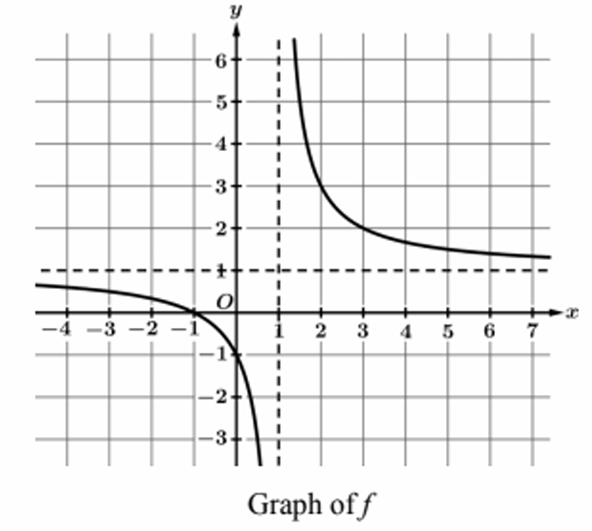
According to the problem text and graph, the point \( (3, 2) \) lies on the graph of \( f \). Therefore, \( f(3) = 2 \).
Now, substitute this value into the outer function \( g(x) \):
\( h(3) = g(2) \)
Using the definition \( g(x) = 2 + 3\ln x \):
\( g(2) = 2 + 3\ln(2) \)
Using a calculator to approximate \( \ln(2) \approx 0.693 \):
\( g(2) = 2 + 3(0.6931…) \approx 2 + 2.079 = 4.079 \)
Answer: \( h(3) \approx 4.079 \)
(A)(ii) Find real zeros of \( f \)
A real zero of a function occurs where the graph intersects the x-axis (where \( f(x) = 0 \)).
Looking at the provided graph, the curve intersects the x-axis at \( x = -1 \).
The problem text confirms the point \( (-1, 0) \) is on the graph.
There are no other intersections with the x-axis shown.
Answer: \( x = -1 \)
(B)(i) Find \( x \) for \( g(x) = e \)
Set up the equation:
\( 2 + 3\ln x = e \)
Subtract 2 from both sides:
\( 3\ln x = e – 2 \)
Divide by 3:
\( \ln x = \frac{e – 2}{3} \)
Convert from logarithmic to exponential form to solve for \( x \):
\( x = e^{\left(\frac{e – 2}{3}\right)} \)
Approximating the value (using \( e \approx 2.718 \)):
\( x \approx e^{0.2394} \)
Answer: \( x \approx 1.271 \)
(B)(ii) End behavior of \( g \)
We need to evaluate the limit as \( x \to \infty \) for \( g(x) = 2 + 3\ln x \).
As \( x \) increases without bound (\( x \to \infty \)), the natural logarithm function \( \ln x \) also increases without bound (\( \ln x \to \infty \)).
Multiplying by 3 and adding 2 does not change the unbounded nature.
Answer: \( \lim_{x \to \infty} g(x) = \infty \)
(C)(i) Is \( f \) invertible?
Answer: Yes, \( f \) is invertible.
(C)(ii) Reason
A function is invertible if and only if it is one-to-one. This can be verified visually using the Horizontal Line Test.
Looking at the graph of \( f(x) \):
1. The function is strictly decreasing on both branches of its domain (\( x < 1 \) and \( x > 1 \)).
2. The range of the left branch appears to be \( (-\infty, 1) \) and the range of the right branch appears to be \( (1, \infty) \).
Because the y-values do not repeat (no horizontal line intersects the graph more than once), the function is one-to-one.
Therefore, \( f \) has an inverse.
Question
Directions:
- Unless otherwise specified, the domain of a function \( f \) is assumed to be the set of all real numbers \( x \) for which \( f(x) \) is a real number. Angle measures for trigonometric functions are assumed to be in radians.
- Solutions to equations must be real numbers. Determine the exact value of any expression that can be obtained without a calculator.
- Unless otherwise specified, combine terms using algebraic methods and rules for exponents and logarithms where applicable.
- For each part of the question, show the work that leads to your answers.
(A) The functions \( g \) and \( h \) are given by
\( g(x) = 3^{(2x)} \cdot 3^{(x+4)} \)
\( h(x) = 2\tan^2 x – 1 \)
(ii) Solve \( h(x) = 5 \) for values of \( x \) in the interval \( [0, 2\pi) \).
(B) The functions \( j \) and \( k \) are given by
\( j(x) = 2\log_{10}(x+3) – \log_{10} x – \log_{10} 3 \)
\( k(x) = \frac{(\tan^2 x)(\cot x)}{\csc x} \)
(ii) Rewrite \( k(x) \) as a fraction involving \( \sec x \) and no other trigonometric functions.
(C) The function \( m \) is given by
\( m(x) = \frac{2^{(5x+3)}}{\left(2^{(x-2)}\right)^3} \)
▶️ Answer/Explanation
(A)(i) Solve \( g(x) = 27 \)
First, simplify the expression for \( g(x) \) using the property of exponents \( a^m \cdot a^n = a^{m+n} \).
\( g(x) = 3^{2x} \cdot 3^{x+4} = 3^{(2x + x + 4)} = 3^{(3x+4)} \)
Set \( g(x) \) equal to 27 and rewrite 27 as a base of 3:
\( 3^{(3x+4)} = 27 \)
\( 3^{(3x+4)} = 3^3 \)
Since the bases are equal, the exponents must be equal:
\( 3x + 4 = 3 \)
\( 3x = 3 – 4 \)
\( 3x = -1 \)
\( x = -\frac{1}{3} \)
(A)(ii) Solve \( h(x) = 5 \) on \( [0, 2\pi) \)
Set the expression for \( h(x) \) equal to 5:
\( 2\tan^2 x – 1 = 5 \)
Add 1 to both sides:
\( 2\tan^2 x = 6 \)
Divide by 2:
\( \tan^2 x = 3 \)
Take the square root of both sides:
\( \tan x = \pm\sqrt{3} \)
The reference angle for \( \tan \theta = \sqrt{3} \) is \( \frac{\pi}{3} \).
Since we have \( \pm\sqrt{3} \), we must consider solutions in all four quadrants within the interval \( [0, 2\pi) \):
Quadrant I: \( x = \frac{\pi}{3} \)
Quadrant II: \( x = \pi – \frac{\pi}{3} = \frac{2\pi}{3} \)
Quadrant III: \( x = \pi + \frac{\pi}{3} = \frac{4\pi}{3} \)
Quadrant IV: \( x = 2\pi – \frac{\pi}{3} = \frac{5\pi}{3} \)
Solution set: \( x = \frac{\pi}{3}, \frac{2\pi}{3}, \frac{4\pi}{3}, \frac{5\pi}{3} \)
(B)(i) Rewrite \( j(x) \) as a single logarithm
Given: \( j(x) = 2\log_{10}(x+3) – \log_{10} x – \log_{10} 3 \)
Use the power rule \( n\log a = \log(a^n) \):
\( = \log_{10}((x+3)^2) – \log_{10} x – \log_{10} 3 \)
Factor out the negative sign for the last two terms to group them:
\( = \log_{10}((x+3)^2) – (\log_{10} x + \log_{10} 3) \)
Use the product rule \( \log a + \log b = \log(ab) \):
\( = \log_{10}((x+3)^2) – \log_{10}(3x) \)
Use the quotient rule \( \log a – \log b = \log(\frac{a}{b}) \):
\( = \log_{10}\left(\frac{(x+3)^2}{3x}\right) \)
(B)(ii) Rewrite \( k(x) \) involving \( \sec x \)
Given: \( k(x) = \frac{(\tan^2 x)(\cot x)}{\csc x} \)
First, simplify the numerator using \( \tan x \cdot \cot x = 1 \):
\( (\tan^2 x)(\cot x) = \tan x \cdot (\tan x \cdot \cot x) = \tan x \cdot 1 = \tan x \)
Now substitute back into the expression:
\( k(x) = \frac{\tan x}{\csc x} \)
Convert to sine and cosine:
\( = \frac{\frac{\sin x}{\cos x}}{\frac{1}{\sin x}} \)
\( = \frac{\sin x}{\cos x} \cdot \frac{\sin x}{1} = \frac{\sin^2 x}{\cos x} \)
We need the expression in terms of \( \sec x \). Use the identity \( \sin^2 x = 1 – \cos^2 x \):
\( = \frac{1 – \cos^2 x}{\cos x} \)
Substitute \( \cos x = \frac{1}{\sec x} \):
\( = \frac{1 – \left(\frac{1}{\sec x}\right)^2}{\frac{1}{\sec x}} \)
\( = \frac{1 – \frac{1}{\sec^2 x}}{\frac{1}{\sec x}} \)
Find a common denominator for the numerator:
\( = \frac{\frac{\sec^2 x – 1}{\sec^2 x}}{\frac{1}{\sec x}} \)
Multiply by the reciprocal of the denominator:
\( = \frac{\sec^2 x – 1}{\sec^2 x} \cdot \frac{\sec x}{1} \)
\( = \frac{\sec^2 x – 1}{\sec x} \)
(C) Find input values for \( m(x) = \frac{1}{16} \)
First, simplify the expression for \( m(x) \):
\( m(x) = \frac{2^{(5x+3)}}{\left(2^{(x-2)}\right)^3} \)
Simplify the denominator using the power rule \( (a^m)^n = a^{m \cdot n} \):
\( \left(2^{(x-2)}\right)^3 = 2^{3(x-2)} = 2^{3x-6} \)
Now apply the quotient rule \( \frac{a^m}{a^n} = a^{m-n} \):
\( m(x) = \frac{2^{5x+3}}{2^{3x-6}} = 2^{(5x+3) – (3x-6)} \)
\( = 2^{5x + 3 – 3x + 6} \)
\( = 2^{2x + 9} \)
Set \( m(x) = \frac{1}{16} \) and rewrite \( \frac{1}{16} \) as a power of 2:
\( \frac{1}{16} = \frac{1}{2^4} = 2^{-4} \)
Equate the simplified \( m(x) \) to \( 2^{-4} \):
\( 2^{2x + 9} = 2^{-4} \)
Equate the exponents:
\( 2x + 9 = -4 \)
\( 2x = -13 \)
\( x = -\frac{13}{2} \) or \( -6.5 \)
