
Extraneous Solutions in Exponential and Logarithmic Equations
When solving exponential and logarithmic equations using analytical or graphical methods, all solutions obtained must be checked against the mathematical rules of the functions and the context of the problem.
Some algebraic steps, such as applying logarithms, squaring both sides, or combining expressions, may introduce extraneous solutions. These are values that satisfy the transformed equation but do not satisfy the original equation.
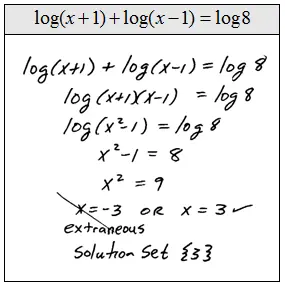
Common Sources of Extraneous Solutions
• Logarithmic expressions require positive arguments
• Contextual constraints may restrict allowable input or output values
• Algebraic manipulations may change the solution set
Therefore, every potential solution must be substituted back into the original equation or verified against the graph and context.
Example
Solve the equation
\( \mathrm{ \displaystyle \log_2(x-3)=2 } \)
▶️ Answer/Explanation
Rewrite in exponential form:
\( \mathrm{ \displaystyle x-3=2^2 } \)
Solve for \( \mathrm{x} \):
\( \mathrm{ \displaystyle x=7 } \)
Check the solution
The logarithmic argument must be positive:
\( \mathrm{ \displaystyle 7-3=4>0 } \)
Conclusion
The solution \( \mathrm{x=7} \) is valid and not extraneous.
Example
Solve the equation and identify any extraneous solutions:
\( \mathrm{ \displaystyle \ln(x-1)=\ln(3-x) } \)
▶️ Answer/Explanation
Since the logarithms are equal, their arguments must be equal:
\( \mathrm{ \displaystyle x-1=3-x } \)
Solve for \( \mathrm{x} \):
\( \mathrm{ \displaystyle 2x=4 \Rightarrow x=2 } \)
Check domain restrictions
Both logarithmic arguments must be positive:
\( \mathrm{ \displaystyle x-1>0 \Rightarrow x>1 } \)
\( \mathrm{ \displaystyle 3-x>0 \Rightarrow x<3 } \)
The solution \( \mathrm{x=2} \) satisfies both conditions.
Conclusion
The equation has one valid solution and no extraneous solutions.
Rewriting Exponential Expressions Using Logarithms
Logarithms can be used to rewrite exponential expressions in equivalent forms that may reveal useful information about growth rates, comparisons, or transformations.
In particular, any exponential function with base \( \mathrm{b} \) can be rewritten using the natural base \( \mathrm{e} \).
The key identity is

\( \mathrm{ \displaystyle b^x = e^{(\log_e b)x} } \)
This identity follows from the inverse relationship between exponential and logarithmic functions.
Interpretation
• \( \mathrm{\log_e b} \) represents the constant growth rate when using base \( \mathrm{e} \)
• The expression shows that all exponential functions can be written as natural exponential functions
This form is especially useful in calculus, modeling, and when comparing exponential growth rates.
Example
Rewrite the exponential expression using base \( \mathrm{e} \):
\( \mathrm{ \displaystyle 2^x } \)
▶️ Answer/Explanation
Use the identity \( \mathrm{b^x=e^{(\log_e b)x}} \):
\( \mathrm{ \displaystyle 2^x=e^{(\log_e 2)x} } \)
Conclusion
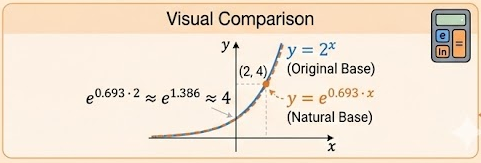
The exponential function with base 2 can be expressed as a natural exponential function with growth rate \( \mathrm{\log_e 2} \).
Example
Rewrite the function and identify the growth constant:
\( \mathrm{ \displaystyle f(x)=5\cdot3^x } \)
▶️ Answer/Explanation
Rewrite \( \mathrm{3^x} \) using base \( \mathrm{e} \):
\( \mathrm{ \displaystyle 3^x=e^{(\log_e 3)x} } \)
Substitute into the function:
\( \mathrm{ \displaystyle f(x)=5e^{(\log_e 3)x} } \)
Conclusion
The growth constant is \( \mathrm{\log_e 3} \), and the function is expressed in natural exponential form.
Inverse of a Transformed Exponential Function
The function
\( \mathrm{ \displaystyle f(x)=ab^{(x-h)}+k } \)
is formed by applying a combination of additive transformations to an exponential function in general form.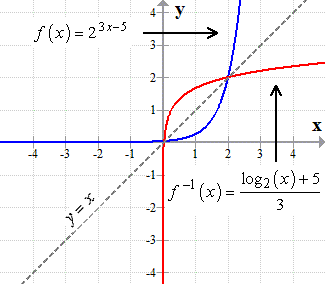
Each parameter has a specific effect:
• \( \mathrm{a} \): vertical dilation and possible reflection
• \( \mathrm{h} \): horizontal translation
• \( \mathrm{k} \): vertical translation
To find the inverse of \( \mathrm{y=f(x)} \), the sequence of operations applied to \( \mathrm{x} \) must be reversed in reverse order.
General Method
• Start with \( \mathrm{y=ab^{(x-h)}+k} \)
• Subtract \( \mathrm{k} \)
• Divide by \( \mathrm{a} \)
• Apply a logarithm to undo the exponential
• Solve for \( \mathrm{x} \)
The inverse function will therefore be a logarithmic function.
Example
Find the inverse of the function
\( \mathrm{ \displaystyle y=2\cdot3^{(x-1)}+5 } \)
▶️ Answer/Explanation
Subtract 5 from both sides:
\( \mathrm{ \displaystyle y-5=2\cdot3^{(x-1)} } \)
Divide by 2:
\( \mathrm{ \displaystyle \dfrac{y-5}{2}=3^{(x-1)} } \)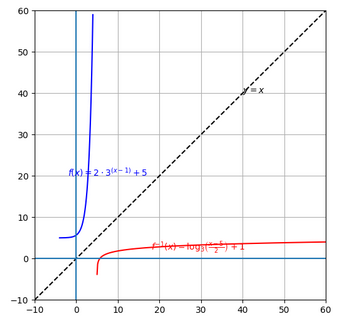
Apply the logarithm base 3:
\( \mathrm{ \displaystyle \log_3\!\left(\dfrac{y-5}{2}\right)=x-1 } \)
Solve for \( \mathrm{x} \):
\( \mathrm{ \displaystyle x=\log_3\!\left(\dfrac{y-5}{2}\right)+1 } \)
Conclusion
The inverse function is
\( \mathrm{ \displaystyle f^{-1}(x)=\log_3\!\left(\dfrac{x-5}{2}\right)+1 } \)
Example
Explain why the inverse of a transformed exponential function is logarithmic.
▶️ Answer/Explanation
Exponential functions involve repeated multiplication.
To reverse this process, logarithms are used because they undo exponentiation.
Conclusion
Therefore, reversing the mapping of a transformed exponential function always results in a logarithmic inverse.
Inverse of a Transformed Logarithmic Function
The function
\( \mathrm{ \displaystyle f(x)=a\log_b(x-h)+k } \)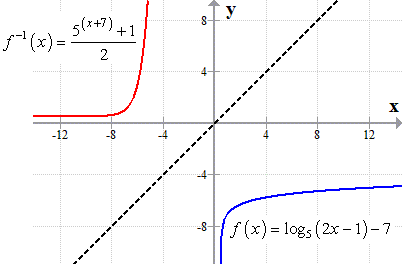
is formed by applying a combination of additive transformations to a logarithmic function in general form.
Each parameter has a specific effect:
• \( \mathrm{a} \): vertical dilation and possible reflection
• \( \mathrm{h} \): horizontal translation
• \( \mathrm{k} \): vertical translation
To find the inverse of \( \mathrm{y=f(x)} \), the sequence of operations must be reversed in reverse order. Because logarithms undo exponentiation, the inverse of a logarithmic function is an exponential function.
General Method
• Start with \( \mathrm{y=a\log_b(x-h)+k} \)
• Subtract \( \mathrm{k} \)
• Divide by \( \mathrm{a} \)
• Rewrite in exponential form
• Solve for \( \mathrm{x} \)
Example
Find the inverse of the function
\( \mathrm{ \displaystyle y=2\log_3(x-4)+1 } \)
▶️ Answer/Explanation
Subtract 1 from both sides:
\( \mathrm{ \displaystyle y-1=2\log_3(x-4) } \)
Divide by 2:
\( \mathrm{ \displaystyle \dfrac{y-1}{2}=\log_3(x-4) } \)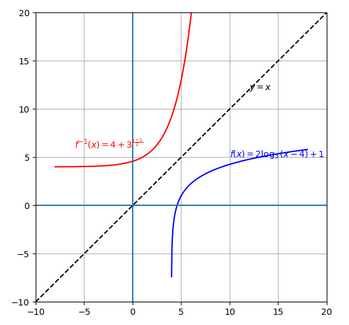
Rewrite in exponential form:
\( \mathrm{ \displaystyle 3^{(y-1)/2}=x-4 } \)
Solve for \( \mathrm{x} \):
\( \mathrm{ \displaystyle x=3^{(y-1)/2}+4 } \)
Conclusion
The inverse function is
\( \mathrm{ \displaystyle f^{-1}(x)=3^{(x-1)/2}+4 } \)
Example
Explain the form of the inverse of
\( \mathrm{ \displaystyle f(x)=-\log_5(x+2)+6 } \)
▶️ Answer/Explanation
Subtract 6 and divide by \(-1\):
\( \mathrm{ \displaystyle 6-y=\log_5(x+2) } \)
Rewrite in exponential form:
\( \mathrm{ \displaystyle 5^{(6-y)}=x+2 } \)
Solve for \( \mathrm{x} \):
\( \mathrm{ \displaystyle x=5^{(6-y)}-2 } \)
Conclusion
The inverse is an exponential function obtained by reversing each transformation applied to the logarithmic function.