
Home / AP® Exam / AP® PreCalculus / AP® Precalculus

AP Precalculus -2.14 Logarithmic Function Modeling- FRQ Exam Style Questions - Effective Fall 2023

AP Precalculus -2.14 Logarithmic Function Modeling- FRQ Exam Style Questions – Effective Fall 2023

AP Precalculus -2.14 Logarithmic Function Modeling- FRQ Exam Style Questions – AP Precalculus- per latest AP Precalculus Syllabus.

AP Precalculus – FRQ Exam Style Questions- All Topics

Question

Students took a math review course to prepare them for college. At the beginning of the course, they were given a pretest to see how much they remembered. At that time \((t = 0)\) the average score was 60 out of 100. The students were then evaluated again at the end of each week. After 4 weeks \((t = 4)\) the average score had increased to 81 out of 100.
The average score can be modeled by \(S(t) = a + b\ln (t + 1)\) , where \(S(t)\) is the average score for month \(t\) , and \(t\) is the number of weeks since the course began.
(A)
(i) Use the given data to write two equations that can be used to find the values for constants \(a\) and \(b\) in the expression \(S(t)\).
(ii) Find the values for \(a\) and \(b\).
(B)
(i) Use the given data to find the average rate of change of the scores in points per week, from \(t = 0\) to \(t = 4\) weeks. Express your answer as a decimal approximation. Show the computations that lead to your answer.
(ii) Interpret the meaning of your answer from (i) in the context of the problem.
(iii) Consider the average rates of change of \(S\) from \(t = 4\) to \(t = p\) weeks, where \(p > 4\). Are these average rates of change less than or greater than the average rate of change from \(t = 0\) to \(t = 4\) months found in (i)? Explain your reasoning.
(C) Explain how the domain values should be limited by the context of the problem.

Most-appropriate topic codes (AP Precalculus CED):

2.14: Logarithmic Function Context and Data Modeling – part A
1.2: Rates of Change – part B
2.11: Logarithmic Functions – part B(iii)
1.13: Function Model Selection and Assumption Articulation – part C
▶️ Answer/Explanation

A (i)
Given \(S(0) = 60\) and \(S(4) = 81\). The equations are: \[ a + b\ln(0+1) = 60 \] \[ a + b\ln(4+1) = 81 \]
Answer: \(a + b\ln(1) = 60\) and \(a + b\ln(5) = 81\).

A (ii)
Since \(\ln(1) = 0\): From the first equation, \(a = 60\). Substituting into the second: \(60 + b\ln(5) = 81 \implies b\ln(5) = 21\). \[ b = \frac{21}{\ln 5} \approx \frac{21}{1.6094} \approx 13.048 \]
Answer: \(a = 60\), \(b \approx 13.048\).

B (i)
The average rate of change from \(t=0\) to \(t=4\): \[ \frac{S(4) – S(0)}{4 – 0} = \frac{81 – 60}{4} = \frac{21}{4} = 5.25 \]
Answer: \(5.25\) points per week.

B (ii)
The value 5.25 represents the average increase in the group’s score per week over the first 4 weeks.
Answer: On average, the students’ scores increased by 5.25 points per week over the first 4 weeks.

B (iii)
The function \(S(t) = a + b\ln(t+1)\) with \(b > 0\) is a logarithmic function. Logarithmic functions are concave down. The average rate of change of a concave down function decreases as the input interval shifts to larger values.
Answer: The average rates of change for \(t = 4\) to \(t = p\) (where \(p > 4\)) will be less than the AROC from \(t=0\) to \(t=4\), because the logarithmic model is concave down, resulting in decreasing rates of change.

C
Time in weeks cannot be negative. Additionally, the context implies a maximum score of 100 on the test. The model predicts scores exceeding 100 for large \(t\) (e.g., \(t > 20.4\)), which is impossible for the context.
Answer: The domain should be limited to non-negative weeks up to the point where the score reaches 100. (Example: \(0 \le t \le 20\)).

Question

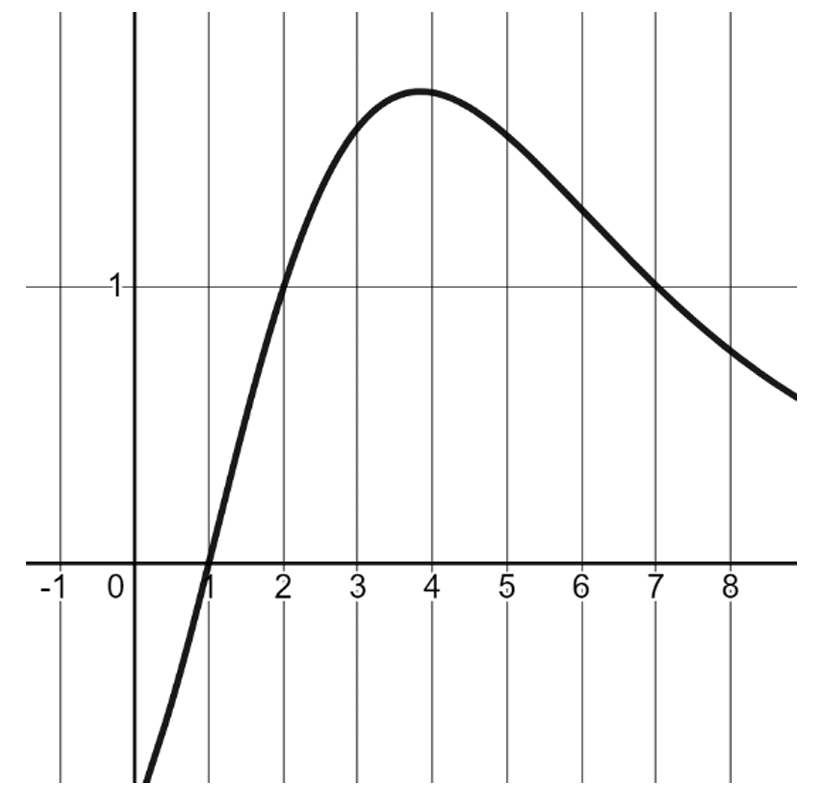
An increasing, continuous function \(g(x)\) has outputs of some values of \(x\) shown in the table. \(f(x)\) is a function shown to the right as the graph.
(A) (i) Estimate the value of \(g(f^{-1}(1))\) for all values if it is defined.
(ii) If \(h(x) = \frac{g(x)}{f(x)}\), then define any discontinuities, their type, and their location when \(x > 0\).
(B) Suppose \(j(x) = \frac{1}{4.998} \ln(x) \cdot e^{2\sin(\sqrt{x})}\) could be used to model \(f(x)\).
(i) Determine the end behavior of \(j\) when \(x\) increases without bound.Express your answer with the mathematical definition of a limit if it exists. If it does not exist, explain why.
(ii) Determine the vertical asymptote of \(j\) when \(x\) approaches 0 from the right.Express your answer with the mathematical definition of a limit if it exists. If it does not, explain why.
(C) Determine if \(g(x)\), using the values in the table, can be best modeled with a linear, quadratic, exponential, or logarithmic function. Explain your answer based on the relationship between the change
in the output values of 𝑔 and the change in the input values of 𝑔.

Most-appropriate topic codes (AP Precalculus CED):

1.9: Rational Functions and Vertical Asymptotes – part A(ii)
2.3: Exponential Functions – part B(i), B(ii)
2.8: Inverse Functions – part A(i)
2.11: Logarithmic Functions – part B(i), B(ii), C
2.14: Logarithmic Function Context and Data Modeling – part C
▶️ Answer/Explanation
Detailed solution

(A) i. \(g(f^{-1}(1))\)

  • From the graph of \(f(x)\), \(f^{-1}(1)\) means find \(x\) such that \(f(x) = 1\).
  • From the graph, \(f(x) = 1\) at approximately \(x \approx 2.5\). So \(f^{-1}(1) \approx 2.5\).
  • From the table, \(g(2) = 1\), \(g(4) = 2\). Since \(g\) is increasing and continuous, by linear interpolation for \(x \approx 2.5\): \(g(2.5) \approx 1 + \frac{2.5-2}{4-2} \cdot (2-1) = 1 + 0.25 = 1.25\).
  • Thus, \(g(f^{-1}(1)) \approx 1.25\).

(A) ii. \(h(x) = \frac{g(x)}{f(x)}\), \(x > 0\)

  • Discontinuities occur where \(f(x) = 0\) or where \(f\) is undefined (but \(f\) appears continuous from the graph for \(x>0\)).
  • From the graph, \(f(x) = 0\) at \(x \approx 1.5\) (where graph crosses x-axis). That is the only zero of \(f\) for \(x>0\).
  • At \(x \approx 1.5\), \(g(x) \neq 0\) (since \(g\) is about 0.5 between \(g(1)=0\) and \(g(2)=1\)).
  • Thus, \(h(x)\) has a vertical asymptote at \(x \approx 1.5\) because denominator → 0, numerator nonzero → \(h(x) \to \pm\infty\).
  • Type: infinite discontinuity (vertical asymptote).

(B) i. End behavior of \(j(x) = \frac{1}{4.998} \ln(x) \cdot e^{2\sin(\sqrt{x})}\) as \(x \to \infty\)

  • As \(x \to \infty\), \(\ln(x) \to \infty\).
  • The factor \(e^{2\sin(\sqrt{x})}\) oscillates between \(e^{-2}\) and \(e^{2}\) because \(\sin(\sqrt{x})\) oscillates in \([-1,1]\).
  • Thus \(j(x)\) oscillates with amplitude growing like \(\ln(x)\). The limit does not exist because oscillations persist and amplitude grows without bound.
  • Limit expression: \(\lim_{x \to \infty} j(x)\) does not exist.

(B) ii. Vertical asymptote as \(x \to 0^+\)

  • As \(x \to 0^+\), \(\ln(x) \to -\infty\).
  • The factor \(e^{2\sin(\sqrt{x})} \to e^{0} = 1\) (since \(\sqrt{x} \to 0\), \(\sin(\sqrt{x}) \to 0\)).
  • Thus \(j(x) \to -\infty\).
  • Limit expression: \(\lim_{x \to 0^+} j(x) = -\infty\). So vertical asymptote at \(x=0\).

(C) Best model for \(g(x)\) from the table:

  • Check changes in \(g(x)\) as \(x\) doubles:
  • From \(x=0.5\) to \(x=1\), \(\Delta g = 1\).
  • From \(x=1\) to \(x=2\), \(\Delta g = 1\).
  • From \(x=2\) to \(x=4\), \(\Delta g = 1\).
  • From \(x=4\) to \(x=8\), \(\Delta g = 1\).
  • Each time \(x\) doubles, \(g(x)\) increases by about 1. This suggests a logarithmic relationship: \(g(x) \approx a + b \ln(x)\).
  • Thus, \(g(x)\) is best modeled by a logarithmic function.

Question 

After Mr. Passwater missed a day of school, a rumor began to spread that he had won the Powerball lottery and moved to Japan. Initially, seven students knew about the rumor (they were the ones that started it!). After two hours (\(t=2\)), a total of 15 students had heard the rumor. After six hours (\(t=6\)), 67 students had heard the rumor.
The number of students that have heard the rumor can be modeled by the piecewise function \(R\) given by: $$R(t) = \begin{cases} 7(a)^{t/2} & \text{for } 0 \le t < 6 \\ -213.29 + b \ln t & \text{for } t \ge 6 \end{cases}$$ where \(R(t)\) is the number of students that have heard the rumor at time \(t\) hours since the rumor first began.

(A) (i) Use the given data to write two equations that can be used to find the values for constants \(a\) and \(b\) in the expression for \(R(t)\).
        (ii) Find the values for \(a\) and \(b\) as decimal approximations.

(B) (i) Use the given data to find the average rate of change in the number of students that have heard the rumor, in students per hour, from \(t=2\) to \(t=6\) hours. Express your answer as a decimal approximation. Show the computations that lead to your answer.
        (ii) Interpret the meaning of your answer from (i) in the context of the problem.
        (iii) Consider the values that result from using the average rate of change found in (i) to estimate the number of students that have heard the rumor for times \(t=p\) hours, where \(0 < p < 6\). Are these estimates less than or greater than the number of students predicted by the model \(R\) for times \(t=p\) hours? Explain your reasoning using characteristics of the average rate of change and characteristics of the model \(R\).

(C) The model \(R\) is valid for \(0 \le t \le 12\) hours. Explain how the range values of the function \(R\) should be limited by the context of the problem.
▶️ Answer/Explanation
Detailed solution

Part (A)

(i) Writing the equations:
We are given the following data points:
• At \(t=2\), \(R(2) = 15\).
• At \(t=6\), \(R(6) = 67\).

For \(t=2\), since \(0 \le 2 < 6\), we use the first part of the piecewise function: \(R(t) = 7(a)^{t/2}\).
$$15 = 7(a)^{2/2} \quad \Rightarrow \quad 15 = 7a^1$$
Equation 1: \(15 = 7a\)

For \(t=6\), since \(t \ge 6\), we use the second part of the piecewise function: \(R(t) = -213.29 + b \ln t\).
Equation 2: \(67 = -213.29 + b \ln(6)\)

(ii) Finding the values for \(a\) and \(b\):
From Equation 1:
$$a = \frac{15}{7} \approx 2.1428$$
From Equation 2:
$$67 + 213.29 = b \ln(6)$$
$$280.29 = b \ln(6)$$
$$b = \frac{280.29}{\ln(6)} \approx \frac{280.29}{1.79176} \approx 156.4328$$
Answer: \(a \approx 2.143\), \(b \approx 156.433\)

Part (B)

(i) Average Rate of Change:
The formula for the average rate of change from \(t=2\) to \(t=6\) is:
$$\text{Avg Rate} = \frac{R(6) – R(2)}{6 – 2}$$
Substituting the given values (\(R(6)=67\) and \(R(2)=15\)):
$$\text{Avg Rate} = \frac{67 – 15}{4} = \frac{52}{4} = 13$$
Answer: 13 students per hour.

(ii) Interpretation:
On average, the number of students who have heard the rumor increases by 13 students per hour between the 2nd hour and the 6th hour.

(iii) Estimates vs. Model Prediction:
Answer: The estimates are greater than the number of students predicted by the model.
Reasoning:
• On the interval \(0 < t < 6\), the function \(R(t) = 7(a)^{t/2}\) is an exponential growth function with a base greater than 1.
• Exponential growth functions are concave up (the rate of change is increasing).
• The average rate of change corresponds to the slope of the secant line connecting the points at \(t=2\) and \(t=6\).
• For a concave up curve, the secant line lies above the curve on the interval between the two points. Therefore, linear estimates based on the average rate (secant line) will be greater than the actual function values.

Part (C)

Explanation:
The range values (outputs) of \(R(t)\) represent the number of students. In the context of the problem, this range must be limited in two ways:
1. Population Cap: The number of students who heard the rumor cannot exceed the total student population of the school.
2. Discrete Values: You cannot have a fraction of a student, so strictly speaking, the context implies the range should consist of whole numbers (non-negative integers).

Question 

The Chinese bamboo tree exhibits a unique growth pattern. Once a seed has been planted, the Chinese bamboo tree does not break through the ground for several years. However, once it breaks through the ground, the Chinese bamboo tree grows exponentially. In one particular experiment, a group of biologists recorded the height of a Chinese bamboo tree once it broke through the ground. After one week (\(t = 1\)), the Chinese bamboo tree measured 3 feet, and after five weeks (\(t = 5\)), the same tree measured 89 feet.
The height of the Chinese bamboo tree can be modeled by the function \(H\) given by \(H(t) = ab^x\), where \(H(t)\) is the height of the tree, in feet, \(t\) weeks after it first breaks ground.
(A) (i) Use the given data to write two equations that can be used to find the values for constants \(a\) and \(b\) in the expression for \(H(t)\).
(ii) Find the values for \(a\) and \(b\).
(B) (i) Use the given data to find the average rate of change of the height of the Chinese bamboo tree, in feet per week, from \(t = 1\) to \(t = 5\) weeks. Express your answer as a decimal approximation. Show the computations that lead to your answer.
(ii) Interpret the meaning of your answer from (i) in the context of the problem.
(iii) Consider the average rates of change of \(H\) from \(t = 5\) to \(t = p\) weeks, where \(p > 5\). Are these average rates of change less than or greater than the average rate of change from \(t = 1\) to \(t = 5\) weeks found in (i)? Explain your reasoning.
(C) For which \(t\)-value, \(t = 4\) weeks or \(t = 11\) weeks, should the biologists have more confidence in when using the model \(H\)? Give a reason for your answer in the context of the problem.
▶️ Answer/Explanation
Detailed solution

(A)(i) Equations
Substituting the points \((1, 3)\) and \((5, 89)\) into \(H(t) = ab^t\):
1. \(3 = ab^1\) (or \(3 = ab\))
2. \(89 = ab^5\)

(A)(ii) Values for a and b
Dividing equation 2 by equation 1: \(\frac{ab^5}{ab} = \frac{89}{3} \implies b^4 = 29.67\).
Solving for \(b\): \(b = (29.67)^{0.25} \approx 2.33\).
Solving for \(a\): \(a = \frac{3}{2.33} \approx 1.29\).

(B)(i) Average Rate of Change
\(\text{Rate} = \frac{H(5) – H(1)}{5 – 1} = \frac{89 – 3}{4} = \frac{86}{4} = 21.5\)
Answer: 21.5 feet per week.

(B)(ii) Interpretation
The answer indicates that between the first and fifth weeks, the bamboo tree grew at an average speed of 21.5 feet per week.

(B)(iii) Comparison
Greater. The function represents exponential growth (\(b > 1\)), which is concave up. This means the rate of growth increases over time, so the rate after week 5 will be steeper than the rate before week 5.

(C) Confidence
\(t = 4\) weeks.
The biologists should be more confident in \(t=4\) because it is an interpolation (within the observed data range). \(t=11\) is an extrapolation; biological growth cannot remain exponential indefinitely, so the model is likely inaccurate that far out.

Scroll to Top