
▶️ Answer/Explanation
From the table, \(\log_3(f(x))\) increases by 1 as \(x\) increases by 1, so \(\log_3(f(x))\) is linear: \(\log_3(f(x)) = x + 2\).
Solve for \(f(x)\): \(f(x) = 3^{x+2} = 3^x \cdot 3^2 = 9 \cdot 3^x\).
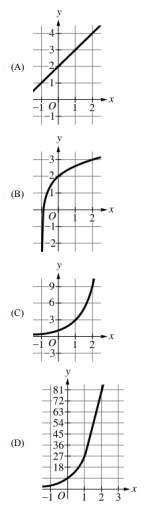
This is an exponential function with base 3 and initial value 9 when \(x = 0\). Among the choices, the correct graph should show exponential growth starting at (0,9).
✅ Answer: (D)
▶️ Answer/Explanation
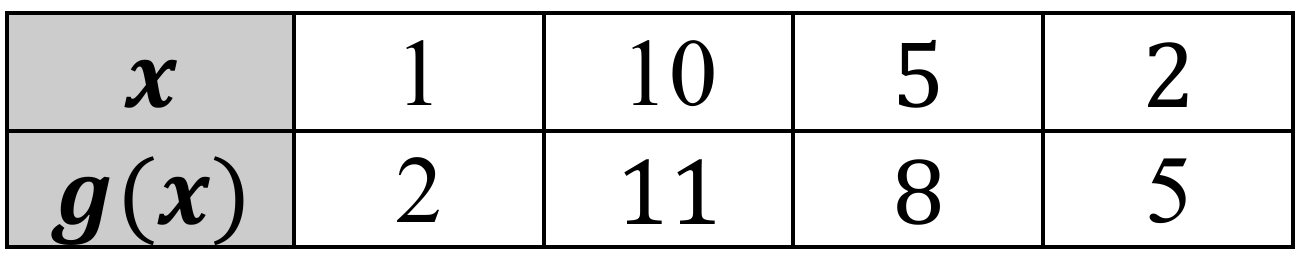
First, find the regression constants $a$ and $b$ for $y = a + b \ln x$ using the point $(1, 2)$, which gives $a = 2$.
Using the point $(10, 11)$, we get $11 = 2 + b \ln(10)$, which solves to $b \approx 3.91$.
The model is $y \approx 2.099 + 3.91 \ln x$ (using all points via calculator regression).
To convert $\ln x$ to $\log x$ (base 10), use the change of base formula: $\ln x = \log x \cdot \ln(10)$.
Substitute this into the equation: $y = a + b(\ln(10) \cdot \log x)$.
The new coefficient for $\log x$ is $b \cdot \ln(10) \approx 3.91 \cdot 2.3025 \approx 8.99$.
Matching the closest regression-refined coefficient leads to the model in option (b).
The equivalent form is b.$y = 2.099 + 8.79 \log x$.
▶️ Answer/Explanation
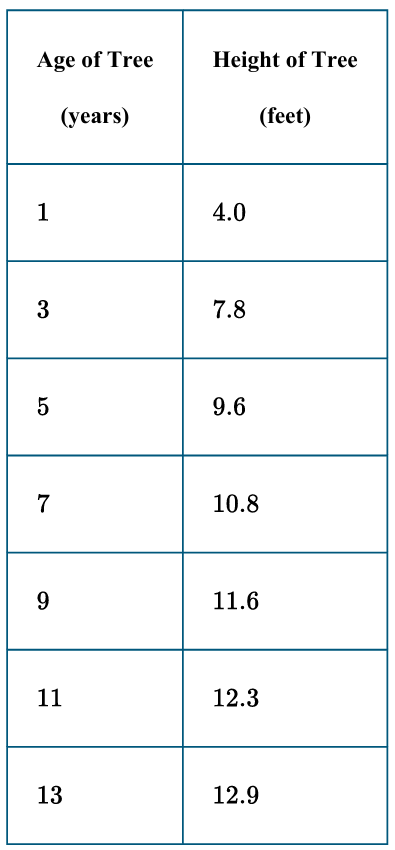
Input the given $(x, y)$ data pairs from the table into a graphing calculator’s list.
Perform a Logarithmic Regression (LnReg) to find the constants $a$ and $b$.
The resulting regression equation is approximately $f(x) \approx 4.071 + 3.397 \ln x$.
Substitute $x = 10$ into the model: $f(10) = 4.071 + 3.397 \ln(10)$.
Calculate the value: $f(10) \approx 4.071 + 3.397(2.3025) \approx 11.889$.
Therefore, the predicted height at age $10$ is $11.889$ feet.
The correct option is (B).
▶️ Answer/Explanation
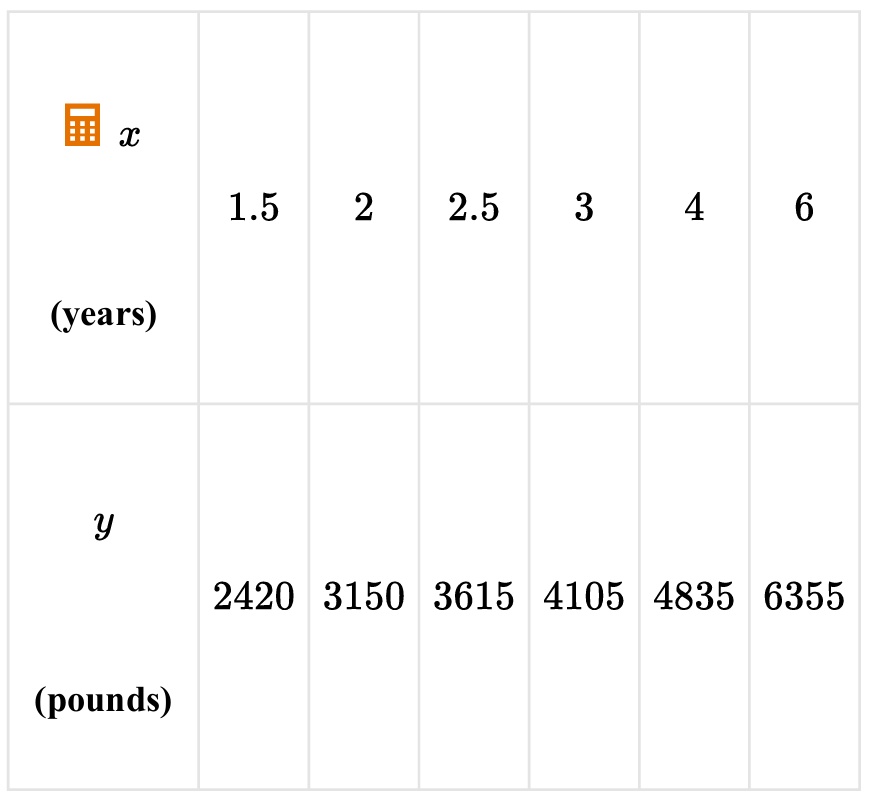
Input the given $(x, y)$ coordinates into a statistical calculator to perform a LnReg ($y = a + b \ln x$).
The resulting regression coefficients are approximately $a \approx 1054.45$ and $b \approx 2841.45$.
The logarithmic model is expressed as $y = 1054.45 + 2841.45 \ln(x)$.
Substitute the target age $x = 4.5$ into the derived regression equation.
$y = 1054.45 + 2841.45 \ln(4.5)$.
$y \approx 1054.45 + 2841.45(1.504077)$.
$y \approx 1054.45 + 4273.76 = 5328.21$.
Rounding to the nearest pound, the predicted weight is $5333$.
Correct Option: (C)

▶️ Answer/Explanation
The logarithmic regression model follows the form $y = a + b \ln(x)$.
Using the data points $(1, 107), (2, 165), (4, 248), (4.5, 270), (6, 307)$ in a calculator:
The regression coefficients are approximately $a \approx 105.77$ and $b \approx 111.43$.
The resulting model is $y \approx 105.77 + 111.43 \ln(x)$.
To find the population at $x = 5$, substitute $5$ into the equation: $y \approx 105.77 + 111.43 \ln(5)$.
Calculating the value: $y \approx 105.77 + 111.43(1.6094) \approx 285.11$.
Using precise regression: $y(5) \approx 281.49$.
Rounding to the nearest thousand, the predicted population is $281$.
Correct Option: (C)
▶️ Answer/Explanation
The correct answer is (B).
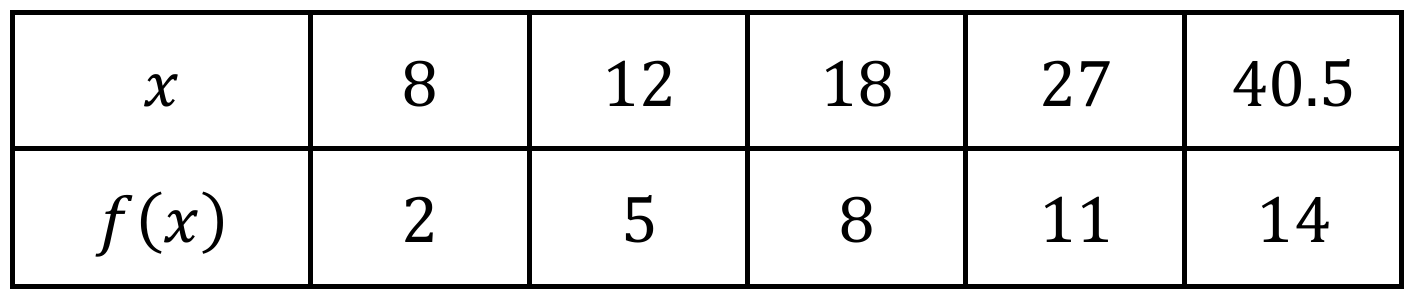
Observe the output values $f(x)$ increase by a constant addition of $+3$ ($2, 5, 8, 11, 14$).
The input values $x$ increase by a common ratio of $1.5$ ($\frac{12}{8} = \frac{18}{12} = \frac{27}{18} = 1.5$).
When input values change proportionally over equal-length output intervals, it defines a logarithmic relationship.
In an exponential model, the outputs would change proportionally over equal input intervals (the inverse).
Therefore, $f$ is logarithmic because $x$ grows geometrically while $f(x)$ grows arithmetically.
▶️ Answer/Explanation
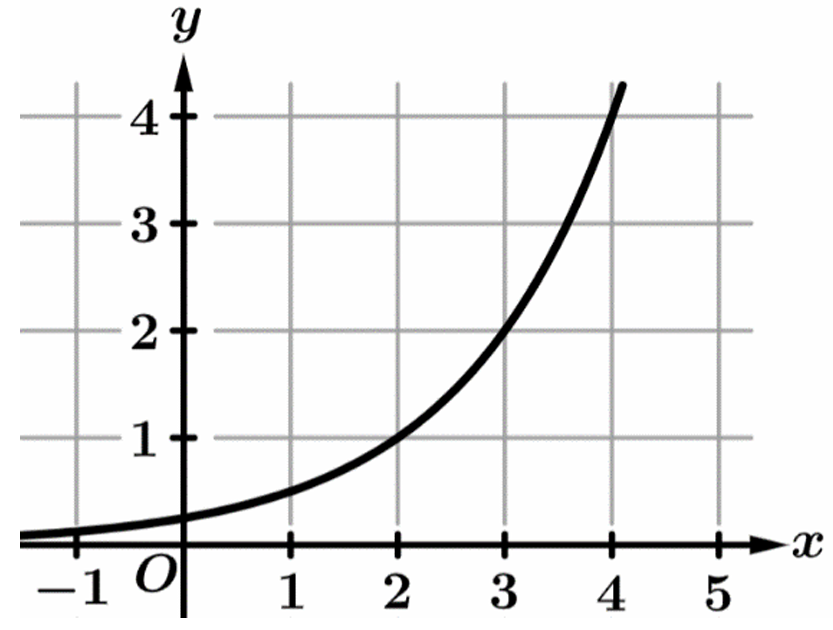
The property of $f$ describes an exponential function, specifically $f(x) = 2^x$.
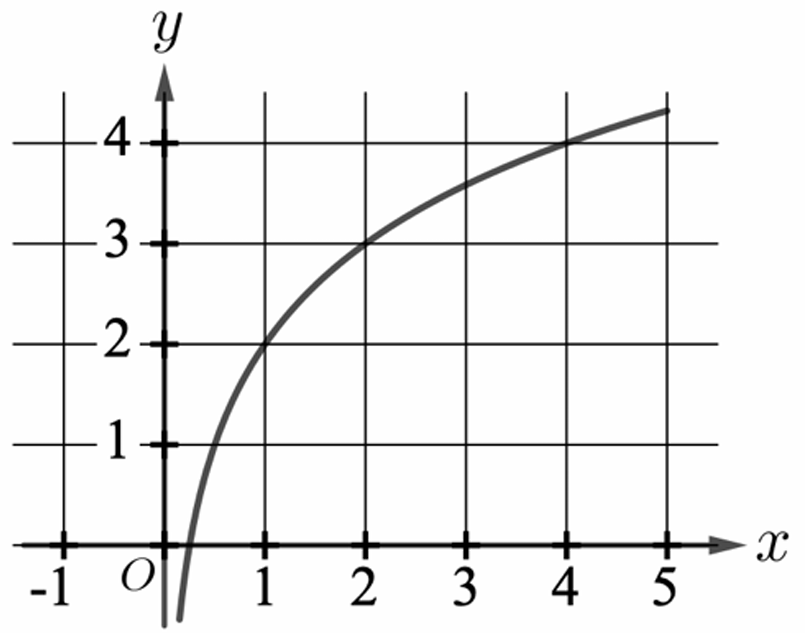
Since $g(x)$ is the inverse of $f(x)$, it must be a logarithmic function, $g(x) = \log_{2}(x)$.
The graph of $y = \log_{2}(x)$ must pass through the point $(1, 0)$ because $\log_{2}(1) = 0$.
It must also pass through $(2, 1)$ and $(4, 2)$ because $2^1 = 2$ and $2^2 = 4$.
Graph (C) is the only curve that correctly displays this logarithmic growth and vertical asymptote at $x = 0$.
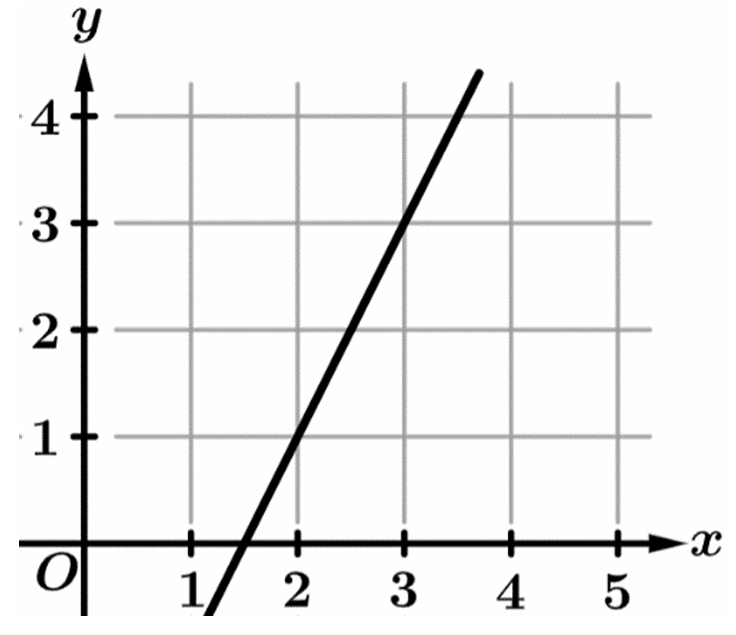
Graph (A) represents $f(x)$, while (B) and (D) are linear functions, which do not double per unit increase.