
Question

Most-appropriate topic codes (AP Precalculus CED):
• 1.14: Function Model Construction and Application — parts (A), (B)(iii), (C)
• 2.2: Change in Linear and Exponential Functions — parts (B)(i), (B)(ii)
• 2.6: Competing Function Model Validation — part (B)(iii)
▶️ Answer/Explanation
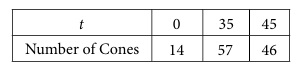
(A)
(i) Substituting the given data into the model \(I(t) = at^2 + bt + c\):
- When \(t = 0\), \(I(0) = 14\): \(a(0)^2 + b(0) + c = 14 \Rightarrow c = 14\).
- When \(t = 35\), \(I(35) = 57\): \(a(35)^2 + b(35) + c = 57 \Rightarrow 1225a + 35b + c = 57\).
- When \(t = 45\), \(I(45) = 46\): \(a(45)^2 + b(45) + c = 46 \Rightarrow 2025a + 45b + c = 46\).
The three equations are:
\(c = 14\)
\(1225a + 35b + 14 = 57\)
\(2025a + 45b + 14 = 46\)
✅ Answer: The three equations are \(c = 14\), \(1225a + 35b = 43\), and \(2025a + 45b = 32\).
(ii) Solve the system:
- \(1225a + 35b = 43\)
- \(2025a + 45b = 32\)
Multiply equation (1) by 9 and equation (2) by 7 to eliminate \(b\): \[ 11025a + 315b = 387 \] \[ 14175a + 315b = 224 \] Subtract the first from the second: \[ 3150a = -163 \Rightarrow a = -\frac{163}{3150} \approx -0.051746\ldots \] Substitute \(a\) into \(1225a + 35b = 43\): \[ 1225(-0.051746) + 35b = 43 \Rightarrow -63.38885 + 35b = 43 \Rightarrow 35b = 106.38885 \Rightarrow b \approx 3.039681 \] Thus, \[ a \approx -0.052, \quad b \approx 3.040, \quad c = 14 \] ✅ Answer: \(\boxed{a \approx -0.052,\ b \approx 3.040,\ c = 14}\) (or \(a \approx -0.0517,\ b \approx 3.0397,\ c = 14\)).
(B)
(i) Average rate of change from \(t = 35\) to \(t = 45\): \[ \frac{I(45) – I(35)}{45 – 35} = \frac{46 – 57}{10} = \frac{-11}{10} = -1.1 \] ✅ Answer: \(\boxed{-1.1}\) cones per day.
(ii) Using the average rate of change: \[ I(40) \approx I(35) + (-1.1)(40 – 35) = 57 + (-1.1)(5) = 57 – 5.5 = 51.5 \] ✅ Answer: \(\boxed{51.5}\) cones (approximately 51 or 52 cones).
(iii) Using the model: \[ I(40) \approx -0.052(40)^2 + 3.040(40) + 14 = -0.052(1600) + 121.6 + 14 = -83.2 + 135.6 = 52.4 \] More precisely with stored values: \(I(40) \approx 52.794\).
The estimate from the average rate of change (51.5) is less than \(I(40) \approx 52.8\).
Explanation: The average rate of change gives the slope of the secant line between \(t = 35\) and \(t = 45\). Since the quadratic model has \(a < 0\), its graph is concave down. On the interval \((35, 45)\), the secant line lies below the graph. Therefore, the linear estimate using the average rate of change underestimates the actual value given by the concave-down quadratic at \(t = 40\).
✅ Answer: The secant-line estimate is lower because the quadratic is concave down.
(C) The range of \(I\) is limited by the context:
- The number of cones sold cannot be negative: \(I(t) \ge 0\).
- Since \(a < 0\), the quadratic has a maximum. From the model, the vertex gives the maximum number of cones sold. The vertex \(t = -\frac{b}{2a} \approx 29.23\) yields \(I_{\text{max}} \approx 58.64\).
Thus, a reasonable range is \(0 \le I(t) \le 59\) (whole cones).
✅ Answer: The range is limited to non‑negative integers up to about 59 cones.