
AP Precalculus -2.2 Linear and Exponential Change- MCQ Exam Style Questions - Effective Fall 2023
AP Precalculus -2.2 Linear and Exponential Change- MCQ Exam Style Questions – Effective Fall 2023
AP Precalculus -2.2 Linear and Exponential Change- MCQ Exam Style Questions – AP Precalculus- per latest AP Precalculus Syllabus.
Question
(B) \[\begin{array}{c|c} x & y \\ \hline 5 & 30 \\ 6 & 42 \\ 7 & 56 \\ 8 & 72 \\ \end{array}\]
(C) \[\begin{array}{c|c} x & \ln y \\ \hline 1 & 1 \\ 2 & 3 \\ 3 & 9 \\ 4 & 27 \\ \end{array}\]
(D) \[\begin{array}{c|c} x & \ln y \\ \hline 5 & 50 \\ 6 & 60 \\ 7 & 70 \\ 8 & 80 \\ \end{array}\]
▶️ Answer/Explanation
A function is exponential if the natural logarithm of its output values \( \ln y \) is linear in \( x \).
In option (C), \( \ln y \) values are 1, 3, 9, 27 — these are not linear in \( x \).
In option (D), \( \ln y \) values are 50, 60, 70, 80 — these form an arithmetic sequence, so \( \ln y \) is linear in \( x \).
Thus \( y = e^{mx+b} \) is exponential.
✅ Answer: (D)
Question
(B) The output values of \( f \) only, not \( g \), are proportional over equal-length input-value intervals.
(C) The output values of \( g \) only, not \( f \), are proportional over equal-length input-value intervals.
(D) The output values of neither \( f \) nor \( g \) are proportional over equal-length input-value intervals.
▶️ Answer/Explanation
Exponential functions \( g(x) = a \cdot b^x \) have outputs that are proportional over equal-length input intervals (ratio constant).
Adding a constant \( +4 \) to \( g \) gives \( f(x) \), which is no longer a pure exponential; its successive ratios are not constant.
Thus only \( g \) has proportional output changes over equal-length input intervals.
✅ Answer: (C)
Question
▶️ Answer/Explanation
Question
▶️ Answer/Explanation
The problem describes a geometric sequence where the term \(g_n\) represents the number of infected computers on day \(n\).
We are given \(g_6 = 750\) and \(g_{10} = 3200\).
Using the property of geometric sequences, we can relate terms using the common ratio \(r\): \(g_{10} = g_6 \cdot r^{(10-6)}\).
Substitute the known values: \(3200 = 750 \cdot r^4\).
Solving for \(r^4\) gives: \(r^4 = \frac{3200}{750}\).
We need to find \(g_{14}\), which can be expressed as: \(g_{14} = g_{10} \cdot r^{(14-10)} = 3200 \cdot r^4\).
Substituting the value of \(r^4\): \(g_{14} = 3200 \cdot \left(\frac{3200}{750}\right) = 13653.33\dots\)
Rounding to the nearest whole number, the number of infected computers is \(13,653\).
The correct option is (C).
Question
| $x$ | $y$ |
| $1$ | $3$ |
| $2$ | $6$ |
| $3$ | $9$ |
| $4$ | $12$ |
(B)
| $x$ | $y$ |
| $5$ | $30$ |
| $6$ | $42$ |
| $7$ | $56$ |
| $8$ | $72$ |
(C)
| $x$ | $\ln y$ |
| $1$ | $1$ |
| $2$ | $3$ |
| $3$ | $9$ |
| $4$ | $27$ |
(D)
| $x$ | $\ln y$ |
| $5$ | $50$ |
| $6$ | $60$ |
| $7$ | $70$ |
| $8$ | $80$ |
▶️ Answer/Explanation
An exponential function $y = a \cdot b^x$ becomes linear when transformed by logarithms.
Applying the natural log gives the equation $\ln y = \ln a + x \ln b$.
This implies that for an exponential function, $\ln y$ must have a constant rate of change relative to $x$.
In Table (D), as $x$ increases by $1$ unit, $\ln y$ increases by a constant addition of $10$.
Table (A) shows a linear relationship for $y$ itself, not an exponential one.
Table (C) shows $\ln y$ growing exponentially, which would mean $y$ grows even faster.
Only Table (D) shows the constant slope for $\ln y$ that characterizes an exponential function $f(x)$.
Thus, the correct choice is Table (D).
Question
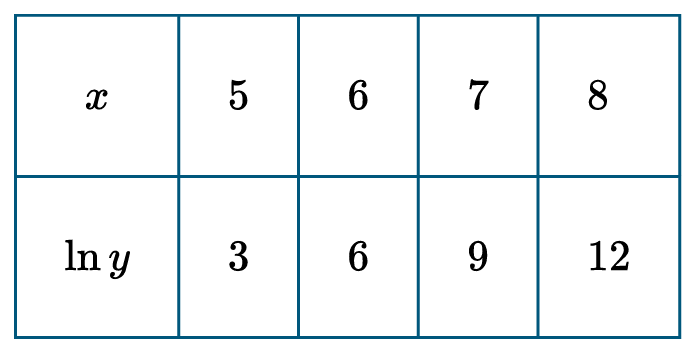
(B) The function $f$ is linear because the values in each column form an arithmetic sequence.
(C) The function $f$ is exponential because the values of $x$ and the values of $\ln y$ both form arithmetic sequences.
(D) The function $f$ is exponential because the values of $\ln y$ increase faster than the values of $x$.
▶️ Answer/Explanation
The $x$ values increase by a constant $1$ ($5, 6, 7, 8$), forming an arithmetic sequence.
The $\ln y$ values increase by a constant $3$ ($3, 6, 9, 12$), forming an arithmetic sequence.
Since $\ln y$ is a linear function of $x$, the relationship is of the form $\ln y = mx + b$.
Applying the exponential to both sides gives $y = e^{mx + b}$, which simplifies to $y = Ab^x$.
This structure confirms that the function $f(x)$ is an exponential function.
Therefore, statement (C) is the correct characterization of the data.
Correct Option: (C)
Question
▶️ Answer/Explanation
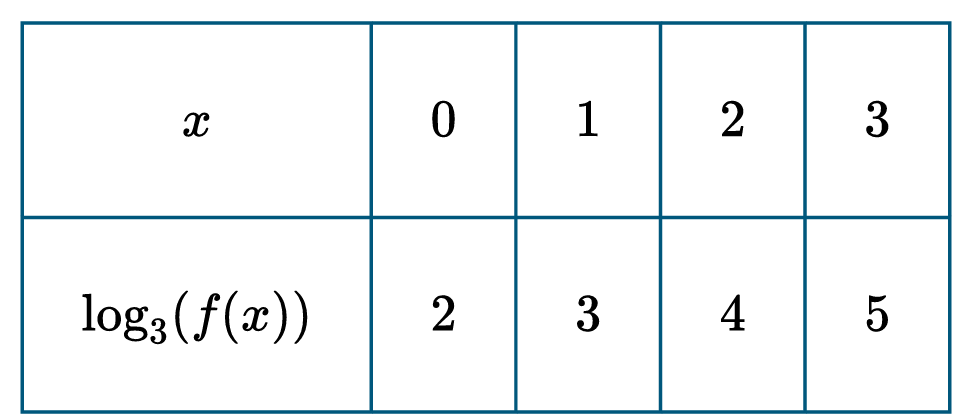
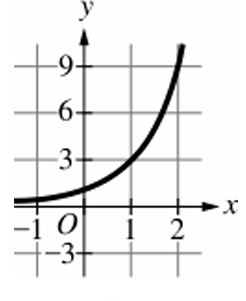
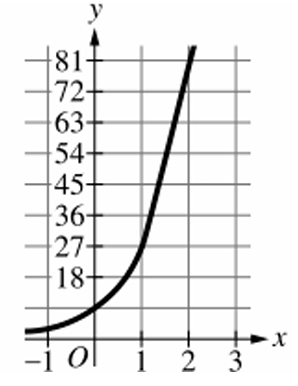
From the table, the linear relationship is $\log_{3}(f(x)) = x + 2$.
Convert this to exponential form: $f(x) = 3^{x+2}$.
Calculate the y-intercept by setting $x = 0$: $f(0) = 3^{0+2} = 9$.
Calculate the value at $x = 1$: $f(1) = 3^{1+2} = 27$.
Calculate the value at $x = 2$: $f(2) = 3^{2+2} = 81$.
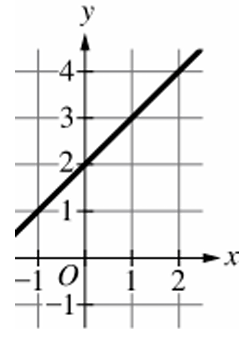
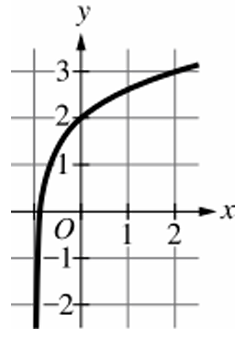
The graph must be exponential and pass through points $(0, 9)$ and $(1, 27)$.
Therefore, the correct choice is (D).