
▶️ Answer/Explanation
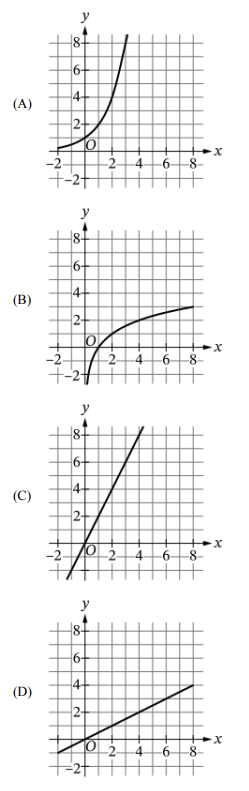
The property “when input doubles, output increases by 1” is characteristic of a logarithmic function with base 2: \( g(x) = \log_2 x \).
This function satisfies \( g(2x) = g(x) + 1 \).
Graphically, it is increasing, passes through (1,0), (2,1), (4,2), etc., with a vertical asymptote at \( x=0 \).
✅ Answer: (B)
▶️ Answer/Explanation
1. Determine Decay Factor:
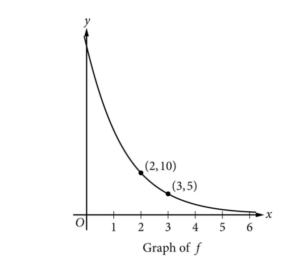
Moving from \(x=2\) to \(x=3\), \(y\) changes from \(10\) to \(5\).
Ratio = \(5/10 = 1/2\).
2. Work Backward to \(x=0\):
At \(x=1\): \(y = 10 \div (1/2) = 20\).
At \(x=0\): \(y = 20 \div (1/2) = 40\).
✅ Answer: (A)
▶️ Answer/Explanation
From the table:
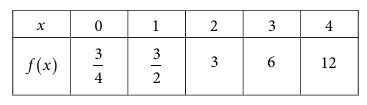
\[ f(0) = ab^0 = a = \frac{3}{4} \]
\[ f(1) = ab^1 = \frac{3}{4} b = \frac{3}{2} \quad\Rightarrow\quad b = 2 \]
Check further: \( f(2) = \frac{3}{4} \cdot 2^2 = 3 \), \( f(3) = \frac{3}{4} \cdot 2^3 = 6 \), \( f(4) = \frac{3}{4} \cdot 2^4 = 12 \), consistent.
So \( a = \frac{3}{4} > 0 \), \( b = 2 > 1 \).
Since \( b > 1 \), the function shows exponential growth.
✅ Answer: (D)
▶️ Answer/Explanation
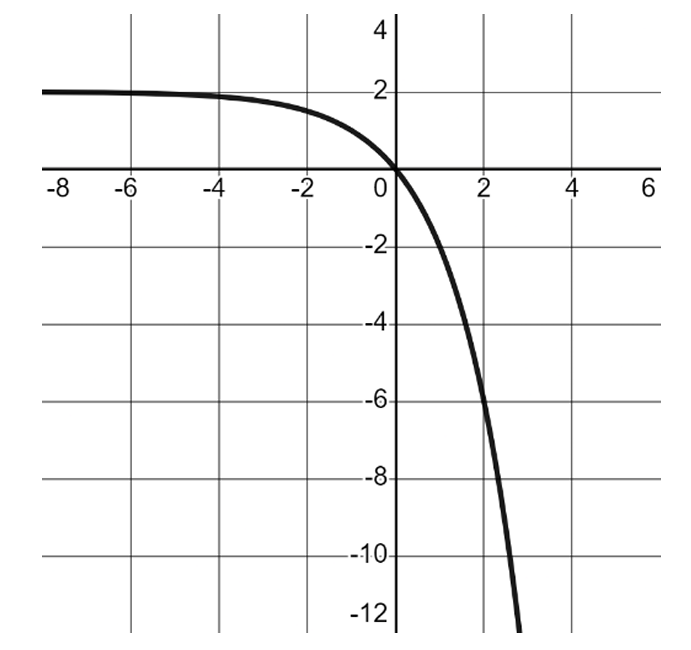
The graph shows a horizontal asymptote at $y = 2$, which does not match any given option exactly.
However, testing the $y$-intercept $(0, 0)$ is the most efficient way to identify the intended equation.
For option (b): $y = -2 \cdot 2^{0+1} + 1 = -2 \cdot 2 + 1 = -3$ (Incorrect).
For option (c): $y = -2 \cdot 2^{0-1} + 1 = -2 \cdot 2^{-1} + 1 = -2 \cdot \frac{1}{2} + 1 = 0$ (Correct).
The point $(0, 0)$ lies exactly on the graph, confirming the function’s behavior.
Option (c) also correctly shows a downward-opening exponential curve consistent with the visual trend.
Therefore, the best representation of the graph is option c.
▶️ Answer/Explanation
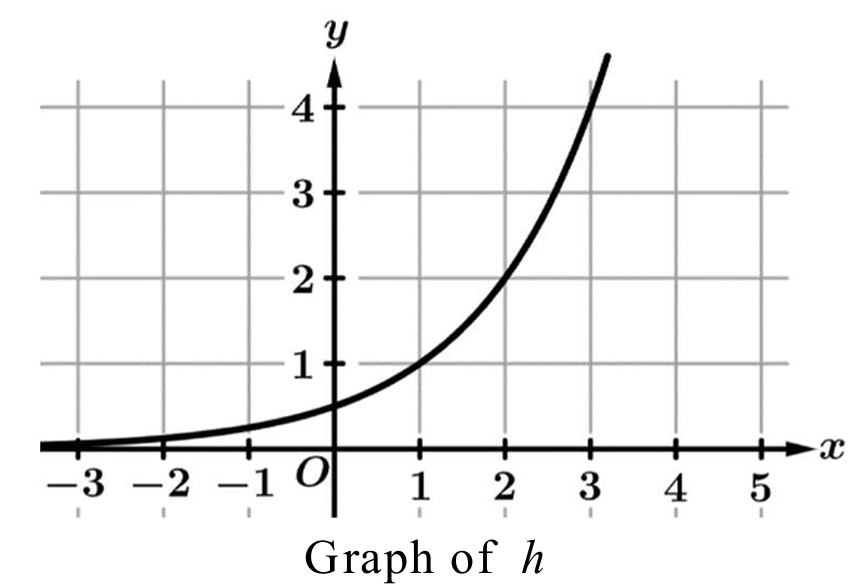
1. Examine the coordinates of points on the graph: specifically, the points \((1, 1)\), \((2, 2)\), and \((3, 4)\) are clearly identifiable.
2. Analyze the input intervals: The step from \(x = 1\) to \(x = 2\) is an increase of \(1\), and from \(x = 2\) to \(x = 3\) is also an increase of \(1\). These are equal-length input-value intervals.
3. Analyze the corresponding output values: As \(x\) increases by \(1\), \(y\) changes from \(1\) to \(2\), and then from \(2\) to \(4\).
4. Calculate the ratio of outputs: \(\frac{2}{1} = 2\) and \(\frac{4}{2} = 2\). The output values are being multiplied by a constant factor of \(2\).
5. This behavior, where output values change by a constant ratio (are proportional) over equal arithmetic steps in the input, defines an exponential function.
6. A logarithmic function would exhibit the inverse relationship (inputs proportional over equal output intervals).
7. Therefore, the correct conclusion is that \( h \) is exponential because the output values are proportional over equal-length input-value intervals.
Correct Option: (C)
▶️ Answer/Explanation
The correct option is (C).
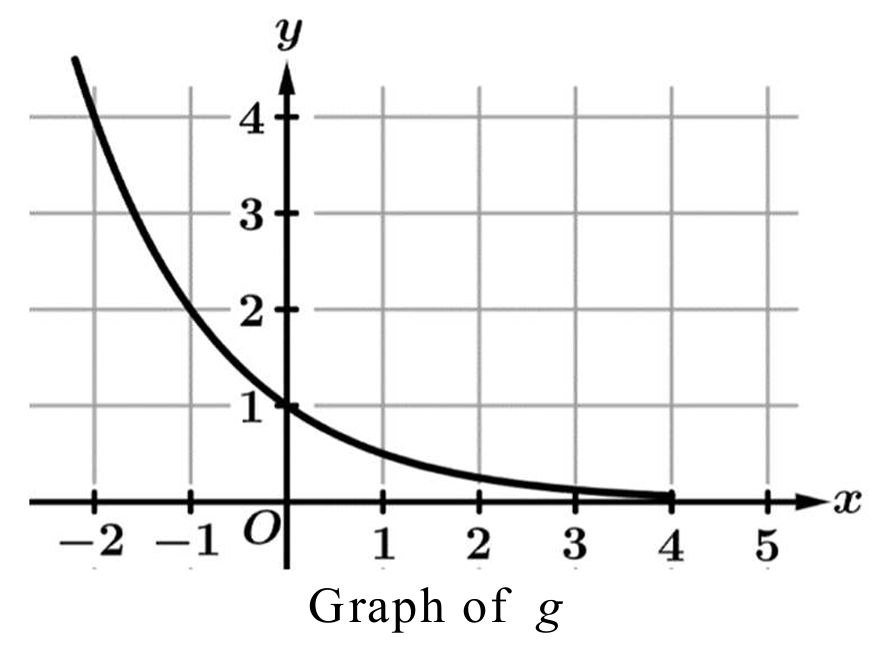
1. Examine the points on the graph: \( (-2, 4) \), \( (-1, 2) \), and \( (0, 1) \).
2. Analyze the change in output values (\( y \)) as the input values (\( x \)) increase by a constant interval of \( 1 \).
3. From \( x = -2 \) to \( x = -1 \), the output changes from \( 4 \) to \( 2 \), which is a factor of \( \frac{1}{2} \).
4. From \( x = -1 \) to \( x = 0 \), the output changes from \( 2 \) to \( 1 \), which is again a factor of \( \frac{1}{2} \).
5. A function where output values are multiplied by a constant factor over equal-length input intervals is an exponential function.
6. Specifically, as noted in the image, the output values are multiplied by \( \frac{1}{2} \) over equal-length input-value intervals.
7. Therefore, \( g \) is exponential because the output values are proportional over equal-length input-value intervals.
▶️ Answer/Explanation
The correct option is (C).
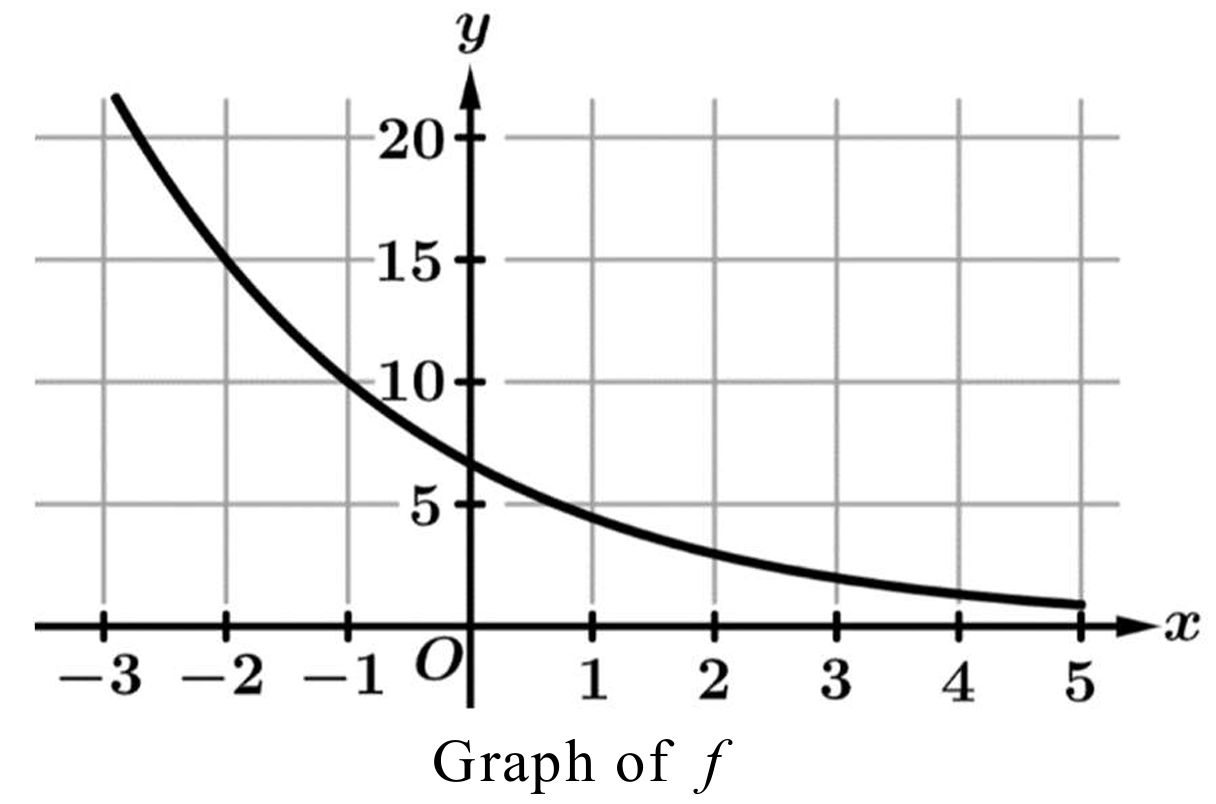
By observing the graph, at $x = -2$, $y \approx 15$, and at $x = -1$, $y = 10$.
The output values are multiplied by a constant ratio of $\frac{10}{15} = \frac{2}{3}$ over equal intervals of $\Delta x = 1$.
This constant proportionality of output values is the defining characteristic of an exponential function.
Option (B) describes a property of quadratic functions, but the graph shows asymptotic behavior toward the $x$-axis.
Option (D) is incorrect because exponential rates of change are themselves exponential, not linear.
Therefore, $f$ is exponential because the outputs are proportional over equal-length input intervals.
▶️ Answer/Explanation
To determine the behavior of the function, we must find the values of \(a\) and \(b\).
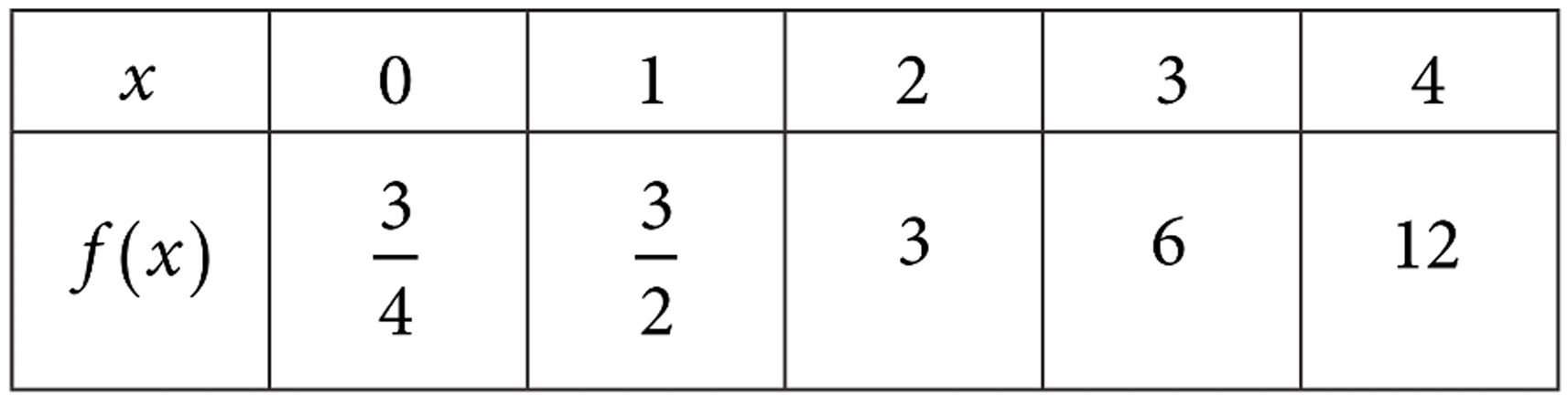
First, substitute \(x = 0\) into \(f(x) = ab^x\). Since \(f(0) = \frac{3}{4}\), we have \(a(b)^0 = a = \frac{3}{4}\). Thus, \(a > 0\).
Next, substitute \(x = 1\) to find \(b\). Since \(f(1) = \frac{3}{2}\), we have \(f(1) = a(b)^1 \Rightarrow \frac{3}{4}(b) = \frac{3}{2}\).
Solving for \(b\), we multiply both sides by \(\frac{4}{3}\): \(b = \frac{3}{2} \cdot \frac{4}{3} = 2\).
An exponential function exhibits growth when the base \(b > 1\) and decay when \(0 < b < 1\) (given \(a > 0\)).
Since we calculated that \(b = 2\), which is greater than \(1\), the function demonstrates exponential growth.
Therefore, statement (D) is the correct description.
Correct Option: (D)
▶️ Answer/Explanation
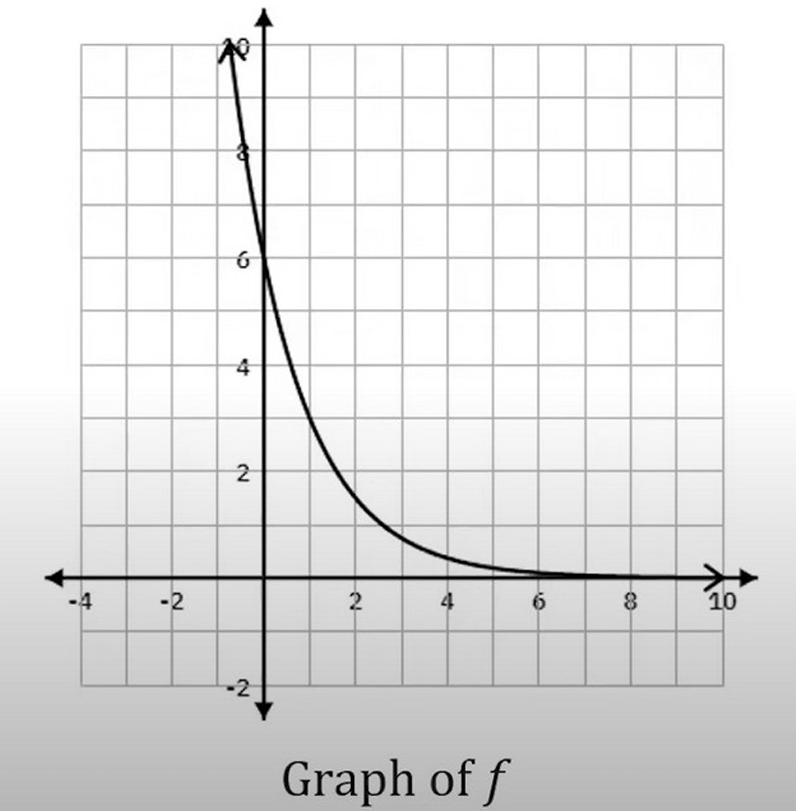
The function \(f\) is described as an exponential decay function with the \(x\)-axis as a horizontal asymptote.
Looking at the graph, as \(x\) moves to the right (\(x \to \infty\)), the curve approaches the x-axis, implying \(\lim_{x \to \infty} f(x) = 0\).
Looking at the left side of the graph, as \(x\) moves to the left (\(x \to -\infty\)), the curve goes up steeply.
This upward trend indicates that the function values increase without bound as \(x\) decreases.
Mathematically, this behavior is written as \(\lim_{x \to -\infty} f(x) = \infty\).
Comparing this result with the given choices, option (D) is the correct description.
▶️ Answer/Explanation
The correct option is (D).
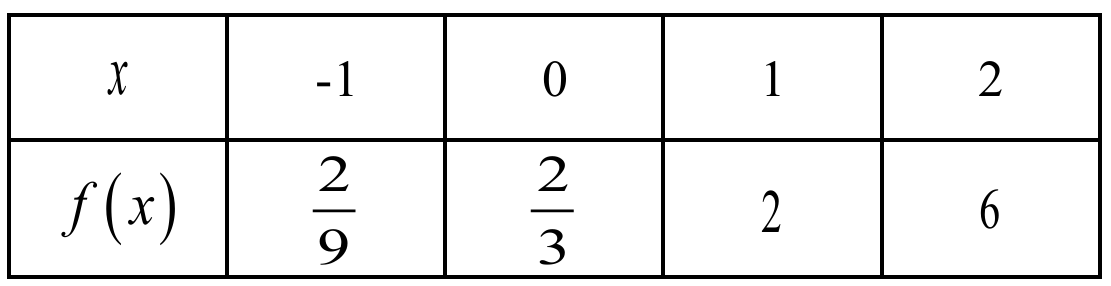
Identify the $y$-intercept from the table: at $x = 0$, $f(0) = \frac{2}{3}$, so $a = \frac{2}{3}$, which is $> 0$.
Determine the common ratio $b$ by calculating $\frac{f(x+1)}{f(x)}$, for example: $\frac{f(1)}{f(0)} = \frac{2}{2/3} = 3$.
Since $b = 3$, it follows that $b > 1$.
An exponential function $f(x) = ab^{x}$ with $a > 0$ and $b > 1$ represents exponential growth.
As $x$ increases, the values of $f(x)$ in the table ($\frac{2}{9}, \frac{2}{3}, 2, 6$) are strictly increasing.
Therefore, $f$ demonstrates exponential growth because $a > 0$ and $b > 1$.