
Product Property of Exponents and Exponential Transformations
The product property for exponents states that when multiplying powers with the same base, the exponents are added.
\( \mathrm{ \displaystyle b^m \cdot b^n = b^{(m+n)} } \)
This algebraic property has an important graphical interpretation for exponential functions.
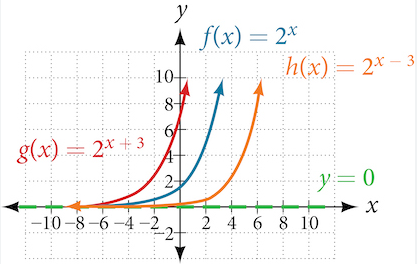
Consider an exponential function with a horizontal translation:
\( \mathrm{ \displaystyle f(x) = b^{(x+k)} } \)
Using the product property, this expression can be rewritten as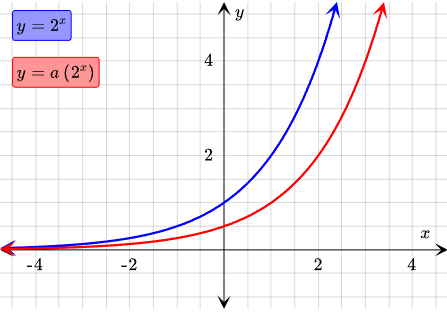
\( \mathrm{ \displaystyle b^{(x+k)} = b^x \cdot b^k } \)
Let \( \mathrm{a = b^k} \). Then the function becomes
\( \mathrm{ \displaystyle f(x) = ab^x } \)
This shows that a horizontal translation of an exponential function is equivalent to a vertical dilation.
Key Insight
• Horizontal shifts of exponential functions can be rewritten as vertical scalings
• This equivalence is unique to exponential functions because of exponent rules
Example
Rewrite the function
\( \mathrm{ \displaystyle f(x) = 2^{(x+3)} } \)
in the form \( \mathrm{ab^x} \).
▶️ Answer/Explanation
Apply the product property:
\( \mathrm{ \displaystyle 2^{(x+3)} = 2^x \cdot 2^3 } \)
Simplify:
\( \mathrm{ \displaystyle 2^{(x+3)} = 8 \cdot 2^x } \)
Conclusion
A horizontal shift left by 3 units is equivalent to a vertical stretch by a factor of 8.
Example
Rewrite the function
\( \mathrm{ \displaystyle f(x) = 5^{(x-2)} } \)
as a vertical dilation of \( \mathrm{5^x} \).
▶️ Answer/Explanation
Use the product property:
\( \mathrm{ \displaystyle 5^{(x-2)} = 5^x \cdot 5^{-2} } \)
Evaluate \( \mathrm{5^{-2}} \):
\( \mathrm{ \displaystyle 5^{-2} = \dfrac{1}{25} } \)
So the function becomes
\( \mathrm{ \displaystyle f(x) = \dfrac{1}{25} \cdot 5^x } \)
Conclusion
A horizontal shift right by 2 units is equivalent to a vertical shrink by a factor of \( \mathrm{\dfrac{1}{25}} \).
Power Property of Exponents and Exponential Dilations
The power property for exponents states that when a power is raised to another power, the exponents are multiplied.
\( \mathrm{ \displaystyle (b^m)^n = b^{(mn)} } \)
This algebraic property has an important graphical interpretation for exponential functions.
Consider an exponential function that includes a horizontal dilation:
\( \mathrm{ \displaystyle f(x) = b^{cx} } \)
Using the power property, this expression can be rewritten as
\( \mathrm{ \displaystyle b^{cx} = (b^c)^x } \)
This shows that a horizontal dilation of an exponential function is equivalent to a change in the base of the exponential function.
Here, \( \mathrm{b^c} \) is a constant base, and \( \mathrm{c \ne 0} \).
Key Insight
• Horizontal dilations compress or stretch the graph along the x-axis
• This effect can be represented by changing the base of the exponential function
Example
Rewrite the function
\( \mathrm{ \displaystyle f(x) = 3^{2x} } \)
as an exponential function with a new base.
▶️ Answer/Explanation
Apply the power property:
\( \mathrm{ \displaystyle 3^{2x} = (3^2)^x } \)
Simplify the base:
\( \mathrm{ \displaystyle (3^2)^x = 9^x } \)
Conclusion
A horizontal compression by a factor of \( \mathrm{\tfrac{1}{2}} \) is equivalent to changing the base from 3 to 9.
Example
Rewrite the function
\( \mathrm{ \displaystyle f(x) = 4^{\tfrac{x}{2}} } \)
as a function of the form \( \mathrm{(b^c)^x} \).
▶️ Answer/Explanation
Rewrite the exponent:
\( \mathrm{ \displaystyle 4^{\tfrac{x}{2}} = (4^{\tfrac{1}{2}})^x } \)
Simplify the base:
\( \mathrm{ \displaystyle (4^{\tfrac{1}{2}})^x = 2^x } \)
Conclusion
A horizontal stretch by a factor of 2 is equivalent to changing the base from 4 to 2.