
Home / AP® Exam / AP® PreCalculus / AP® Precalculus

AP Precalculus -2.5 Exponential Function Modeling- MCQ Exam Style Questions - Effective Fall 2023

AP Precalculus -2.5 Exponential Function Modeling- MCQ Exam Style Questions – Effective Fall 2023

AP Precalculus -2.5 Exponential Function Modeling- MCQ Exam Style Questions – AP Precalculus- per latest AP Precalculus Syllabus.

AP Precalculus – MCQ Exam Style Questions- All Topics

Question 

Water hyacinth is an invasive plant species found in many lakes that typically grows at a rate of 7% per day. As part of a study, a scientist introduces a 150-gram sample of water hyacinth into a testing pool. Which of the following functions gives the amount of water hyacinth in the testing pool \( t \) weeks after the sample is introduced? (Note: 1 week is 7 days.)
(A) \( f(t) = 150 \left( 1 + 0.07^{(1/7)} \right)^t \)
(B) \( g(t) = 150 \left( 1.07^{(1/7)} \right)^t \)
(C) \( h(t) = 150 \left( 1 + 0.07^{(7)} \right)^t \)
(D) \( k(t) = 150 \left( 1.07^{(7)} \right)^t \)
▶️ Answer/Explanation
Detailed solution

Daily growth factor: \( 1 + 0.07 = 1.07 \).
In one week (7 days), growth factor = \( (1.07)^7 \).
If \( t \) is in weeks, amount after \( t \) weeks: \( 150 \cdot (1.07^7)^t = 150 \cdot (1.07)^{7t} \).
The given options:
(D) \( k(t) = 150 (1.07^{(7)})^t = 150 \cdot (1.07^7)^t \), matches.
Answer: (D)

Question 

The sales of a new product, in items per month, is modeled by the expression \( 225 + 500 \log_{10}(15t + 10) \), where \( t \) represents the time since the product became available for purchase, in months. What is the number of items sold per month for time \( t = 6 \)?
(A) 725
(B) 1225
(C) 1700
(D) 5225
▶️ Answer/Explanation
Detailed solution

Plug \( t = 6 \):
\( 15t + 10 = 15(6) + 10 = 90 + 10 = 100 \)
\( \log_{10}(100) = 2 \)
Sales = \( 225 + 500 \times 2 = 225 + 1000 = 1225 \)
Answer: (B)

Question 

At time \(t=0\) years, the population of a certain city was \(23,144\). During each of the next \(10\) years, the population decreased by \(4\%\) per year. Based on this information, which of the following models the population as a function of time \(t\), in years, for \(0\le t\le10\)?
(A) \(23,144-0.04t\)
(B) \(23,144-0.96t\)
(C) \(23,144(0.96)^{t}\)
(D) \(23,144(1.04)^{t}\)
▶️ Answer/Explanation
Detailed solution

1. Identify Model Type:
Constant percentage decrease implies exponential decay.

2. Determine Growth Factor:
Decay of \(4\%\) means the multiplier is \(1 – 0.04 = 0.96\).

3. Construct Function:
\(P(t) = \text{Initial Value} \cdot (\text{Factor})^t\)
\(P(t) = 23,144(0.96)^t\)

Answer: (C)

Question 

The function \( S \) is given by \( S(t) = \frac{500,000}{1 + 0.4e^{kt}} \), where \( k \) is a constant. If \( S(4) = 300,000 \), what is the value of \( S(12) \)?
(A) 175,325
(B) 214,772
(C) 343,764
(D) 357,143
▶️ Answer/Explanation
Detailed solution

Given \( S(4) = 300,000 \):
\( 300000 = \frac{500000}{1 + 0.4 e^{4k}} \)
\( 1 + 0.4 e^{4k} = \frac{500000}{300000} = \frac{5}{3} \)
\( 0.4 e^{4k} = \frac{5}{3} – 1 = \frac{2}{3} \)
\( e^{4k} = \frac{2/3}{0.4} = \frac{2}{3} \cdot \frac{5}{2} = \frac{5}{3} \)
So \( e^{4k} = \frac{5}{3} \).
Now \( S(12) = \frac{500000}{1 + 0.4 e^{12k}} \).
Note \( e^{12k} = (e^{4k})^3 = \left(\frac{5}{3}\right)^3 = \frac{125}{27} \).
\( S(12) = \frac{500000}{1 + 0.4 \cdot \frac{125}{27}} \)
\( 0.4 \cdot \frac{125}{27} = \frac{2}{5} \cdot \frac{125}{27} = \frac{50}{27} \)
\( 1 + \frac{50}{27} = \frac{77}{27} \)
\( S(12) = 500000 \cdot \frac{27}{77} \approx 175324.675 \approx 175325 \)
Answer: (A)

Question 

A scientist concludes that an organism in a given dish doubles every 3 hours. Write an equation to represent this equation where t is the number of days after a 0 ​ organisms were put in the dish.
a. y=a 0 ​ (2) t/3
b. y=a 0 ​ (2) 8t
c. y=a 0 ​ (2) t/72
d. y=a 0 ​ (2) t/8
▶️ Answer/Explanation
Detailed solution

The standard doubling formula is y=a 0 ​ (2) n , where n is the number of doubling periods.
The organism doubles every 3 hours, so there are 24/3=8 doubling periods per day.
Since t represents the number of days, the total number of doubling periods is 8×t.
Substituting n=8t into the growth formula gives y=a 0 ​ (2) 8t .
This matches option b.
The correct equation must account for the unit conversion from hours to days.

Question 

The value of a car decreasing $15\%$ for the first $3$ years and $5\%$ for each year after $3$ years. If a value of a car is $\$70,000$ at brand new, what would the value of the car be after $5$ years?
a. $\$59.06$
b. $\$43,361.74$
c. $\$36,857.48$
d. $\$38,797.35$
▶️ Answer/Explanation
Detailed solution

Initial value of the car: $P = \$70,000$.
Depreciation for first $3$ years at $15\%$: $V_3 = 70,000 \times (1 – 0.15)^3$.
Calculation: $V_3 = 70,000 \times (0.85)^3 = 70,000 \times 0.614125 = \$42,988.75$.
Depreciation for next $2$ years ($5$ years total) at $5\%$: $V_5 = V_3 \times (1 – 0.05)^2$.
Calculation: $V_5 = 42,988.75 \times (0.95)^2 = 42,988.75 \times 0.9025$.
Final Value: $V_5 = \$38,797.3468 \approx \$38,797.35$.
Therefore, the correct option is d.

Question 

The increasing function $C$ gives the number of cars that are stuck in traffic due to lane closures. The table gives values of $C(t)$ for selected values of $t$, in minutes, since the beginning of the lane closures. If a model is constructed to represent these data, which of the following best applies to this situation?
(A) $y = 30t + 10$
(B) $y = 300t + 10$
(C) $y = 10\left(\frac{1}{3}\right)^{t}$
(D) $y = 10(3)^{t}$
▶️ Answer/Explanation
Detailed solution

The correct option is (D).
At $t = 0$, the initial value $C(0) = 10$, which matches the constant $a$ in $y = a(b)^t$.
Observe the ratio between successive output values: $\frac{30}{10} = 3$, $\frac{90}{30} = 3$, and $\frac{270}{90} = 3$.
Since the output values are multiplied by $3$ over equal-length input intervals, the function is exponential.
The common ratio or growth factor is $b = 3$.
Substituting these into the general form gives the model $y = 10(3)^{t}$.
$C(t)$ is exponential because the output values are proportional over equal-length input-value intervals.

Question 

The number of cars that travel along a busy highway on a particular morning can be modeled by a function $C$. For $0 \leq t \leq 8$ hours, the total number of cars that have traveled on the highway at time $t$ hours increases by $15\%$ each hour. At time $t = 0$ hours, a total of $54$ cars had traveled on the highway. If $t$ is measured in minutes, which of the following is an expression for $C(t)$? (Note: There are $60$ minutes in one hour).
(A) $54(0.15)^{(t/60)}$
(B) $54(0.15)^{(60t)}$
(C) $54(1.15)^{(t/60)}$
(D) $54(1.15)^{(60t)}$
▶️ Answer/Explanation
Detailed solution

The initial value at $t = 0$ is $a = 54$ cars.
An increase of $15\%$ per hour gives a growth factor $b = 1 + 0.15 = 1.15$.
The standard hourly model is $C(h) = 54(1.15)^h$, where $h$ is hours.
Since $t$ is in minutes, we convert minutes to hours using $h = \frac{t}{60}$.
Substituting the conversion into the model gives $C(t) = 54(1.15)^{(t/60)}$.
Therefore, the correct expression is represented by option (C).

Question 

Radon-222 has a half-life of $3.8$ days. In a particular sample, the amount of Radon-222 remaining after $d$ days can be modeled by the function $R$ given by $R(d) = A_0(0.5)^{(d/3.8)}$, where $A_0$ is the amount of Radon-222 in the sample at time $d = 0$. Which of the following functions $L$ models the amount of Radon-222 remaining after $w$ weeks, where $A_0$ is the amount of Radon-222 in the sample at time $w = 0$? (There are $7$ days in a week, so $d = 7w$.)
(A) $L(w) = A_0(0.5)^{(w/7)}$
(B) $L(w) = A_0\left(0.5^{(1/7)}\right)^{(3.8w)}$
(C) $L(w) = A_0\left(0.5^{(1/7)}\right)^{(w/3.8)}$
(D) $L(w) = A_0\left(0.5^{(7)}\right)^{(w/3.8)}$
▶️ Answer/Explanation
Detailed solution

The original function is given as $R(d) = A_0(0.5)^{(d/3.8)}$, where $d$ is in days.
Since there are $7$ days in one week, we use the substitution $d = 7w$.
Substituting this into the function gives $L(w) = A_0(0.5)^{(7w/3.8)}$.
Applying the power of a power rule: $a^{bc} = (a^b)^c$.
We rewrite the exponent as $(7) \cdot (w/3.8)$.
This results in the function $L(w) = A_0\left(0.5^{(7)}\right)^{(w/3.8)}$.
Therefore, the correct option is (D).

Question 

From $2015 – 2024$, the number of residents in a small town that subscribed to the local newspaper decreased with exponential decay. The number of residents that subscribed to the newspaper is modeled by the function $S$, which decreased by $43\%$ each year. In $2015$ ($t = 0$), $5200$ residents subscribed to the newspaper. If $t$ is measured in months, which of the following is an expression for $S(t)$? (Note: There are twelve months in one year.)
(A) $5200(0.43)^{(t/12)}$
(B) $5200(0.43)^{(12t)}$
(C) $5200(0.57)^{(t/12)}$
(D) $5200(0.57)^{(12t)}$
▶️ Answer/Explanation
Detailed solution

The correct option is (C).
The initial amount at $t = 0$ is $a = 5200$.
A decrease of $43\%$ per year gives a decay factor $b = 1 – 0.43 = 0.57$.
Since $t$ is in months, the number of years is represented by $\frac{t}{12}$.
Substituting into the exponential form $S(t) = a(b)^{\text{years}}$ gives $S(t) = 5200(0.57)^{(t/12)}$.

Question 

The value, in thousands of dollars, of an investment is modeled by the function $I$. The value is expected to increase by $2.9\%$ each month of the year. At time $t = 0$ years, the investment had a value of $215$ thousand dollars. If $t$ is measured in years, which of the following is an expression for $I(t)$? (Note: A month is one twelfth of a year.)
(A) $215(0.029)^{(t/12)}$
(B) $215(0.029)^{(12t)}$
(C) $215(1.029)^{(t/12)}$
(D) $215(1.029)^{(12t)}$
▶️ Answer/Explanation
Detailed solution

The initial value at $t = 0$ is $a = 215$ thousand dollars.
An increase of $2.9\%$ per month gives a growth factor $b = 1 + 0.029 = 1.029$.
The variable $t$ is measured in years, so the number of months is $12t$.
The general exponential growth form is $I(t) = a(b)^{\text{number of periods}}$.
Substituting the values gives $I(t) = 215(1.029)^{(12t)}$.
Therefore, the correct expression is represented by option (D).

Question 

The table gives values of a decreasing function $f$ for selected values of $x$. If a model is constructed to represent these data, which of the following best applies to this situation?

(A) $y = -80x + 324$
(B) $y = -216x + 324$
(C) $y = 324 \left( \frac{1}{3} \right)^x$
(D) $y = 324(3)^x$
▶️ Answer/Explanation
Detailed solution

The correct option is (C).
Identify the initial value (y-intercept) where $x = 0$, giving $f(0) = 324$, so $a = 324$.
Observe the ratio between successive output values: $\frac{108}{324} = \frac{1}{3}$ and $\frac{36}{108} = \frac{1}{3}$.
Since the outputs are multiplied by a constant factor over equal intervals, the model is exponential.
The constant ratio represents the base $b = \frac{1}{3}$.
The general form of the exponential model is $y = a(b)^x$.
Substituting the values, we get the specific model: $y = 324 \left( \frac{1}{3} \right)^x$.
Question 

The initial population size of an animal species is measured to be $2000$. The population doubles every $8$ years. Which of the following functions gives the time, in years, as an output value, and a certain number $x$ for the population size as an input value?
(A) $f(x) = \frac{1}{8} \log_{2} \left( \frac{x}{2000} \right)$
(B) $g(x) = \log_{2} \left( \frac{8x}{2000} \right)$
(C) $h(x) = 8 \log_{2} \left( \frac{x}{2000} \right)$
(D) $k(x) = 2000 \log_{8} x$
▶️ Answer/Explanation
Detailed solution

The standard growth model is $x = 2000(2)^{\frac{t}{8}}$, where $x$ is population and $t$ is time.
Divide both sides by $2000$ to isolate the exponential term: $\frac{x}{2000} = 2^{\frac{t}{8}}$.
Convert the exponential equation into its logarithmic form: $\log_{2} \left( \frac{x}{2000} \right) = \frac{t}{8}$.
Multiply both sides by $8$ to solve for $t$: $t = 8 \log_{2} \left( \frac{x}{2000} \right)$.
Comparing this result to the given options, we find it matches function $h(x)$.
Therefore, the correct option is (C).

Question 

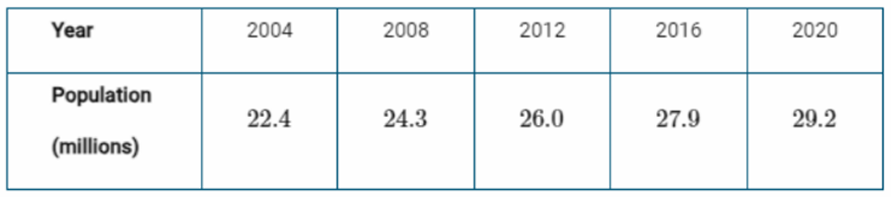
The table gives the population, in millions, of a certain region for selected years. An exponential regression of the form \( f(x) = a \cdot b^x \) is calculated for the five data points, where \( x = 4 \) represents 2004 and \( x = 8 \) represents 2008. Based on using the model \( f \) to predict the future population, in what year will the population first reach 35 million?
(A) 2025
(B) 2030
(C) 2033
(D) 2037
▶️ Answer/Explanation
Detailed solution

The correct option is (B) 2030.

1. Define variables and list data: Let \( x \) be the years since 2000 (so \( x=4 \) is 2004) and \( y \) be the population. The points are \((4, 22.4), (8, 24.3), (12, 26.0), (16, 27.9), (20, 29.2)\).
2. Linearize for regression: To fit \( y = a \cdot b^x \), we take the natural log: \( \ln(y) = \ln(a) + x \ln(b) \). We perform linear regression on the \( (x, \ln y) \) pairs.
3. Calculate regression parameters: Using statistical tools or a calculator, the regression yields approximately \( \ln(a) \approx 3.0516 \) and \( \ln(b) \approx 0.0167 \), giving \( a \approx 21.15 \) and \( b \approx 1.0168 \).
4. Establish the model: The exponential function is approximately \( f(x) = 21.15 \cdot (1.0168)^x \).
5. Set target population: We need to find \( x \) when \( f(x) = 35 \). So, \( 35 = 21.15 \cdot (1.0168)^x \).
6. Solve for x: Divide by 21.15 to get \( 1.6548 \approx (1.0168)^x \). Take the natural log: \( \ln(1.6548) = x \cdot \ln(1.0168) \), which gives \( 0.5037 \approx 0.0167x \). Thus, \( x \approx 30.1 \).
7. Convert to year: Since \( x \) is the number of years after 2000, the year is \( 2000 + 30 = 2030 \).

Question 

The value of a new boat is modeled by the function $B$. The value of the boat is expected to decrease by $11\%$ each year. At time $t = 0$ years, the value of the boat was $\$32,000$. Which of the following expressions gives the value of the boat after $m$ months? (Note: There are $12$ months in a year).
(A) $32,000(0.11)^{12m}$
(B) $32,000(0.11)^{m/12}$
(C) $32,000(0.89)^{12m}$
(D) $32,000(0.89)^{m/12}$
▶️ Answer/Explanation
Detailed solution

The initial value of the boat at $t = 0$ is $P = 32,000$.
A decrease of $11\%$ means the remaining value factor is $1 – 0.11 = 0.89$.
The annual decay formula is $V = 32,000(0.89)^t$, where $t$ is in years.
To convert years to months, we use the relation $t = \frac{m}{12}$.
Substituting this into the formula gives $V = 32,000(0.89)^{m/12}$.
Therefore, the correct expression is given in option (D).

Question 

After returning home from spending spring break at the beach, Mr. Smith notices a large number of spring onions in his yard and decides to apply weed killer to his yard. The decreasing function $D$ gives the number of spring onions in his yard. The table below gives values of $D(t)$ for selected values of $t$, in weeks, since Mr. Smith applied weed killer to his yard. If a model is constructed to represent these data, which of the following best applies to this situation?
(A) $D(t) = 64 \left( \frac{1}{4} \right)^t$
(B) $D(t) = 64 \left( \frac{3}{4} \right)^t$
(C) $D(t) = 64 – \frac{1}{4}t$
(D) $D(t) = 64 – \frac{3}{4}t$
▶️ Answer/Explanation
Detailed solution

The initial value at $t = 0$ is $D(0) = 64$, which matches the coefficient in all options.
To find the rate of change, calculate the ratio between successive terms: $\frac{48}{64} = \frac{3}{4}$.
Verify the ratio for the next interval: $\frac{36}{48} = \frac{3}{4}$ and $\frac{27}{36} = \frac{3}{4}$.
Since the common ratio $r = \frac{3}{4}$ is constant, the function is exponential.
The general form for an exponential model is $D(t) = a(r)^t$.
Substituting $a = 64$ and $r = \frac{3}{4}$ gives $D(t) = 64 \left( \frac{3}{4} \right)^t$.
Therefore, the correct option is (B).

Question 

The increasing function $C$ gives the number of followers, in hundreds, of a new comedian on social media. The table gives values of $C(t)$ at selected values of $t$, in months since the comedian created a social media account. If a model is constructed to represent these data, which of the following statements best applies to this situation?
(A) $C(t) = 8 \left( \frac{5}{2} \right)^t + 5$
(B) $C(t) = 8 \left( \frac{5}{2} \right)^t + 1$
(C) $C(t) = 8 \left( \frac{3}{2} \right)^t + 1$
(D) $C(t) = 8 \left( \frac{3}{2} \right)^t + 5$
▶️ Answer/Explanation
Detailed solution

At $t = 0$, the table shows $C(0) = 13$.
Substituting $t = 0$ into Option (A): $C(0) = 8(1) + 5 = 13$, which matches.
Substituting $t = 0$ into Option (B) or (C): $C(0) = 8(1) + 1 = 9$, which is incorrect.
Checking $t = 1$ for Option (A): $C(1) = 8 \left( \frac{5}{2} \right) + 5 = 20 + 5 = 25$, which matches the table.
Checking $t = 2$ for Option (A): $C(2) = 8 \left( \frac{25}{4} \right) + 5 = 50 + 5 = 55$, which matches the table.
Therefore, Option (A) correctly models the provided data points.
The base $\frac{5}{2}$ represents the growth factor of the exponential component.

Scroll to Top