

▶️ Answer/Explanation
The correct option is (D).
At $t = 0$, the initial value $C(0) = 10$, which matches the constant $a$ in $y = a(b)^t$.
Observe the ratio between successive output values: $\frac{30}{10} = 3$, $\frac{90}{30} = 3$, and $\frac{270}{90} = 3$.
Since the output values are multiplied by $3$ over equal-length input intervals, the function is exponential.
The common ratio or growth factor is $b = 3$.
Substituting these into the general form gives the model $y = 10(3)^{t}$.
$C(t)$ is exponential because the output values are proportional over equal-length input-value intervals.

▶️ Answer/Explanation
The correct option is (C).
Identify the initial value (y-intercept) where $x = 0$, giving $f(0) = 324$, so $a = 324$.
Observe the ratio between successive output values: $\frac{108}{324} = \frac{1}{3}$ and $\frac{36}{108} = \frac{1}{3}$.
Since the outputs are multiplied by a constant factor over equal intervals, the model is exponential.
The constant ratio represents the base $b = \frac{1}{3}$.
The general form of the exponential model is $y = a(b)^x$.
Substituting the values, we get the specific model: $y = 324 \left( \frac{1}{3} \right)^x$.
▶️ Answer/Explanation
The correct option is (B) 2030.
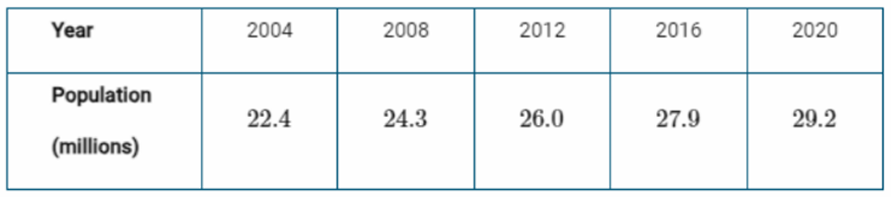
1. Define variables and list data: Let \( x \) be the years since 2000 (so \( x=4 \) is 2004) and \( y \) be the population. The points are \((4, 22.4), (8, 24.3), (12, 26.0), (16, 27.9), (20, 29.2)\).
2. Linearize for regression: To fit \( y = a \cdot b^x \), we take the natural log: \( \ln(y) = \ln(a) + x \ln(b) \). We perform linear regression on the \( (x, \ln y) \) pairs.
3. Calculate regression parameters: Using statistical tools or a calculator, the regression yields approximately \( \ln(a) \approx 3.0516 \) and \( \ln(b) \approx 0.0167 \), giving \( a \approx 21.15 \) and \( b \approx 1.0168 \).
4. Establish the model: The exponential function is approximately \( f(x) = 21.15 \cdot (1.0168)^x \).
5. Set target population: We need to find \( x \) when \( f(x) = 35 \). So, \( 35 = 21.15 \cdot (1.0168)^x \).
6. Solve for x: Divide by 21.15 to get \( 1.6548 \approx (1.0168)^x \). Take the natural log: \( \ln(1.6548) = x \cdot \ln(1.0168) \), which gives \( 0.5037 \approx 0.0167x \). Thus, \( x \approx 30.1 \).
7. Convert to year: Since \( x \) is the number of years after 2000, the year is \( 2000 + 30 = 2030 \).

▶️ Answer/Explanation
The initial value at $t = 0$ is $D(0) = 64$, which matches the coefficient in all options.
To find the rate of change, calculate the ratio between successive terms: $\frac{48}{64} = \frac{3}{4}$.
Verify the ratio for the next interval: $\frac{36}{48} = \frac{3}{4}$ and $\frac{27}{36} = \frac{3}{4}$.
Since the common ratio $r = \frac{3}{4}$ is constant, the function is exponential.
The general form for an exponential model is $D(t) = a(r)^t$.
Substituting $a = 64$ and $r = \frac{3}{4}$ gives $D(t) = 64 \left( \frac{3}{4} \right)^t$.
Therefore, the correct option is (B).

▶️ Answer/Explanation
At $t = 0$, the table shows $C(0) = 13$.
Substituting $t = 0$ into Option (A): $C(0) = 8(1) + 5 = 13$, which matches.
Substituting $t = 0$ into Option (B) or (C): $C(0) = 8(1) + 1 = 9$, which is incorrect.
Checking $t = 1$ for Option (A): $C(1) = 8 \left( \frac{5}{2} \right) + 5 = 20 + 5 = 25$, which matches the table.
Checking $t = 2$ for Option (A): $C(2) = 8 \left( \frac{25}{4} \right) + 5 = 50 + 5 = 55$, which matches the table.
Therefore, Option (A) correctly models the provided data points.
The base $\frac{5}{2}$ represents the growth factor of the exponential component.