
▶️ Answer/Explanation
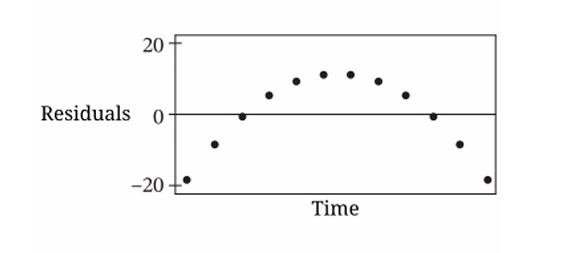
If residuals show a clear pattern (curved shape, systematic deviation), the linear model is not appropriate.
From the description/figure (not shown here), residuals likely show a pattern.
✅ Answer: (A)
▶️ Answer/Explanation
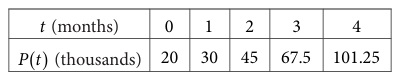
Check ratios:
\( P(1)/P(0) = 30/20 = 1.5 \)
\( P(2)/P(1) = 45/30 = 1.5 \)
\( P(3)/P(2) = 67.5/45 = 1.5 \)
\( P(4)/P(3) = 101.25/67.5 = 1.5 \)
Constant ratio ⇒ exponential growth with base \( b = 1.5 = \frac{3}{2} \).
Initial value \( P(0) = 20 \) ⇒ \( a = 20 \).
Thus \( P(t) = 20 \left( \frac{3}{2} \right)^t \).
✅ Answer: (D)
▶️ Answer/Explanation
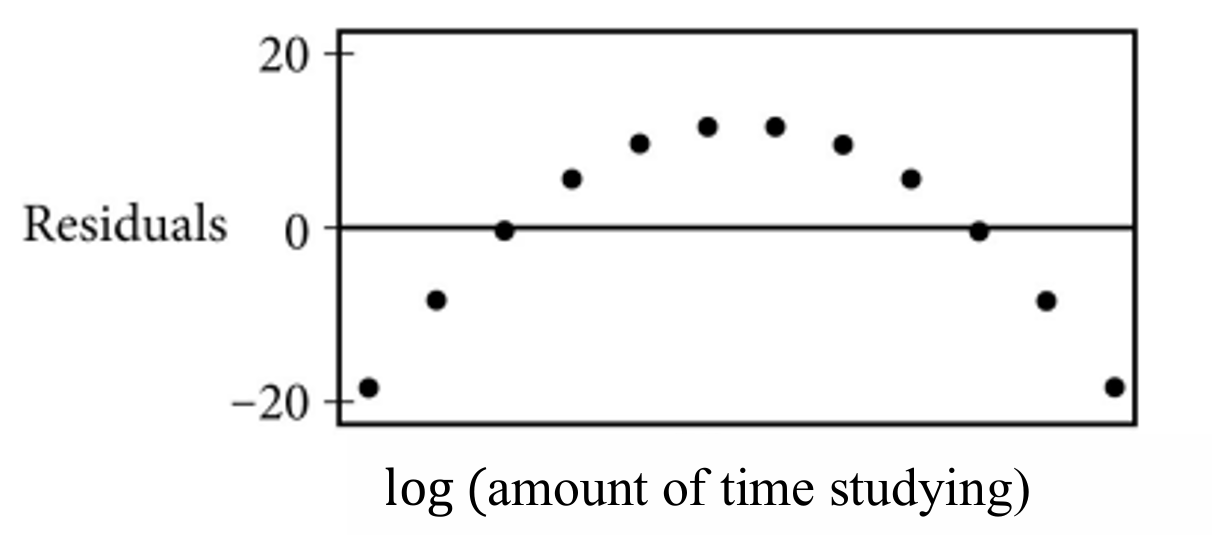
The transformation used is $(x, \log y)$, which is the standard method to linearize an exponential model.
A residual plot shows the difference between the observed values and the values predicted by the regression line.
The provided residual plot shows a clear distinct curved pattern (a parabolic shape).
In statistics, a patterned residual plot indicates that the chosen model is not a good fit for the data.
Since the linear model was applied to $(x, \log y)$, this “bad fit” refers to the underlying exponential relationship.
Therefore, an exponential regression is not appropriate for this specific data set.
Correct Option: a
▶️ Answer/Explanation
The correct option is (D).
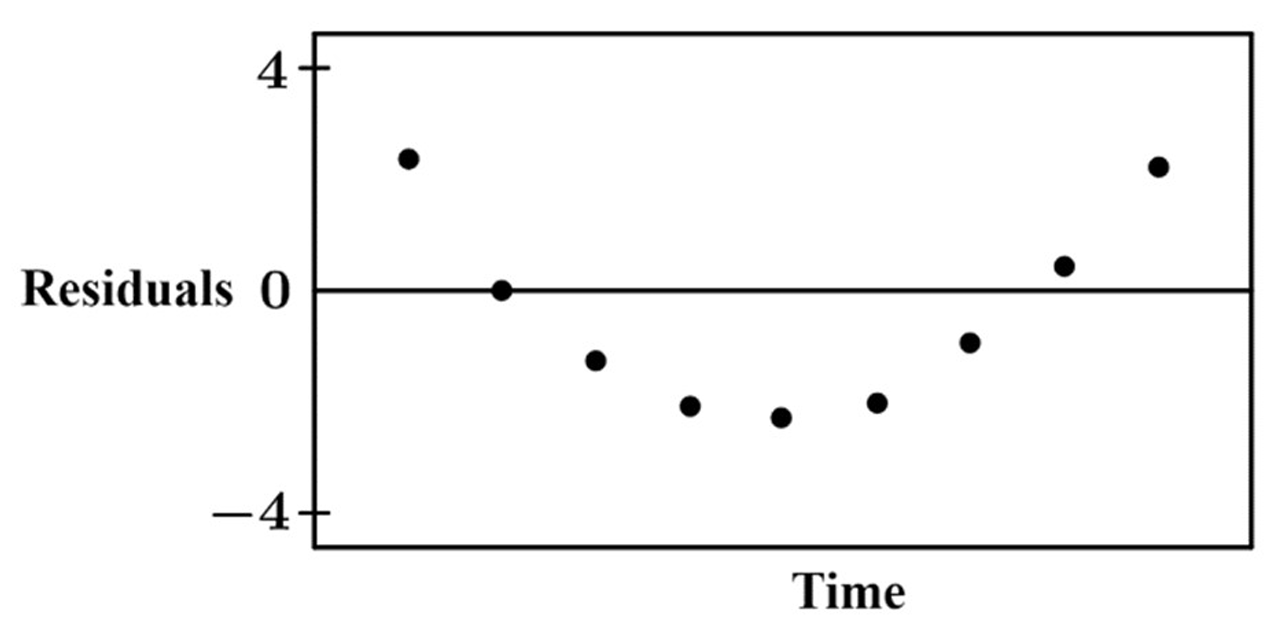
A residual plot should show a random scatter of points if a linear model is appropriate.
In this graph, the residuals exhibit a distinct $U$-shaped or curved pattern.
The presence of a non-random pattern indicates that the linear model fails to capture the underlying trend.
Therefore, the linear regression is not appropriate for this specific dataset.
This pattern suggests that a nonlinear model, such as a quadratic one, would be a better fit.
Option (D) correctly identifies that the pattern itself is the reason for the model’s inappropriateness.
▶️ Answer/Explanation
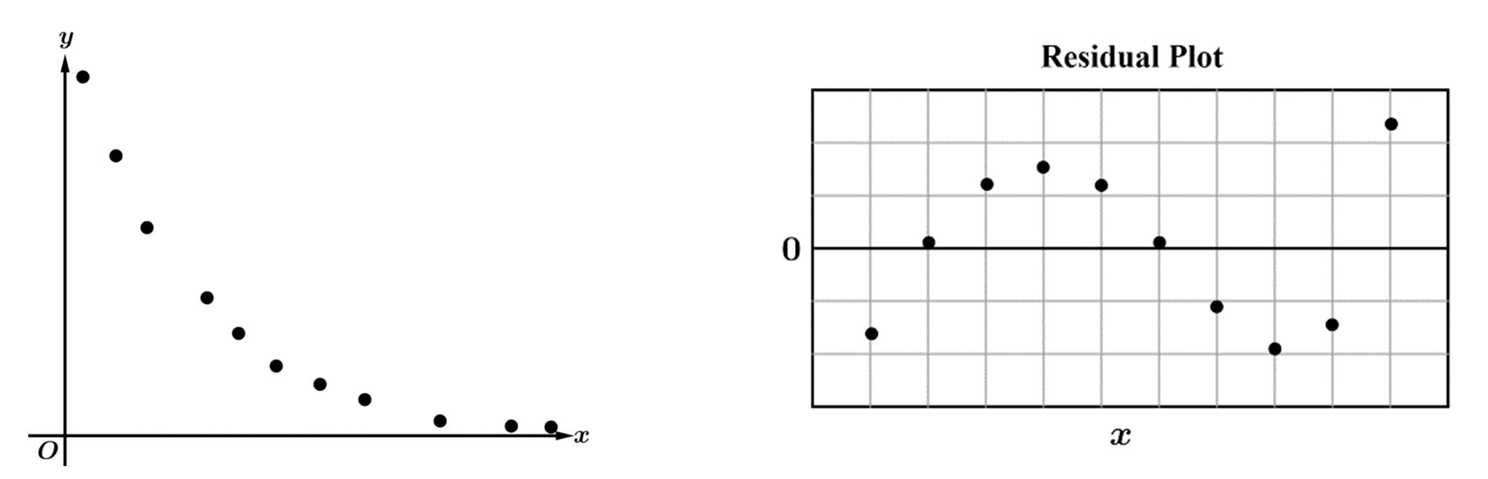
The correct option is (B).
The residual plot shows a distinct curved, non-random pattern (a “U” or “inverted U” shape).
A curved pattern in a residual plot indicates that the model used is not appropriate for the data.
The original scatterplot shows a curved relationship that could be modeled by a quadratic function $y = ax^2 + bx + c$.
However, since the residuals are not randomly scattered around the $y = 0$ line, a quadratic fit fails to capture the full trend.
For a model to be appropriate, the residuals should be randomly distributed with no discernible pattern.
Therefore, the quadratic model was used, but the resulting pattern in the residuals proves it is not the best fit.
▶️ Answer/Explanation
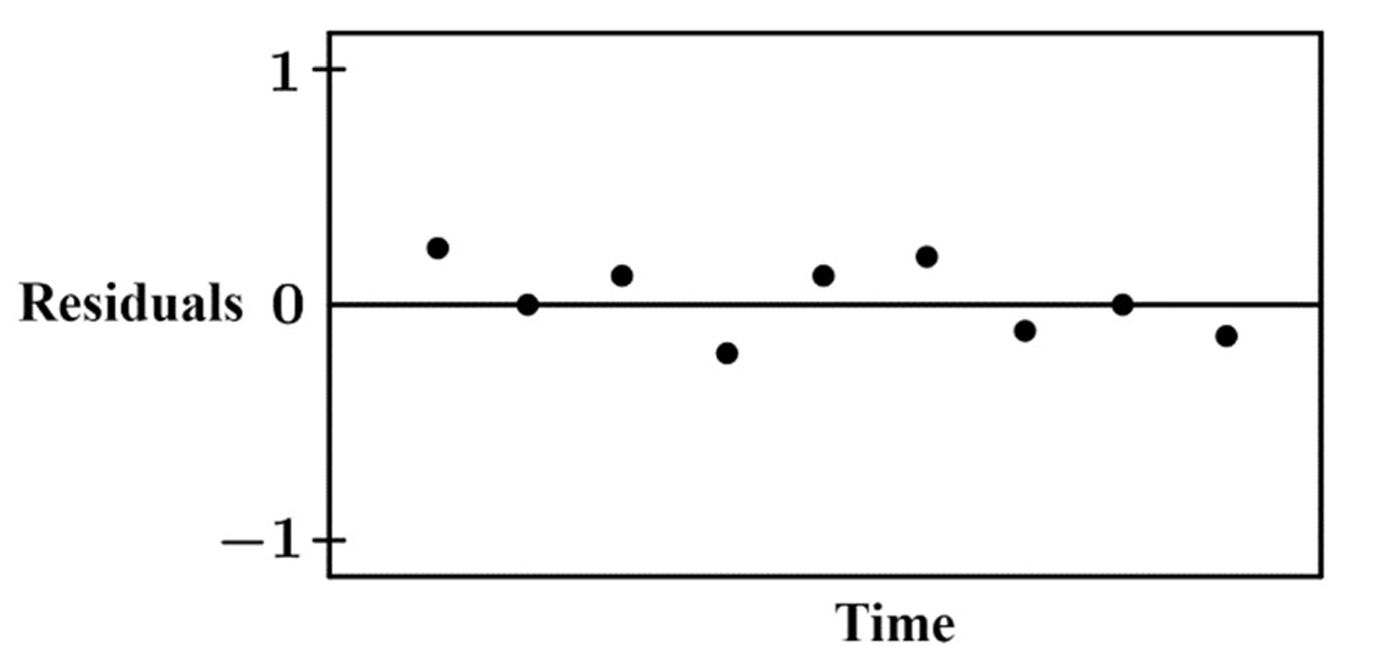
The correct option is (A).
A residual is calculated as $\text{observed value} – \text{predicted value}$.
The provided residual plot shows points randomly scattered above and below the line $y = 0$.
There is no curved, U-shaped, or systematic pattern visible in the residuals.
A random distribution of residuals indicates that the chosen model fits the data well.
Since there is no apparent pattern, the exponential regression model is considered appropriate.
Therefore, the data confirms Mr. Passwater’s belief regarding the exponential growth.

▶️ Answer/Explanation
Correct Answer: (C) $y = 4(3)^x$
An appropriate regression model is indicated by a residual plot with no clear pattern and points randomly dispersed around the horizontal axis.
The Linear Residual Plot shows a distinct U-shaped pattern, suggesting a linear model is inappropriate.
The Quadratic Residual Plot also shows a clear curved pattern, indicating the quadratic model does not fit well.
The Exponential Residual Plot shows a random distribution of points above and below the $x$-axis.
Since the exponential residual plot is the most random, an exponential model is the best fit.
Option (C) represents an exponential function, $y = 4(3)^x$, making it the appropriate choice.
▶️ Answer/Explanation
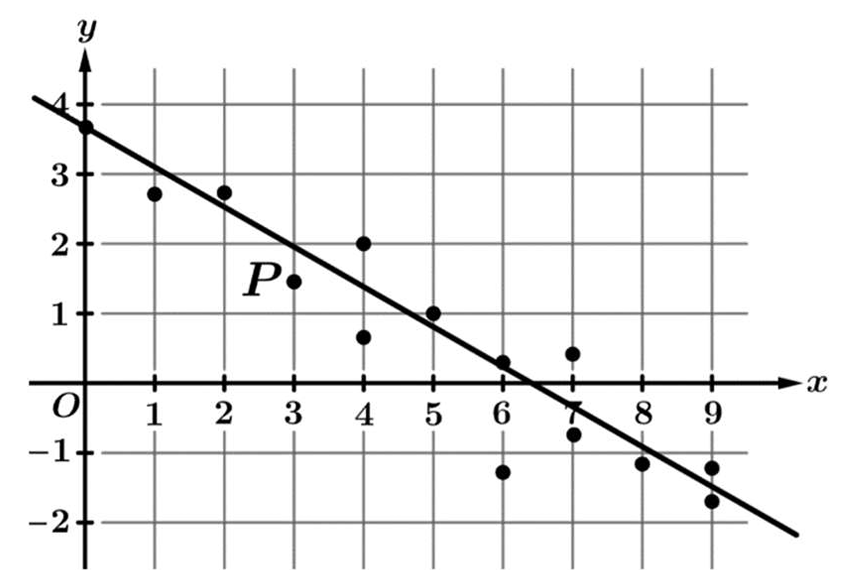
The residual is defined as the difference between the observed $y$-value and the predicted $\hat{y}$-value: $\text{Residual} = y – \hat{y}$.
Locate data point $P$ on the graph at the $x$-coordinate of $3$.
The actual $y$-value for point $P$ is $1.5$.
The predicted value $\hat{y}$ on the regression line at $x = 3$ is $2$.
Calculate the residual: $1.5 – 2 = -0.5$.
Therefore, the best estimate of the residual is $-0.5$.
The correct option is (A).
▶️ Answer/Explanation
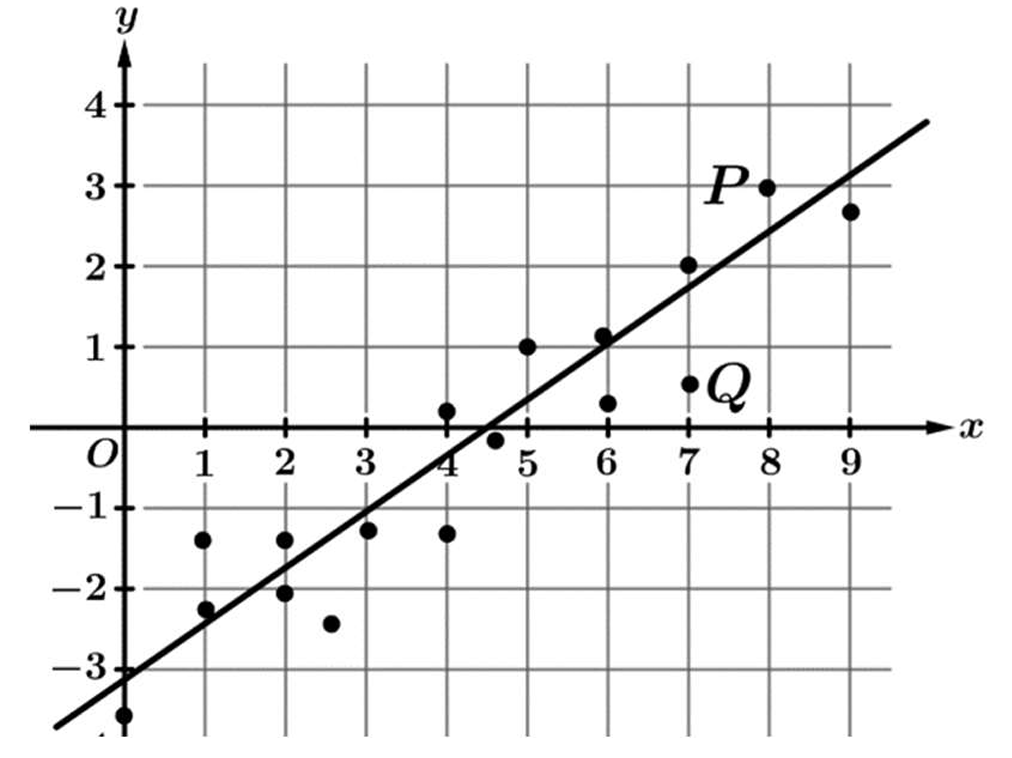
Point \(P\) is above the regression line, meaning it has a positive residual.
Point \(Q\) is below the regression line, meaning it has a negative residual.
Since one is positive and one is negative, the residuals have opposite signs.
The vertical distance from \(Q\) to the line is visually larger than the distance from \(P\) to the line.
The absolute value of a residual represents the magnitude of error for that point.
Therefore, there is a greater error in the model for point \(Q\) than for point \(P\).
This matches statement (D).

▶️ Answer/Explanation
The differences between consecutive \(P(t)\) values (\(30-20=10\), \(45-30=15\)) are not constant, so the model is not linear (eliminates A and B).
Calculate the ratio of consecutive terms: \(\frac{30}{20} = 1.5\) and \(\frac{45}{30} = 1.5\).
Since the ratio is constant at \(1.5\) or \(\frac{3}{2}\), the data represents an exponential growth model.
An exponential function has the form \(y = a(b)^t\), where \(a\) is the initial value and \(b\) is the growth factor.
From the table, at \(t=0\), the value is \(20\), so the initial value \(a = 20\).
The growth factor \(b\) is the constant ratio \(\frac{3}{2}\).
Therefore, the function is \(y = 20 \left(\frac{3}{2}\right)^t\), which corresponds to option (D).
▶️ Answer/Explanation
The correct answer is (D).
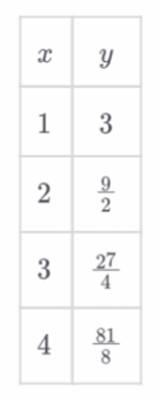
Analysis of the $y$-values shows a constant ratio: $\frac{9/2}{3} = \frac{27/4}{9/2} = \frac{81/8}{27/4} = 1.5$.
A constant ratio indicates that the data is perfectly exponential.
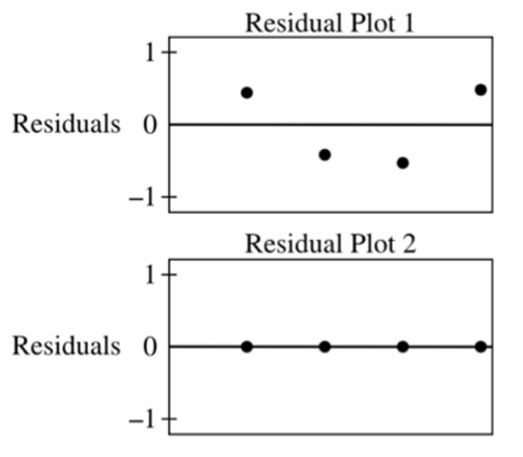
Residual Plot 2 shows all residuals are exactly $0$, meaning the model fits the data perfectly.
Therefore, the exponential model is the most appropriate for this data set.
Residual Plot 2 corresponds to this perfect exponential fit.
Residual Plot 1 shows a pattern, which usually indicates an inappropriate model (likely the linear one).

▶️ Answer/Explanation
The correct option is (C).
As the output values $f(x)$ increase by a constant addition of $2$ ($2, 4, 6, 8, 10$),
the corresponding input values $x$ change by a constant factor of $1/2$ ($80, 40, 20, 10, 5$).
This relationship defines a logarithmic function, where inputs change geometrically while outputs change arithmetically.
In an exponential function, the roles are reversed: inputs change arithmetically and outputs change geometrically.
Therefore, $f$ is logarithmic because input values change proportionately as output values increase in equal-length intervals.
The specific model for this data is $f(x) = \log_{1/\sqrt{2}}(x/80) + 2$.
▶️ Answer/Explanation
The correct option is (D).
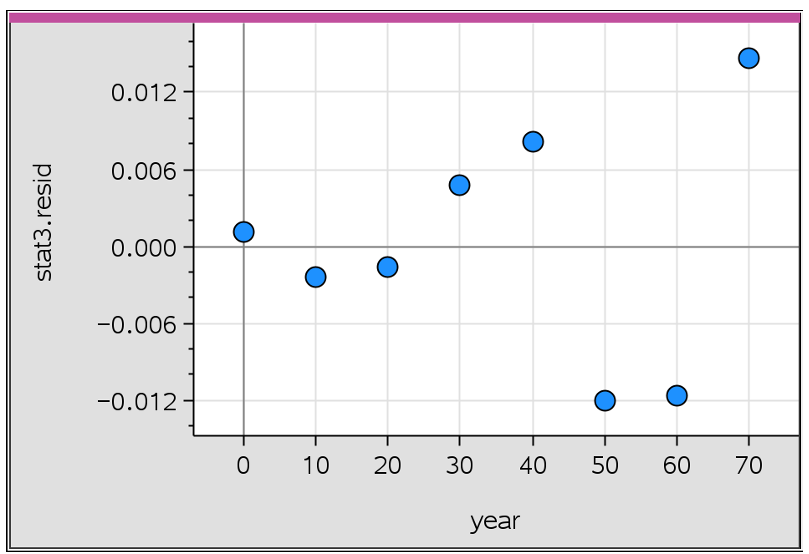
The residual plot clearly shows a distinct $U$-shaped curve rather than a random scatter.
A visible pattern in a residual plot indicates that the chosen model (exponential) does not capture the underlying trend.
In statistics, a model is considered “appropriate” only if its residuals are randomly distributed around the horizontal axis.
Since a clear non-linear pattern exists, the exponential regression is an inappropriate fit for this specific data set.
Therefore, the presence of a pattern confirms the model’s inadequacy.