Home / AP® Exam / AP® PreCalculus / AP® Precalculus

AP Precalculus -2.7 Composition of Functions- MCQ Exam Style Questions - Effective Fall 2023

AP Precalculus -2.7 Composition of Functions- MCQ Exam Style Questions – Effective Fall 2023

AP Precalculus -2.7 Composition of Functions- MCQ Exam Style Questions – AP Precalculus- per latest AP Precalculus Syllabus.

AP Precalculus – MCQ Exam Style Questions- All Topics

Question 

The functions \( f \) and \( g \) are given by \( f(x) = x^2 + 1 \) and \( g(x) = 4x – 1 \). Which of the following is an expression for \( f(g(x)) \)?
(A) \( x^2 + 4x \)
(B) \( 4x^2 + 3 \)
(C) \( 16x^2 – 8x + 2 \)
(D) \( 4x^3 – x^2 + 4x – 1 \)
▶️ Answer/Explanation
Detailed solution

Given \( f(x) = x^2 + 1 \) and \( g(x) = 4x – 1 \).
Then \( f(g(x)) = f(4x – 1) = (4x – 1)^2 + 1 \).
Expand: \( (4x – 1)^2 = 16x^2 – 8x + 1 \).
Thus, \( f(g(x)) = 16x^2 – 8x + 1 + 1 = 16x^2 – 8x + 2 \).
Answer: (C)

Question 

Two functions \( f \) and \( g \) are composed such that \( f(g(x)) = 4\sqrt{x-3} + 2 \). Which of the following could be the expressions for \( f(x) \) and \( g(x) \)?
(A) \( f(x) = \sqrt{x} \) and \( g(x) = 4x – 3 \)
(B) \( f(x) = 4x – 3 \) and \( g(x) = \sqrt{x} \)
(C) \( f(x) = \sqrt{x-3} \) and \( g(x) = 4x + 2 \)
(D) \( f(x) = 4x + 2 \) and \( g(x) = \sqrt{x-3} \)
▶️ Answer/Explanation
Detailed solution

We have \( f(g(x)) = 4\sqrt{x-3} + 2 \).
Check option (D): \( f(x) = 4x + 2 \) and \( g(x) = \sqrt{x-3} \).
Then \( f(g(x)) = f(\sqrt{x-3}) = 4(\sqrt{x-3}) + 2 \), which matches the given composition exactly.
None of the other options produce \( 4\sqrt{x-3} + 2 \) when composed in the given order.
Answer: (D)

Question 

The functions \( f \) and \( g \) are given by \( f(x) = \frac{1}{x} \) and \( g(x) = \sqrt{x} \). What is the domain of the function \( h \) given by \( h(x) = f(g(x)) \)?
(A) All real numbers
(B) All real numbers not equal to 0
(C) All real numbers greater than 0
(D) All real numbers greater than or equal to 0
▶️ Answer/Explanation
Detailed solution

First find \( h(x) \):
\( g(x) = \sqrt{x} \) has domain \( x \ge 0 \).
\( h(x) = f(g(x)) = f(\sqrt{x}) = \frac{1}{\sqrt{x}} \).
This requires \( \sqrt{x} > 0 \) (since division by zero is undefined).
Thus \( x > 0 \).
Domain: all real numbers greater than 0.
Answer: (C)

Question 


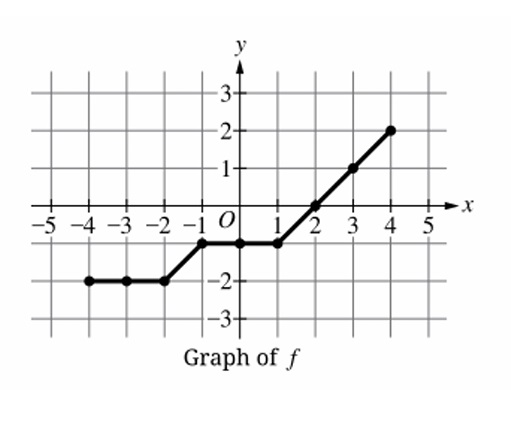
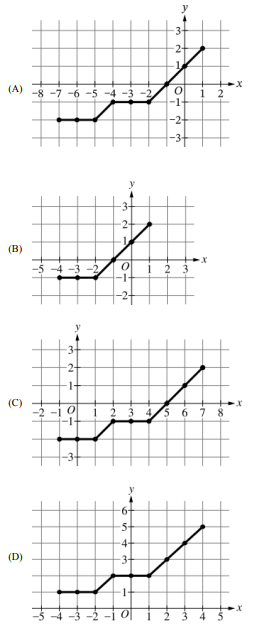
The piecewise-linear function \( f \), defined on \( -4 \le x \le 4 \), is shown in the graph. The function \( g \) is given by \( g(x) = x + 3 \). Which of the following is the graph of \( y = f(g(x)) \)?

▶️ Answer/Explanation
Detailed solution

Given \( g(x) = x + 3 \), we have \( f(g(x)) = f(x + 3) \).
This composition corresponds to shifting the graph of \( f \) horizontally to the left by 3 units.
The original domain of \( f \) is \( -4 \le x \le 4 \).
For \( f(x + 3) \), we require \( -4 \le x + 3 \le 4 \), which simplifies to \( -7 \le x \le 1 \).
Thus, the graph of \( y = f(g(x)) \) is the graph of \( f \) shifted left 3 units, with the domain shifted accordingly.
Answer: (A)

Question 


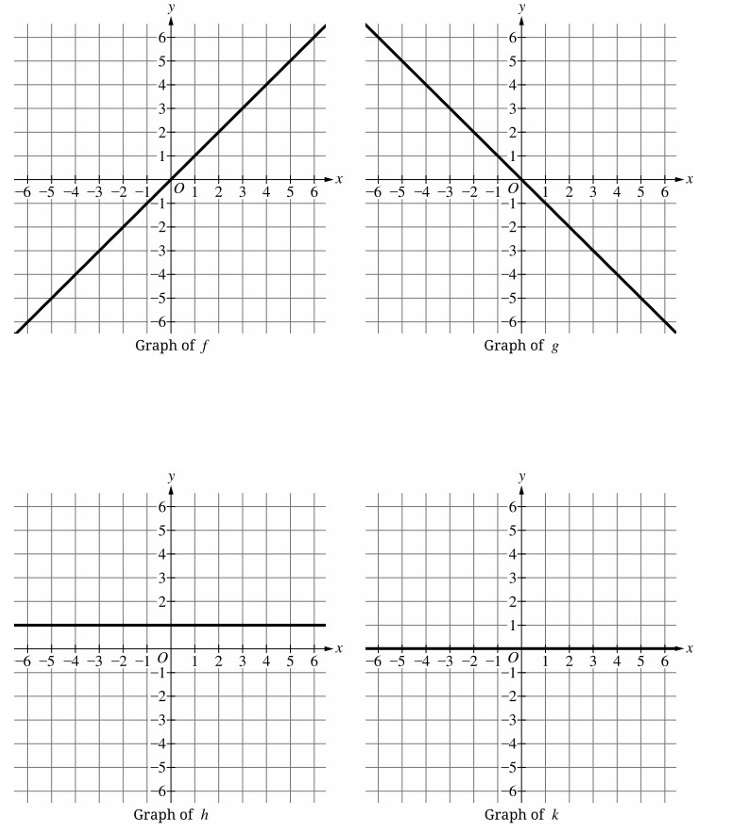
The function \( p \) (not shown) is a polynomial function of degree 3. The graphs of four functions \( f, g, h, \) and \( k \) are given. The output values of \( p \) are the same as the output values of the composition function when \( p \) is composed with one of these functions as the input function. For which of the functions is this statement true?
(A) \( f \)
(B) \( g \)
(C) \( h \)
(D) \( k \)
▶️ Answer/Explanation
Detailed solution

The condition means \( p(f(x)) = p(x) \) for all \( x \), so \( f \) must be the identity function.
Only the graph of \( f \) is a straight line through the origin with slope 1, which represents \( f(x) = x \).
Thus, composing \( p \) with \( f \) leaves \( p \) unchanged.
Answer: (A)

Question 

The table gives values of the function \( f \) for selected values of \( x \). The function \( g \) is given by \( g(x) = x^2 \). Which of the following gives values of \( g(f(x)) \) for \( x = -1, x = 0, \) and \( x = 1 \)?
(A) \[\begin{array}{c|c|c|c} x & -1 & 0 & 1 \\ \hline g(f(x)) & -1 & 1 & -1 \\ \end{array}\]
(B) \[\begin{array}{c|c|c|c} x & -1 & 0 & 1 \\ \hline g(f(x)) & 0 & 0 & -1 \\ \end{array}\]
(C) \[\begin{array}{c|c|c|c} x & -1 & 0 & 1 \\ \hline g(f(x)) & 0 & 1 & 1 \\ \end{array}\]
(D) \[\begin{array}{c|c|c|c} x & -1 & 0 & 1 \\ \hline g(f(x)) & 1 & 1 & 0 \\ \end{array}\]
▶️ Answer/Explanation
Detailed solution

Given \( g(x) = x^2 \), we compute \( g(f(x)) = [f(x)]^2 \).
From the table:
\( f(-1) = 0 \Rightarrow g(f(-1)) = 0^2 = 0 \)
\( f(0) = 1 \Rightarrow g(f(0)) = 1^2 = 1 \)
\( f(1) = -1 \Rightarrow g(f(1)) = (-1)^2 = 1 \)
Thus, the values are 0, 1, 1.
Answer: (C)

Question 

The function \( f \) is given by \( f(x) = x^2 + 1 \), and the function \( g \) is given by \( g(x) = \frac{x-3}{x} \). Which of the following is an expression for \( f(g(x)) \)?
(A) \( \frac{x^3 – 3x^2 + x – 3}{x} \)
(B) \( \frac{x^2 – 2}{x^2 + 1} \)
(C) \( \frac{x^2 – 6x + 9}{x^2} + 1 \)
(D) \( \frac{x^2 – 8}{x^2} \)
▶️ Answer/Explanation
Detailed solution

\( g(x) = \frac{x-3}{x} \)
\( f(g(x)) = \left( \frac{x-3}{x} \right)^2 + 1 \)
\( = \frac{(x-3)^2}{x^2} + 1 \)
Expand numerator: \( (x-3)^2 = x^2 – 6x + 9 \)
So \( f(g(x)) = \frac{x^2 – 6x + 9}{x^2} + 1 \)
Answer: (C)

Question 

The table gives values of the function \( g \) for selected values of \( x \). The function \( f \) is given by \( f(x) = 3^x + x^2 \). What is the value of \( f(g(3)) \)?
\[ \begin{array}{c|c} x & g(x) \\ \hline -2 & 4 \\ 0 & \frac{1}{2} \\ 3 & -2 \\ 4 & 3 \\ 36 & 9 \\ \end{array} \]
(A) \(-72\)
(B) \(\frac{37}{9}\)
(C) 9
(D) 97
▶️ Answer/Explanation
Detailed solution

From table: \( g(3) = -2 \).
Then \( f(g(3)) = f(-2) = 3^{-2} + (-2)^2 \)
\( = \frac{1}{9} + 4 = \frac{1}{9} + \frac{36}{9} = \frac{37}{9} \).
Answer: (B)

Question 

The function \(f\) is given by \(f(t)=e^{t}\), and the function \(g\) is given by \(g(t)=7 \ln t\). If the function \(h\) is given by \(h(t)=(f\circ g)(t)\), which of the following is an expression for \(h(t)\), for \(t > 0\)?
(A) \(7t\)
(B) \(t^{7}\)
(C) \(te^{7}\)
(D) \(7\)
▶️ Answer/Explanation
Detailed solution

1. Perform Composition:
\(h(t) = f(g(t)) = f(7\ln t) = e^{7\ln t}\).

2. Simplify Exponent:
Use log rule \(a \ln b = \ln(b^a)\): \(e^{\ln(t^7)}\).

3. Evaluate:
\(e^{\ln(t^7)} = t^7\).

Answer: (B)

Question 

The function \(C\) models temperature, in degrees Celsius, as a function of time \(t\), in hours, for \(t\ge0.\) The function \(P\) models electricity usage, in kilowatts, as a function of temperature, in degrees Celsius. Let \(K\) be the composition function defined by \(K(t)=P(C(t))\). Which of the following statements is true about function \(K\)?
(A) \(K\) models electricity usage as a function of time.
(B) \(K\) models temperature as a function of electricity usage.
(C) \(K\) models time as a function of electricity usage.
(D) \(K\) models electricity usage as a function of temperature.
▶️ Answer/Explanation
Detailed solution

1. Analyze Inner Function \(C(t)\):
Input: Time (\(t\)).
Output: Temperature.

2. Analyze Outer Function \(P(\text{Temperature})\):
Input: Temperature (which is the output of \(C\)).
Output: Electricity usage.

3. Analyze Composition \(K(t) = P(C(t))\):
The ultimate input is \(t\) (Time).
The ultimate output is the result of \(P\) (Electricity usage).
Therefore, \(K\) models electricity usage as a function of time.

Answer: (A)

Question 

The function \( f \) is given by \( f(x) = x^2 + 1 \), and the function \( g \) is given by \( g(x) = \frac{x-3}{x} \). Which of the following is an expression for \( f(g(x)) \)?
(A) \( \displaystyle \frac{x^3 – 3x^2 + x – 3}{x} \)
(B) \( \displaystyle \frac{x^2 – 2}{x^2 + 1} \)
(C) \( \displaystyle \frac{x^2 – 6x + 9}{x^2} + 1 \)
(D) \( \displaystyle \frac{x^2 – 8}{x^2} \)
▶️ Answer/Explanation
Detailed solution

\[ f(g(x)) = \left( g(x) \right)^2 + 1 = \left( \frac{x-3}{x} \right)^2 + 1 \]
Simplify:
\[ = \frac{(x-3)^2}{x^2} + 1 \]
\[ = \frac{x^2 – 6x + 9}{x^2} + 1 \]
This matches option (C).
Answer: (C)

Question 


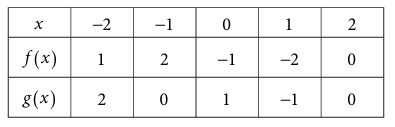
The table gives values for the functions \( f \) and \( g \) at selected values of \( x \). Functions \( f \) and \( g \) are defined for all real numbers. Let \( h \) be the function defined by \( h(x) = f(g(x)) \). What is the value of \( h(0) \)?
(A) \(-2\)
(B) \(-1\)
(C) 0
(D) 2
▶️ Answer/Explanation
Detailed solution

From the (implied) table in the original problem:
\[ g(0) = 1, \quad f(1) = -2 \]
Thus, \[ h(0) = f(g(0)) = f(1) = -2 \]
Answer: (A)

Question 

If the function $f(x) = \sqrt{x}$ and $g(x) = \frac{1}{x-2}$ were combined according to the descriptions below, then which of the following would the combined function have a domain of $[0, 2) \cup (2, \infty)$?
i. $f(x) + g(x)$
ii. $(g \circ f)(x)$
iii. $\frac{g(x)}{f(x)}$
a. i only
b. ii only
c. i and iii only
d. i, ii, and iii
▶️ Answer/Explanation
Detailed solution

For i: $f(x) + g(x)$ requires $x \ge 0$ and $x \neq 2$, resulting in $[0, 2) \cup (2, \infty)$.
For ii: $(g \circ f)(x) = \frac{1}{\sqrt{x}-2}$ requires $x \ge 0$ and $\sqrt{x} \neq 2$, so $x \neq 4$.
For iii: $\frac{g(x)}{f(x)} = \frac{1}{\sqrt{x}(x-2)}$ requires $x > 0$ and $x \neq 2$, making the domain $(0, 2) \cup (2, \infty)$.
Only the first combination matches the required domain precisely.
The correct option is a.

Question 

If $f(x) = x^4 + 3x^3 + 2x^2 + 5x + 3$ and $g(x) = -2x^8 + x^3 + 9$, then what is the end behavior of $h(x) = f(g(x))$?
a. $\lim_{x \to \infty} h(x) = \infty$ and $\lim_{x \to -\infty} h(x) = \infty$
b. $\lim_{x \to \infty} h(x) = -\infty$ and $\lim_{x \to -\infty} h(x) = -\infty$
c. $\lim_{x \to \infty} h(x) = \infty$ and $\lim_{x \to -\infty} h(x) = -\infty$
d. $\lim_{x \to \infty} h(x) = -\infty$ and $\lim_{x \to -\infty} h(x) = \infty$
▶️ Answer/Explanation
Detailed solution

The leading term of $g(x)$ is $-2x^8$, so as $x \to \pm\infty$, $g(x) \to -\infty$.
The composite function is $h(x) = f(g(x))$, where the leading term of $f(x)$ is $x^4$.
As $x \to \infty$, $h(x) \approx f(-2x^8) \approx (-2x^8)^4 = 16x^{32}$, which approaches $\infty$.
As $x \to -\infty$, $h(x) \approx f(-2x^8) \approx (-2x^8)^4 = 16x^{32}$, which approaches $\infty$.
Since both ends approach positive infinity, the correct option is a.
Final Result: $\lim_{x \to \infty} h(x) = \infty$ and $\lim_{x \to -\infty} h(x) = \infty$.

Question 

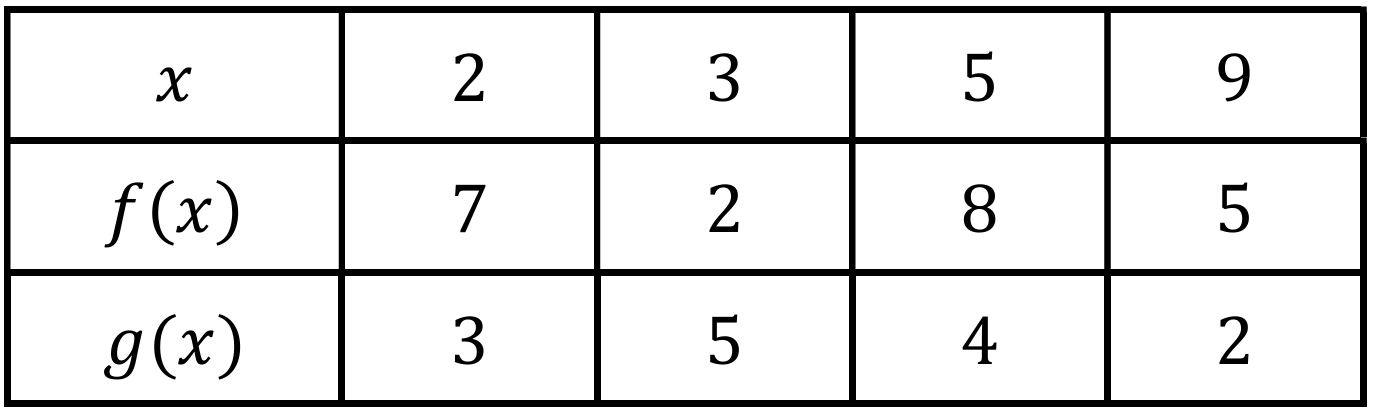
The table gives values for the functions $f$ and $g$ at selected values of $x$. Functions $f$ and $g$ are defined for all real numbers.

Let $h$ be the function defined by $h(x) = g(f(x))$. What is the value of $h(9)$?
(A) $4$
(B) $7$
(C) $8$
(D) $10$
▶️ Answer/Explanation
Detailed solution

To find the value of $h(9)$, we use the composition formula $h(9) = g(f(9))$.
First, locate $x = 9$ in the table and identify the value of $f(9)$.
From the table, when $x = 9$, $f(9) = 5$.
Substitute this value into the outer function: $g(f(9)) = g(5)$.
Next, locate $x = 5$ in the table and identify the value of $g(5)$.
From the table, when $x = 5$, $g(5) = 4$.
Therefore, $h(9) = 4$, which corresponds to option (A).

Question 

The table gives values for the functions $f$ and $g$ at selected values of $x$. Functions $f$ and $g$ are defined for all real numbers.
Let $k$ be the function defined by $k(x) = f(g(x))$. What is the value of $k(3)$?
(A) $3$
(B) $7$
(C) $8$
(D) $10$
▶️ Answer/Explanation
Detailed solution

The correct answer is (C).
To find $k(3)$, identify the composite function $k(3) = f(g(3))$.
First, locate $x = 3$ in the table to find the value of $g(3)$.
From the table, when $x = 3$, $g(3) = 5$.
Substitute this value into the outer function: $f(g(3)) = f(5)$.
Next, locate $x = 5$ in the table to find the value of $f(5)$.
From the table, when $x = 5$, $f(5) = 8$.
Therefore, $k(3) = 8$.
Question 

Graph of f Graph of g
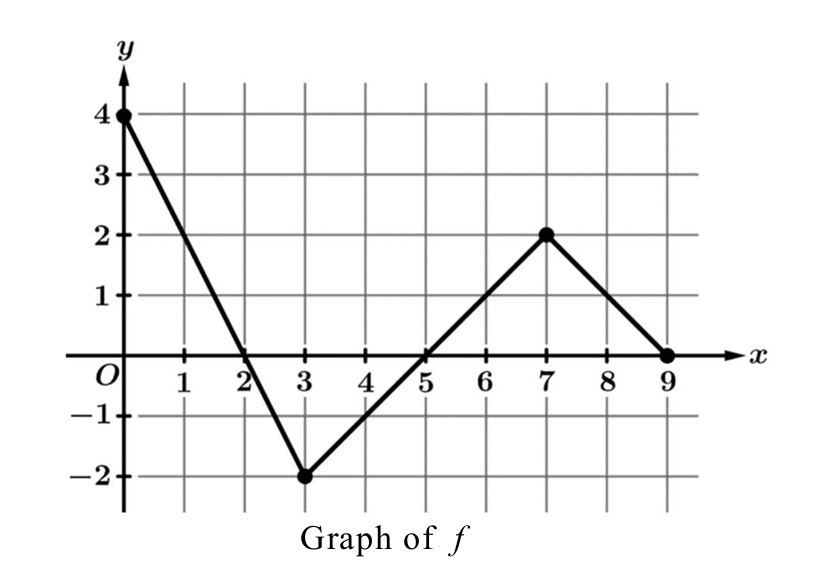
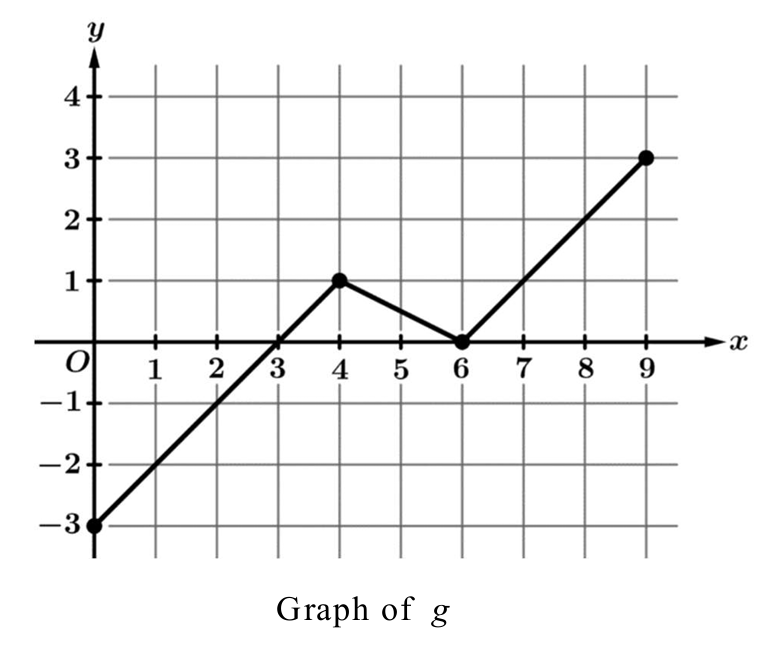
The graphs of $f$ and $g$ are shown for $0 \leq x \leq 9$, each consisting of three line segments.
Let $h$ be the function defined by $h(x) = g(f(x))$. What is the value of $h(8)$?
(A) $-2$
(B) $-1$
(C) $0$
▶️ Answer/Explanation
Detailed solution

To find $h(8)$, use the definition of composite functions: $h(8) = g(f(8))$.
First, locate $x = 8$ on the horizontal axis of the Graph of $f$.
Move vertically to the line segment to find the $y$-value: $f(8) = 1$.
Substitute this result into the outer function to get $g(1)$.
Now, locate $x = 1$ on the horizontal axis of the Graph of $g$.
Move vertically to the line segment to find the corresponding $y$-value: $g(1) = -2$.
Therefore, $h(8) = g(1) = -2$, which corresponds to choice (A).

Question 

The graphs of $f$ and $g$ are shown for $0 \leq x \leq 9$, each consisting of three line segments.
Let $k$ be the function defined by $k(x) = f(g(x))$. What is the value of $k(9)$?
(A) $-3$
(B) $-2$
(C) $0$
(D) $4$
▶️ Answer/Explanation
Detailed solution

To find $k(9)$, we use the definition of a composite function: $k(9) = f(g(9))$.
First, identify the value of $g(9)$ by looking at the Graph of $g$ at $x = 9$.
From the graph, the point $(9, 3)$ exists, so $g(9) = 3$.
Next, substitute this value into $f$: $k(9) = f(3)$.
Identify the value of $f(3)$ by looking at the Graph of $f$ at $x = 3$.
From the graph, the point $(3, -2)$ exists, so $f(3) = -2$.
Therefore, $k(9) = -2$, which corresponds to option (B).
Question 

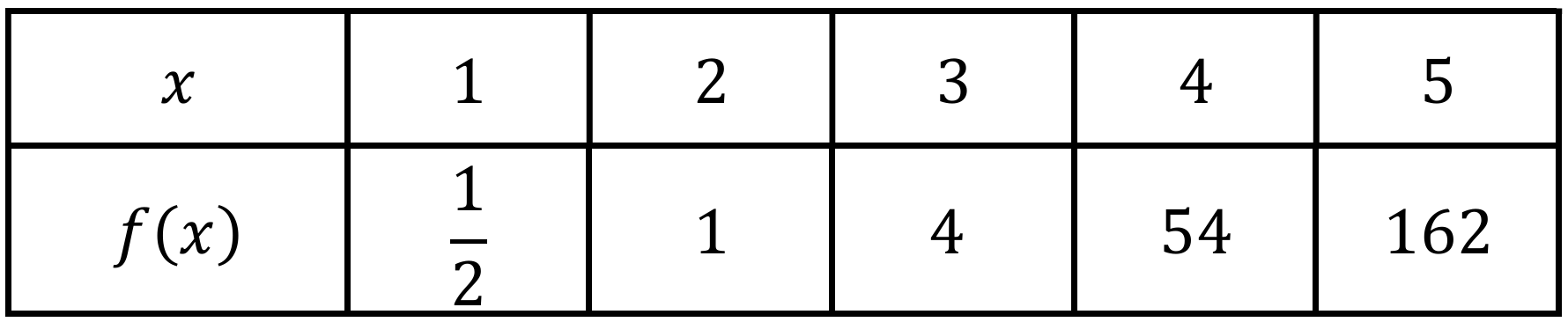
The table gives values of the function $f$ for selected values of $x$. The function $g$ is given by $g(x) = 9^x – 8x$.
What is the value of $g(f(1))$?
(A) $-1$
(B) $\frac{1}{2}$
(C) $\frac{3}{2}$
(D) $65$
▶️ Answer/Explanation
Detailed solution

To find $g(f(1))$, first identify the value of $f(1)$ from the provided table.
From the table, when $x = 1$, the corresponding value is $f(1) = \frac{1}{2}$.
Next, substitute this value into the function $g(x) = 9^x – 8x$.
This gives the expression $g\left(\frac{1}{2}\right) = 9^{1/2} – 8\left(\frac{1}{2}\right)$.
Calculate the square root: $9^{1/2} = \sqrt{9} = 3$.
Calculate the product: $8 \cdot \frac{1}{2} = 4$.
Subtract the values: $3 – 4 = -1$.
Therefore, the correct option is (A).
Question 

The function $f$ is given by $f(x) = 4^{x^2}$, and the function $g$ is given by $g(x) = 3x$. Which of the following is an expression for $f(g(x))$?
(A) $4^{3x^2}$
(B) $4^{6x^2}$
(C) $4^{9x^2}$
(D) $3 \cdot 4^{x^2}$
▶️ Answer/Explanation
Detailed solution

To find the composite function $f(g(x))$, substitute the expression for $g(x)$ into $f(x)$.
Given $g(x) = 3x$, we replace the $x$ in $f(x) = 4^{x^2}$ with $(3x)$.
This gives the expression $f(g(x)) = 4^{(3x)^2}$.
Apply the power of a product rule: $(3x)^2 = 3^2 \cdot x^2$.
Simplify the exponent: $3^2 = 9$, resulting in $9x^2$.
The final expression is $4^{9x^2}$.
Therefore, the correct choice is (C).

Question 

The function $f$ is given by $f(x) = 2x – 1$, and the function $g$ is given by $g(x) = x^2 + 3x$. Which of the following is an expression for $g(f(x))$?
(A) $2x^2 + 6x – 1$
(B) $4x^2 – x – 1$
(C) $4x^2 + 2x – 2$
(D) $2x^3 + 5x^2 – 3x$
▶️ Answer/Explanation
Detailed solution

To find the composite function $g(f(x))$, substitute the expression for $f(x)$ into $g(x)$.
Substitute $f(x) = 2x – 1$ into $g(x) = x^2 + 3x$:
$g(f(x)) = (2x – 1)^2 + 3(2x – 1)$
Expand the squared term: $(2x – 1)^2 = 4x^2 – 4x + 1$
Distribute the 3: $3(2x – 1) = 6x – 3$
Combine the parts: $4x^2 – 4x + 1 + 6x – 3$
Simplify by combining like terms: $4x^2 + 2x – 2$
Therefore, the correct choice is (C).

Question 

The function \( f \) is given by \( f(t) = e^t \), and the function \( g \) is given by \( g(t) = 7 \ln t \). If the function \( h \) is given by \( h(t) = (f \circ g)(t) \), which of the following expression for \( h(t) \), for \( t > 0 \)?
(A) \( 7t \)
(B) \( t^7 \)
(C) \( te^2 \)
(D) \( 7^t \)
▶️ Answer/Explanation
Detailed solution

The correct answer is (B).
We need to evaluate the composite function \( h(t) = f(g(t)) \).
Substitute \( g(t) = 7 \ln t \) into the function \( f \):
\( h(t) = f(7 \ln t) = e^{7 \ln t} \)
Apply the power rule for logarithms, \( a \ln b = \ln(b^a) \), to the exponent:
\( h(t) = e^{\ln(t^7)} \)
Use the inverse property of exponential and logarithmic functions, \( e^{\ln x} = x \):
\( h(t) = t^7 \)

Question 

The function \( f \) is given by \( f(x) = e^{2x} \), and the function \( g \) is given by \( g(x) = \ln(3x) \). For \( x > 0 \), which of the following is an expression for \( f(g(x)) \)?
(A) \( 9x^2 \)
(B) \( 2x + \ln 3 \)
(C) \( (e^{2x}) \cdot \ln(3x) \)
(D) \( 6x \)
▶️ Answer/Explanation
Detailed solution

To find the composite function \( f(g(x)) \), substitute \( g(x) \) into \( f(x) \).

Given \( f(x) = e^{2x} \) and \( g(x) = \ln(3x) \), substitute \( \ln(3x) \) for \( x \) in \( f \):

$$ f(g(x)) = e^{2 \ln(3x)} $$

Use the power property of logarithms, \( a \ln b = \ln(b^a) \), to rewrite the exponent:

$$ 2 \ln(3x) = \ln((3x)^2) = \ln(9x^2) $$

Now, the expression becomes \( f(g(x)) = e^{\ln(9x^2)} \).

Apply the inverse property of natural logarithms and exponentials, \( e^{\ln u} = u \):

$$ f(g(x)) = 9x^2 $$

Therefore, the correct expression is (A).

Question

The function $f$ is given by $f(t) = e^{t}$, and the function $g$ is given by $g(t) = 7 \ln t$. If the function $h$ is given by $h(t) = (f \circ g)(t)$, which of the following is an expression for $h(t)$, for $t > 0$?
(A) $7t$
(B) $t^{7}$
(C) $te^{7}$
(D) $7^{t}$
▶️ Answer/Explanation
Detailed solution

The composition is defined as $h(t) = f(g(t))$.
Substitute $g(t) = 7 \ln t$ into $f(t)$, resulting in $h(t) = e^{7 \ln t}$.
Apply the power rule for logarithms: $7 \ln t = \ln(t^{7})$.
The expression becomes $h(t) = e^{\ln(t^{7})}$.
Using the identity $e^{\ln x} = x$, the expression simplifies to $t^{7}$.
Therefore, the correct expression for $h(t)$ is $t^{7}$.
The correct option is (B).

Question 

Both nonzero functions $f$ and $g$ are invertible. The input values of $f$ are times, in hours, and the output values of $f$ are rates, in miles per hour. The input values of $g$ are rates, in miles per hour, and the output values of $g$ are costs, in dollars. For which of the following are the input values costs, in dollars, and the output values times, in hours?
(A) $y = f(g(x))$
(B) $y = g^{-1}(f^{-1}(x))$
(C) $y = f^{-1}(g^{-1}(x))$
(D) $y = g(f(x))$
▶️ Answer/Explanation
Detailed solution

For function $f$, the mapping is $\text{hours} \rightarrow \text{miles per hour}$.
For function $g$, the mapping is $\text{miles per hour} \rightarrow \text{dollars}$.
The inverse $g^{-1}$ reverses its mapping to $\text{dollars} \rightarrow \text{miles per hour}$.
The inverse $f^{-1}$ reverses its mapping to $\text{miles per hour} \rightarrow \text{hours}$.
To start with dollars, $g^{-1}(x)$ must be the inner function.
The output of $g^{-1}$ matches the required input for $f^{-1}$.
Thus, $y = f^{-1}(g^{-1}(x))$ maps dollars to hours.
The correct option is (C).

Question 

Consider the constant function $f$ given by $f(x) = -1$ and the function $g$ given by $g(x) = \log_{3} x$. Let $h$ be the function given by $h(x) = g(x) – f(x)$. In the $xy$-plane, what is the $x$-intercept of the graph of $h$?
(A) $(-3, 0)$
(B) $(\frac{1}{3}, 0)$
(C) $(3, 0)$
(D) The graph of $h$ does not have an $x$-intercept.
▶️ Answer/Explanation
Detailed solution

First, define the function $h(x) = g(x) – f(x)$.
Substitute the given functions: $h(x) = \log_{3} x – (-1)$, which simplifies to $h(x) = \log_{3} x + 1$.
To find the $x$-intercept, set $h(x) = 0$.
This gives the equation $0 = \log_{3} x + 1$.
Subtract $1$ from both sides to get $\log_{3} x = -1$.
Rewrite the logarithmic equation in exponential form: $x = 3^{-1}$.
Solving for $x$ yields $x = \frac{1}{3}$.
The $x$-intercept is the point $(\frac{1}{3}, 0)$, which corresponds to option (B).

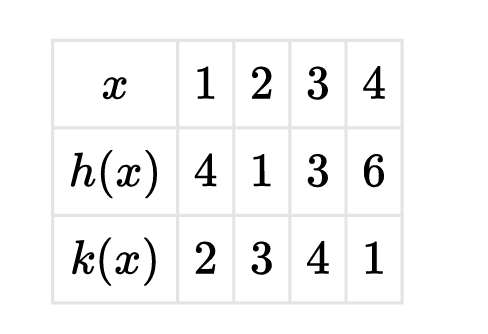
Question 

The table gives values for the invertible functions $h$ and $k$ at selected values of $x$. What is the value of $h^{-1}(k(3))$ ?
(A) $1$
(B) $2$
(C) $6$
(D) $12$
▶️ Answer/Explanation
Detailed solution

First, locate $x = 3$ in the table to find the value of $k(3)$.
From the table, when $x = 3$, the value of $k(3) = 4$.
The expression now becomes $h^{-1}(4)$.
To find $h^{-1}(4)$, look for the value of $x$ such that $h(x) = 4$.
From the table, $h(x) = 4$ when $x = 1$.
Therefore, $h^{-1}(4) = 1$.
The final value is $1$, which corresponds to option (A).
Question 

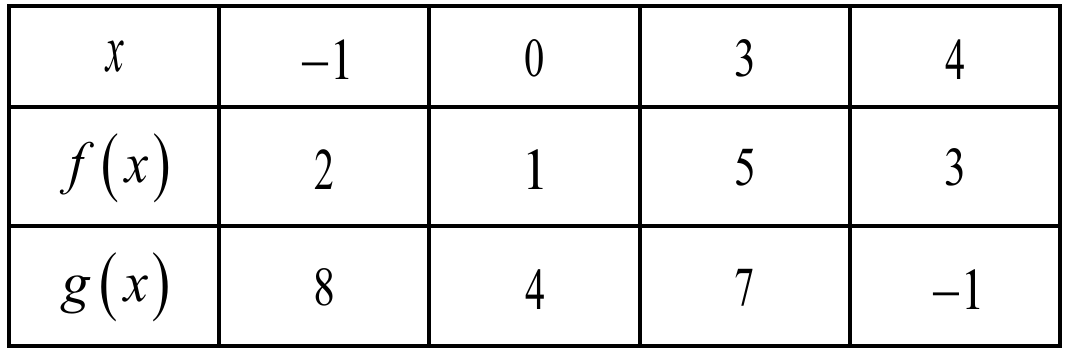
The table gives values for the functions \(f\) and \(g\) at selected values of \(x\). Functions \(f\) and \(g\) are defined for all real numbers. Let \(h\) be the function defined by \(h(x) = g(f(x))\). What is the value of \(h(4)\)?
(A) \(-3\)
(B) \(1\)
(C) \(2\)
(D) \(7\)
▶️ Answer/Explanation
Detailed solution

To find \(h(4)\), we use the definition \(h(4) = g(f(4))\).
First, locate \(x = 4\) in the table to find the value of \(f(4)\).
From the table, when \(x = 4\), \(f(4) = 3\).
Now, substitute this value into the function \(g\), so we need to find \(g(3)\).
Locate \(x = 3\) in the table to find the value of \(g(3)\).
From the table, when \(x = 3\), \(g(3) = 7\).
Therefore, \(h(4) = 7\).
The correct option is (D).

Question 

The function \(f\) is given by \(f(x) = x^2 – 4\), and the function \(g\) is given by \(g(x) = \frac{2x}{x+1}\). Which of the following is an expression for \(g(f(x))\)?
(A) \(\frac{2x^3 – 8x}{x + 1}\)
(B) \(\frac{4x^2}{(x + 1)^2} – 4\)
(C) \(\frac{2x^2 – 4}{x + 1}\)
(D) \(\frac{2(x^2 – 4)}{x^2 – 3}\)
▶️ Answer/Explanation
Detailed solution

To find \(g(f(x))\), substitute the expression for \(f(x)\) into the function \(g(x)\).
Given \(f(x) = x^2 – 4\), replace every \(x\) in \(g(x) = \frac{2x}{x+1}\) with \((x^2 – 4)\).
The numerator becomes: \(2(x^2 – 4)\).
The denominator becomes: \((x^2 – 4) + 1\).
Simplify the denominator: \(-4 + 1 = -3\), resulting in \(x^2 – 3\).
The final composite expression is \(\frac{2(x^2 – 4)}{x^2 – 3}\).
Therefore, the correct choice is (D).

Question 

An increasing, continuous function \( g(x) \) has outputs of some values of \( x \) shown above. \( f(x) \) is a function shown to the right as the graph.
(A) i. Estimate the value of \( g(f^{-1}(1)) \) for all values if it is defined.
ii. If \( h(x) = \frac{g(x)}{f(x)} \), then define any discontinuities, their type, and their location when \( x > 0 \).
(B) Suppose \( j(x) = \frac{1}{4.99 – \ln(x)} \cdot e^{2 \sin (\sqrt{x})} \) could be used to model \( f(x) \).
i. Determine the end behavior of \( j \) when it increases without bound. Express your answer with the mathematical definition of a limit if it exists. If it does not exist, explain why.
ii. Determine the vertical asymptote of \( j \) when it approaches \( 0 \) from the right. Express your answer with the mathematical definition of a limit if it exists. If it does not, explain why.
(C) Determine if \( g(x) \), using the values in the table, can be best modeled with a linear, quadratic, exponential, or logarithmic function. Explain your answer based on the relationship between the change in the output values of \( g \) and the change in the input values of \( g \).

Most-appropriate topic codes (CED):

TOPIC 2.8: Inverses of Exponential Functions — part (A)i
TOPIC 1.10: Rational Functions and Holes — part (A)ii
TOPIC 1.7: Rational Functions and End Behavior — part (B)i
TOPIC 1.9: Rational Functions and Vertical Asymptotes — part (B)ii
TOPIC 2.10: Logarithmic Function Context and Data Modeling — part (C)
▶️ Answer/Explanation
Detailed solution

(A)

i. The graph of \( f(x) \) shows that \( f(2) \approx 1 \), so \( f^{-1}(1) \approx 2 \). From the table, \( g(2) = 1 \). Thus, \( g(f^{-1}(1)) \approx 1 \).
Since \( f(x) \) is continuous and increasing, the inverse is defined for values in its range.
The estimate is a single value, \( 1 \), as the graph aligns precisely with the point. No other values exist due to the strictly increasing nature of \( f(x) \).

ii. The graph of \( f(x) \) crosses zero at \( x=1 \), so \( f(1)=0 \), and from the table, \( g(1)=0 \).
Thus, \( h(1) \) is undefined (\( 0/0 \) form).
The limit as \( x \to 1 \) of \( h(x) \) exists and equals \( 1 \), since both \( g(x) \) and \( f(x) \) resemble \( \log_2(x) \), making \( h(x)=1 \) elsewhere.
This indicates a removable discontinuity at \( x=1 \). No other discontinuities for \( x>0 \), as \( f(x) \neq 0 \) elsewhere in the domain.
The location is \( x=1 \), type: removable.

(B)

i. As \( x \to \infty \), \( \ln(x) \to \infty \), so \( 4.99 – \ln(x) \to -\infty \), and \( \frac{1}{4.99 – \ln(x)} \to 0^- \).
The term \( e^{2 \sin(\sqrt{x})} \) oscillates between \( e^{-2} \) and \( e^{2} \), remaining bounded.
By the squeeze theorem, since the amplitude approaches \( 0 \), \( \lim_{x \to \infty} j(x) = 0 \).
The end behavior is that \( j(x) \) approaches \( 0 \). The limit exists.

ii. As \( x \to 0^+ \), \( \ln(x) \to -\infty \), so \( 4.99 – \ln(x) \to +\infty \), and \( \frac{1}{4.99 – \ln(x)} \to 0^+ \).
Also, \( \sqrt{x} \to 0^+ \), \( \sin(\sqrt{x}) \to 0^+ \), so \( e^{2 \sin(\sqrt{x})} \to e^0 = 1 \).
Thus, \( j(x) \to 0 \cdot 1 = 0 \).
The limit is \( \lim_{x \to 0^+} j(x) = 0 \).
No vertical asymptote at \( x=0 \), as the function approaches a finite value, not \( \pm \infty \).

(C)

The table shows \( g(x) \) values: at \( x=0.5, 1, 2, 4, 7, 8 \), \( g(x)=-1, 0, 1, 2, 2.807, 3 \).
When \( x \) doubles (\( 0.5 \) to \( 1 \), \( 1 \) to \( 2 \), \( 2 \) to \( 4 \), \( 4 \) to \( 8 \)), \( \Delta g = +1 \) consistently.
This pattern matches logarithmic functions, where outputs increase by a constant for multiplicative input changes.
Linear would require constant \( \Delta g \) for constant \( \Delta x \), but \( \Delta x \) varies while \( \Delta g =1 \) for doublings.
Quadratic would show constant second differences, but here first differences are not constant.
Exponential would show constant ratios in outputs for additive input changes, which does not fit.
Thus, best modeled by a logarithmic function like \( g(x) = \log_2(x) \).

Question 

Let $f$ be an increasing function defined for $x > 0$. The table gives values for $f(x)$ at selected values of $x$. The function $g$ is given by $g(x) = 0.25x^3 – 9.5x^2 + 110x – 399$.
Part A
(i) The function $h$ is defined by $h(x) = (g \circ f)(x) = g(f(x))$. Find the value of $h(8)$ as a decimal approximation, or indicate that it is not defined.
(ii) Find the value of $f^{-1}(20)$, or indicate that it is not defined.
Part B
(i) Find all values of $x$, as decimal approximations, for which $g(x) = -45$, or indicate there are no such values.
(ii) Determine the end behavior of $g$ as $x$ increases without bound. Express your answer using the mathematical notation of a limit.
Part C
(i) Use the table of values of $f(x)$ to determine if $f$ is best modeled by a linear, quadratic, exponential, or logarithmic function.
(ii) Give a reason for your answer based on the relationship between the change in the output values of $f$ and the change in the input values of $f$.
▶️ Answer/Explanation
Detailed solution

Part A

(i) From the table, we find $f(8) = 15$.

Substitute $15$ into the function $g(x)$: $h(8) = g(15) = 0.25(15)^3 – 9.5(15)^2 + 110(15) – 399$.

$h(8) = 0.25(3375) – 9.5(225) + 1650 – 399$.

$h(8) = 843.75 – 2137.5 + 1650 – 399$.

$h(8) = -42.75$.

(ii) To find $f^{-1}(20)$, we look for the $x$ value where $f(x) = 20$.

From the table, $f(16) = 20$.

Therefore, $f^{-1}(20) = 16$.

Part B

(i) We solve the equation $0.25x^3 – 9.5x^2 + 110x – 399 = -45$.

Set the equation to zero: $0.25x^3 – 9.5x^2 + 110x – 354 = 0$.

Using numerical methods or a graphing calculator, the real solutions are approximately:

$x \approx 5.242$

$x \approx 12.188$

$x \approx 20.570$

(ii) The end behavior of a polynomial is determined by its leading term, $0.25x^3$.

Since the leading coefficient is positive and the degree is odd, as $x \to \infty$, $g(x) \to \infty$.

The limit notation is $\lim_{x \to \infty} g(x) = \infty$.

Part C

(i) The function $f$ is best modeled by a logarithmic function.

(ii) In a logarithmic model, constant changes in the output values correspond to proportional changes in the input values.

As the output $f(x)$ increases by a constant $5$ ($0, 5, 10, 15 \dots$),

The input $x$ values are multiplied by a constant factor of $2$ ($1, 2, 4, 8 \dots$).

This constant ratio of inputs for constant additions of outputs is the hallmark of logarithmic growth.

Question 

The figure shows the graph of the decreasing function \( f \) on its domain of all real numbers where \( x \neq 1 \). The points \( (-1, 0) \) and \( (3, 2) \) are on the graph of \( f \). The function \( g \) is given by \( g(x) = 2 + 3\ln x \).
(A) (i) The function \( h \) is defined by \( h(x) = (g \circ f)(x) = g(f(x)) \). Find the value of \( h(3) \) as a decimal approximation, or indicate that it is not defined.
       (ii) Find all real zeros of \( f \), or indicate there are no real zeros.
(B) (i) Find all values of \( x \), as decimal approximations, for which \( g(x) = e \), or indicate there are no such values.
       (ii) Determine the end behavior of \( g \) as \( x \) increases without bound. Express your answer using the mathematical notation of a limit.
(C) (i) Determine if \( f \) is invertible.
       (ii) Give a reason for your answer based on the definition of a function and the graph of \( y = f(x) \).
▶️ Answer/Explanation
Detailed solution

(A)(i) Find \( h(3) \)
The function is defined as \( h(x) = g(f(x)) \).
First, we find the value of the inner function, \( f(3) \).
According to the problem text and graph, the point \( (3, 2) \) lies on the graph of \( f \). Therefore, \( f(3) = 2 \).
Now, substitute this value into the outer function \( g(x) \):
\( h(3) = g(2) \)
Using the definition \( g(x) = 2 + 3\ln x \):
\( g(2) = 2 + 3\ln(2) \)
Using a calculator to approximate \( \ln(2) \approx 0.693 \):
\( g(2) = 2 + 3(0.6931…) \approx 2 + 2.079 = 4.079 \)
Answer: \( h(3) \approx 4.079 \)

(A)(ii) Find real zeros of \( f \)
A real zero of a function occurs where the graph intersects the x-axis (where \( f(x) = 0 \)).
Looking at the provided graph, the curve intersects the x-axis at \( x = -1 \).
The problem text confirms the point \( (-1, 0) \) is on the graph.
There are no other intersections with the x-axis shown.
Answer: \( x = -1 \)

(B)(i) Find \( x \) for \( g(x) = e \)
Set up the equation:
\( 2 + 3\ln x = e \)
Subtract 2 from both sides:
\( 3\ln x = e – 2 \)
Divide by 3:
\( \ln x = \frac{e – 2}{3} \)
Convert from logarithmic to exponential form to solve for \( x \):
\( x = e^{\left(\frac{e – 2}{3}\right)} \)
Approximating the value (using \( e \approx 2.718 \)):
\( x \approx e^{0.2394} \)
Answer: \( x \approx 1.271 \)

(B)(ii) End behavior of \( g \)
We need to evaluate the limit as \( x \to \infty \) for \( g(x) = 2 + 3\ln x \).
As \( x \) increases without bound (\( x \to \infty \)), the natural logarithm function \( \ln x \) also increases without bound (\( \ln x \to \infty \)).
Multiplying by 3 and adding 2 does not change the unbounded nature.
Answer: \( \lim_{x \to \infty} g(x) = \infty \)

(C)(i) Is \( f \) invertible?
Answer: Yes, \( f \) is invertible.

(C)(ii) Reason
A function is invertible if and only if it is one-to-one. This can be verified visually using the Horizontal Line Test.
Looking at the graph of \( f(x) \):
1. The function is strictly decreasing on both branches of its domain (\( x < 1 \) and \( x > 1 \)).
2. The range of the left branch appears to be \( (-\infty, 1) \) and the range of the right branch appears to be \( (1, \infty) \).
Because the y-values do not repeat (no horizontal line intersects the graph more than once), the function is one-to-one.
Therefore, \( f \) has an inverse.

Question 

A graphing calculator is required for these questions.
Let \(f\) be an increasing function defined for \(x \ge 0\). The table gives values of \(f(x)\) at selected values of \(x\). The function \(g\) is given by \(g(x) = \frac{x^3 – 14x – 27}{x+2}\).
(A) (i) The function \(h\) is defined by \(h(x) = (g \circ f)(x) = g(f(x))\). Find the value of \(h(5)\) as a decimal approximation, or indicate that it is not defined.
(ii) Find the value of \(f^{-1}(4)\), or indicate that it is not defined.
(B) (i) Find all values of \(x\), as decimal approximations, for which \(g(x) = 3\), or indicate there are no such values.
(ii) Determine the end behavior of \(g\) as \(x\) decreases without bound. Express your answer using the mathematical notation of a limit.
(C) (i) Use the table of values of \(f(x)\) to determine if \(f\) is best modeled by a linear, quadratic, exponential, or logarithmic function.
(ii) Give a reason for your answer based on the relationship between the change in the output values of \(f\) and the change in the input values of \(f\).
▶️ Answer/Explanation
Detailed solution

(A) (i)
First, evaluate the inner function \(f(5)\) using the table: \(f(5) = 34\).
Next, substitute this value into \(g(x)\) to find \(h(5) = g(34)\).
\(g(34) = \frac{34^3 – 14(34) – 27}{34 + 2}\)
\(g(34) = \frac{39304 – 476 – 27}{36} = \frac{38801}{36}\)
\(h(5) \approx 1077.806\)

(A) (ii)
To find \(f^{-1}(4)\), we look for the input value \(x\) in the table that produces an output of \(4\).
The table shows that \(f(3) = 4\).
Therefore, \(f^{-1}(4) = 3\).

(B) (i)
Set \(g(x) = 3\) and solve for \(x\):
\(\frac{x^3 – 14x – 27}{x + 2} = 3\)
Multiply both sides by \((x+2)\): \(x^3 – 14x – 27 = 3(x + 2)\)
Simplify: \(x^3 – 14x – 27 = 3x + 6\)
Rearrange into polynomial form: \(x^3 – 17x – 33 = 0\)
Using a graphing calculator to find the zero of this polynomial:
\(x \approx 4.879\)

(B) (ii)
We evaluate the limit as \(x \to -\infty\) for \(g(x)\).
\(\lim_{x \to -\infty} \frac{x^3 – 14x – 27}{x + 2}\)
By examining the leading terms, the function behaves like \(\frac{x^3}{x} = x^2\) for large absolute values of \(x\).
As \(x \to -\infty\), \(x^2 \to \infty\).
\(\lim_{x \to -\infty} g(x) = \infty\)

(C) (i)
Calculate the first differences of \(f(x)\): \((-5) – (-10) = 5\), \(4 – (-5) = 9\), \(17 – 4 = 13\), \(34 – 17 = 17\).
Calculate the second differences: \(9 – 5 = 4\), \(13 – 9 = 4\), \(17 – 13 = 4\).
Since the second differences are constant, \(f\) is best modeled by a quadratic function.

(C) (ii)
The model is quadratic because for equal intervals of the input values \(x\) (step size of \(1\)), the rate of change of the output values increases by a constant amount (constant second difference of \(4\)).

Scroll to Top