
Composite Functions and Domain Restrictions
If \( \mathrm{f} \) and \( \mathrm{g} \) are functions, the composite function \( \mathrm{f \circ g} \) maps a set of input values to a set of output values by using the output of \( \mathrm{g} \) as the input of \( \mathrm{f} \).
The composite function is written as

\( \mathrm{ \displaystyle (f \circ g)(x) = f(g(x)) } \)
This notation emphasizes the order of operations: evaluate \( \mathrm{g(x)} \) first, then substitute the result into \( \mathrm{f} \).
Domain of a Composite Function
The domain of \( \mathrm{f \circ g} \) is restricted because:

• \( \mathrm{x} \) must be in the domain of \( \mathrm{g} \)
• \( \mathrm{g(x)} \) must be in the domain of \( \mathrm{f} \)
Therefore, the domain of \( \mathrm{f \circ g} \) consists of all input values of \( \mathrm{g} \) for which the corresponding output lies in the domain of \( \mathrm{f} \).
Example
Let
\( \mathrm{ \displaystyle g(x) = x – 1 } \)
\( \mathrm{ \displaystyle f(x) = \sqrt{x} } \)
Find \( \mathrm{(f \circ g)(x)} \) and its domain.
▶️ Answer/Explanation
Form the composite:
\( \mathrm{ \displaystyle (f \circ g)(x) = f(g(x)) = \sqrt{x – 1} } \)
For the square root to be defined, the input must be nonnegative:
\( \mathrm{ \displaystyle x – 1 \ge 0 \Rightarrow x \ge 1 } \)
Conclusion
\( \mathrm{(f \circ g)(x) = \sqrt{x – 1}} \) with domain \( \mathrm{x \ge 1} \).
Example
Let
\( \mathrm{ \displaystyle g(x) = \dfrac{1}{x} } \)
\( \mathrm{ \displaystyle f(x) = x^2 + 3 } \)
Find \( \mathrm{(f \circ g)(x)} \) and describe its domain.
▶️ Answer/Explanation
Form the composite:
\( \mathrm{ \displaystyle (f \circ g)(x) = f\!\left(\dfrac{1}{x}\right) = \left(\dfrac{1}{x}\right)^2 + 3 } \)
Simplify:
\( \mathrm{ \displaystyle (f \circ g)(x) = \dfrac{1}{x^2} + 3 } \)
The function \( \mathrm{g(x) = \tfrac{1}{x}} \) is undefined at \( \mathrm{x = 0} \).
Conclusion
\( \mathrm{(f \circ g)(x) = \dfrac{1}{x^2} + 3} \) with domain \( \mathrm{x \ne 0} \).
Evaluating Composite Functions Using Multiple Representations
Values of a composite function \( \mathrm{f \circ g} \) can be calculated or estimated by using the output values of \( \mathrm{g} \) as the input values of \( \mathrm{f} \).
The composite function is written as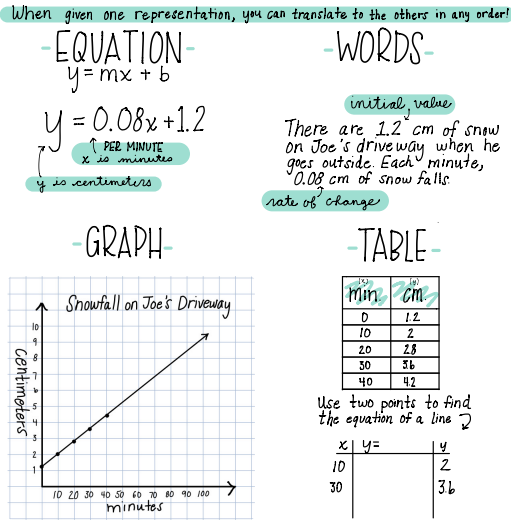
\( \mathrm{ \displaystyle (f \circ g)(x) = f(g(x)) } \)
This process can be carried out using different representations of the functions:
• Analytical: substitute expressions algebraically
• Numerical: use tables of values
• Graphical: read outputs from graphs
• Verbal: follow descriptions of how quantities change
In every case, the key idea is the same: evaluate \( \mathrm{g} \) first, then apply \( \mathrm{f} \).
Example
Let
\( \mathrm{ \displaystyle g(x) = 2x + 1 } \)
\( \mathrm{ \displaystyle f(x) = x^2 } \)
Find \( \mathrm{(f \circ g)(3)} \).
▶️ Answer/Explanation
First evaluate \( \mathrm{g(3)} \):
\( \mathrm{ \displaystyle g(3) = 2(3) + 1 = 7 } \)
Then use this value as the input for \( \mathrm{f} \):
\( \mathrm{ \displaystyle f(7) = 7^2 = 49 } \)
Conclusion
\( \mathrm{(f \circ g)(3) = 49} \).
Example
A table shows values of a function \( \mathrm{g} \):
\( \mathrm{g(1) = 4,\; g(2) = 6} \)
A graph of \( \mathrm{f} \) shows that
\( \mathrm{f(4) = 10,\; f(6) = 18} \)
Estimate \( \mathrm{(f \circ g)(2)} \).
▶️ Answer/Explanation
From the table,
\( \mathrm{g(2) = 6} \)
Using the graph of \( \mathrm{f} \),
\( \mathrm{f(6) \approx 18} \)
Conclusion
\( \mathrm{(f \circ g)(2) \approx 18} \).
Non-Commutativity of Function Composition
The composition of functions is not commutative. This means that, in general, changing the order in which two functions are composed changes the result.
If \( \mathrm{f} \) and \( \mathrm{g} \) are functions, then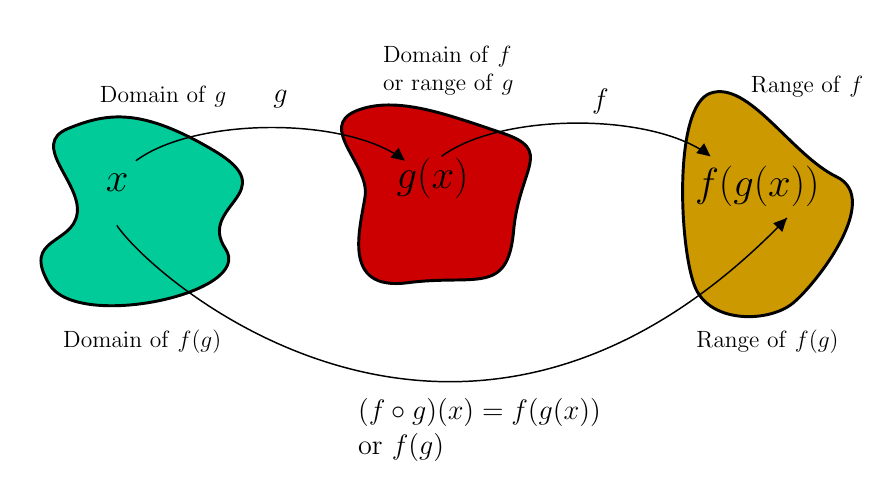
\( \mathrm{ \displaystyle (f \circ g)(x) = f(g(x)) } \)
and
\( \mathrm{ \displaystyle (g \circ f)(x) = g(f(x)) } \)
Because the output of the first function becomes the input of the second, reversing the order usually produces a different expression and different values.
As a result,
• \( \mathrm{(f \circ g)(x) \ne (g \circ f)(x)} \) in general
• \( \mathrm{f(g(x))} \) and \( \mathrm{g(f(x))} \) usually represent different values
This contrasts with addition and multiplication of numbers, which are commutative.
Example
Let
\( \mathrm{ \displaystyle f(x) = x + 3 } \)
\( \mathrm{ \displaystyle g(x) = 2x } \)
Find \( \mathrm{(f \circ g)(x)} \) and \( \mathrm{(g \circ f)(x)} \).
▶️ Answer/Explanation
Compute \( \mathrm{(f \circ g)(x)} \):
\( \mathrm{ \displaystyle f(g(x)) = f(2x) = 2x + 3 } \)
Compute \( \mathrm{(g \circ f)(x)} \):
\( \mathrm{ \displaystyle g(f(x)) = g(x + 3) = 2(x + 3) = 2x + 6 } \)
Conclusion
Since \( \mathrm{2x + 3 \ne 2x + 6} \), the compositions are different.
Example
Let
\( \mathrm{ \displaystyle f(x) = x^2 } \)
\( \mathrm{ \displaystyle g(x) = x – 1 } \)
Evaluate \( \mathrm{(f \circ g)(2)} \) and \( \mathrm{(g \circ f)(2)} \).
▶️ Answer/Explanation
First, compute \( \mathrm{(f \circ g)(2)} \):
\( \mathrm{ \displaystyle g(2) = 1 } \)
\( \mathrm{ \displaystyle f(1) = 1 } \)
So \( \mathrm{(f \circ g)(2) = 1} \).
Now compute \( \mathrm{(g \circ f)(2)} \):
\( \mathrm{ \displaystyle f(2) = 4 } \)
\( \mathrm{ \displaystyle g(4) = 3 } \)
Conclusion
Since \( \mathrm{1 \ne 3} \), the two compositions produce different values.
The Identity Function and Function Composition
The function defined by 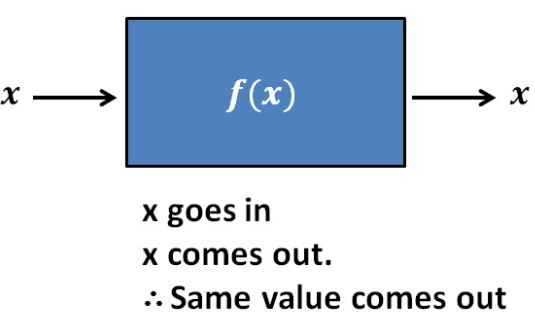
\( \mathrm{ \displaystyle f(x) = x } \)
is called the identity function.
When the identity function is composed with any function \( \mathrm{g} \), the resulting composite function is unchanged:
\( \mathrm{ \displaystyle g(f(x)) = g(x) } \)
\( \mathrm{ \displaystyle f(g(x)) = g(x) } \)
Thus, composing any function with the identity function leaves the function exactly the same.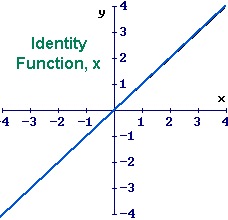
The identity function plays a special role in composition, similar to how:
• 0 is the additive identity, since \( \mathrm{x + 0 = x} \)
• 1 is the multiplicative identity, since \( \mathrm{x \cdot 1 = x} \)
Likewise, the identity function is the identity element for function composition.
Example
Let
\( \mathrm{ \displaystyle g(x) = 3x – 5 } \)
Verify that composing \( \mathrm{g} \) with the identity function leaves \( \mathrm{g} \) unchanged.
▶️ Answer/Explanation
Using \( \mathrm{f(x) = x} \):
\( \mathrm{ \displaystyle g(f(x)) = g(x) = 3x – 5 } \)
\( \mathrm{ \displaystyle f(g(x)) = g(x) = 3x – 5 } \)
Conclusion
Composing with the identity function does not change the function.
Example
Let
\( \mathrm{ \displaystyle g(x) = x^2 + 1 } \)
Evaluate both compositions with the identity function.
▶️ Answer/Explanation
\( \mathrm{ \displaystyle g(f(x)) = g(x) = x^2 + 1 } \)
\( \mathrm{ \displaystyle f(g(x)) = g(x) = x^2 + 1 } \)
Conclusion
The identity function behaves like a “do nothing” operation in composition.
Numerical and Graphical Representations of Composite Functions
A numerical or graphical representation of a composite function \( \mathrm{f \circ g} \) can often be constructed by calculating or estimating ordered pairs of the form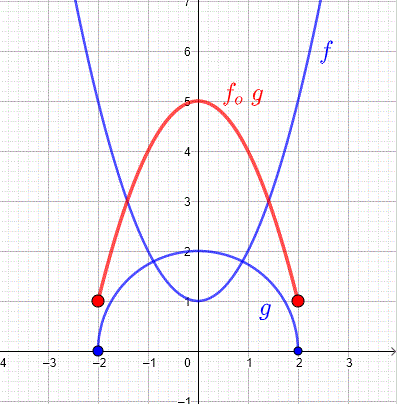
\( \mathrm{ \displaystyle (x,\; f(g(x))) } \)
This process follows the definition of composition: for each input value \( \mathrm{x} \), the value of \( \mathrm{g(x)} \) is found first, and that output is then used as the input to \( \mathrm{f} \).
By repeating this process for several input values, a table of values can be created. Plotting these points produces a graphical representation of the composite function.
This approach is especially useful when:
• the functions are given by tables or graphs rather than formulas
• exact algebraic expressions are difficult to obtain
Example
The table below gives values of \( \mathrm{g} \) and \( \mathrm{f} \):
\( \mathrm{ g(1)=2,\; g(2)=4,\; g(3)=5 } \)
\( \mathrm{ f(2)=6,\; f(4)=12,\; f(5)=15 } \)
Construct a numerical representation of \( \mathrm{(f \circ g)} \).
▶️ Answer/Explanation
Evaluate \( \mathrm{f(g(x))} \) for each input:
\( \mathrm{(f \circ g)(1)=f(2)=6} \)
\( \mathrm{(f \circ g)(2)=f(4)=12} \)
\( \mathrm{(f \circ g)(3)=f(5)=15} \)
Conclusion
The composite function includes the points \( \mathrm{(1,6),\; (2,12),\; (3,15)} \).
Example
The graph of \( \mathrm{g} \) shows that \( \mathrm{g(0)=1} \) and \( \mathrm{g(2)=3} \).
The graph of \( \mathrm{f} \) shows that \( \mathrm{f(1)=4} \) and \( \mathrm{f(3)=10} \).
Estimate values of \( \mathrm{(f \circ g)} \).
▶️ Answer/Explanation
Using the graphs:
\( \mathrm{(f \circ g)(0)=f(1)=4} \)
\( \mathrm{(f \circ g)(2)=f(3)=10} \)
Conclusion
The composite function includes approximate points \( \mathrm{(0,4)} \) and \( \mathrm{(2,10)} \), which can be plotted to form its graph.
Additive Transformations as Function Composition
An additive transformation of a function \( \mathrm{f} \) that produces vertical or horizontal translations can be understood using function composition.
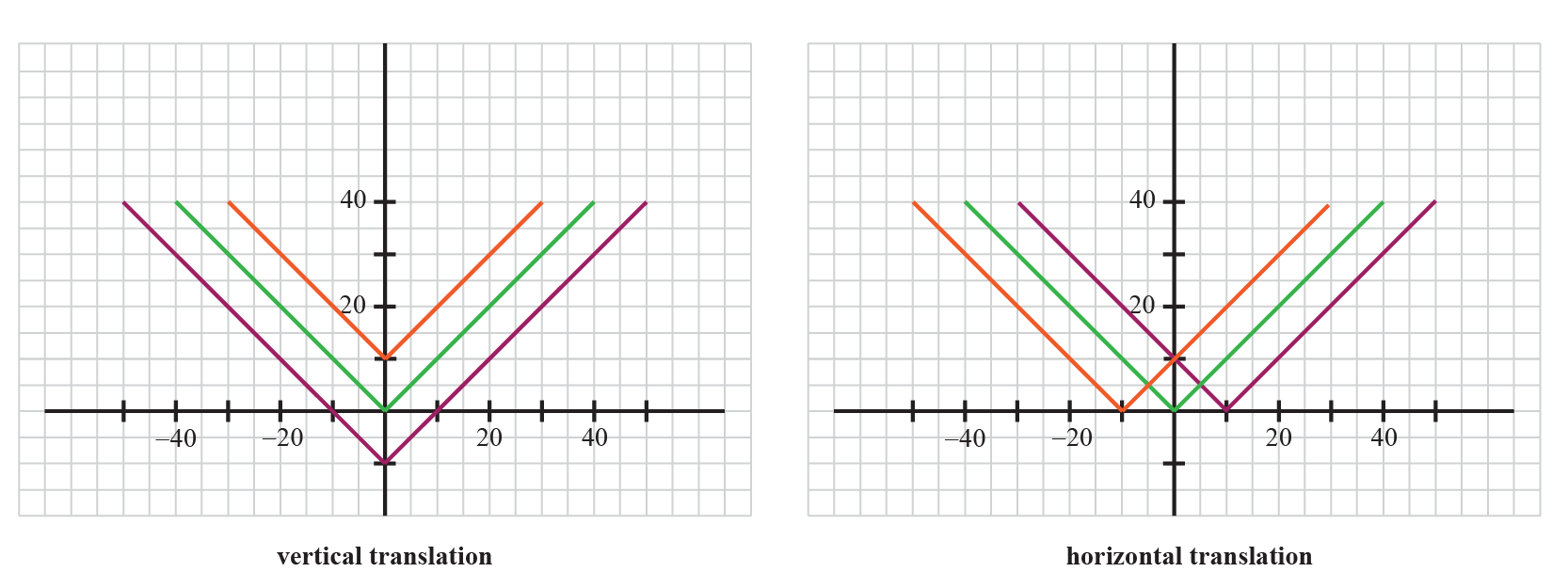
Consider the function
\( \mathrm{ \displaystyle g(x) = x + k } \)
where \( \mathrm{k} \) is a real number.
When this function is composed with \( \mathrm{f} \), it results in a horizontal translation:
\( \mathrm{ \displaystyle (f \circ g)(x) = f(x + k) } \)
This shifts the graph of \( \mathrm{f} \) left by \( \mathrm{k} \) units if \( \mathrm{k > 0} \), and right by \( \mathrm{|k|} \) units if \( \mathrm{k < 0} \).
A vertical translation occurs when a constant is added to the output of the function:
\( \mathrm{ \displaystyle f(x) + k } \)
Thus, additive transformations can be interpreted through composition and direct addition, providing a structured way to analyze graph shifts.
Example
Let
\( \mathrm{ \displaystyle f(x) = x^2 } \)
Describe the transformation represented by
\( \mathrm{ \displaystyle f(x + 3) } \)
▶️ Answer/Explanation
Here, \( \mathrm{g(x) = x + 3} \).
The composite function is
\( \mathrm{ \displaystyle (f \circ g)(x) = f(x + 3) } \)
Conclusion
The graph of \( \mathrm{f(x) = x^2} \) is shifted 3 units to the left.
Example
Let
\( \mathrm{ \displaystyle f(x) = \sqrt{x} } \)
Describe the transformation represented by
\( \mathrm{ \displaystyle f(x – 2) + 4 } \)
▶️ Answer/Explanation
The expression \( \mathrm{f(x – 2)} \) represents a horizontal shift.
Since \( \mathrm{x – 2 = x + (-2)} \), the graph shifts 2 units to the right.
The \( \mathrm{+4} \) outside the function causes a vertical shift upward by 4 units.
Conclusion
The graph of \( \mathrm{f(x)} \) is shifted right 2 units and up 4 units.
Multiplicative Transformations as Function Composition
A multiplicative transformation of a function \( \mathrm{f} \) that produces vertical or horizontal dilations can be understood using function composition.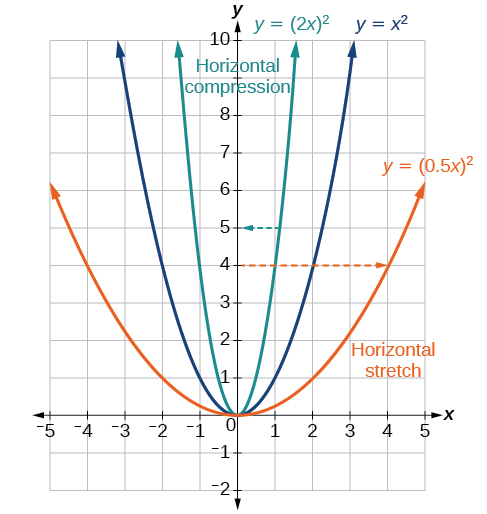
Consider the function
\( \mathrm{ \displaystyle g(x) = kx } \)
where \( \mathrm{k \ne 0} \) is a real number.
When this function is composed with \( \mathrm{f} \), it results in a horizontal dilation:
\( \mathrm{ \displaystyle (f \circ g)(x) = f(kx) } \)
The graph of \( \mathrm{f(x)} \) is horizontally scaled by a factor of
\( \mathrm{ \displaystyle \left| \dfrac{1}{k} \right| } \)
If \( \mathrm{|k| > 1} \), the graph is compressed horizontally. If \( \mathrm{0 < |k| < 1} \), the graph is stretched horizontally.

If \( \mathrm{k < 0} \), the transformation also includes a reflection across the y-axis.
A vertical dilation occurs when the output of the function is multiplied by a constant:
\( \mathrm{ \displaystyle kf(x) } \)
If \( \mathrm{|k| > 1} \), the graph is stretched vertically. If \( \mathrm{0 < |k| < 1} \), the graph is compressed vertically. If \( \mathrm{k < 0} \), the graph is reflected across the x-axis.
Thus, multiplicative transformations can be interpreted through composition with \( \mathrm{g(x)=kx} \) and multiplication of function outputs.
Example
Let
\( \mathrm{ \displaystyle f(x) = x^2 } \)
Describe the transformation represented by
\( \mathrm{ \displaystyle f(2x) } \)
▶️ Answer/Explanation
Here, \( \mathrm{g(x)=2x} \).
The composite function is
\( \mathrm{ \displaystyle (f \circ g)(x) = f(2x) } \)
Conclusion
The graph of \( \mathrm{f(x)} \) is horizontally compressed by a factor of \( \mathrm{\tfrac{1}{2}} \).
Example
Let
\( \mathrm{ \displaystyle f(x) = \sqrt{x} } \)
Describe the transformation represented by
\( \mathrm{ \displaystyle 3f(x) } \)
▶️ Answer/Explanation
The expression multiplies all output values by 3.
This results in a vertical stretch by a factor of 3.
Conclusion
The graph of \( \mathrm{f(x)} \) is stretched vertically.