
▶️ Answer/Explanation
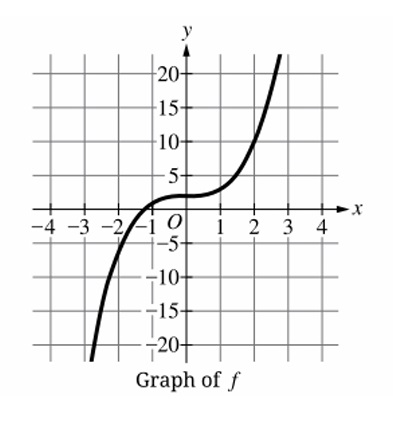
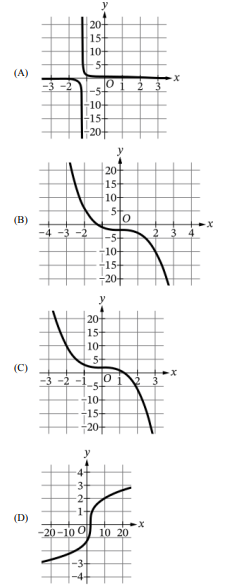
The graph of \( y = f^{-1}(x) \) is the reflection of the graph of \( y = f(x) \) across the line \( y = x \).
From the given figure, \( f \) appears to be a curve that increases and spans large \( y \)-values for small \( x \) changes.
The inverse should thus have large \( x \)-values for small \( y \) changes, resembling the shape in option (D) where the axes appear swapped.
✅ Answer: (D)
▶️ Answer/Explanation
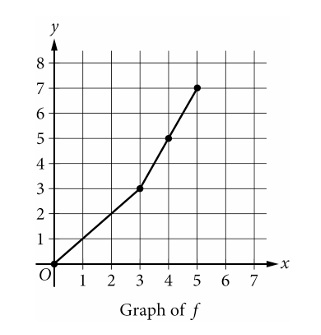
From the graph, \( f \) is increasing and its maximum output is \( y = 7 \) at \( x = 5 \) (endpoint).
Since \( g \) is the inverse of \( f \), the domain of \( g \) is the range of \( f \), and the range of \( g \) is the domain of \( f \).
The range of \( g \) is \( [0,5] \), so the maximum value of \( g \) is 5, which occurs when the input to \( g \) is 7 because \( f(5) = 7 \) ⇒ \( g(7) = 5 \).
✅ Answer: (C)
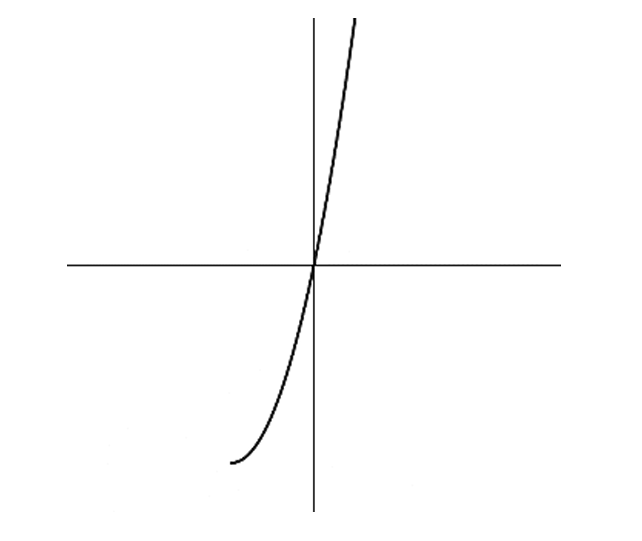
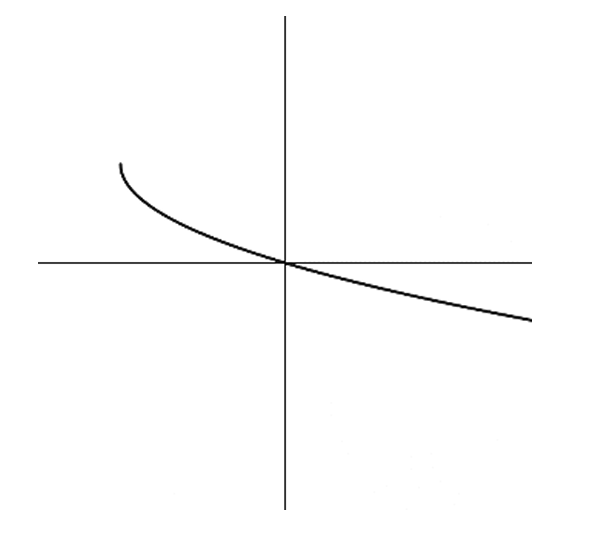
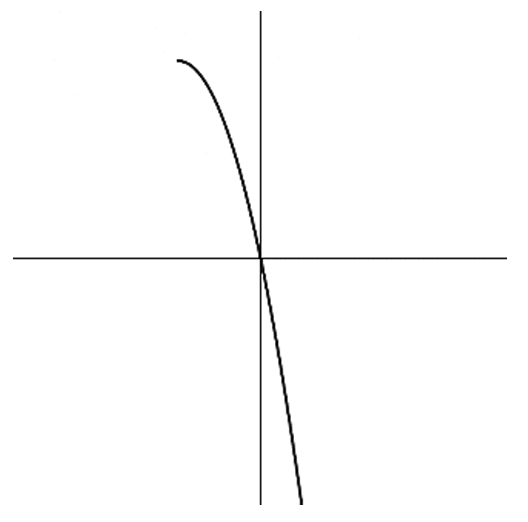
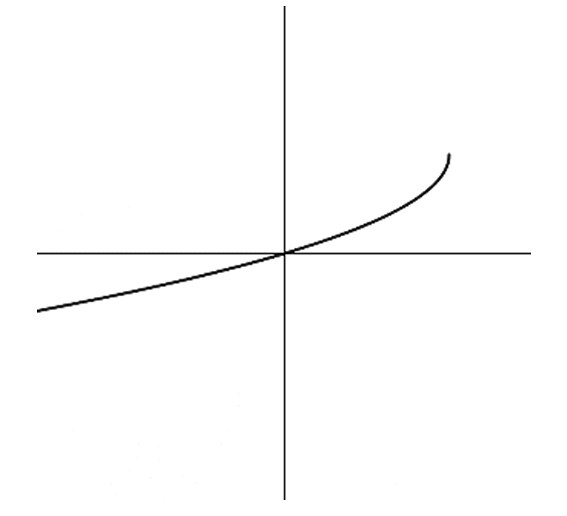
▶️ Answer/Explanation
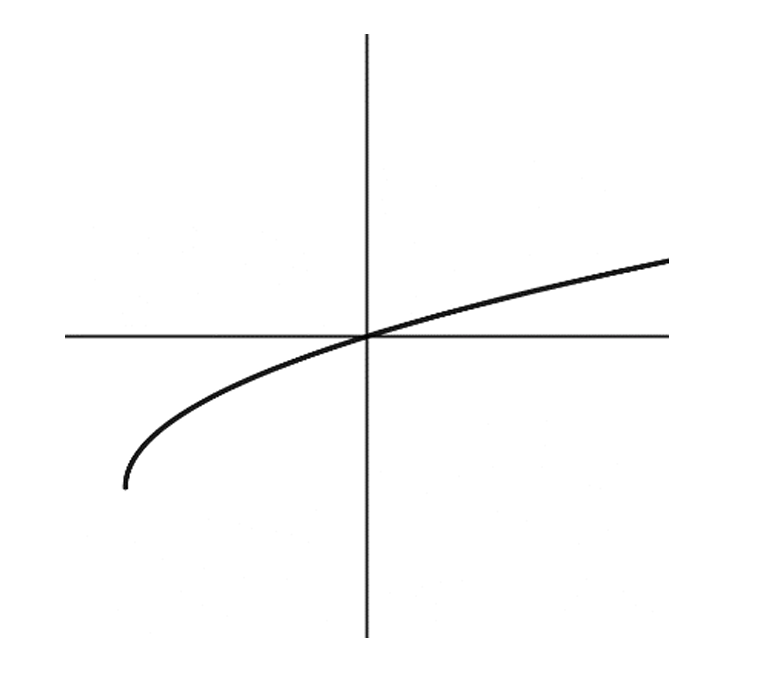
The inverse of a function $f(x)$ is found by reflecting its graph across the line $y = x$.
In the original graph, the curve passes through the origin $(0,0)$.
The original function has a slow horizontal growth in the first quadrant and a steep drop in the third quadrant.
When reflected across $y = x$, the horizontal behavior becomes vertical and the vertical becomes horizontal.
This results in a graph that is steep in the first quadrant and flattens out in the third quadrant.
Comparing the choices, Option (a) correctly represents this reflection.
Therefore, the correct representation of the inverse $f^{-1}(x)$ is a.
▶️ Answer/Explanation
▶️ Answer/Explanation
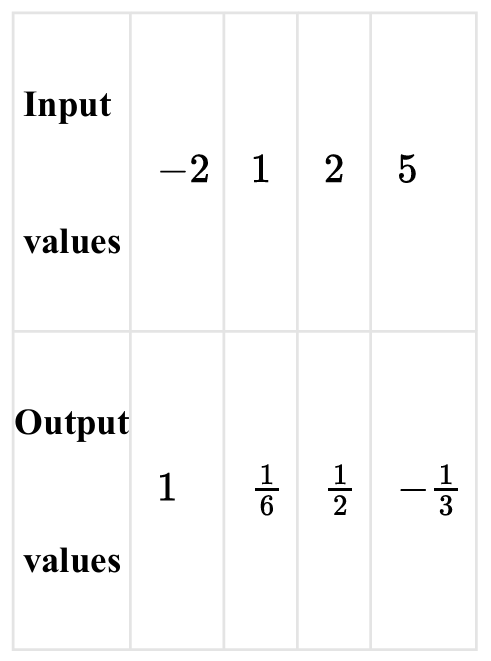
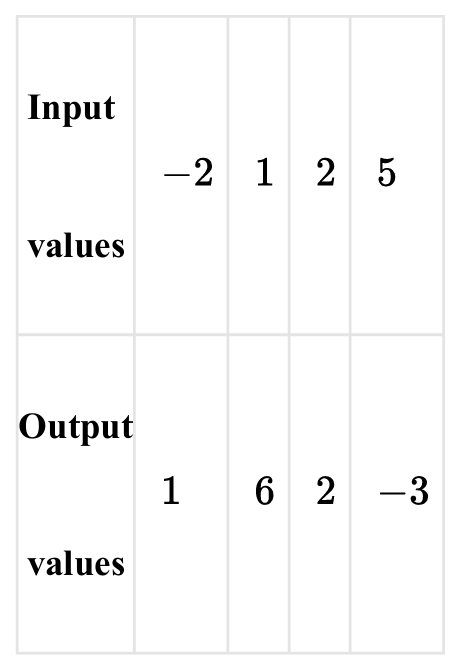
The inverse function $f^{-1}$ swaps the inputs and outputs of the original function $f$.
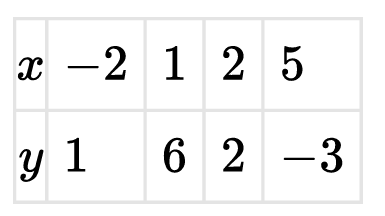
From the table, the original pairs $(x, y)$ are $(-2, 1)$, $(1, 6)$, $(2, 2)$, and $(5, -3)$.
The inverse pairs $(y, x)$ must be $(1, -2)$, $(6, 1)$, $(2, 2)$, and $(-3, 5)$.
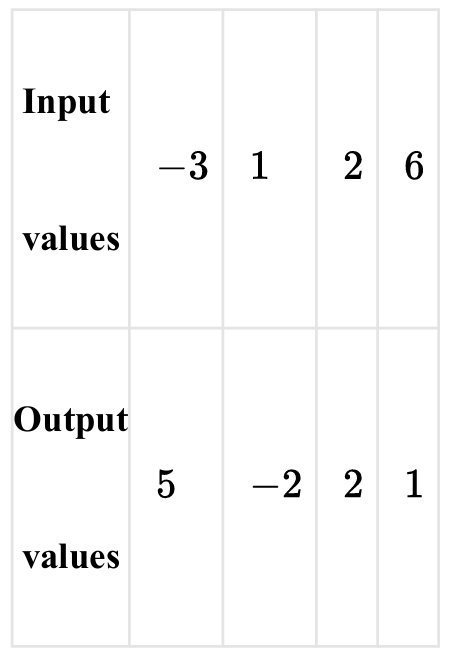
Sorting these by input value, we get: $(-3, 5)$, $(1, -2)$, $(2, 2)$, and $(6, 1)$.
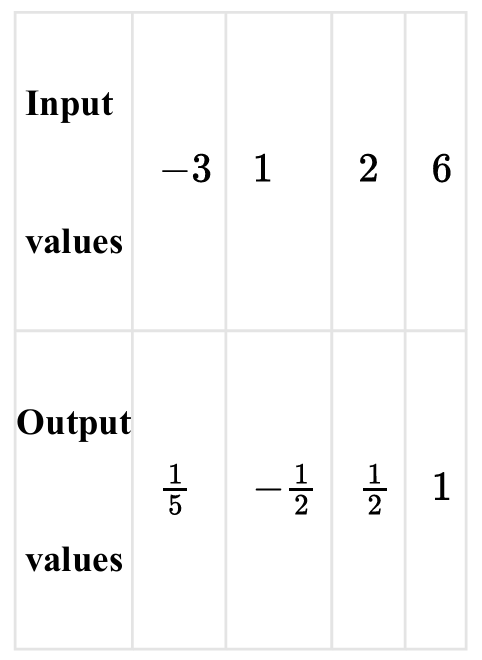
Option (B) lists these input values $\{-3, 1, 2, 6\}$ with corresponding outputs $\{5, -2, 2, 1\}$.
Therefore, (B) is the correct description of the inverse function $f^{-1}$.
▶️ Answer/Explanation
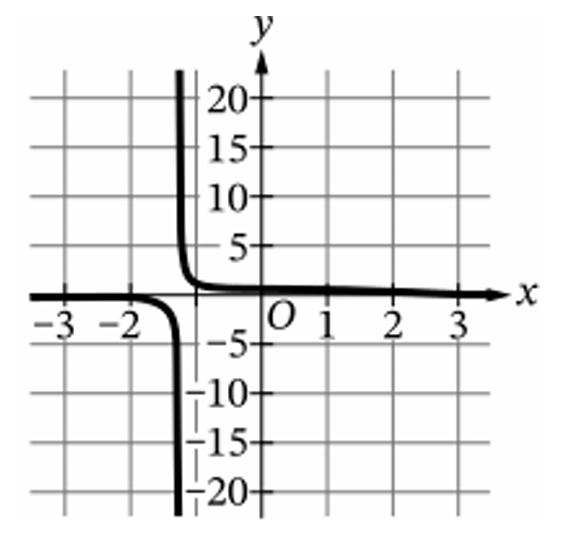
The correct option is (D).
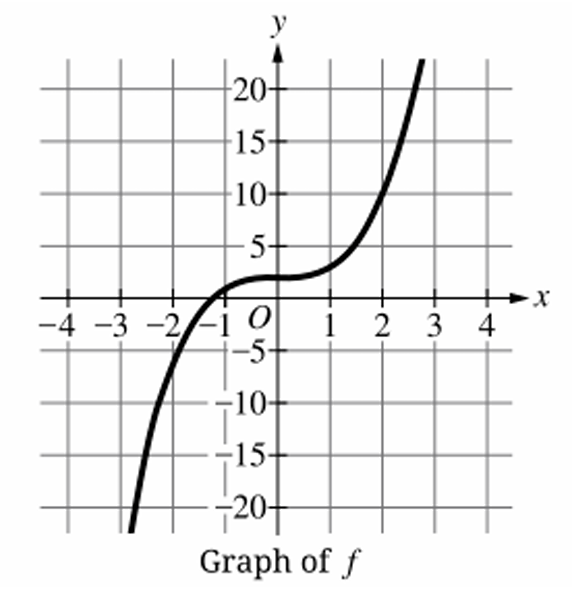
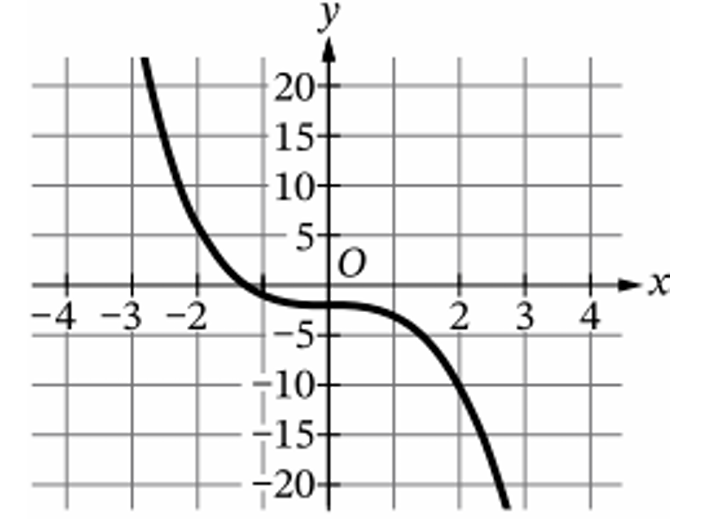
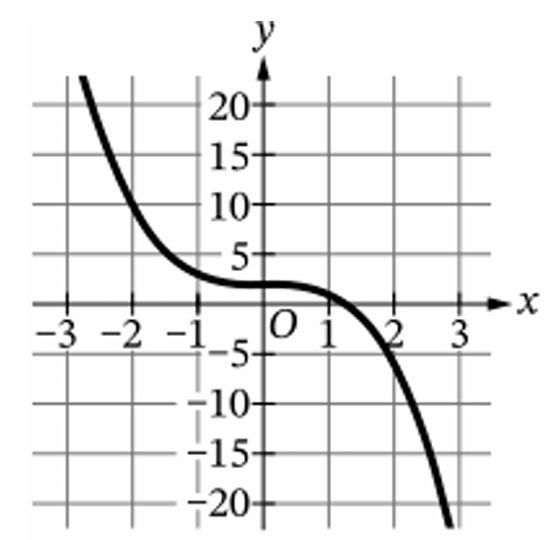
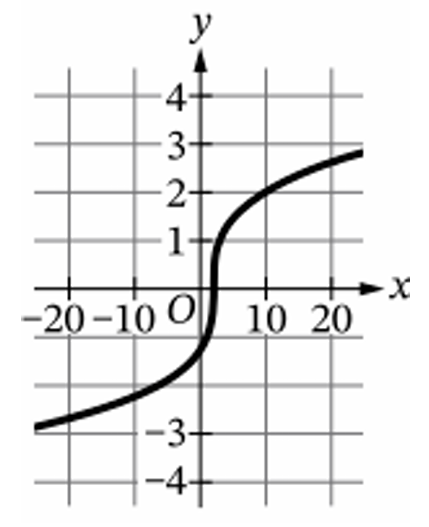
Identify key points on the graph of $y = f(x)$, such as $(-2, -10)$, $(0, 2)$, and $(2, 10)$.
For the inverse function $y = f^{-1}(x)$, the $x$ and $y$ coordinates are swapped.
The corresponding points on $f^{-1}(x)$ must be $(-10, -2)$, $(2, 0)$, and $(10, 2)$.
Graphically, $f^{-1}(x)$ is the reflection of $f(x)$ across the line $y = x$.
Option (D) is the only graph that contains these swapped points and reflects the original shape.
Notice the $x$-axis scale in (D) extends to $\pm 20$, matching the original $y$-axis range.
▶️ Answer/Explanation
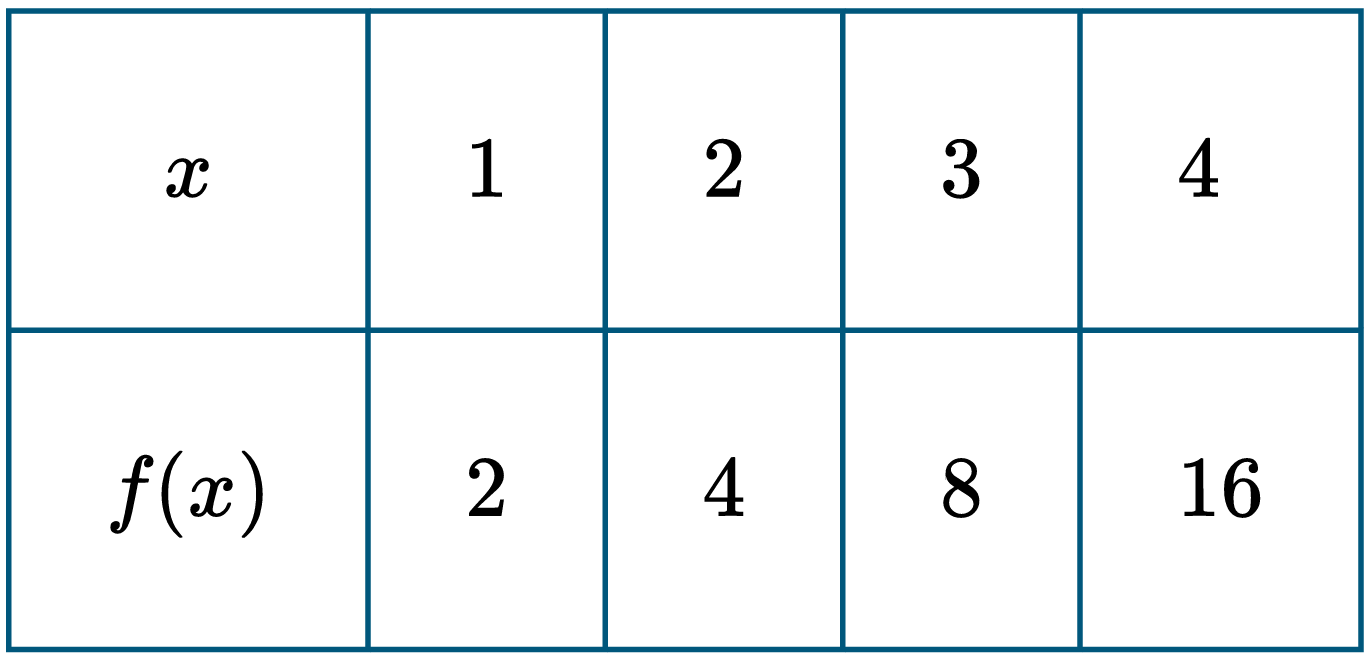
The original function $f$ is exponential because as $x$ increases by $1$, $f(x)$ doubles ($2, 4, 8, 16$).
The inverse of an exponential function is a logarithmic function, ruling out (C) and (D).
For the inverse function $f^{-1}(x)$, the inputs and outputs of $f$ are swapped.
The inputs of $f^{-1}(x)$ are the values $\{2, 4, 8, 16\}$ and the outputs are $\{1, 2, 3, 4\}$.
As the input values of $f^{-1}(x)$ double, the output values increase by $1$.
This matches the description provided in option (B).
Therefore, $f^{-1}(x)$ is logarithmic with output values increasing by $1$ every time input values double.
▶️ Answer/Explanation
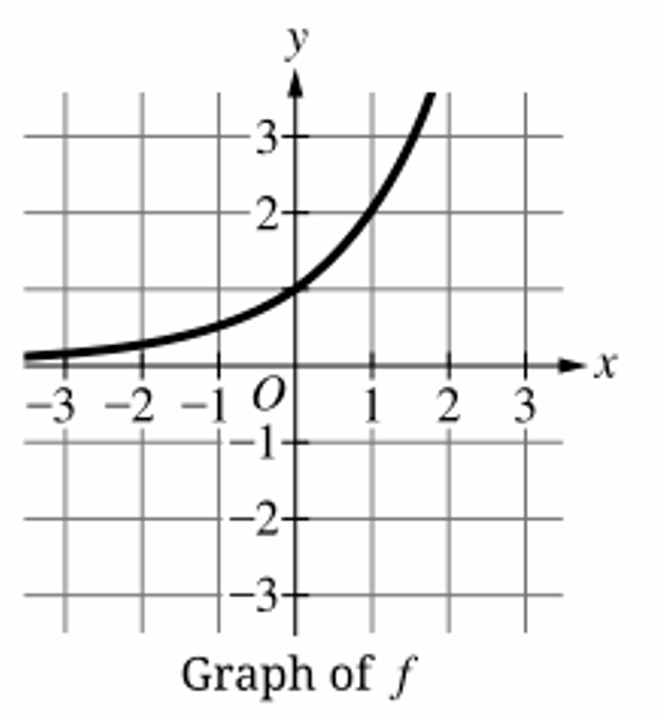
The graph shows $f$ passes through $(0, 1)$, $(1, 2)$, and $(2, 4)$.
This indicates the exponential function is defined by $f(x) = 2^x$.
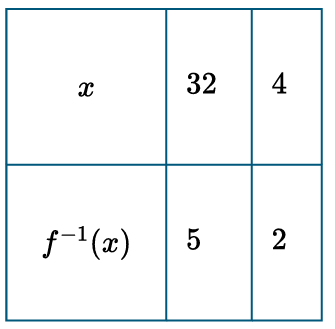
An inverse function $f^{-1}(x)$ swaps input and output: $(x, y) \rightarrow (y, x)$.
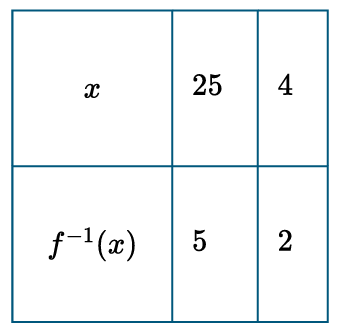
Since $f(2) = 4$, the inverse must contain the point $(4, 2)$.
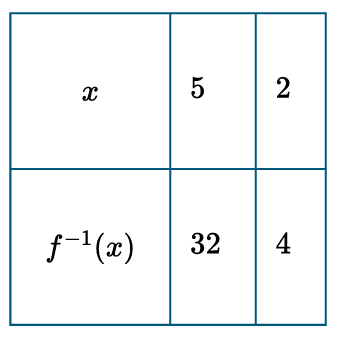
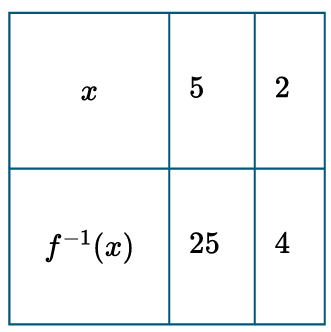
Since $f(5) = 2^5 = 32$, the inverse must contain the point $(32, 5)$.
Table (D) is the only one correctly matching these coordinates.
Therefore, (D) is the correct table for the inverse function.
▶️ Answer/Explanation
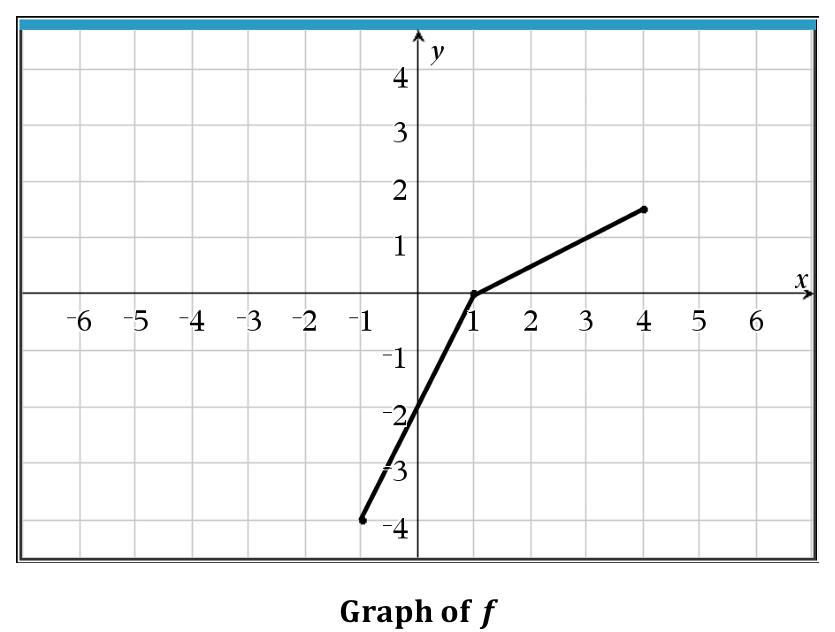
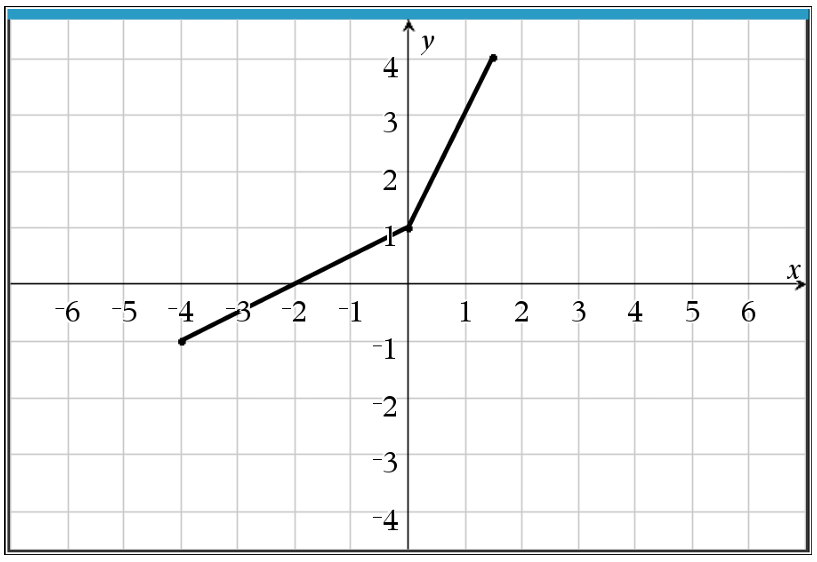
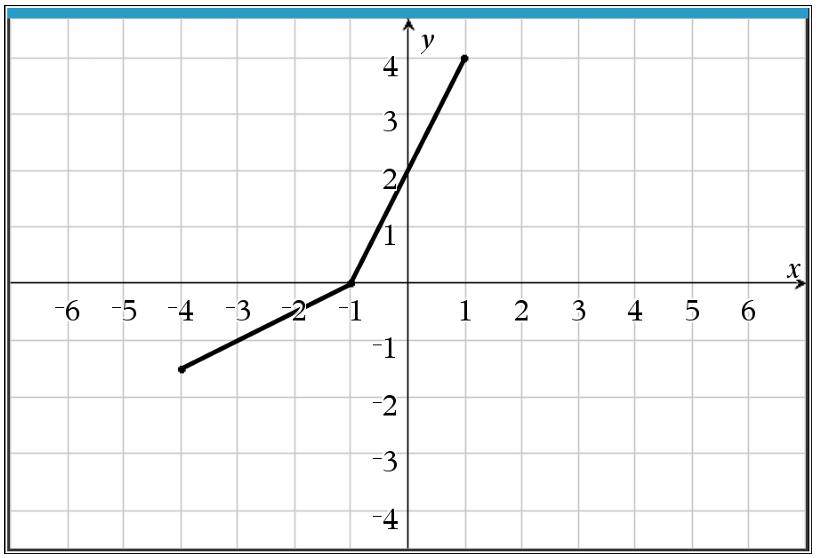
The graph of $f$ contains the key endpoints and vertices: $(-1, -4)$, $(1, 0)$, and $(4, 2)$.
For an inverse function $f^{-1}$, the coordinates $(x, y)$ of $f$ are swapped to $(y, x)$.
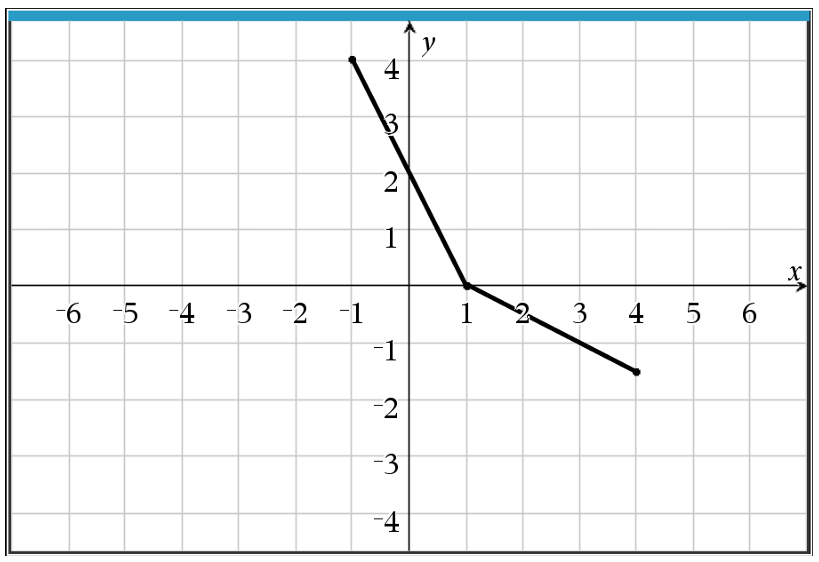
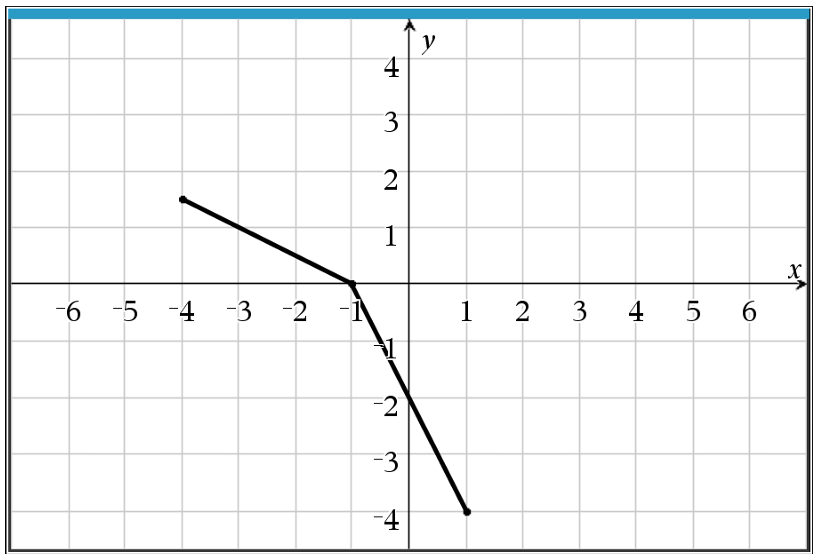
The corresponding points for $f^{-1}$ must be $(-4, -1)$, $(0, 1)$, and $(2, 4)$.
Graph (C) is the only option that contains these specific inverted coordinates.
Graphically, $f^{-1}$ is the reflection of $f$ across the line $y = x$.
Option (C) correctly reflects the two linear segments across the identity line $y = x$.
▶️ Answer/Explanation
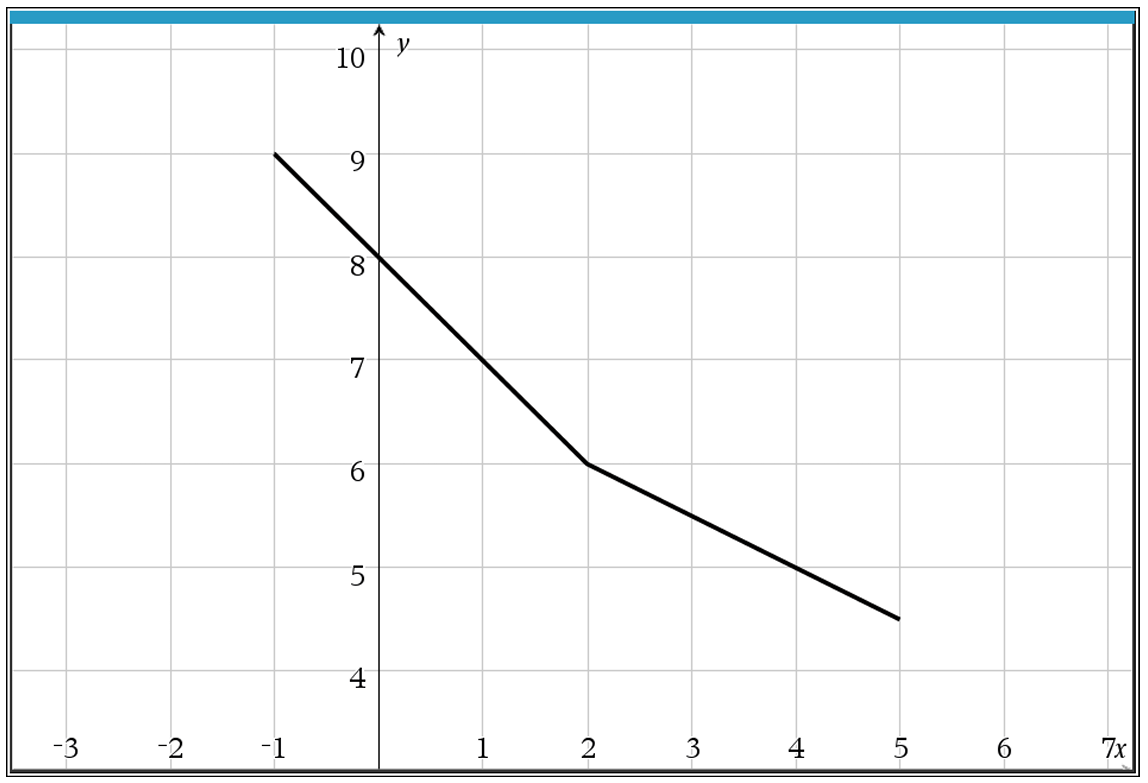
By definition of an inverse function, if $g$ is the inverse of $f$, then $g(y) = x$ is equivalent to $f(x) = y$.
To find the value of $g(7)$, we must locate the point on the graph of $f$ where the $y$-coordinate is $7$.
Observing the provided graph, when $y = 7$, the corresponding $x$-coordinate on the line segment is $1$.
This means that $f(1) = 7$.
Therefore, $g(7) = 1$.
The correct option is (C).