
▶️ Answer/Explanation
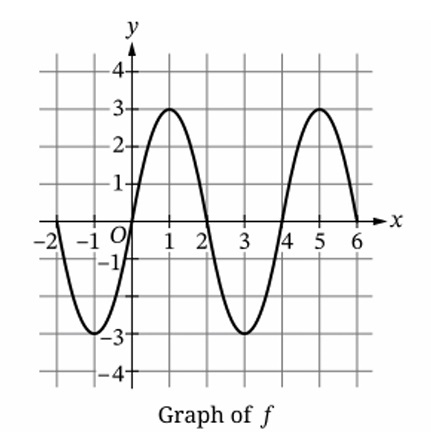
The period of a sinusoidal function is the horizontal distance between consecutive points at which the pattern repeats (e.g., from peak to peak or trough to trough). From the given graph, consecutive maxima occur at \( x = 1 \) and \( x = 5 \), and consecutive minima occur at \( x = -1 \) and \( x = 3 \). Thus, the period is \( 5 – 1 = 4 \) (or \( 3 – (-1) = 4 \)).
✅ Answer: (C)
▶️ Answer/Explanation
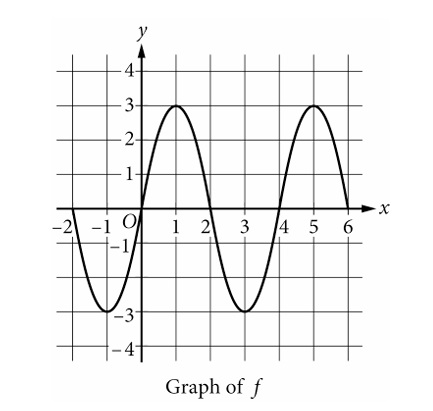
The period is the horizontal distance after which the graph repeats itself. From the given graph description (and typical sinusoidal graph shown in original problem):
• Maxima occur at \( x = 1 \) and \( x = 5 \), so the horizontal distance between consecutive maxima is \( 5 – 1 = 4 \).
• Minima occur at \( x = -1 \) and \( x = 3 \), distance \( 3 – (-1) = 4 \).
Thus, the period is 4.
✅ Answer: (C)
▶️ Answer/Explanation
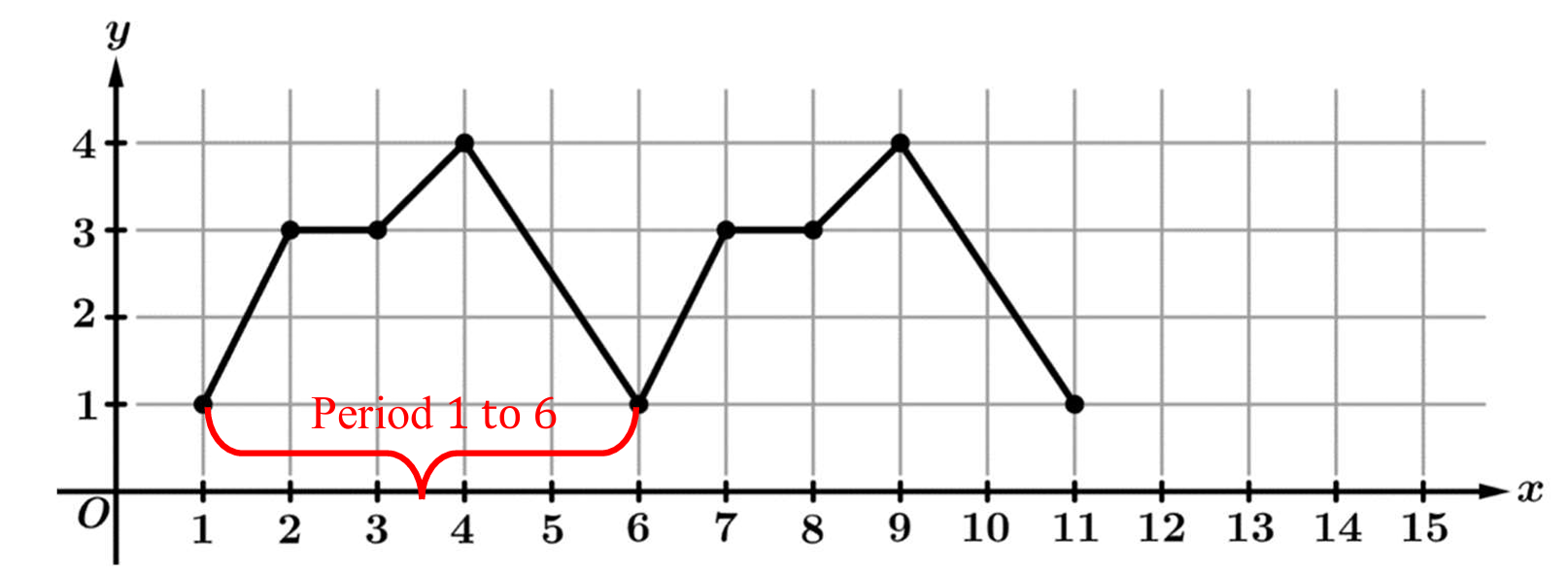
The period is the length of one complete cycle of the function. Observing the graph, the pattern begins at \( x=1 \) and repeats starting at \( x=6 \).
Therefore, the period is \( 6 – 1 = 5 \).
For a periodic function with period \( T \), the property \( f(x) = f(x + nT) \) holds true for any integer \( n \).
To find \( f(31) \), we can express \( 31 \) in terms of the starting point and the period: \( 31 = 1 + 30 = 1 + (6 \times 5) \).
This allows us to simplify the evaluation: \( f(31) = f(1 + 6 \times 5) = f(1) \).
Looking at the graph, the value of the function at \( x=1 \) is \( y=1 \).
Thus, \( f(31) = 1 \).
Comparing this with the given options, the correct statement is that the period is \( 5 \) and \( f(31)=1 \).
▶️ Answer/Explanation
The period of a function is the horizontal length of one complete cycle after which the graph repeats itself.
To find the period, identify two corresponding consecutive points on the graph, such as the peaks.
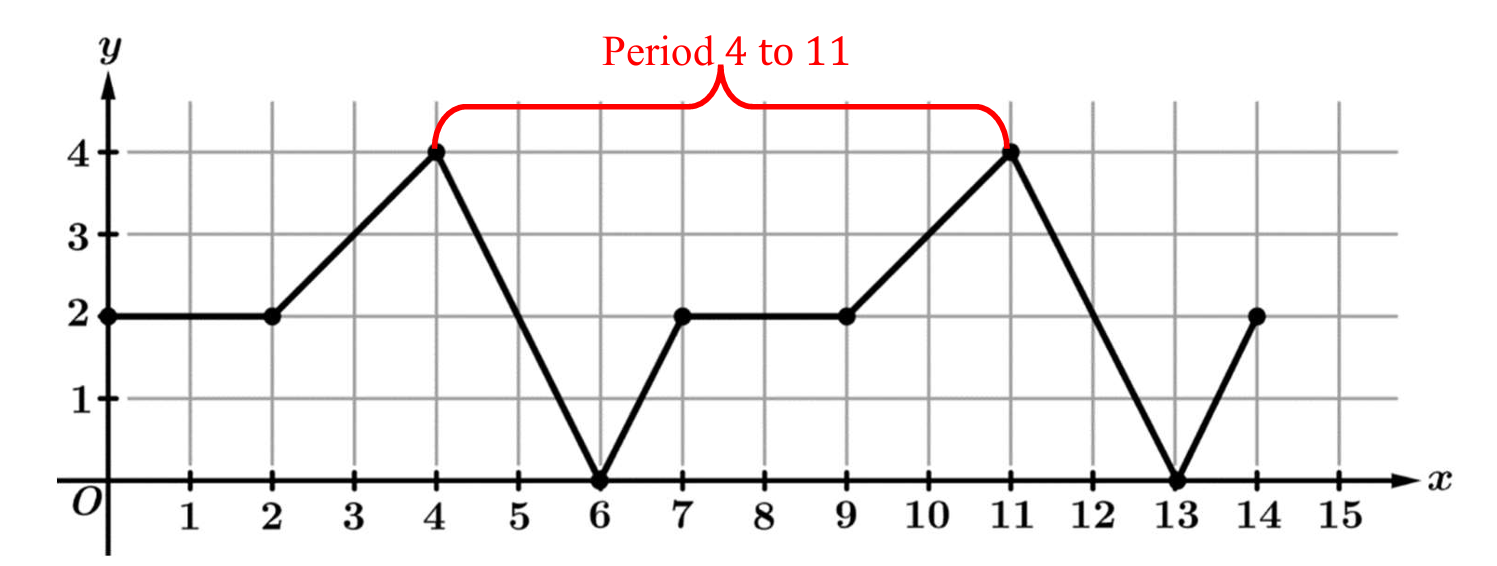
Observing the graph, the first peak is located at \( x = 4 \).
The next corresponding peak appears at \( x = 11 \).
The distance between these two peaks is calculated as \( 11 – 4 = 7 \).
Alternatively, the cycle starts at \( x=0 \) and begins to repeat the same pattern at \( x=7 \), which confirms the length.
Therefore, the period of the function \( g \) is 7.
Correct Option: (B)
▶️ Answer/Explanation
From the graph, we can observe that the function is periodic.
The pattern repeats between the peak at $x = 4$ and the next peak at $x = 11$.
The period of the function is the difference between these values: $11 – 4 = 7$.
To find $g(32)$, we divide $32$ by the period $7$: $32 = 4 \times 7 + 4$.
The remainder is $4$, which implies that $g(32) = g(4)$.
Looking at the graph, at $x = 4$, the value of the function is $4$.
Therefore, $g(32) = 4$.
The correct option is (D).
▶️ Answer/Explanation
The graph indicates that the function \( g \) is periodic. The pattern repeats every \( 7 \) units (e.g., from peak \( x=4 \) to peak \( x=11 \)), so the period is \( 7 \).
Within the fundamental period starting at \( x=4 \), the graph goes downward from \( x=4 \) to \( x=6 \). Therefore, \( g \) is decreasing on the interval \( (4, 6) \).
Since the function repeats every \( 7 \) units, it is decreasing on all intervals of the form \( (4 + 7k, 6 + 7k) \) for any integer \( k \).
We must find which option fits this form. Let’s test values of \( k \) to reach the \( 70 \)s range.
Set \( k = 10 \). The interval becomes \( (4 + 7(10), 6 + 7(10)) \).
Simplifying the expression: \( (4 + 70, 6 + 70) = (74, 76) \).
This calculated interval matches option (C).
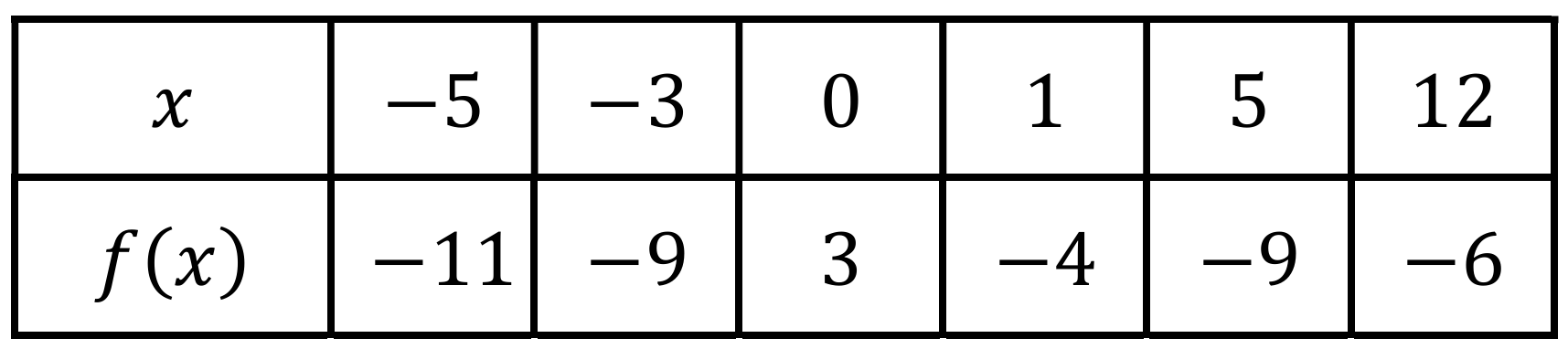
▶️ Answer/Explanation
The correct answer is (A).
1. Examine the values in the table to identify a pattern. Notice that \( f(-3) = -9 \) and \( f(5) = -9 \).
2. The difference between these \( x \)-values is \( 5 – (-3) = 8 \). Since the function values repeat, this implies the function is periodic with a period of \( 8 \), meaning \( f(x) = f(x+8) \).
3. The question asks for the value of \( f(3) \).
4. Using the periodicity property, we can relate \( f(3) \) to a value known in the table by subtracting the period: \( f(3) = f(3 – 8) \).
5. Calculating the value inside the function gives \( f(3) = f(-5) \).
6. Referring back to the table, the value of \( f(x) \) when \( x = -5 \) is \( -11 \).
7. Therefore, \( f(3) = -11 \).
▶️ Answer/Explanation
▶️ Answer/Explanation
From the table provided, we can identify the value of $x$ for which $f(x) = -4$.
Looking at the row for $f(x)$, the value $-4$ corresponds to $x = 1$. Therefore, we know that $f(1) = -4$.
The question asks to select a value of $x$ from the given options. However, $x = 1$ is not among the options ($-12, -8, 4, 9$).
Based on the red annotation in the image, the correct option is (D) $x = 9$ because of the relationship $f(9 – 8) = f(1) = -4$.
This implies that the question likely intended to ask for the value of $x$ such that $f(x – 8) = -4$.
If we solve for $x$ in the equation $x – 8 = 1$ (since $f(1) = -4$), we get:
$x = 1 + 8$
$x = 9$
Thus, the value that satisfies the condition implied by the solution is $x = 9$.
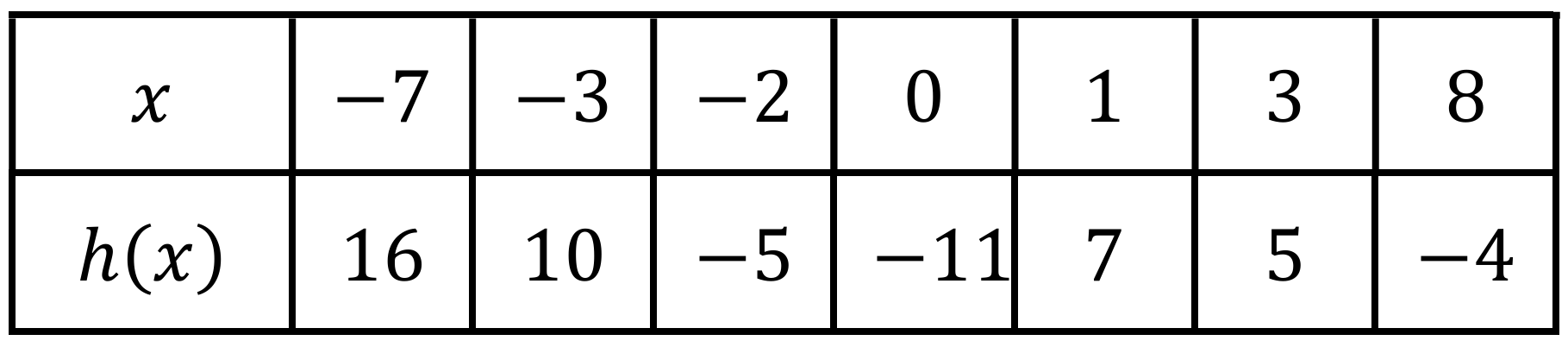
▶️ Answer/Explanation
The correct option is (D).
The solution relies on the function having a periodic property, given by the condition \( h(x + 9) = h(x) \).
This equation indicates that the period of the function is \( 9 \), meaning values repeat every \( 9 \) units.
To find \( h(2) \), we can use this periodicity to find an equivalent input value that exists in the given table.
Using the relationship \( h(x) = h(x – 9) \), we substitute \( x = 2 \).
This gives us \( h(2) = h(2 – 9) \).
Calculating the difference inside the function: \( 2 – 9 = -7 \).
Therefore, \( h(2) = h(-7) \).
Looking at the provided table, the value of \( h(x) \) when \( x = -7 \) is \( 16 \).
Thus, \( h(2) = 16 \).
▶️ Answer/Explanation
▶️ Answer/Explanation
We are asked to find the value of \( h(9k-1) \) given that \( k \) is an integer.
We need to find an integer value for \( k \) such that the resulting expression \( 9k-1 \) corresponds to an \( x \)-value listed in the table.
Let’s test the integer \( k = 1 \).
Substituting \( k = 1 \) into the expression: \( 9(1) – 1 = 9 – 1 = 8 \).
Looking at the table, we verify if \( x = 8 \) is present. It is the last column.
From the table, when \( x = 8 \), the function value is \( h(8) = -4 \).
Therefore, \( h(9k-1) = -4 \).
Correct Option: (C)
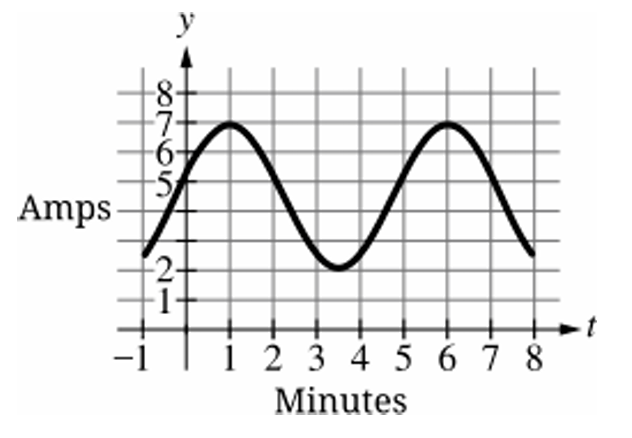
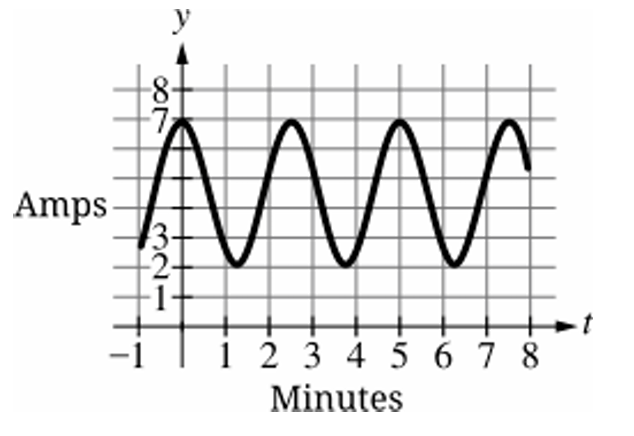
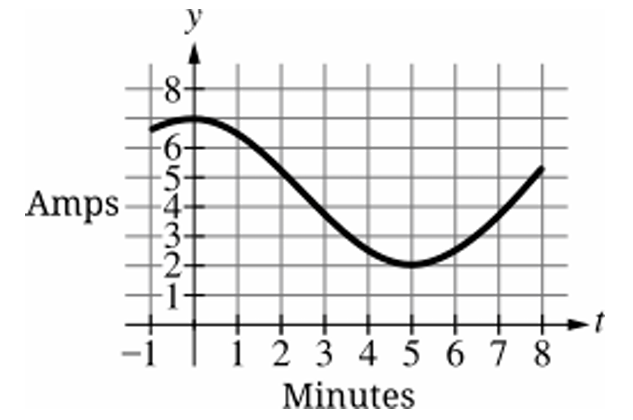
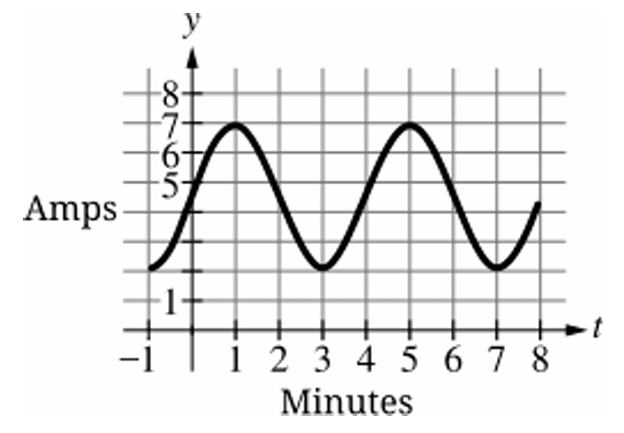
▶️ Answer/Explanation
The maximum value (peak) of the graph must be $y = 7$.
The minimum value (trough) of the graph must be $y = 2$.
The period (the horizontal distance between two consecutive peaks) must be $5$ minutes.
Graph (A) has a maximum of $7$ and a minimum of $2$, but its period is $5$ minutes ($t = 1$ to $t = 6$).
Graph (B) has a maximum of $7$ and a minimum of $2$, but its period is only $2$ minutes.
Graph (C) has a period much longer than $5$ minutes.
Graph (D) shows a peak at $t = 0$ (approx), another at $t = 5$, and another at $t = 10$, confirming a period of $5$.
Therefore, Graph (D) is the correct model as it satisfies the range $[2, 7]$ and the $5$-minute periodicity.
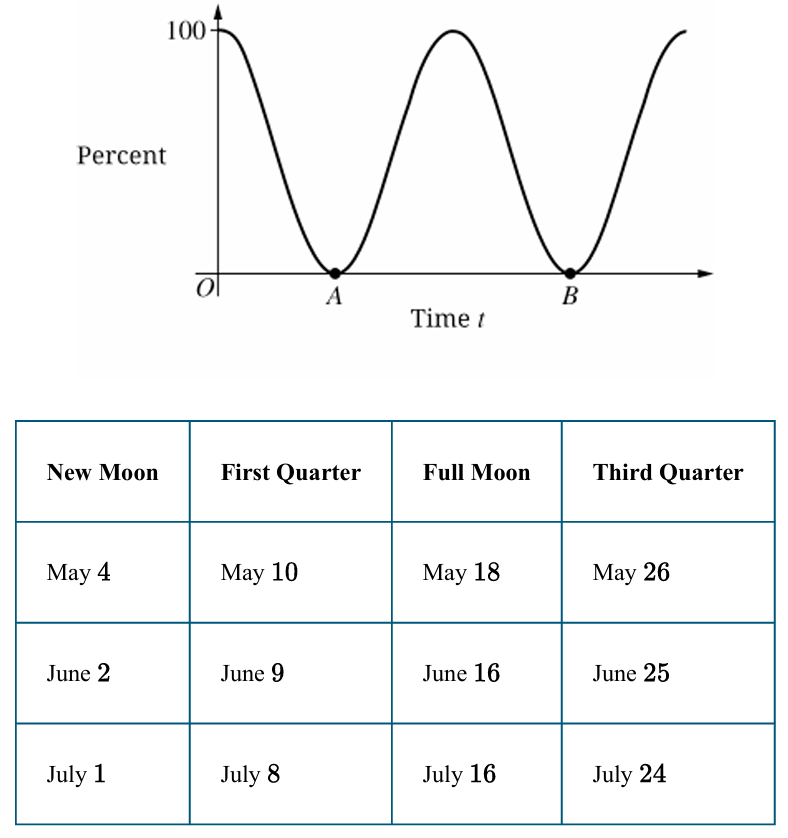
▶️ Answer/Explanation
Point $A$ and Point $B$ represent two consecutive New Moon phases where illumination is $0\%$.
According to the table, the first New Moon occurs on May 4 and the next on June 2.
The number of days in May is $31$.
Days from May 4 to May 31 is $31 – 4 = 27$ days.
Adding the $2$ days in June gives $27 + 2 = 29$ days.
Checking the next cycle: June 2 to July 1 is $28$ days in June plus $1$ day in July, totaling $29$ days.
Among the choices, $28$ is the closest approximation to the lunar cycle length.
Therefore, the correct option is (C).
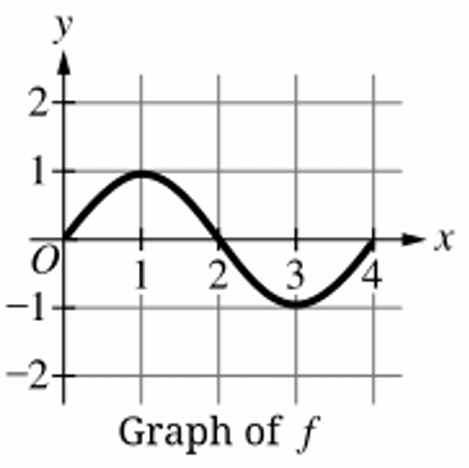
▶️ Answer/Explanation
The graph shows one full cycle of the function $f$ from $x = 0$ to $x = 4$.
The period of the function is $P = 4$.
To find the behavior at $39 < x < 41$, we find the equivalent values in the first cycle by calculating $x \pmod 4$.
For $x = 39$, $39 = (9 \times 4) + 3$, which corresponds to $x = 3$.
For $x = 41$, $41 = (10 \times 4) + 1$, which corresponds to $x = 1$.
On the interval $3 < x < 4$ of the original cycle, the function is increasing.
On the interval $0 < x < 1$ of the original cycle, the function is also increasing.
Since $x = 40$ (where $40 \equiv 0 \pmod 4$) is the transition point, the function continues increasing throughout the interval.
Therefore, the correct behavior is that the function $f$ is increasing.
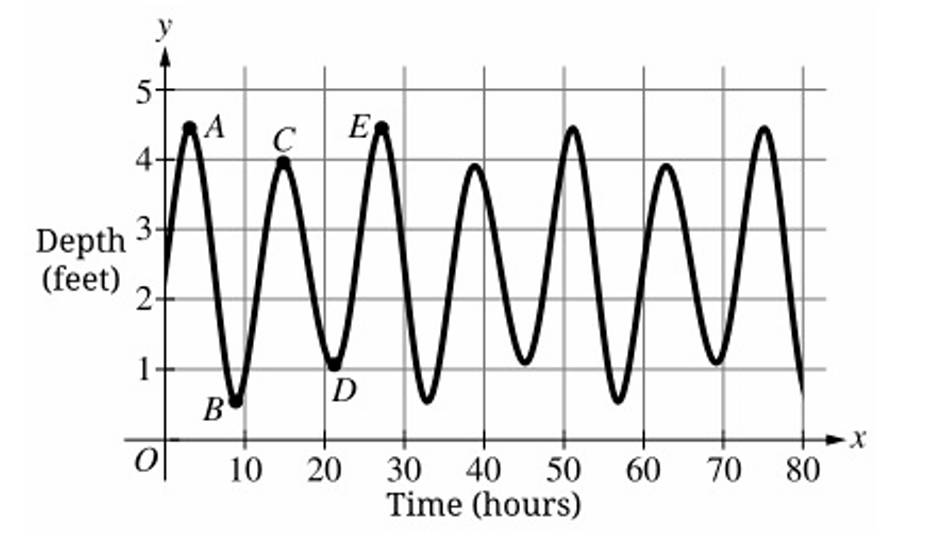
▶️ Answer/Explanation
The period of a periodic function is the horizontal distance required to complete one full cycle.
Point $A$ represents a maximum (peak) of the graph.
The next consecutive maximum of the same height occurs at point $E$.
The horizontal distance (time interval) from one peak to the very next peak represents one full cycle.
Intervals $A$ to $B$ or $A$ to $C$ only represent fractions of a cycle.
Therefore, the time interval between points $A$ and $E$ gives the period.
The correct option is (D).