
Identifying Periodic Relationships
A periodic relationship exists between two aspects of a context when the output values follow a repeating pattern as the input values increase.
Specifically, a relationship is periodic if the pattern in the output values repeats over successive equal-length input intervals.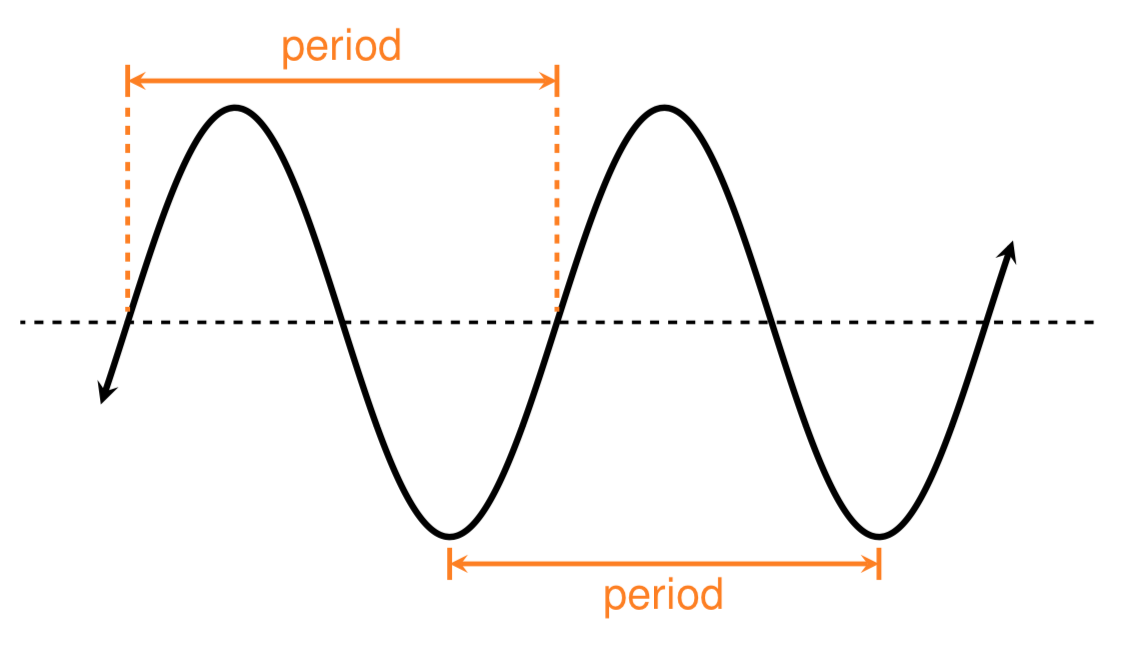
Mathematically, a function \( \mathrm{f} \) is periodic if there exists a positive constant \( \mathrm{P} \) such that
\( \mathrm{ \displaystyle f(x+P)=f(x) } \)
for all input values where the function is defined. The value \( \mathrm{P} \) is called the period of the function.
Periodic relationships commonly appear in contexts involving cycles, oscillations, or repeated behavior over time.
Common Contexts
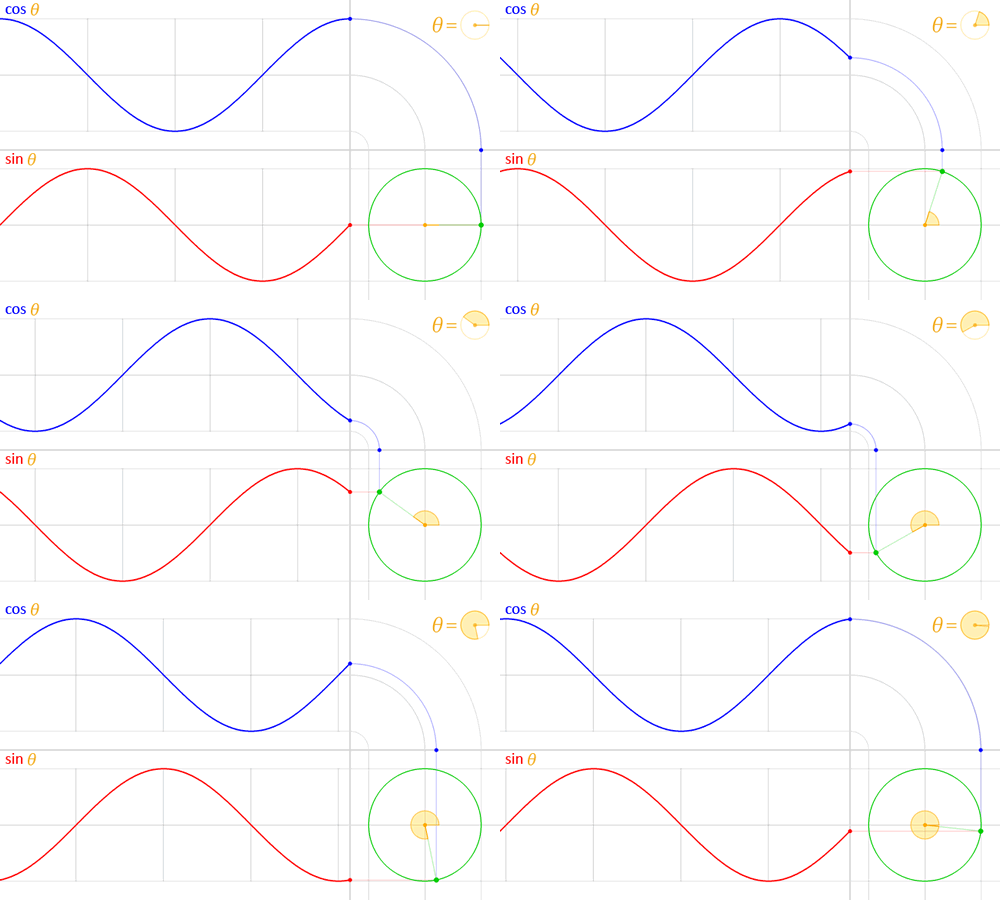
• motion that repeats regularly
• seasonal or daily patterns
• sound waves, light waves, and tides
Example
The height of a point on a Ferris wheel is recorded as time increases. The height rises and falls in the same way during each full rotation.
Explain why this relationship is periodic.
▶️ Answer/Explanation
Each rotation of the Ferris wheel takes the same amount of time.
After one full rotation, the height values repeat exactly.
Conclusion
Because the height pattern repeats over equal time intervals, the relationship is periodic.
Example
The temperature over a 24-hour day rises in the morning, peaks in the afternoon, and decreases at night, repeating this pattern each day.
Identify the periodic behavior.
▶️ Answer/Explanation
The temperature pattern repeats every 24 hours.
This means the period of the relationship is 24 hours.
Conclusion
Because the output values repeat over equal-length time intervals, the relationship is periodic.
Constructing the Graph of a Periodic Relationship
The graph of a periodic relationship can be constructed by first identifying and graphing a single cycle of the relationship.
Once one complete cycle is known, the entire graph can be generated by repeating that cycle over successive equal-length input intervals.
If a function \( \mathrm{f} \) is periodic with period \( \mathrm{P} \), then
\( \mathrm{ \displaystyle f(x+P)=f(x) } \)
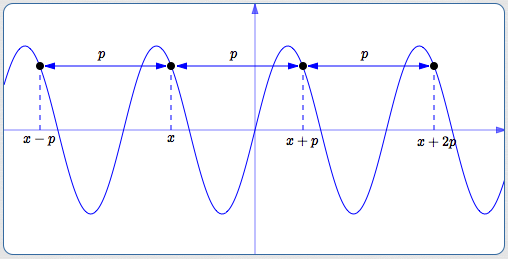
This means the shape of the graph on the interval \( \mathrm{[a,\,a+P]} \) is identical to its shape on \( \mathrm{[a+P,\,a+2P]} \), \( \mathrm{[a+2P,\,a+3P]} \), and so on.
Key Idea
• One cycle determines the entire graph
• The cycle is repeated horizontally by the period
• The output pattern does not change from cycle to cycle
Example
A periodic function has a period of \( \mathrm{4} \). The graph of one cycle is known on the interval \( \mathrm{[0,4]} \).
Explain how to construct the full graph.
▶️ Answer/Explanation
Because the period is 4, the graph on \( \mathrm{[0,4]} \) repeats on \( \mathrm{[4,8]} \), \( \mathrm{[8,12]} \), and so on.
Each repeated section has the same shape and output values.
Conclusion
Repeating the single cycle horizontally constructs the entire periodic graph.
Example
The height of a point on a rotating wheel completes one full cycle every 6 seconds.
Describe how the graph of height versus time can be constructed using a single cycle.
▶️ Answer/Explanation
One cycle of the graph represents the height changes during the first 6 seconds.
This same pattern is repeated every 6 seconds as the wheel continues to rotate.
Conclusion
The full periodic graph is formed by repeating the single cycle over equal time intervals of 6 seconds.
Estimating the Period of a Periodic Function
A function is periodic if its output values repeat in a regular pattern as the input values increase.
The period is the length of the smallest input-value interval over which the function completes one full cycle and begins to repeat.
The period can be estimated by examining successive equal-length output values and identifying where the pattern of outputs starts to repeat.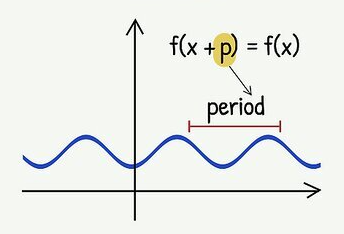
If a function satisfies
\( f(x + P) = f(x) \)
for all \( x \) in the domain, then \( P \) is the period of the function.
Graphically, the period represents the horizontal distance between repeating features such as peaks, troughs, or identical points on the graph.
Example:
The table below shows output values of a function at equal input intervals of 1 unit.
\( f(0) = 2,\; f(1) = 5,\; f(2) = 2,\; f(3) = -1,\; f(4) = 2,\; f(5) = 5 \)
Estimate the period of the function.
▶️ Answer/Explanation
The output values follow the repeating pattern
\( 2, 5, 2, -1 \)
This pattern begins again at \( x = 4 \).
The input difference between repeating values is
\( 4 – 0 = 4 \)
Conclusion: The estimated period of the function is 4.
Example:
The graph of a periodic function shows consecutive maximum values at \( x = 1 \) and \( x = 7 \). Estimate the period of the function.
▶️ Answer/Explanation
A period is the horizontal distance between repeating features.
The distance between consecutive maxima is
\( 7 – 1 = 6 \)
Conclusion: The estimated period of the function is 6.
Characteristics of Periodic Functions
A periodic function is a function whose values repeat at regular intervals along the input axis.
Although periodic functions repeat, they still exhibit many of the same characteristics as nonperiodic functions.
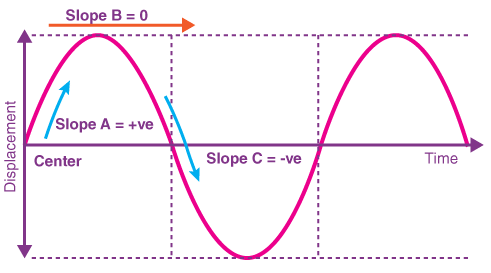
Within each period, a periodic function can have:
- intervals where the function is increasing or decreasing
- intervals with different concavities, such as concave up or concave down
- varying rates of change
If the period of a function is \( P \), then all characteristics that occur on an interval of length \( P \) repeat on every interval of length \( P \).
\( f(x + P) = f(x) \)
This means that once the behavior of a periodic function is understood on one period, the behavior on the entire domain is known.
Example:
The function \( f(x) = \sin x \) has a period of \( 2\pi \). Describe how its characteristics repeat.
▶️ Answer/Explanation
On the interval \( [0, 2\pi] \), the function:
increases from \( 0 \) to \( \frac{\pi}{2} \)
decreases from \( \frac{\pi}{2} \) to \( \frac{3\pi}{2} \)
changes concavity throughout the interval
These same patterns repeat on every interval of length \( 2\pi \).
Example:
A periodic function has a period of 4. On the interval \( [1, 5] \), the function increases from \( x = 1 \) to \( x = 3 \) and decreases from \( x = 3 \) to \( x = 5 \). Describe the behavior on the interval \( [5, 9] \).
▶️ Answer/Explanation
Since the period is 4, the behavior on \( [5, 9] \) repeats the behavior on \( [1, 5] \).
Therefore, the function:
increases from \( x = 5 \) to \( x = 7 \)
decreases from \( x = 7 \) to \( x = 9 \)
All characteristics repeat exactly in each period.