Home / AP® Exam / AP® PreCalculus / AP® Precalculus

AP Precalculus -3.10 Trigonometric Equations and Inequalities- FRQ Exam Style Questions - Effective Fall 2023

AP Precalculus -3.10 Trigonometric Equations and Inequalities- FRQ Exam Style Questions – Effective Fall 2023

AP Precalculus -3.10 Trigonometric Equations and Inequalities- FRQ Exam Style Questions – AP Precalculus- per latest AP Precalculus Syllabus.

AP Precalculus – FRQ Exam Style Questions- All Topics

Question

(A) The function \(g\) and \(h\) are given by

\(g(x) = 3 \ln x – \frac{1}{2} \ln x\)

\(h(x) = \frac{\sin^2 x – 1}{\cos x}\)

(i) Rewrite \(g(x)\) as a single natural logarithm without negative exponents in any part of the expression. Your result should be of the form \(\ln(\text{expression})\).
(ii) Rewrite \(h(x)\) as an expression in which \(\cos x\) appears once and no other trigonometric functions are involved.

(B) The functions \(j\) and \(k\) are given by

\(j(x) = 2(\sin x)(\cos x)\)

\(k(x) = 8e^{(3x)} – e\)

(i) Solve \(j(x) = 0\) for values of \(x\) in the interval \(\left[0, \frac{\pi}{2}\right]\).
(ii) Solve \(k(x) = 3e\) for values of \(x\) in the domain of \(k\).

(C) The function \(m\) is given by

\(m(x) = \cos(2x) + 4\)

Find all input values in the domain of \(m\) that yield an output of \(\frac{9}{2}\).

Most-appropriate topic codes (AP Precalculus CED):

2.12: Logarithmic Function Manipulation – part A(i)
3.12: Equivalent Representations of Trigonometric Functions – part A(ii)
3.10: Trigonometric Equations and Inequalities – part B(i), part C
2.13: Exponential and Logarithmic Equations and Inequalities – part B(ii)
▶️ Answer/Explanation
Detailed solution

(A)(i) Rewrite \(g(x)\)

The function is given by \(g(x) = 3 \ln x – \frac{1}{2} \ln x\).
Combine the like terms:
\(g(x) = \left(3 – \frac{1}{2}\right) \ln x\)
\(g(x) = \frac{5}{2} \ln x\)
Apply the power property of logarithms, \(a \ln b = \ln(b^a)\):
\(g(x) = \ln\left(x^{5/2}\right)\)

(A)(ii) Rewrite \(h(x)\)

The function is given by \(h(x) = \frac{\sin^2 x – 1}{\cos x}\).
Recall the Pythagorean identity: \(\sin^2 x + \cos^2 x = 1\).
Rearrange the identity to isolate the numerator expression: \(\sin^2 x – 1 = -\cos^2 x\).
Substitute this into the function:
\(h(x) = \frac{-\cos^2 x}{\cos x}\)
Simplify the expression by canceling one \(\cos x\) term:
\(h(x) = -\cos x\)

(B)(i) Solve \(j(x) = 0\)

Set the function equal to zero: \(2(\sin x)(\cos x) = 0\).
Divide both sides by 2:
\(\sin x \cos x = 0\)
By the zero product property, either \(\sin x = 0\) or \(\cos x = 0\).
Case 1: \(\sin x = 0\). In the interval \(\left[0, \frac{\pi}{2}\right]\), \(x = 0\).
Case 2: \(\cos x = 0\). In the interval \(\left[0, \frac{\pi}{2}\right]\), \(x = \frac{\pi}{2}\).
The solutions are \(x = 0\) and \(x = \frac{\pi}{2}\).

(B)(ii) Solve \(k(x) = 3e\)

Set the function equal to \(3e\):
\(8e^{(3x)} – e = 3e\)
Add \(e\) to both sides:
\(8e^{(3x)} = 4e\)
Divide both sides by 8:
\(e^{(3x)} = \frac{4e}{8}\)
\(e^{(3x)} = \frac{e}{2}\)
Take the natural logarithm (\(\ln\)) of both sides:
\(\ln\left(e^{3x}\right) = \ln\left(\frac{e}{2}\right)\)
Use logarithm properties to simplify (\(\ln(e^a) = a\) and \(\ln(a/b) = \ln a – \ln b\)):
\(3x = \ln e – \ln 2\)
Since \(\ln e = 1\):
\(3x = 1 – \ln 2\)
Divide by 3:
\(x = \frac{1 – \ln 2}{3}\)

(C) Find input values for \(m(x) = \frac{9}{2}\)

Set the function equal to \(\frac{9}{2}\):
\(\cos(2x) + 4 = \frac{9}{2}\)
Subtract 4 from both sides (note that \(4 = \frac{8}{2}\)):
\(\cos(2x) = \frac{9}{2} – \frac{8}{2}\)
\(\cos(2x) = \frac{1}{2}\)
The reference angle for cosine equal to \(\frac{1}{2}\) is \(\frac{\pi}{3}\).
The general solution for \(2x\) is:
\(2x = \frac{\pi}{3} + 2\pi n\) or \(2x = -\frac{\pi}{3} + 2\pi n\) (where \(n\) is an integer).
Solve for \(x\) by dividing by 2:
\(x = \frac{\pi}{6} + \pi n\) or \(x = -\frac{\pi}{6} + \pi n\)
Combining these, the input values are \(x = \pm \frac{\pi}{6} + \pi n\) for any integer \(n\).
Question

The functions \( g \) and \( h \) are given by
\[g(x) = 2 \log a – 3 \log b + \frac{\log a}{2} + \log_{100} c\]
\[h(x) = \cot x \sec^2 x – \tan x\]
(A) (i) Rewrite \( g(x) \) as a single logarithm with base 10 without negative exponents in any part of the expression. Your result should be simplified in the form \( \log(\text{expression}) \)
(ii) Rewrite \( h(x) \) as an expression in which \(\cot x\) appears once and no other trigonometric functions are involved.
(B) The functions \( j \) and \( k \) are given by
\[j(x) = 3 \cot^2 \theta + 3 \csc \theta\]
\[k(x) = 7e^{7-2x} + 9\]
(i) Solve \( j(x) = -3 \) for values of \( x \) in the interval \((0, 2\pi)\)
(ii) Solve \( k(x) = 86 \) for all values of \( x \) in the domain of \( k \)
(C) Two functions \( a \) and \( b \) are given by
\[a(x) = 3 – 3 \csc 3\theta\]
\[b(x) = -1 + \csc 3\theta\]
Find all the input values in the domain of \( a \) and \( b \) where \( a(x) \) and \( b(x) \) intersect.

Most-appropriate topic codes (AP Precalculus CED):

2.12: Logarithmic Function Manipulation – part A(i)
3.12: Equivalent Representations of Trigonometric Functions – part A(ii)
3.10: Trigonometric Equations and Inequalities – part B(i)
2.13: Exponential and Logarithmic Equations and Inequalities – part B(ii)
3.10: Trigonometric Equations and Inequalities – part C
▶️ Answer/Explanation
(A) i. Simplifying \( g(x) \)

Step 1: Write all logs in base 10 Assume \( \log \) means \( \log_{10} \). Given: \[ g(x) = 2 \log a – 3 \log b + \frac{\log a}{2} + \log_{100} c \] Note: \( \log_{100} c = \frac{\log_{10} c}{\log_{10} 100} = \frac{\log c}{2} \). So: \[ g(x) = 2\log a – 3\log b + \frac{\log a}{2} + \frac{\log c}{2} \] Step 2: Combine like terms Terms with \( \log a \): \( 2\log a + \frac{\log a}{2} = \frac{4\log a}{2} + \frac{\log a}{2} = \frac{5\log a}{2} \). Other terms: \( -3\log b + \frac{\log c}{2} \). Thus: \[ g(x) = \frac{5}{2} \log a – 3\log b + \frac{1}{2} \log c \] Step 3: Express as a single logarithm \[ g(x) = \log\left( a^{5/2} \right) + \log\left( b^{-3} \right) + \log\left( c^{1/2} \right) \] \[ = \log\left( a^{5/2} \cdot b^{-3} \cdot c^{1/2} \right) \] \[ = \log\left( \frac{a^{5/2} c^{1/2}}{b^3} \right) \] \[ = \log\left( \frac{\sqrt{a^5} \sqrt{c}}{b^3} \right) = \log\left( \frac{\sqrt{a^5 c}}{b^3} \right) \] Step 4: Without negative exponents The expression inside log is \( \frac{a^{5/2} c^{1/2}}{b^3} \). No negative exponents inside — all exponents positive in numerator, denominator exponent positive as well (it’s \( b^3 \)). Final: \[ g(x) = \log\left( \frac{a^{5/2} c^{1/2}}{b^3} \right) \quad \text{or} \quad \log\left( \frac{\sqrt{a^5 c}}{b^3} \right) \]

(A) ii. Simplifying \( h(x) \)

Given: \[ h(x) = \cot x \sec^2 x – \tan x \] Step 1: Write in sines and cosines \[ \cot x = \frac{\cos x}{\sin x}, \quad \sec^2 x = \frac{1}{\cos^2 x}, \quad \tan x = \frac{\sin x}{\cos x} \] So: \[ h(x) = \frac{\cos x}{\sin x} \cdot \frac{1}{\cos^2 x} – \frac{\sin x}{\cos x} \] \[ = \frac{1}{\sin x \cos x} – \frac{\sin x}{\cos x} \] Step 2: Common denominator \( \sin x \cos x \) \[ h(x) = \frac{1 – \sin^2 x}{\sin x \cos x} \] Step 3: Use \( 1 – \sin^2 x = \cos^2 x \) \[ h(x) = \frac{\cos^2 x}{\sin x \cos x} = \frac{\cos x}{\sin x} = \cot x \] Final: \[ h(x) = \cot x \]

(B) i. Solve \( j(x) = -3 \) for \( x \in [0, 2\pi) \)

Given: \[ j(x) = 3 \cot^2 \theta + 3 \csc \theta \] It appears \( j \) is a function of \( \theta \), so likely \( j(\theta) \). Solve \( j(\theta) = -3 \). \[ 3 \cot^2 \theta + 3 \csc \theta = -3 \] Divide by 3: \[ \cot^2 \theta + \csc \theta = -1 \] Step 1: Express \( \cot^2 \theta \) in terms of \( \csc \theta \) \[ \cot^2 \theta = \csc^2 \theta – 1 \] So: \[ \csc^2 \theta – 1 + \csc \theta = -1 \] \[ \csc^2 \theta + \csc \theta = 0 \] Step 2: Factor \[ \csc \theta (\csc \theta + 1) = 0 \] Thus: \[ \csc \theta = 0 \quad \text{or} \quad \csc \theta = -1 \] But \( \csc \theta = \frac{1}{\sin \theta} \), so \( \csc \theta = 0 \) has no solution. Only: \[ \csc \theta = -1 \implies \sin \theta = -1 \] Step 3: Solve \( \sin \theta = -1 \) on \([0, 2\pi)\) \[ \theta = \frac{3\pi}{2} \] Final: \[ \boxed{\theta = \frac{3\pi}{2}} \] (Note: The problem says \( j(x) \) but uses \( \theta \) — likely a typo. Solving for \( \theta \).)

(B) ii. Solve \( k(x) = 86 \)

\[ k(x) = 7e^{7-2x} + 9 = 86 \] \[ 7e^{7-2x} = 77 \] \[ e^{7-2x} = 11 \] Step 1: Take natural log \[ 7-2x = \ln 11 \] \[ 2x = 7 – \ln 11 \] \[ x = \frac{7 – \ln 11}{2} \] Step 2: Domain of \( k \) \( k(x) \) is defined for all real \( x \) (exponential function). So only this one solution. Final: \[ \boxed{x = \frac{7 – \ln 11}{2}} \]

(C) Intersection of \( a(x) \) and \( b(x) \)

Given: \[ a(\theta) = 3 – 3 \csc 3\theta \] \[ b(\theta) = -1 + \csc 3\theta \] Set \( a(\theta) = b(\theta) \): \[ 3 – 3 \csc 3\theta = -1 + \csc 3\theta \] \[ 3 + 1 = \csc 3\theta + 3 \csc 3\theta \] \[ 4 = 4 \csc 3\theta \] \[ \csc 3\theta = 1 \] \[ \sin 3\theta = 1 \] Step 1: Solve \( \sin 3\theta = 1 \) \[ 3\theta = \frac{\pi}{2} + 2n\pi, \quad n \in \mathbb{Z} \] \[ \theta = \frac{\pi}{6} + \frac{2n\pi}{3} \] Step 2: Domain considerations For \( \csc 3\theta \) to be defined, \( \sin 3\theta \neq 0 \). Here \( \sin 3\theta = 1 \) so fine. We need all \( \theta \) in the domain of both \( a \) and \( b \) — typically all reals except where \( \sin 3\theta = 0 \). Our solutions avoid those points. Step 3: General solution \[ \theta = \frac{\pi}{6} + \frac{2n\pi}{3}, \quad n \in \mathbb{Z} \] Final: \[ \boxed{\theta = \frac{\pi}{6} + \frac{2n\pi}{3}, \quad n \in \mathbb{Z}} \]

Question

A second hand on a clock rotates clockwise at a constant speed around the clock. However, Charlie bought a new clock that is dysfunctional, where the second hand completes a cycle every 30 seconds. The clock is 24 inches in diameter and is 5 feet above the ground. The distance between the point at which the second hand is pointing to and the ground is periodically increasing and decreasing. The second hand starts at \( t = 0 \) pointing straight up towards the number 12.
(A) This situation can be represented with a sinusoid function in the form \( h(t) = a\cos(b(t + c)) + d \), where \( t \) is the number of seconds after starting the clock and \( h(t) \) is the height of the end of the second hand in inches. Find the function.
(B) When does the arrow of the second hand become \( 72 – 6\sqrt{2} \) inches above the ground on the interval \( 0 < t \leq 30 \)?
(C) (i) Between \( 0 \leq t < 30 \), does the graph of \( h(t) \) have a point of inflection? If so, identify all the points of inflection between the time intervals. If it does not, explain why using your knowledge of a cosine function and its continuity.
(ii) Explain the meaning of these points in context of the problem using the definition of the rate of change and the rate the rate is changing.

Most-appropriate topic codes (AP Precalculus CED):

3.1: Periodic Phenomena – part A, overall context
3.4: Sine and Cosine Function Graphs – part A
3.5: Sinusoidal Functions – part A
3.6: Sinusoidal Function Transformations – part A
3.7: Sinusoidal Function Context and Data Modeling – part A, part B, part C(ii)
3.8: The Tangent Function – part C(i) (concavity/points of inflection concepts)
3.10: Trigonometric Equations and Inequalities – part B
1.4: Polynomial Functions and Rates of Change – part C(i), part C(ii) (points of inflection, rate of change concepts)
▶️ Answer/Explanation
(A) Determining the sinusoid function \( h(t) \)

Step 1: Identify parameters
– Clock diameter = 24 inches ⇒ radius \( r = 12 \) inches.
– Clock center height above ground: 5 feet = \( 5 \times 12 = 60 \) inches.
– Bottom of clock: \( 60 – 12 = 48 \) inches above ground.
– Top of clock: \( 60 + 12 = 72 \) inches above ground.
– Cycle period = 30 seconds ⇒ \( b = \frac{2\pi}{30} = \frac{\pi}{15} \).
– At \( t = 0 \), second hand points straight up ⇒ height is maximum: \( h(0) = 72 \).

Step 2:
Form of \( h(t) \) General form: \( h(t) = a\cos(b(t + c)) + d \).
Maximum height = \( d + |a| = 72 \)
Minimum height = \( d – |a| = 48 \)
Solve: \( d = \frac{72+48}{2} = 60 \), \( |a| = 72 – 60 = 12 \).
Since at \( t = 0 \) we have max height, choose cosine with no horizontal shift that gives max at \( t=0 \) ⇒ \( a > 0 \), \( c = 0 \) (since \(\cos(0)=1\) gives max).
Thus \( a = 12 \), \( c = 0 \), \( b = \frac{\pi}{15} \), \( d = 60 \).

Step 3: Final function \[ h(t) = 12\cos\left( \frac{\pi}{15} t \right) + 60 \]

(B) Solving \( h(t) = 72 – 6\sqrt{2} \)

Step 1:
Set up equation \[ 12\cos\left( \frac{\pi}{15} t \right) + 60 = 72 – 6\sqrt{2} \] \[ 12\cos\left( \frac{\pi}{15} t \right) = 12 – 6\sqrt{2} \] \[ \cos\left( \frac{\pi}{15} t \right) = 1 – \frac{\sqrt{2}}{2} \]
Note: \( 1 – \frac{\sqrt{2}}{2} \approx 0.2929 \).

Step 2: General solutions Let \( \theta = \frac{\pi}{15} t \). \(\cos \theta = 1 – \frac{\sqrt{2}}{2} \).
Since cosine is positive, solutions are in QI and QIV (for principal values \( 0 \leq \theta < 2\pi \)).
\(\theta_1 = \cos^{-1}\left(1 – \frac{\sqrt{2}}{2}\right)\) \(\theta_2 = 2\pi – \theta_1\).

Step 3: Find \( t \)
\( t = \frac{15}{\pi} \theta \).
Numerically: \( 1 – \frac{\sqrt{2}}{2} \approx 0.292893 \) \(\theta_1 \approx \cos^{-1}(0.292893) \approx 1.2735 \) rad.
\( t_1 \approx \frac{15}{\pi} \times 1.2735 \approx 6.08 \) s. \(\theta_2 \approx 2\pi – 1.2735 \approx 5.0097 \) rad. \( t_2 \approx \frac{15}{\pi} \times 5.0097 \approx 23.92 \) s.
Both are in \( 0 < t \leq 30 \).

Step 4: Exact form Exact \( \theta_1 = \cos^{-1}\left( 1 – \frac{\sqrt{2}}{2} \right) \), but simpler:
Note \( 1 – \frac{\sqrt{2}}{2} = \frac{2 – \sqrt{2}}{2} \).
Thus: \[ t_1 = \frac{15}{\pi} \cos^{-1}\left( \frac{2 – \sqrt{2}}{2} \right), \quad t_2 = 30 – t_1 \]
because cosine is symmetric about \( \theta = \pi \). Final times: \( t \approx 6.08 \) s and \( t \approx 23.92 \) s.

(C) i. Points of inflection

Step 1: Second derivative
\( h(t) = 12\cos\left( \frac{\pi}{15} t \right) + 60 \) \( h'(t) = -12 \cdot \frac{\pi}{15} \sin\left( \frac{\pi}{15} t \right) \)
\( h”(t) = -12 \cdot \frac{\pi^2}{225} \cos\left( \frac{\pi}{15} t \right) = -\frac{4\pi^2}{75} \cos\left( \frac{\pi}{15} t \right) \).

Step 2: Inflection points occur when \( h”(t) = 0 \) \[ \cos\left( \frac{\pi}{15} t \right) = 0 \] \[ \frac{\pi}{15} t = \frac{\pi}{2} + n\pi, \quad n \in \mathbb{Z} \] \[ t = 7.5 + 15n \]

Step 3: In \( 0 \leq t < 30 \) \( n = 0 \): \( t = 7.5 \) s \( n = 1 \): \( t = 22.5 \) s
So yes, there are two points of inflection at \( t = 7.5 \) s and \( t = 22.5 \) s.

(C) ii. Meaning in context

At a point of inflection, the rate of change of height \( h'(t) \) is at a local extremum (maximum or minimum magnitude of vertical speed). Equivalently, the acceleration \( h”(t) \) changes sign, meaning the rate at which the height is changing (speed) stops increasing and starts decreasing, or vice versa.
In this problem:
– At \( t = 7.5 \) s, second hand is horizontal (3 o’clock position), vertical speed is maximum in downward direction, and acceleration changes from negative to positive (decelerating downward motion before starting to slow and reverse).
– At \( t = 22.5 \) s, second hand is horizontal (9 o’clock position), vertical speed is maximum in upward direction, and acceleration changes from positive to negative.
Thus, these are the moments when the vertical motion switches from speeding up to slowing down (or vice versa) while moving toward the extreme top or bottom of its path.

Question

(A) The functions \(g\) and \(h\) are given by
\[ g(x)=e^{2x} \]
\[ h(x)=\arcsin(x+3) \].
(i) Solve \( g(x)=10 \) for values of \(x\) in the domain of \(g\).
(ii) Solve \( h(x)=\frac{\pi}{4} \) for values of \(x\) in the domain of \(h\).
(B) The functions \(j\) and \(k\) are given by
\[ j(x)=\log_{10}(8)+\log_{10}(x^9)-\log_{10}(2x^3) \]
\[ k(x)=\dfrac{\sin x}{\sec x} \].
(i) Rewrite \( j(x) \) as a single logarithm base \(10\) without negative exponents.
(ii) Rewrite \( k(x) \) as a single term involving \( \tan x \).
(C) The function \(m\) is given by
\[ m(x)=\cos(\tan(2x-1)) \].
Find all values in the domain of \(m\) that yield an output value of \(0\).

Most-appropriate topic codes (CED):

TOPIC 2.8: Inverse Trigonometric Functions — part (A)
TOPIC 2.9: Logarithmic Properties — part (B)
TOPIC 3.10: Trigonometric Equations — part (C)
▶️ Answer/Explanation
Concise solution

(A)(i)
\( e^{2x}=10 \)
\( 2x=\ln(10) \)
\( x=\frac{1}{2}\ln(10) \).

(A)(ii)
\( \arcsin(x+3)=\frac{\pi}{4} \)
\( x+3=\sin\!\left(\frac{\pi}{4}\right)=\frac{\sqrt{2}}{2} \)
\( x=\frac{\sqrt{2}}{2}-3 \).

(B)(i)
\( j(x)=\log_{10}\!\left(\frac{8x^9}{2x^3}\right) \)
\( =\log_{10}(4x^6) \).

(B)(ii)
\( k(x)=\frac{\sin x}{\sec x}=\sin x\cos x \)
\( =\frac{\sin x}{\cos x}\cos^2 x=\tan x \).

(C)
\( \cos(\tan(2x-1))=0 \)
\( \tan(2x-1)=\frac{\pi}{2}+k\pi \)
\( 2x-1=\arctan\!\left(\frac{\pi}{2}+k\pi\right) \), where defined.
Question 

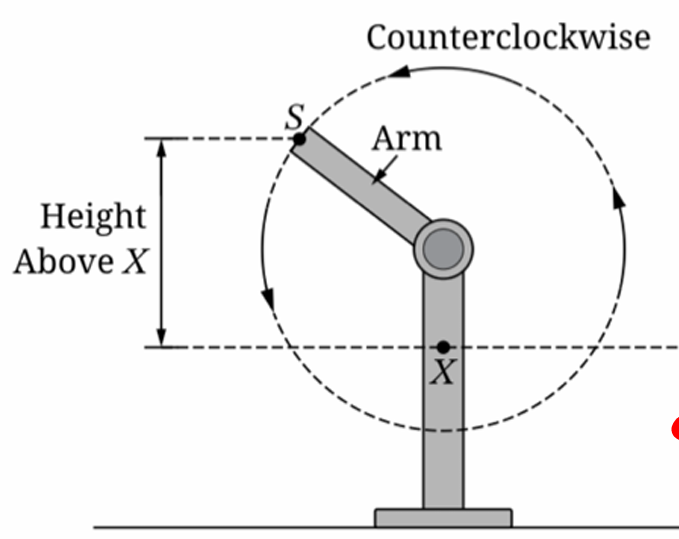
The figure shows a robotic arm rotating in a circular counterclockwise direction that completes one rotation every $2$ seconds. Point $S$ is on the tip of the arm, and point $X$ does not move. As the arm rotates at a constant speed, the height of $S$ above $X$ periodically increases and decreases. At time $t = 0$ seconds, $S$ is at its lowest position, $6$ inches directly below $X$. At its highest position, $S$ is $20$ inches directly above $X$.
The sinusoidal function $h$ models the height of $S$ above $X$, in inches, as a function of time $t$, in seconds. A positive value of $h(t)$ indicates $S$ is above $X$; a negative value of $h(t)$ indicates $S$ is below $X$.
Part A
The graph of $h$ and its dashed midline for two full cycles is shown. Five points, $F, G, J, K,$ and $P$, are labeled on the graph. Determine possible coordinates $(t, h(t))$ for the five points.
Part B
The function $h$ can be written in the form $h(t) = a \cos(b(t + c)) + d$. Find values of constants $a, b, c,$ and $d$.
Part C
Refer to the graph of $h$ in part (A). The $t$-coordinate of $K$ is $t_1$, and the $t$-coordinate of $P$ is $t_2$.
(i) On the interval $(t_1, t_2)$, which of the following is true about $h$?
      a. $h$ is positive and increasing.
      b. $h$ is positive and decreasing.
      c. $h$ is negative and increasing.
      d. $h$ is negative and decreasing.
(ii) Describe how the rate of change of $h$ is changing on the interval $(t_1, t_2)$.
▶️ Answer/Explanation
Detailed solution

Part A: Coordinates of Points

At $t = 0$, $S$ is at its minimum height $-6$ (below $X$).
The maximum height is $20$.
The midline $d = \frac{20 + (-6)}{2} = 7$.
The period is $2$ seconds.
The graph starts at a minimum at $t = 0$, reaches midline at $t = 0.5$, maximum at $t = 1$, midline at $t = 1.5$, and minimum at $t = 2$.
Based on the visual positions in the provided graph:
$F$ (first maximum): $(1, 20)$
$G$ (midline, decreasing): $(1.5, 7)$
$J$ (minimum): $(2, -6)$
$K$ (midline, increasing): $(2.5, 7)$
$P$ (second maximum): $(3, 20)$

Part B: Finding Constants

$a$ (Amplitude) $= \frac{20 – (-6)}{2} = 13$. Since we use $\cos$ and start at a minimum, $a = -13$ (or use a phase shift).
$d$ (Vertical shift/Midline) $= 7$.
$b$ (Frequency factor) $= \frac{2\pi}{\text{period}} = \frac{2\pi}{2} = \pi$.
$c$ (Phase shift): For $h(t) = a \cos(b(t+c)) + d$, if $a = -13$, then at $t=0$, $-13\cos(b(0+c))+7 = -6 \implies \cos(bc)=1 \implies c = 0$.
Final values: $a = -13, b = \pi, c = 0, d = 7$.

Part C: Interval Analysis

(i) At $K$, $h(t)=7$ and is increasing. At $P$, $h(t)=20$ (maximum).
On $(t_1, t_2)$, the height is between $7$ and $20$, so it is positive.
The graph is moving from the midline up to the peak, so it is increasing.
Correct Option: a

(ii) On the interval $(t_1, t_2)$, the graph is concave down as it approaches the maximum.
Therefore, the rate of change of $h$ (the slope) is decreasing.
It starts at its maximum positive value at $K$ and decreases toward zero at $P$.

Question 

Directions:

  • Unless otherwise specified, the domain of a function \( f \) is assumed to be the set of all real numbers \( x \) for which \( f(x) \) is a real number. Angle measures for trigonometric functions are assumed to be in radians.
  • Solutions to equations must be real numbers. Determine the exact value of any expression that can be obtained without a calculator. For example, \( \log_2 8 \), \( \cos(\frac{\pi}{2}) \), and \( \sin^{-1}(1) \) can be evaluated without a calculator.
  • Unless otherwise specified, combine terms using algebraic methods and rules for exponents and logarithms, where applicable. For example, \( 2x + 3x \), \( 5^2 \cdot 5^3 \), \( \frac{x^5}{x^2} \), and \( \ln 3 + \ln 5 \) should be rewritten in equivalent forms.
  • For each part of the question, show the work that leads to your answers.

Part A
The functions \( g \) and \( h \) are given by

\( g(x) = \log_5(4x – 2) \)
\( h(x) = \sin^{-1}(8x) \)
(i) Solve \( g(x) = 3 \) for values of \( x \) in the domain of \( g \).
(ii) Solve \( h(x) = \frac{\pi}{4} \) for values of \( x \) in the domain of \( h \).

Part B
The functions \( j \) and \( k \) are given by

\( j(x) = (\sec x)(\cot x) \)
\( k(x) = \frac{(16^{3x}) \cdot 4^x}{2} \)
(i) Rewrite \( j(x) \) as an expression involving \( \sin x \) and no other trigonometric functions.
(ii) Rewrite \( k(x) \) as an expression of the form \( 4^{(ax+b)} \), where \( a \) and \( b \) are constants.

Part C
The function \( m \) is given by

\( m(x) = \sqrt{3}\tan(x + \frac{\pi}{2}) \).
Find all values in the domain of \( m \) that yield an output value of 1.
▶️ Answer/Explanation
Detailed solution

Part A
(i) Solve \( g(x) = 3 \)
Start with the given equation:
\( \log_5(4x – 2) = 3 \)
Convert the logarithmic equation to exponential form (\( y = \log_b x \iff x = b^y \)):
\( 4x – 2 = 5^3 \)
Evaluate the exponent:
\( 4x – 2 = 125 \)
Add 2 to both sides:
\( 4x = 127 \)
Divide by 4:
\( x = \frac{127}{4} \)

(ii) Solve \( h(x) = \frac{\pi}{4} \)
Start with the given equation:
\( \sin^{-1}(8x) = \frac{\pi}{4} \)
Take the sine of both sides to isolate the argument:
\( 8x = \sin\left(\frac{\pi}{4}\right) \)
Substitute the exact value of \( \sin\left(\frac{\pi}{4}\right) \):
\( 8x = \frac{\sqrt{2}}{2} \)
Divide by 8:
\( x = \frac{\sqrt{2}}{16} \)

Part B
(i) Rewrite \( j(x) \)
Start with the function definition:
\( j(x) = (\sec x)(\cot x) \)
Substitute the reciprocal and quotient identities (\( \sec x = \frac{1}{\cos x} \) and \( \cot x = \frac{\cos x}{\sin x} \)):
\( j(x) = \left(\frac{1}{\cos x}\right) \left(\frac{\cos x}{\sin x}\right) \)
Cancel the \( \cos x \) terms:
\( j(x) = \frac{1}{\sin x} \)

(ii) Rewrite \( k(x) \)
Start with the function definition:
\( k(x) = \frac{(16^{3x}) \cdot 4^x}{2} \)
To write in the form \( 4^{(ax+b)} \), convert bases 16 and 2 to base 4.
Since \( 16 = 4^2 \) and \( 2 = \sqrt{4} = 4^{1/2} = 4^{0.5} \):
\( k(x) = \frac{(4^2)^{3x} \cdot 4^x}{4^{0.5}} \)
Apply the power of a power rule (\( (a^m)^n = a^{mn} \)):
\( k(x) = \frac{4^{6x} \cdot 4^x}{4^{0.5}} \)
Apply the product rule for exponents (\( a^m \cdot a^n = a^{m+n} \)) in the numerator:
\( k(x) = \frac{4^{6x + x}}{4^{0.5}} = \frac{4^{7x}}{4^{0.5}} \)
Apply the quotient rule for exponents (\( \frac{a^m}{a^n} = a^{m-n} \)):
\( k(x) = 4^{7x – 0.5} \) (or \( 4^{7x – \frac{1}{2}} \))
Thus, \( a = 7 \) and \( b = -0.5 \).

Part C
Find values where \( m(x) = 1 \)
Set the function equal to 1:
\( \sqrt{3}\tan\left(x + \frac{\pi}{2}\right) = 1 \)
Isolate the tangent function by dividing by \( \sqrt{3} \):
\( \tan\left(x + \frac{\pi}{2}\right) = \frac{1}{\sqrt{3}} \)
Determine the reference angle. We know that \( \tan\left(\frac{\pi}{6}\right) = \frac{1}{\sqrt{3}} \).
Set up the general solution for tangent (\( \theta = \text{ref} + n\pi \)):
\( x + \frac{\pi}{2} = \frac{\pi}{6} + n\pi \), where \( n \) is any integer.
Solve for \( x \) by subtracting \( \frac{\pi}{2} \) from both sides:
\( x = \frac{\pi}{6} – \frac{\pi}{2} + n\pi \)
Find a common denominator (6) to combine fractions:
\( x = \frac{\pi}{6} – \frac{3\pi}{6} + n\pi \)
\( x = -\frac{2\pi}{6} + n\pi \)
Simplify the fraction:
\( x = -\frac{\pi}{3} + n\pi \)

Question 

Directions:

  • Unless otherwise specified, the domain of a function \( f \) is assumed to be the set of all real numbers \( x \) for which \( f(x) \) is a real number. Angle measures for trigonometric functions are assumed to be in radians.
  • Solutions to equations must be real numbers. Determine the exact value of any expression that can be obtained without a calculator. For example, \( \log_2 8 \), \( \cos(\frac{\pi}{2}) \), and \( \sin^{-1}(1) \) can be evaluated without a calculator.
  • Unless otherwise specified, combine terms using algebraic methods and rules for exponents and logarithms, where applicable. For example, \( 2x + 3x \), \( 5^2 \cdot 5^3 \), \( \frac{x^5}{x^2} \), and \( \ln 3 + \ln 5 \) should be rewritten in equivalent forms.
  • For each part of the question, show the work that leads to your answers.

Part A
The functions \( g \) and \( h \) are given by

\( g(x) = \log_5(4x – 2) \)
\( h(x) = \sin^{-1}(8x) \)
(i) Solve \( g(x) = 3 \) for values of \( x \) in the domain of \( g \).
(ii) Solve \( h(x) = \frac{\pi}{4} \) for values of \( x \) in the domain of \( h \).

Part B
The functions \( j \) and \( k \) are given by

\( j(x) = (\sec x)(\cot x) \)
\( k(x) = \frac{(16^{3x}) \cdot 4^x}{2} \)
(i) Rewrite \( j(x) \) as an expression involving \( \sin x \) and no other trigonometric functions.
(ii) Rewrite \( k(x) \) as an expression of the form \( 4^{(ax+b)} \), where \( a \) and \( b \) are constants.

Part C
The function \( m \) is given by

\( m(x) = \sqrt{3}\tan(x + \frac{\pi}{2}) \).
Find all values in the domain of \( m \) that yield an output value of 1.
▶️ Answer/Explanation
Detailed solution

Part A
(i) Solve \( g(x) = 3 \)
Start with the given equation:
\( \log_5(4x – 2) = 3 \)
Convert the logarithmic equation to exponential form (\( y = \log_b x \iff x = b^y \)):
\( 4x – 2 = 5^3 \)
Evaluate the exponent:
\( 4x – 2 = 125 \)
Add 2 to both sides:
\( 4x = 127 \)
Divide by 4:
\( x = \frac{127}{4} \)

(ii) Solve \( h(x) = \frac{\pi}{4} \)
Start with the given equation:
\( \sin^{-1}(8x) = \frac{\pi}{4} \)
Take the sine of both sides to isolate the argument:
\( 8x = \sin\left(\frac{\pi}{4}\right) \)
Substitute the exact value of \( \sin\left(\frac{\pi}{4}\right) \):
\( 8x = \frac{\sqrt{2}}{2} \)
Divide by 8:
\( x = \frac{\sqrt{2}}{16} \)

Part B
(i) Rewrite \( j(x) \)
Start with the function definition:
\( j(x) = (\sec x)(\cot x) \)
Substitute the reciprocal and quotient identities (\( \sec x = \frac{1}{\cos x} \) and \( \cot x = \frac{\cos x}{\sin x} \)):
\( j(x) = \left(\frac{1}{\cos x}\right) \left(\frac{\cos x}{\sin x}\right) \)
Cancel the \( \cos x \) terms:
\( j(x) = \frac{1}{\sin x} \)

(ii) Rewrite \( k(x) \)
Start with the function definition:
\( k(x) = \frac{(16^{3x}) \cdot 4^x}{2} \)
To write in the form \( 4^{(ax+b)} \), convert bases 16 and 2 to base 4.
Since \( 16 = 4^2 \) and \( 2 = \sqrt{4} = 4^{1/2} = 4^{0.5} \):
\( k(x) = \frac{(4^2)^{3x} \cdot 4^x}{4^{0.5}} \)
Apply the power of a power rule (\( (a^m)^n = a^{mn} \)):
\( k(x) = \frac{4^{6x} \cdot 4^x}{4^{0.5}} \)
Apply the product rule for exponents (\( a^m \cdot a^n = a^{m+n} \)) in the numerator:
\( k(x) = \frac{4^{6x + x}}{4^{0.5}} = \frac{4^{7x}}{4^{0.5}} \)
Apply the quotient rule for exponents (\( \frac{a^m}{a^n} = a^{m-n} \)):
\( k(x) = 4^{7x – 0.5} \) (or \( 4^{7x – \frac{1}{2}} \))
Thus, \( a = 7 \) and \( b = -0.5 \).

Part C
Find values where \( m(x) = 1 \)
Set the function equal to 1:
\( \sqrt{3}\tan\left(x + \frac{\pi}{2}\right) = 1 \)
Isolate the tangent function by dividing by \( \sqrt{3} \):
\( \tan\left(x + \frac{\pi}{2}\right) = \frac{1}{\sqrt{3}} \)
Determine the reference angle. We know that \( \tan\left(\frac{\pi}{6}\right) = \frac{1}{\sqrt{3}} \).
Set up the general solution for tangent (\( \theta = \text{ref} + n\pi \)):
\( x + \frac{\pi}{2} = \frac{\pi}{6} + n\pi \), where \( n \) is any integer.
Solve for \( x \) by subtracting \( \frac{\pi}{2} \) from both sides:
\( x = \frac{\pi}{6} – \frac{\pi}{2} + n\pi \)
Find a common denominator (6) to combine fractions:
\( x = \frac{\pi}{6} – \frac{3\pi}{6} + n\pi \)
\( x = -\frac{2\pi}{6} + n\pi \)
Simplify the fraction:
\( x = -\frac{\pi}{3} + n\pi \)

Question 

Directions:

  • Unless otherwise specified, the domain of a function \( f \) is assumed to be the set of all real numbers \( x \) for which \( f(x) \) is a real number. Angle measures for trigonometric functions are assumed to be in radians.
  • Solutions to equations must be real numbers. Determine the exact value of any expression that can be obtained without a calculator. For example, \( \log_2 8 \), \( \cos(\frac{\pi}{2}) \), and \( \sin^{-1}(1) \) can be evaluated without a calculator.
  • Unless otherwise specified, combine terms using algebraic methods and rules for exponents and logarithms, where applicable. For example, \( 2x + 3x \), \( 5^2 \cdot 5^3 \), \( \frac{x^5}{x^2} \), and \( \ln 3 + \ln 5 \) should be rewritten in equivalent forms.
  • For each part of the question, show the work that leads to your answers.

Part A
The functions \( g \) and \( h \) are given by

\( g(x) = \log_5(4x – 2) \)
\( h(x) = \sin^{-1}(8x) \)
(i) Solve \( g(x) = 3 \) for values of \( x \) in the domain of \( g \).
(ii) Solve \( h(x) = \frac{\pi}{4} \) for values of \( x \) in the domain of \( h \).

Part B
The functions \( j \) and \( k \) are given by

\( j(x) = (\sec x)(\cot x) \)
\( k(x) = \frac{(16^{3x}) \cdot 4^x}{2} \)
(i) Rewrite \( j(x) \) as an expression involving \( \sin x \) and no other trigonometric functions.
(ii) Rewrite \( k(x) \) as an expression of the form \( 4^{(ax+b)} \), where \( a \) and \( b \) are constants.

Part C
The function \( m \) is given by

\( m(x) = \sqrt{3}\tan(x + \frac{\pi}{2}) \).
Find all values in the domain of \( m \) that yield an output value of 1.
▶️ Answer/Explanation
Detailed solution

Part A
(i) Solve \( g(x) = 3 \)
Start with the given equation:
\( \log_5(4x – 2) = 3 \)
Convert the logarithmic equation to exponential form (\( y = \log_b x \iff x = b^y \)):
\( 4x – 2 = 5^3 \)
Evaluate the exponent:
\( 4x – 2 = 125 \)
Add 2 to both sides:
\( 4x = 127 \)
Divide by 4:
\( x = \frac{127}{4} \)

(ii) Solve \( h(x) = \frac{\pi}{4} \)
Start with the given equation:
\( \sin^{-1}(8x) = \frac{\pi}{4} \)
Take the sine of both sides to isolate the argument:
\( 8x = \sin\left(\frac{\pi}{4}\right) \)
Substitute the exact value of \( \sin\left(\frac{\pi}{4}\right) \):
\( 8x = \frac{\sqrt{2}}{2} \)
Divide by 8:
\( x = \frac{\sqrt{2}}{16} \)

Part B
(i) Rewrite \( j(x) \)
Start with the function definition:
\( j(x) = (\sec x)(\cot x) \)
Substitute the reciprocal and quotient identities (\( \sec x = \frac{1}{\cos x} \) and \( \cot x = \frac{\cos x}{\sin x} \)):
\( j(x) = \left(\frac{1}{\cos x}\right) \left(\frac{\cos x}{\sin x}\right) \)
Cancel the \( \cos x \) terms:
\( j(x) = \frac{1}{\sin x} \)

(ii) Rewrite \( k(x) \)
Start with the function definition:
\( k(x) = \frac{(16^{3x}) \cdot 4^x}{2} \)
To write in the form \( 4^{(ax+b)} \), convert bases 16 and 2 to base 4.
Since \( 16 = 4^2 \) and \( 2 = \sqrt{4} = 4^{1/2} = 4^{0.5} \):
\( k(x) = \frac{(4^2)^{3x} \cdot 4^x}{4^{0.5}} \)
Apply the power of a power rule (\( (a^m)^n = a^{mn} \)):
\( k(x) = \frac{4^{6x} \cdot 4^x}{4^{0.5}} \)
Apply the product rule for exponents (\( a^m \cdot a^n = a^{m+n} \)) in the numerator:
\( k(x) = \frac{4^{6x + x}}{4^{0.5}} = \frac{4^{7x}}{4^{0.5}} \)
Apply the quotient rule for exponents (\( \frac{a^m}{a^n} = a^{m-n} \)):
\( k(x) = 4^{7x – 0.5} \) (or \( 4^{7x – \frac{1}{2}} \))
Thus, \( a = 7 \) and \( b = -0.5 \).

Part C
Find values where \( m(x) = 1 \)
Set the function equal to 1:
\( \sqrt{3}\tan\left(x + \frac{\pi}{2}\right) = 1 \)
Isolate the tangent function by dividing by \( \sqrt{3} \):
\( \tan\left(x + \frac{\pi}{2}\right) = \frac{1}{\sqrt{3}} \)
Determine the reference angle. We know that \( \tan\left(\frac{\pi}{6}\right) = \frac{1}{\sqrt{3}} \).
Set up the general solution for tangent (\( \theta = \text{ref} + n\pi \)):
\( x + \frac{\pi}{2} = \frac{\pi}{6} + n\pi \), where \( n \) is any integer.
Solve for \( x \) by subtracting \( \frac{\pi}{2} \) from both sides:
\( x = \frac{\pi}{6} – \frac{\pi}{2} + n\pi \)
Find a common denominator (6) to combine fractions:
\( x = \frac{\pi}{6} – \frac{3\pi}{6} + n\pi \)
\( x = -\frac{2\pi}{6} + n\pi \)
Simplify the fraction:
\( x = -\frac{\pi}{3} + n\pi \)

Question 

Directions:

  • Unless otherwise specified, the domain of a function \( f \) is assumed to be the set of all real numbers \( x \) for which \( f(x) \) is a real number. Angle measures for trigonometric functions are assumed to be in radians.
  • Solutions to equations must be real numbers. Determine the exact value of any expression that can be obtained without a calculator.
  • Unless otherwise specified, combine terms using algebraic methods and rules for exponents and logarithms where applicable.
  • For each part of the question, show the work that leads to your answers.

(A) The functions \( g \) and \( h \) are given by

\( g(x) = 3^{(2x)} \cdot 3^{(x+4)} \)
\( h(x) = 2\tan^2 x – 1 \)

(i) Solve \( g(x) = 27 \) for values of \( x \) in the domain of \( g \).
(ii) Solve \( h(x) = 5 \) for values of \( x \) in the interval \( [0, 2\pi) \).

(B) The functions \( j \) and \( k \) are given by

\( j(x) = 2\log_{10}(x+3) – \log_{10} x – \log_{10} 3 \)
\( k(x) = \frac{(\tan^2 x)(\cot x)}{\csc x} \)

(i) Rewrite \( j(x) \) as a single logarithm base 10 without negative exponents in any part of the expression. Your result should be of the form \( \log_{10}(\text{expression}) \).
(ii) Rewrite \( k(x) \) as a fraction involving \( \sec x \) and no other trigonometric functions.

(C) The function \( m \) is given by

\( m(x) = \frac{2^{(5x+3)}}{\left(2^{(x-2)}\right)^3} \)

Find all input values in the domain of \( m \) that yield an output value of \( \frac{1}{16} \).
▶️ Answer/Explanation
Detailed Solution

(A)(i) Solve \( g(x) = 27 \)

First, simplify the expression for \( g(x) \) using the property of exponents \( a^m \cdot a^n = a^{m+n} \).
\( g(x) = 3^{2x} \cdot 3^{x+4} = 3^{(2x + x + 4)} = 3^{(3x+4)} \)
Set \( g(x) \) equal to 27 and rewrite 27 as a base of 3:
\( 3^{(3x+4)} = 27 \)
\( 3^{(3x+4)} = 3^3 \)
Since the bases are equal, the exponents must be equal:
\( 3x + 4 = 3 \)
\( 3x = 3 – 4 \)
\( 3x = -1 \)
\( x = -\frac{1}{3} \)

(A)(ii) Solve \( h(x) = 5 \) on \( [0, 2\pi) \)

Set the expression for \( h(x) \) equal to 5:
\( 2\tan^2 x – 1 = 5 \)
Add 1 to both sides:
\( 2\tan^2 x = 6 \)
Divide by 2:
\( \tan^2 x = 3 \)
Take the square root of both sides:
\( \tan x = \pm\sqrt{3} \)
The reference angle for \( \tan \theta = \sqrt{3} \) is \( \frac{\pi}{3} \).
Since we have \( \pm\sqrt{3} \), we must consider solutions in all four quadrants within the interval \( [0, 2\pi) \):
Quadrant I: \( x = \frac{\pi}{3} \)
Quadrant II: \( x = \pi – \frac{\pi}{3} = \frac{2\pi}{3} \)
Quadrant III: \( x = \pi + \frac{\pi}{3} = \frac{4\pi}{3} \)
Quadrant IV: \( x = 2\pi – \frac{\pi}{3} = \frac{5\pi}{3} \)
Solution set: \( x = \frac{\pi}{3}, \frac{2\pi}{3}, \frac{4\pi}{3}, \frac{5\pi}{3} \)

(B)(i) Rewrite \( j(x) \) as a single logarithm

Given: \( j(x) = 2\log_{10}(x+3) – \log_{10} x – \log_{10} 3 \)
Use the power rule \( n\log a = \log(a^n) \):
\( = \log_{10}((x+3)^2) – \log_{10} x – \log_{10} 3 \)
Factor out the negative sign for the last two terms to group them:
\( = \log_{10}((x+3)^2) – (\log_{10} x + \log_{10} 3) \)
Use the product rule \( \log a + \log b = \log(ab) \):
\( = \log_{10}((x+3)^2) – \log_{10}(3x) \)
Use the quotient rule \( \log a – \log b = \log(\frac{a}{b}) \):
\( = \log_{10}\left(\frac{(x+3)^2}{3x}\right) \)

(B)(ii) Rewrite \( k(x) \) involving \( \sec x \)

Given: \( k(x) = \frac{(\tan^2 x)(\cot x)}{\csc x} \)
First, simplify the numerator using \( \tan x \cdot \cot x = 1 \):
\( (\tan^2 x)(\cot x) = \tan x \cdot (\tan x \cdot \cot x) = \tan x \cdot 1 = \tan x \)
Now substitute back into the expression:
\( k(x) = \frac{\tan x}{\csc x} \)
Convert to sine and cosine:
\( = \frac{\frac{\sin x}{\cos x}}{\frac{1}{\sin x}} \)
\( = \frac{\sin x}{\cos x} \cdot \frac{\sin x}{1} = \frac{\sin^2 x}{\cos x} \)
We need the expression in terms of \( \sec x \). Use the identity \( \sin^2 x = 1 – \cos^2 x \):
\( = \frac{1 – \cos^2 x}{\cos x} \)
Substitute \( \cos x = \frac{1}{\sec x} \):
\( = \frac{1 – \left(\frac{1}{\sec x}\right)^2}{\frac{1}{\sec x}} \)
\( = \frac{1 – \frac{1}{\sec^2 x}}{\frac{1}{\sec x}} \)
Find a common denominator for the numerator:
\( = \frac{\frac{\sec^2 x – 1}{\sec^2 x}}{\frac{1}{\sec x}} \)
Multiply by the reciprocal of the denominator:
\( = \frac{\sec^2 x – 1}{\sec^2 x} \cdot \frac{\sec x}{1} \)
\( = \frac{\sec^2 x – 1}{\sec x} \)

(C) Find input values for \( m(x) = \frac{1}{16} \)

First, simplify the expression for \( m(x) \):
\( m(x) = \frac{2^{(5x+3)}}{\left(2^{(x-2)}\right)^3} \)
Simplify the denominator using the power rule \( (a^m)^n = a^{m \cdot n} \):
\( \left(2^{(x-2)}\right)^3 = 2^{3(x-2)} = 2^{3x-6} \)
Now apply the quotient rule \( \frac{a^m}{a^n} = a^{m-n} \):
\( m(x) = \frac{2^{5x+3}}{2^{3x-6}} = 2^{(5x+3) – (3x-6)} \)
\( = 2^{5x + 3 – 3x + 6} \)
\( = 2^{2x + 9} \)
Set \( m(x) = \frac{1}{16} \) and rewrite \( \frac{1}{16} \) as a power of 2:
\( \frac{1}{16} = \frac{1}{2^4} = 2^{-4} \)
Equate the simplified \( m(x) \) to \( 2^{-4} \):
\( 2^{2x + 9} = 2^{-4} \)
Equate the exponents:
\( 2x + 9 = -4 \)
\( 2x = -13 \)
\( x = -\frac{13}{2} \) or \( -6.5 \)

Question 

(A) The function \(g\) and \(h\) are given by

\(g(x) = 3 \ln x – \frac{1}{2} \ln x\)

\(h(x) = \frac{\sin^2 x – 1}{\cos x}\)

(i) Rewrite \(g(x)\) as a single natural logarithm without negative exponents in any part of the expression. Your result should be of the form \(\ln(\text{expression})\).
(ii) Rewrite \(h(x)\) as an expression in which \(\cos x\) appears once and no other trigonometric functions are involved.

(B) The functions \(j\) and \(k\) are given by

\(j(x) = 2(\sin x)(\cos x)\)

\(k(x) = 8e^{(3x)} – e\)

(i) Solve \(j(x) = 0\) for values of \(x\) in the interval \(\left[0, \frac{\pi}{2}\right]\).
(ii) Solve \(k(x) = 3e\) for values of \(x\) in the domain of \(k\).

(C) The function \(m\) is given by

\(m(x) = \cos(2x) + 4\)

Find all input values in the domain of \(m\) that yield an output of \(\frac{9}{2}\).

▶️ Answer/Explanation
Detailed solution

(A)(i) Rewrite \(g(x)\)

The function is given by \(g(x) = 3 \ln x – \frac{1}{2} \ln x\).
Combine the like terms:
\(g(x) = \left(3 – \frac{1}{2}\right) \ln x\)
\(g(x) = \frac{5}{2} \ln x\)
Apply the power property of logarithms, \(a \ln b = \ln(b^a)\):
\(g(x) = \ln\left(x^{5/2}\right)\)

(A)(ii) Rewrite \(h(x)\)

The function is given by \(h(x) = \frac{\sin^2 x – 1}{\cos x}\).
Recall the Pythagorean identity: \(\sin^2 x + \cos^2 x = 1\).
Rearrange the identity to isolate the numerator expression: \(\sin^2 x – 1 = -\cos^2 x\).
Substitute this into the function:
\(h(x) = \frac{-\cos^2 x}{\cos x}\)
Simplify the expression by canceling one \(\cos x\) term:
\(h(x) = -\cos x\)

(B)(i) Solve \(j(x) = 0\)

Set the function equal to zero: \(2(\sin x)(\cos x) = 0\).
Divide both sides by 2:
\(\sin x \cos x = 0\)
By the zero product property, either \(\sin x = 0\) or \(\cos x = 0\).
Case 1: \(\sin x = 0\). In the interval \(\left[0, \frac{\pi}{2}\right]\), \(x = 0\).
Case 2: \(\cos x = 0\). In the interval \(\left[0, \frac{\pi}{2}\right]\), \(x = \frac{\pi}{2}\).
The solutions are \(x = 0\) and \(x = \frac{\pi}{2}\).

(B)(ii) Solve \(k(x) = 3e\)

Set the function equal to \(3e\):
\(8e^{(3x)} – e = 3e\)
Add \(e\) to both sides:
\(8e^{(3x)} = 4e\)
Divide both sides by 8:
\(e^{(3x)} = \frac{4e}{8}\)
\(e^{(3x)} = \frac{e}{2}\)
Take the natural logarithm (\(\ln\)) of both sides:
\(\ln\left(e^{3x}\right) = \ln\left(\frac{e}{2}\right)\)
Use logarithm properties to simplify (\(\ln(e^a) = a\) and \(\ln(a/b) = \ln a – \ln b\)):
\(3x = \ln e – \ln 2\)
Since \(\ln e = 1\):
\(3x = 1 – \ln 2\)
Divide by 3:
\(x = \frac{1 – \ln 2}{3}\)

(C) Find input values for \(m(x) = \frac{9}{2}\)

Set the function equal to \(\frac{9}{2}\):
\(\cos(2x) + 4 = \frac{9}{2}\)
Subtract 4 from both sides (note that \(4 = \frac{8}{2}\)):
\(\cos(2x) = \frac{9}{2} – \frac{8}{2}\)
\(\cos(2x) = \frac{1}{2}\)
The reference angle for cosine equal to \(\frac{1}{2}\) is \(\frac{\pi}{3}\).
The general solution for \(2x\) is:
\(2x = \frac{\pi}{3} + 2\pi n\) or \(2x = -\frac{\pi}{3} + 2\pi n\) (where \(n\) is an integer).
Solve for \(x\) by dividing by 2:
\(x = \frac{\pi}{6} + \pi n\) or \(x = -\frac{\pi}{6} + \pi n\)
Combining these, the input values are \(x = \pm \frac{\pi}{6} + \pi n\) for any integer \(n\).

Scroll to Top