
AP Precalculus -3.10 Trigonometric Equations and Inequalities- MCQ Exam Style Questions - Effective Fall 2023
AP Precalculus -3.10 Trigonometric Equations and Inequalities- MCQ Exam Style Questions – Effective Fall 2023
AP Precalculus -3.10 Trigonometric Equations and Inequalities- MCQ Exam Style Questions – AP Precalculus- per latest AP Precalculus Syllabus.
Question
(B) One
(C) Two
(D) Infinitely many
▶️ Answer/Explanation
\( f(t) = \sin^2 t – 1 = 0 \)
→ \( \sin^2 t = 1 \)
→ \( \sin t = \pm 1 \)
This occurs when \( t = \frac{\pi}{2} + k\pi \) for integer \( k \).
Since \( k \) can be any integer, there are infinitely many solutions.
✅ Answer: (D)
Question
(B) \( x = \arctan 3 \) and \( x = \pi + \mathrm{arctanh} (3 + \pi) \) only
(C) \( x = 2\pi k + \arctan 3 \) only, where \( k \) is any integer
(D) \( x = \pi k + \arctan 3 \), where \( k \) is any integer
▶️ Answer/Explanation
The equation \( \tan x = 3 \) has one principal solution \( x = \arctan 3 \).
Since the tangent function has period \( \pi \), the general solution is \( x = \arctan 3 + \pi k \), where \( k \) is any integer.
✅ Answer: (D)
Question
| \(x\) | \(y\) |
| \(-1\) | \(-\frac{\pi}{2}\) |
| \(-\frac{1}{2}\) | \(-\frac{\pi}{6}\) |
| 0 | 0 |
| \(\frac{1}{2}\) | \(\frac{\pi}{6}\) |
| 1 | \(\frac{\pi}{2}\) |
(B) \( y = \cos^{-1} x \)
(C) \( y = \sin x \)
(D) \( y = \sin^{-1} x \)
▶️ Answer/Explanation
The table shows \( y \) values in \([-\frac{\pi}{2}, \frac{\pi}{2}]\) for \( x \) in \([-1, 1]\), and \( y = 0 \) when \( x = 0 \).
This matches the inverse sine function: \( y = \sin^{-1} x \) has domain \([-1, 1]\) and range \([-\frac{\pi}{2}, \frac{\pi}{2}]\).
✅ Answer: (D)
Question
(B) \( 92 < t < 273 \)
(C) \( 183 < t < 365 \)
(D) \( 0 < t < 91 \) and \( 274 < t < 365 \)
▶️ Answer/Explanation
\( M(t) \) is a sine function with period \( 365 \) days, amplitude \( 150 \), midline \( 174 \).
Sine increases from minimum to maximum in the first half of its cycle, then decreases from maximum to minimum in the second half.
The maximum occurs when \( \frac{2\pi}{365}t = \frac{\pi}{2} \Rightarrow t = 91.25 \approx 91 \).
The minimum occurs when \( \frac{2\pi}{365}t = \frac{3\pi}{2} \Rightarrow t = 273.75 \approx 274 \).
Thus \( M \) is decreasing between these: approximately \( 92 < t < 273 \).
✅ Answer: (B)
Question
(B) \(0, \pi, \frac{7\pi}{6}, \text{ and } \frac{11\pi}{6}\)
(C) \(\frac{\pi}{2}, \frac{3\pi}{2}, \frac{\pi}{3}, \text{ and } \frac{5\pi}{3}\)
(D) \(\frac{\pi}{2}, \frac{3\pi}{2}, \frac{2\pi}{3}, \text{ and } \frac{4\pi}{3}\)
▶️ Answer/Explanation
Rewrite: \(2\sin^2\theta + \sin\theta = 0\).
Factor: \(\sin\theta (2\sin\theta + 1) = 0\).
Case 1: \(\sin\theta = 0 \) ⇒ \(\theta = 0, \pi\) in \([0, 2\pi)\).
Case 2: \(2\sin\theta + 1 = 0 \) ⇒ \(\sin\theta = -\frac{1}{2}\) ⇒ \(\theta = \frac{7\pi}{6}, \frac{11\pi}{6}\).
All solutions: \(0, \pi, \frac{7\pi}{6}, \frac{11\pi}{6}\).
✅ Answer: (B)
Question
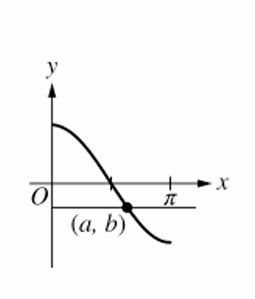
(B) \(\begin{cases} y = \cos^{-1}x \\ x = b \end{cases}\)
(C) \(\begin{cases} y = \sin^{-1}x \\ y = b \end{cases}\)
(D) \(\begin{cases} y = \sin^{-1}x \\ x = b \end{cases}\)
▶️ Answer/Explanation
Given \( f(a) = b \) and \( f \) resembles \( y = \cos x \).
Then \( a = \cos^{-1} b \), i.e., \( (b, a) \) satisfies \( y = \cos^{-1} x \).
To have \((b, a)\) as a solution to a system, the second equation must force \( x = b \) and \( y = a \), which is exactly system (B).
✅ Answer: (B)
Question
(B) \( \pi + \arccos\left(\frac{5}{7}\right) \)
(C) \( \pi + \arccos\left(-\frac{5}{7}\right) \)
(D) \( 2\pi – \arccos\left(\frac{5}{7}\right) \)
▶️ Answer/Explanation
Solve \( 5 + 7\cos x = 0 \) ⇒ \( \cos x = -\frac{5}{7} \).
The reference angle is \( \alpha = \arccos\left(\frac{5}{7}\right) \).
Since \( \cos x \) is negative in Quadrants II and III, and \( \pi < x < 2\pi \) is Quadrants III and IV, we need Quadrant III: \( x = \pi + \alpha \).
Thus \( x = \pi + \arccos\left(\frac{5}{7}\right) \).
✅ Answer: (B)
Question
(B) \( \frac{\pi}{6}, \frac{5\pi}{6} \)
(C) \( \frac{2\pi}{3}, \frac{4\pi}{3} \)
(D) \( \frac{7\pi}{6}, \frac{11\pi}{6} \)
▶️ Answer/Explanation
Solve \( 1 + 3\sec x = -5 \) ⇒ \( 3\sec x = -6 \) ⇒ \( \sec x = -2 \).
Thus \( \cos x = -\frac{1}{2} \).
Solutions in \( [0, 2\pi) \): \( x = \frac{2\pi}{3}, \frac{4\pi}{3} \).
✅ Answer: (C)
Question
(B) \( \sqrt{3}\cos x + \sin x = 1 \)
(C) \( \sqrt{3}\sin x – \cos x = 1 \)
(D) \( \sqrt{3}\sin x + \cos x = 1 \)
▶️ Answer/Explanation
Expand: \( \cos(x + \frac{\pi}{6}) = \cos x\cos\frac{\pi}{6} – \sin x\sin\frac{\pi}{6} = \frac{\sqrt{3}}{2}\cos x – \frac{1}{2}\sin x \).
Set equal to \( \frac{1}{2} \):
\( \frac{\sqrt{3}}{2}\cos x – \frac{1}{2}\sin x = \frac{1}{2} \).
Multiply by 2: \( \sqrt{3}\cos x – \sin x = 1 \).
✅ Answer: (A)
Question
(B) \( x = \frac{\pi}{4}, \frac{\pi}{2}, \frac{5\pi}{4}, \frac{3\pi}{2} \)
(C) \( x = \pi k \) and \( x = -\frac{\pi}{4} + \pi k \) for any integer \( k \)
(D) \( x = \frac{\pi}{2} + \pi k \) and \( x = \frac{\pi}{4} + \pi k \) for any integer \( k \)
▶️ Answer/Explanation
Use identity \( \sec^2 x = 1 + \tan^2 x \):
\( g(x) = (1 + \tan^2 x) + \tan x = 1 \) ⇒ \( \tan^2 x + \tan x = 0 \).
Factor: \( \tan x (\tan x + 1) = 0 \).
Case 1: \( \tan x = 0 \) ⇒ \( x = 0, \pi, 2\pi \).
Case 2: \( \tan x = -1 \) ⇒ \( x = \frac{3\pi}{4}, \frac{7\pi}{4} \).
All solutions in [0, 2π]: \( 0, \frac{3\pi}{4}, \pi, \frac{7\pi}{4}, 2\pi \).
✅ Answer: (A)
Question
(B) \( \cos^2 x – \cos x – 2 = 0 \)
(C) \( \cos^2 x + \cos x + 2 = 0 \)
(D) \( \sin^2 x – \sin x + 2 = 0 \)
▶️ Answer/Explanation
Substitute \( \sin^2 x = 1 – \cos^2 x \):
\( f(x) = (1 – \cos^2 x) + \cos x + 1 = -\cos^2 x + \cos x + 2 \).
Set \( f(x) = 0 \): \( -\cos^2 x + \cos x + 2 = 0 \) ⇒ multiply by -1:
\( \cos^2 x – \cos x – 2 = 0 \).
✅ Answer: (B)
Question
(B) \( \frac{\pi}{6} < \theta < \frac{5\pi}{6} \) only
(C) \( -\frac{2\pi}{3} < \theta < \frac{2\pi}{3} \) only
(D) \( \frac{\pi}{3} < \theta < \frac{2\pi}{3} \) only
▶️ Answer/Explanation
\( 2\cos\theta > -1 \) ⇒ \( \cos\theta > -\frac{1}{2} \).
On \( [-\pi, \pi] \), this holds for \( -\frac{2\pi}{3} < \theta < \frac{2\pi}{3} \) (excluding endpoints where equality).
\( 2\sin\theta > \sqrt{3} \) ⇒ \( \sin\theta > \frac{\sqrt{3}}{2} \).
On \( [-\pi, \pi] \), this holds for \( \frac{\pi}{3} < \theta < \frac{2\pi}{3} \).
Intersection of both inequalities: \( \frac{\pi}{3} < \theta < \frac{2\pi}{3} \).
✅ Answer: (D)
Question
(B) Quadrants I and III only
(C) All four quadrants
(D) No value satisfies
▶️ Answer/Explanation
\( \tan\theta = 1 \) ⇒ \( \theta = \frac{\pi}{4} + \pi k \).
On \( [0, 2\pi) \): \( \frac{\pi}{4} \) (QI) and \( \frac{5\pi}{4} \) (QIII).
✅ Answer: (B)
Question
(B) \(\theta=\frac{\pi}{3}\) and \(\theta=\frac{5\pi}{3}\)
(C) \(\theta=\frac{2\pi}{3}\) and \(\theta=\frac{4\pi}{3}\)
(D) \(\theta=\frac{7\pi}{6}\) and \(\theta=\frac{11\pi}{6}\)
▶️ Answer/Explanation
1. Solve for \(\sin\theta\):
\(2\sin\theta = -1 \implies \sin\theta = -\frac{1}{2}\)
2. Identify Quadrants:
Sine is negative in Quadrants III and IV.
3. Find Angles:
Reference angle is \(\frac{\pi}{6}\) (since \(\sin\frac{\pi}{6}=\frac{1}{2}\)).
Quadrant III: \(\pi + \frac{\pi}{6} = \frac{7\pi}{6}\)
Quadrant IV: \(2\pi – \frac{\pi}{6} = \frac{11\pi}{6}\)
✅ Answer: (D)
Question
(B) \( 0, \pi, \frac{7\pi}{6}, \) and \( \frac{11\pi}{6} \)
(C) \( \frac{\pi}{2}, \frac{3\pi}{2}, \frac{\pi}{3}, \) and \( \frac{5\pi}{3} \)
(D) \( \frac{\pi}{2}, \frac{3\pi}{2}, \frac{2\pi}{3}, \) and \( \frac{4\pi}{3} \)
▶️ Answer/Explanation
Rewrite:
\[ 2\sin^2\theta + \sin\theta = 0 \]
\[ \sin\theta(2\sin\theta + 1) = 0 \]
Case 1: \( \sin\theta = 0 \) ⇒ \( \theta = 0, \pi \) in \( [0, 2\pi) \).
Case 2: \( 2\sin\theta + 1 = 0 \) ⇒ \( \sin\theta = -\frac{1}{2} \) ⇒ \( \theta = \frac{7\pi}{6}, \frac{11\pi}{6} \).
All solutions: \( 0, \pi, \frac{7\pi}{6}, \frac{11\pi}{6} \).
✅ Answer: (B)
Question
(B) 1.307 and 2.704
(C) 1.540 and 2.471
(D) 0.144, 1.075, and 2.936
▶️ Answer/Explanation
\( g(x) = \sin(2.25x + 0.2) + 0.5 \).
Set \( g(x) = 0 \):
\[ \sin(2.25x + 0.2) = -0.5 \]
General solution: \( 2.25x + 0.2 = \frac{7\pi}{6} + 2n\pi \) or \( \frac{11\pi}{6} + 2n\pi \).
Solve for \( x \) in \( [0,\pi] \):
Using calculator approximations:
For \( n = 0 \):
• \( 2.25x + 0.2 = 7\pi/6 \approx 3.66519 \) ⇒ \( x \approx 1.540 \)
• \( 2.25x + 0.2 = 11\pi/6 \approx 5.75959 \) ⇒ \( x \approx 2.471 \)
Both are in \( [0,\pi] \).
✅ Answer: (C)
Question
b. $\theta = 181.25$
c. $\theta = 4.39$
d. $\theta = 7.53$
▶️ Answer/Explanation
First, find the reference angle using $\alpha = \arctan(3) \approx 1.25$ radians.
Given $\tan \theta = 3$ (positive) and $\cos \theta < 0$ (negative), the angle must be in Quadrant III.
In Quadrant III, the formula for the angle is $\theta = \pi + \alpha$.
Substitute the values: $\theta = 3.14159 + 1.25$.
The resulting calculation is $\theta \approx 4.39$ radians.
This value falls within the required range of $0 \leq \theta < 2\pi$.
Therefore, the correct option is c.
Question
▶️ Answer/Explanation
Use the double-angle identity \(\sin(2x) = 2\sin(x)\cos(x)\) to rewrite the equation:
\(2\sin(x)\cos(x) + \sin(x) = 0\)
Factor out \(\sin(x)\):
\(\sin(x)(2\cos(x) + 1) = 0\)
This gives two cases: \(\sin(x) = 0\) or \(2\cos(x) + 1 = 0\).
Case 1: \(\sin(x) = 0 \implies x = 0, \pi\) (in the given interval).
Case 2: \(\cos(x) = -\frac{1}{2} \implies x = \frac{2\pi}{3}, \frac{4\pi}{3}\) (cosine is negative in Q2 and Q3).
The complete solution set is \(\{0, \frac{2\pi}{3}, \pi, \frac{4\pi}{3}\}\).
Note: Option (C) is the closest match, likely containing a typo where \(\pi\) was misprinted as \(\frac{\pi}{3}\).
Question
▶️ Answer/Explanation
We are looking for an equation equivalent to \( g(x) = 1 \), where \( g(x) = \sin \left( x + \frac{\pi}{3} \right) \).
Using the sum identity for sine, \( \sin(A + B) = \sin A \cos B + \cos A \sin B \), we expand the left side:
\( \sin x \cos \left( \frac{\pi}{3} \right) + \cos x \sin \left( \frac{\pi}{3} \right) = 1 \)
Substitute the known trigonometric values \( \cos \left( \frac{\pi}{3} \right) = \frac{1}{2} \) and \( \sin \left( \frac{\pi}{3} \right) = \frac{\sqrt{3}}{2} \):
\( \sin x \left( \frac{1}{2} \right) + \cos x \left( \frac{\sqrt{3}}{2} \right) = 1 \)
Multiplying the entire equation by 2 to eliminate the denominators gives:
\( \sin x + \sqrt{3} \cos x = 2 \)
Therefore, the correct option is (A).
Question
▶️ Answer/Explanation
Question
▶️ Answer/Explanation
A zero of the function $h(x)$ occurs where $h(x) = 0$.
This means we must find $x$ such that $f(x) – g(x) = 0$, or $f(x) = g(x)$.
Substitute the functions: $3\cos(x + 2.78) = \sin(x – 0.25)$.
Using a graphing utility, plot $y = 3\cos(x + 2.78) – \sin(x – 0.25)$ on $[0, \pi]$.
Observe the point where the graph crosses the $x$-axis within the interval.
The intersection occurs at $x \approx 2.242$.
Thus, the zero of the function in the given interval is $2.242$.
The correct option is (A).
Question
▶️ Answer/Explanation
Set the function equal to the target value: $2 \sin \theta = -1$.
Isolate the sine function by dividing both sides by $2$ to get $\sin \theta = -\frac{1}{2}$.
Identify the reference angle where $\sin \theta = \frac{1}{2}$, which is $\theta_{ref} = \frac{\pi}{6}$.
Since the sine value is negative, $\theta$ must be in Quadrant III or Quadrant IV.
In Quadrant III: $\theta = \pi + \frac{\pi}{6} = \frac{7\pi}{6}$.
In Quadrant IV: $\theta = 2\pi – \frac{\pi}{6} = \frac{11\pi}{6}$.
Therefore, the correct option is (D).
Question
▶️ Answer/Explanation
Set the function equal to the target value: \( 2\sin \theta = -1 \).
Isolate the sine term by dividing both sides by 2: \( \sin \theta = -\frac{1}{2} \).
Identify the reference angle: \( \sin \frac{\pi}{6} = \frac{1}{2} \), so the reference angle is \( \frac{\pi}{6} \).
Since \( \sin \theta \) is negative, \( \theta \) must lie in Quadrant III or Quadrant IV.
For Quadrant III: \( \theta = \pi + \frac{\pi}{6} = \frac{7\pi}{6} \).
For Quadrant IV: \( \theta = 2\pi – \frac{\pi}{6} = \frac{11\pi}{6} \).
Therefore, the values are \( \frac{7\pi}{6} \) and \( \frac{11\pi}{6} \), which corresponds to option (D).
Question
(B) One
(C) Two
(D) Infinitely many
▶️ Answer/Explanation
Using the identity $\sin(\theta + \frac{\pi}{2}) = \cos\theta$, we set $f(\theta) = g(\theta)$ as $\sin\theta = \cos\theta$.
Dividing by $\cos\theta$ (where $\cos\theta \neq 0$), we get $\tan\theta = 1$.
In the interval $[0, 2\pi]$, the tangent function equals $1$ at two specific points.
The first solution occurs in Quadrant I at $\theta = \frac{\pi}{4}$.
The second solution occurs in Quadrant III at $\theta = \frac{5\pi}{4}$.
Therefore, there are exactly two solutions within the given interval.
The correct option is (C).