AP Precalculus -3.12 Equivalent Trigonometric Forms- MCQ Exam Style Questions - Effective Fall 2023
AP Precalculus -3.12 Equivalent Trigonometric Forms- MCQ Exam Style Questions – Effective Fall 2023
AP Precalculus -3.12 Equivalent Trigonometric Forms- MCQ Exam Style Questions – AP Precalculus- per latest AP Precalculus Syllabus.
Question
(B) \( 1 – 2\cos^2\theta \)
(C) \( 1 – 2\sin^2\theta \)
(D) \( 2\cos\theta\sin\theta \)
▶️ Answer/Explanation
Using the double-angle identity:
\( \cos(2\theta) = \cos^2\theta – \sin^2\theta \).
Replace \( \cos^2\theta = 1 – \sin^2\theta \):
\( \cos(2\theta) = (1 – \sin^2\theta) – \sin^2\theta = 1 – 2\sin^2\theta \).
✅ Answer: (C)
Question
(B) \( c = 2a, d = 2b \)
(C) \( c = a^2 + b^2, d = 2ab \)
(D) \( c = a^2 – b^2, d = 2ab \)
▶️ Answer/Explanation
On unit circle: \( a = \cos\theta, b = \sin\theta \).
Then \( c = \cos(2\theta) = \cos^2\theta – \sin^2\theta = a^2 – b^2 \).
\( d = \sin(2\theta) = 2\sin\theta\cos\theta = 2ab \).
✅ Answer: (D)
Question
(B) \( \cos^3 x \)
(C) \( \tan x \sec x \)
(D) \( \cot x \csc x \)
▶️ Answer/Explanation
Using \( 1 + \tan^2 x = \sec^2 x \):
\( f(x) = \cos x \cdot \sec^2 x = \cos x \cdot \frac{1}{\cos^2 x} = \frac{1}{\cos x} = \sec x \).
✅ Answer: (A)
Question
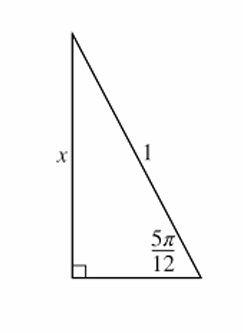
(B) \( \left( \frac{\sqrt{2}}{2} \right) \left( \frac{\sqrt{3}}{2} \right) + \left( \frac{\sqrt{2}}{2} \right) \left( \frac{1}{2} \right) \)
(C) \( \left( \frac{\sqrt{2}}{2} \right) \left( \frac{\sqrt{3}}{2} \right) – \left( \frac{\sqrt{2}}{2} \right) \left( \frac{1}{2} \right) \)
(D) \( \left( \frac{\sqrt{2}}{2} \right) \left( \frac{1}{2} \right) – \left( \frac{\sqrt{2}}{2} \right) \left( \frac{\sqrt{3}}{2} \right) \)
▶️ Answer/Explanation
\( x = \sin\frac{5\pi}{12} \).
Let \( \frac{3\pi}{12} = \frac{\pi}{4} \), \( \frac{2\pi}{12} = \frac{\pi}{6} \).
Using sum identity: \( \sin\left(\frac{\pi}{4} + \frac{\pi}{6}\right) = \sin\frac{\pi}{4}\cos\frac{\pi}{6} + \cos\frac{\pi}{4}\sin\frac{\pi}{6} \).
\( \sin\frac{\pi}{4} = \frac{\sqrt{2}}{2}, \cos\frac{\pi}{6} = \frac{\sqrt{3}}{2} \), \( \cos\frac{\pi}{4} = \frac{\sqrt{2}}{2}, \sin\frac{\pi}{6} = \frac{1}{2} \).
Thus \( x = \left(\frac{\sqrt{2}}{2}\right)\left(\frac{\sqrt{3}}{2}\right) + \left(\frac{\sqrt{2}}{2}\right)\left(\frac{1}{2}\right) \).
✅ Answer: (B)
Question
(B) The sum identity for cosine
(C) The double-angle identity for sine
(D) The double-angle identity for cosine
▶️ Answer/Explanation
The sum identity for sine: \( \sin(A + B) = \sin A \cos B + \cos A \sin B \).
Let \( A = x, B = \frac{\pi}{2} \):
\( \sin(x + \frac{\pi}{2}) = \sin x \cos\frac{\pi}{2} + \cos x \sin\frac{\pi}{2} \).
Since \( \cos\frac{\pi}{2} = 0 \) and \( \sin\frac{\pi}{2} = 1 \), we get \( \cos x \).
✅ Answer: (A)
Question
(B) \( (7\cos x)(7\sin x) \)
(C) \( 7\cos^2 x – 7\sin^2 x \)
(D) \( 7 – 14\sin^2 x \)
▶️ Answer/Explanation
Using the double-angle identity: \( \sin(2x) = 2\sin x \cos x \).
Thus \( g(x) = 7 \cdot 2\sin x \cos x = 14\sin x \cos x \).
✅ Answer: (A)
Question
(B) \(\frac{\tan^{2}x}{\cos^{2}x}\)
(C) \(\sin^{2}x\)
(D) \(\cos^{2}x\)
▶️ Answer/Explanation
1. Use Pythagorean Identity:
\(\sec^2 x – 1 = \tan^2 x\).
2. Simplify Fraction:
\(\frac{\tan^2 x}{\sec^2 x} = \tan^2 x \cdot \cos^2 x\)
\(= \frac{\sin^2 x}{\cos^2 x} \cdot \cos^2 x = \sin^2 x\)
✅ Answer: (C)
Question
(B) \( g(x) = (7 \cos x)(7 \sin x) \)
(C) \( g(x) = 7 \cos^2 x – 7 \sin^2 x \)
(D) \( g(x) = 7 – 14 \sin^2 x \)
▶️ Answer/Explanation
Using the double-angle identity:
\[ \sin(2x) = 2 \sin x \cos x \]
Thus, \[ g(x) = 7 \sin(2x) = 7 \cdot 2 \sin x \cos x = 14 \sin x \cos x \]
This matches option (A).
✅ Answer: (A)
Question
▶️ Answer/Explanation
The correct answer is (D).
Step 1: Identify the Pythagorean identity in the numerator. We know that \(\tan^2 x + 1 = \sec^2 x\), therefore \(\sec^2 x – 1 = \tan^2 x\).
Step 2: Substitute this into the expression: \(\frac{\tan^2 x}{\sec^2 x}\).
Step 3: Rewrite in terms of sine and cosine: \(\tan^2 x = \frac{\sin^2 x}{\cos^2 x}\) and \(\sec^2 x = \frac{1}{\cos^2 x}\).
Step 4: Divide the fractions: \(\frac{\sin^2 x}{\cos^2 x} \div \frac{1}{\cos^2 x} = \frac{\sin^2 x}{\cos^2 x} \cdot \cos^2 x\).
Step 5: Cancel the \(\cos^2 x\) terms to get the final result: \(\sin^2 x\).
Question
▶️ Answer/Explanation
Question
The functions \( g \) and \( h \) are given by:
$$ g(x) = 2 \log a – 3 \log b + \frac{\log a}{2} + \log (100 c) $$
$$ h(x) = \cot x \sec^{2} x – \tan x $$
(A) i. Rewrite \( g(x) \) as a single logarithm with base 10 without negative exponents in any part of the expression. Your result should be simplified in the form \( \log(\text{expression}) \).
ii. Rewrite \( h(x) \) as an expression in which \( \cot x \) appears once and no other trigonometric functions are involved.
(B) The functions \( j \) and \( k \) are given by:
$$ j(x) = 3 \cot^{2} \theta + 3 \csc \theta $$
$$ k(x) = 7 e^{-2x} + 9 $$
i. Solve \( j(x) = -3 \) for values of \( x \) in the interval \( [0, 2\pi) \).
ii. Solve \( k(x) = 86 \) for all values of \( x \) in the domain of \( k \).
(C) Two functions \( a \) and \( b \) are given by:
$$ a(x) = 3 – 3 \csc 3\theta $$
$$ b(x) = -1 + \csc 3\theta $$
Find all the input values in the domain of \( a \) and \( b \) where \( a(x) \) and \( b(x) \) intersect.
Most-appropriate topic codes (CED):
• TOPIC 3.11: Equivalent Representations of Trigonometric Functions — part (A) ii
• TOPIC 3.12: Trigonometric Equation Solving — part (B) i
• TOPIC 2.13: Exponential and Logarithmic Equations and Inequalities — part (B) ii
• TOPIC 3.12: Trigonometric Equation Solving — part (C)
▶️ Answer/Explanation
(A) i. Logarithmic Simplification
Start with the given expression:
\( g(x) = 2 \log a + \frac{1}{2} \log a – 3 \log b + \log (100 c) \)
Combine the \( \log a \) terms (\( 2 + 0.5 = 2.5 \)):
\( \frac{5}{2} \log a – 3 \log b + \log (100 c) \)
Use power rules to move coefficients inside the logarithms:
\( \log (a^{5/2}) – \log (b^3) + \log (100 c) \)
Combine using product and quotient rules:
\( \log \left( \frac{100 c \cdot a^{5/2}}{b^3} \right) \)
Final Answer: \( \log \left( \frac{100 a^{5/2} c}{b^3} \right) \)
(A) ii. Trigonometric Simplification
Start with: \( h(x) = \cot x \sec^2 x – \tan x \)
Convert to sine and cosine:
\( \left(\frac{\cos x}{\sin x}\right) \cdot \left(\frac{1}{\cos^2 x}\right) – \frac{\sin x}{\cos x} \)
Simplify the first term:
\( \frac{1}{\sin x \cos x} – \frac{\sin x}{\cos x} \)
Find a common denominator (\( \sin x \cos x \)) and simplify:
\( \frac{1 – \sin^2 x}{\sin x \cos x} = \frac{\cos^2 x}{\sin x \cos x} \)
Cancel terms:
\( \frac{\cos x}{\sin x} \)
Final Answer: \( \cot x \)
(B) i. Trigonometric Equation
Set \( j(x) = -3 \):
\( 3 \cot^2 \theta + 3 \csc \theta = -3 \)
Divide by 3 and rearrange:
\( \cot^2 \theta + \csc \theta + 1 = 0 \)
Substitute identity \( \cot^2 \theta = \csc^2 \theta – 1 \):
\( (\csc^2 \theta – 1) + \csc \theta + 1 = 0 \)
\( \csc^2 \theta + \csc \theta = 0 \)
Factor:
\( \csc \theta (\csc \theta + 1) = 0 \)
Solve \( \csc \theta = -1 \) (since \( \csc \theta \neq 0 \)):
\( \sin \theta = -1 \)
[Image of unit circle sine values]
In the interval \( [0, 2\pi) \):
Final Answer: \( \theta = \frac{3\pi}{2} \)
(B) ii. Exponential Equation
Set \( k(x) = 86 \):
\( 7 e^{-2x} + 9 = 86 \)
Subtract 9 and divide by 7:
\( 7 e^{-2x} = 77 \implies e^{-2x} = 11 \)
Take the natural log:
\( -2x = \ln 11 \)
Final Answer: \( x = -\frac{1}{2} \ln 11 \)
(C) Intersection
Set \( a(x) = b(x) \):
\( 3 – 3 \csc 3\theta = -1 + \csc 3\theta \)
Rearrange:
\( 4 = 4 \csc 3\theta \implies \csc 3\theta = 1 \)
So, \( \sin 3\theta = 1 \). The sine function equals 1 at \( \frac{\pi}{2} \) plus full rotations:
\( 3\theta = \frac{\pi}{2} + 2k\pi \)
Final Answer: \( \theta = \frac{\pi}{6} + \frac{2k\pi}{3} \), where \( k \in \mathbb{Z} \)
Question
Directions:
- Unless otherwise specified, the domain of a function \( f \) is assumed to be the set of all real numbers \( x \) for which \( f(x) \) is a real number. Angle measures for trigonometric functions are assumed to be in radians.
- Solutions to equations must be real numbers. Determine the exact value of any expression that can be obtained without a calculator. For example, \( \log_2 8 \), \( \cos(\frac{\pi}{2}) \), and \( \sin^{-1}(1) \) can be evaluated without a calculator.
- Unless otherwise specified, combine terms using algebraic methods and rules for exponents and logarithms, where applicable. For example, \( 2x + 3x \), \( 5^2 \cdot 5^3 \), \( \frac{x^5}{x^2} \), and \( \ln 3 + \ln 5 \) should be rewritten in equivalent forms.
- For each part of the question, show the work that leads to your answers.
Part A
The functions \( g \) and \( h \) are given by
\( h(x) = \sin^{-1}(8x) \)
Part B
The functions \( j \) and \( k \) are given by
\( k(x) = \frac{(16^{3x}) \cdot 4^x}{2} \)
Part C
The function \( m \) is given by
▶️ Answer/Explanation
Part A
(i) Solve \( g(x) = 3 \)
Start with the given equation:
\( \log_5(4x – 2) = 3 \)
Convert the logarithmic equation to exponential form (\( y = \log_b x \iff x = b^y \)):
\( 4x – 2 = 5^3 \)
Evaluate the exponent:
\( 4x – 2 = 125 \)
Add 2 to both sides:
\( 4x = 127 \)
Divide by 4:
\( x = \frac{127}{4} \)
(ii) Solve \( h(x) = \frac{\pi}{4} \)
Start with the given equation:
\( \sin^{-1}(8x) = \frac{\pi}{4} \)
Take the sine of both sides to isolate the argument:
\( 8x = \sin\left(\frac{\pi}{4}\right) \)
Substitute the exact value of \( \sin\left(\frac{\pi}{4}\right) \):
\( 8x = \frac{\sqrt{2}}{2} \)
Divide by 8:
\( x = \frac{\sqrt{2}}{16} \)
Part B
(i) Rewrite \( j(x) \)
Start with the function definition:
\( j(x) = (\sec x)(\cot x) \)
Substitute the reciprocal and quotient identities (\( \sec x = \frac{1}{\cos x} \) and \( \cot x = \frac{\cos x}{\sin x} \)):
\( j(x) = \left(\frac{1}{\cos x}\right) \left(\frac{\cos x}{\sin x}\right) \)
Cancel the \( \cos x \) terms:
\( j(x) = \frac{1}{\sin x} \)
(ii) Rewrite \( k(x) \)
Start with the function definition:
\( k(x) = \frac{(16^{3x}) \cdot 4^x}{2} \)
To write in the form \( 4^{(ax+b)} \), convert bases 16 and 2 to base 4.
Since \( 16 = 4^2 \) and \( 2 = \sqrt{4} = 4^{1/2} = 4^{0.5} \):
\( k(x) = \frac{(4^2)^{3x} \cdot 4^x}{4^{0.5}} \)
Apply the power of a power rule (\( (a^m)^n = a^{mn} \)):
\( k(x) = \frac{4^{6x} \cdot 4^x}{4^{0.5}} \)
Apply the product rule for exponents (\( a^m \cdot a^n = a^{m+n} \)) in the numerator:
\( k(x) = \frac{4^{6x + x}}{4^{0.5}} = \frac{4^{7x}}{4^{0.5}} \)
Apply the quotient rule for exponents (\( \frac{a^m}{a^n} = a^{m-n} \)):
\( k(x) = 4^{7x – 0.5} \) (or \( 4^{7x – \frac{1}{2}} \))
Thus, \( a = 7 \) and \( b = -0.5 \).
Part C
Find values where \( m(x) = 1 \)
Set the function equal to 1:
\( \sqrt{3}\tan\left(x + \frac{\pi}{2}\right) = 1 \)
Isolate the tangent function by dividing by \( \sqrt{3} \):
\( \tan\left(x + \frac{\pi}{2}\right) = \frac{1}{\sqrt{3}} \)
Determine the reference angle. We know that \( \tan\left(\frac{\pi}{6}\right) = \frac{1}{\sqrt{3}} \).
Set up the general solution for tangent (\( \theta = \text{ref} + n\pi \)):
\( x + \frac{\pi}{2} = \frac{\pi}{6} + n\pi \), where \( n \) is any integer.
Solve for \( x \) by subtracting \( \frac{\pi}{2} \) from both sides:
\( x = \frac{\pi}{6} – \frac{\pi}{2} + n\pi \)
Find a common denominator (6) to combine fractions:
\( x = \frac{\pi}{6} – \frac{3\pi}{6} + n\pi \)
\( x = -\frac{2\pi}{6} + n\pi \)
Simplify the fraction:
\( x = -\frac{\pi}{3} + n\pi \)
Question
Directions:
- Unless otherwise specified, the domain of a function \( f \) is assumed to be the set of all real numbers \( x \) for which \( f(x) \) is a real number. Angle measures for trigonometric functions are assumed to be in radians.
- Solutions to equations must be real numbers. Determine the exact value of any expression that can be obtained without a calculator.
- Unless otherwise specified, combine terms using algebraic methods and rules for exponents and logarithms where applicable.
- For each part of the question, show the work that leads to your answers.
(A) The functions \( g \) and \( h \) are given by
\( g(x) = 3^{(2x)} \cdot 3^{(x+4)} \)
\( h(x) = 2\tan^2 x – 1 \)
(ii) Solve \( h(x) = 5 \) for values of \( x \) in the interval \( [0, 2\pi) \).
(B) The functions \( j \) and \( k \) are given by
\( j(x) = 2\log_{10}(x+3) – \log_{10} x – \log_{10} 3 \)
\( k(x) = \frac{(\tan^2 x)(\cot x)}{\csc x} \)
(ii) Rewrite \( k(x) \) as a fraction involving \( \sec x \) and no other trigonometric functions.
(C) The function \( m \) is given by
\( m(x) = \frac{2^{(5x+3)}}{\left(2^{(x-2)}\right)^3} \)
▶️ Answer/Explanation
(A)(i) Solve \( g(x) = 27 \)
First, simplify the expression for \( g(x) \) using the property of exponents \( a^m \cdot a^n = a^{m+n} \).
\( g(x) = 3^{2x} \cdot 3^{x+4} = 3^{(2x + x + 4)} = 3^{(3x+4)} \)
Set \( g(x) \) equal to 27 and rewrite 27 as a base of 3:
\( 3^{(3x+4)} = 27 \)
\( 3^{(3x+4)} = 3^3 \)
Since the bases are equal, the exponents must be equal:
\( 3x + 4 = 3 \)
\( 3x = 3 – 4 \)
\( 3x = -1 \)
\( x = -\frac{1}{3} \)
(A)(ii) Solve \( h(x) = 5 \) on \( [0, 2\pi) \)
Set the expression for \( h(x) \) equal to 5:
\( 2\tan^2 x – 1 = 5 \)
Add 1 to both sides:
\( 2\tan^2 x = 6 \)
Divide by 2:
\( \tan^2 x = 3 \)
Take the square root of both sides:
\( \tan x = \pm\sqrt{3} \)
The reference angle for \( \tan \theta = \sqrt{3} \) is \( \frac{\pi}{3} \).
Since we have \( \pm\sqrt{3} \), we must consider solutions in all four quadrants within the interval \( [0, 2\pi) \):
Quadrant I: \( x = \frac{\pi}{3} \)
Quadrant II: \( x = \pi – \frac{\pi}{3} = \frac{2\pi}{3} \)
Quadrant III: \( x = \pi + \frac{\pi}{3} = \frac{4\pi}{3} \)
Quadrant IV: \( x = 2\pi – \frac{\pi}{3} = \frac{5\pi}{3} \)
Solution set: \( x = \frac{\pi}{3}, \frac{2\pi}{3}, \frac{4\pi}{3}, \frac{5\pi}{3} \)
(B)(i) Rewrite \( j(x) \) as a single logarithm
Given: \( j(x) = 2\log_{10}(x+3) – \log_{10} x – \log_{10} 3 \)
Use the power rule \( n\log a = \log(a^n) \):
\( = \log_{10}((x+3)^2) – \log_{10} x – \log_{10} 3 \)
Factor out the negative sign for the last two terms to group them:
\( = \log_{10}((x+3)^2) – (\log_{10} x + \log_{10} 3) \)
Use the product rule \( \log a + \log b = \log(ab) \):
\( = \log_{10}((x+3)^2) – \log_{10}(3x) \)
Use the quotient rule \( \log a – \log b = \log(\frac{a}{b}) \):
\( = \log_{10}\left(\frac{(x+3)^2}{3x}\right) \)
(B)(ii) Rewrite \( k(x) \) involving \( \sec x \)
Given: \( k(x) = \frac{(\tan^2 x)(\cot x)}{\csc x} \)
First, simplify the numerator using \( \tan x \cdot \cot x = 1 \):
\( (\tan^2 x)(\cot x) = \tan x \cdot (\tan x \cdot \cot x) = \tan x \cdot 1 = \tan x \)
Now substitute back into the expression:
\( k(x) = \frac{\tan x}{\csc x} \)
Convert to sine and cosine:
\( = \frac{\frac{\sin x}{\cos x}}{\frac{1}{\sin x}} \)
\( = \frac{\sin x}{\cos x} \cdot \frac{\sin x}{1} = \frac{\sin^2 x}{\cos x} \)
We need the expression in terms of \( \sec x \). Use the identity \( \sin^2 x = 1 – \cos^2 x \):
\( = \frac{1 – \cos^2 x}{\cos x} \)
Substitute \( \cos x = \frac{1}{\sec x} \):
\( = \frac{1 – \left(\frac{1}{\sec x}\right)^2}{\frac{1}{\sec x}} \)
\( = \frac{1 – \frac{1}{\sec^2 x}}{\frac{1}{\sec x}} \)
Find a common denominator for the numerator:
\( = \frac{\frac{\sec^2 x – 1}{\sec^2 x}}{\frac{1}{\sec x}} \)
Multiply by the reciprocal of the denominator:
\( = \frac{\sec^2 x – 1}{\sec^2 x} \cdot \frac{\sec x}{1} \)
\( = \frac{\sec^2 x – 1}{\sec x} \)
(C) Find input values for \( m(x) = \frac{1}{16} \)
First, simplify the expression for \( m(x) \):
\( m(x) = \frac{2^{(5x+3)}}{\left(2^{(x-2)}\right)^3} \)
Simplify the denominator using the power rule \( (a^m)^n = a^{m \cdot n} \):
\( \left(2^{(x-2)}\right)^3 = 2^{3(x-2)} = 2^{3x-6} \)
Now apply the quotient rule \( \frac{a^m}{a^n} = a^{m-n} \):
\( m(x) = \frac{2^{5x+3}}{2^{3x-6}} = 2^{(5x+3) – (3x-6)} \)
\( = 2^{5x + 3 – 3x + 6} \)
\( = 2^{2x + 9} \)
Set \( m(x) = \frac{1}{16} \) and rewrite \( \frac{1}{16} \) as a power of 2:
\( \frac{1}{16} = \frac{1}{2^4} = 2^{-4} \)
Equate the simplified \( m(x) \) to \( 2^{-4} \):
\( 2^{2x + 9} = 2^{-4} \)
Equate the exponents:
\( 2x + 9 = -4 \)
\( 2x = -13 \)
\( x = -\frac{13}{2} \) or \( -6.5 \)
Question

(A) The function \(g\) and \(h\) are given by
\(g(x) = 3 \ln x – \frac{1}{2} \ln x\)
\(h(x) = \frac{\sin^2 x – 1}{\cos x}\)
(i) Rewrite \(g(x)\) as a single natural logarithm without negative exponents in any part of the expression. Your result should be of the form \(\ln(\text{expression})\).
(ii) Rewrite \(h(x)\) as an expression in which \(\cos x\) appears once and no other trigonometric functions are involved.
(B) The functions \(j\) and \(k\) are given by
\(j(x) = 2(\sin x)(\cos x)\)
\(k(x) = 8e^{(3x)} – e\)
(i) Solve \(j(x) = 0\) for values of \(x\) in the interval \(\left[0, \frac{\pi}{2}\right]\).
(ii) Solve \(k(x) = 3e\) for values of \(x\) in the domain of \(k\).
(C) The function \(m\) is given by
\(m(x) = \cos(2x) + 4\)
Find all input values in the domain of \(m\) that yield an output of \(\frac{9}{2}\).
▶️ Answer/Explanation
(A)(i) Rewrite \(g(x)\)
The function is given by \(g(x) = 3 \ln x – \frac{1}{2} \ln x\).
Combine the like terms:
\(g(x) = \left(3 – \frac{1}{2}\right) \ln x\)
\(g(x) = \frac{5}{2} \ln x\)
Apply the power property of logarithms, \(a \ln b = \ln(b^a)\):
\(g(x) = \ln\left(x^{5/2}\right)\)
(A)(ii) Rewrite \(h(x)\)
The function is given by \(h(x) = \frac{\sin^2 x – 1}{\cos x}\).
Recall the Pythagorean identity: \(\sin^2 x + \cos^2 x = 1\).
Rearrange the identity to isolate the numerator expression: \(\sin^2 x – 1 = -\cos^2 x\).
Substitute this into the function:
\(h(x) = \frac{-\cos^2 x}{\cos x}\)
Simplify the expression by canceling one \(\cos x\) term:
\(h(x) = -\cos x\)
(B)(i) Solve \(j(x) = 0\)
Set the function equal to zero: \(2(\sin x)(\cos x) = 0\).
Divide both sides by 2:
\(\sin x \cos x = 0\)
By the zero product property, either \(\sin x = 0\) or \(\cos x = 0\).
Case 1: \(\sin x = 0\). In the interval \(\left[0, \frac{\pi}{2}\right]\), \(x = 0\).
Case 2: \(\cos x = 0\). In the interval \(\left[0, \frac{\pi}{2}\right]\), \(x = \frac{\pi}{2}\).
The solutions are \(x = 0\) and \(x = \frac{\pi}{2}\).
(B)(ii) Solve \(k(x) = 3e\)
Set the function equal to \(3e\):
\(8e^{(3x)} – e = 3e\)
Add \(e\) to both sides:
\(8e^{(3x)} = 4e\)
Divide both sides by 8:
\(e^{(3x)} = \frac{4e}{8}\)
\(e^{(3x)} = \frac{e}{2}\)
Take the natural logarithm (\(\ln\)) of both sides:
\(\ln\left(e^{3x}\right) = \ln\left(\frac{e}{2}\right)\)
Use logarithm properties to simplify (\(\ln(e^a) = a\) and \(\ln(a/b) = \ln a – \ln b\)):
\(3x = \ln e – \ln 2\)
Since \(\ln e = 1\):
\(3x = 1 – \ln 2\)
Divide by 3:
\(x = \frac{1 – \ln 2}{3}\)
(C) Find input values for \(m(x) = \frac{9}{2}\)
Set the function equal to \(\frac{9}{2}\):
\(\cos(2x) + 4 = \frac{9}{2}\)
Subtract 4 from both sides (note that \(4 = \frac{8}{2}\)):
\(\cos(2x) = \frac{9}{2} – \frac{8}{2}\)
\(\cos(2x) = \frac{1}{2}\)
The reference angle for cosine equal to \(\frac{1}{2}\) is \(\frac{\pi}{3}\).
The general solution for \(2x\) is:
\(2x = \frac{\pi}{3} + 2\pi n\) or \(2x = -\frac{\pi}{3} + 2\pi n\) (where \(n\) is an integer).
Solve for \(x\) by dividing by 2:
\(x = \frac{\pi}{6} + \pi n\) or \(x = -\frac{\pi}{6} + \pi n\)
Combining these, the input values are \(x = \pm \frac{\pi}{6} + \pi n\) for any integer \(n\).

