Home / AP® Exam / AP® PreCalculus / AP® Precalculus

AP Precalculus -3.13 Trigonometry and Polar Coordinates- MCQ Exam Style Questions - Effective Fall 2023

AP Precalculus -3.13 Trigonometry and Polar Coordinates- MCQ Exam Style Questions – Effective Fall 2023

AP Precalculus -3.13 Trigonometry and Polar Coordinates- MCQ Exam Style Questions – AP Precalculus- per latest AP Precalculus Syllabus.

AP Precalculus – MCQ Exam Style Questions- All Topics

Question

A complex number is represented by a point in the complex plane. The complex number has the rectangular coordinates \((3,3)\). Which of the following is one way to express the complex number using its polar coordinates \((r, \theta)\)?
(A) \( \left( 3\sqrt{2}\cos\left(\frac{\pi}{4}\right) + i\left(3\sqrt{2}\sin\left(\frac{\pi}{4}\right)\right) \right) \)
(B) \( \left( 3\cos\left(\frac{\pi}{4}\right) + i\left(3\sin\left(\frac{\pi}{4}\right)\right) \right) \)
(C) \( \left( 3\sqrt{2}\cos\left(-\frac{\pi}{4}\right) + i\left(3\sqrt{2}\sin\left(-\frac{\pi}{4}\right)\right) \right) \)
(D) \( \left( 3\cos\left(-\frac{\pi}{4}\right) + i\left(3\sin\left(-\frac{\pi}{4}\right)\right) \right) \)
▶️ Answer/Explanation
Detailed solution

The polar form of a complex number is \( r(\cos \theta + i \sin \theta) \). For the point \((3,3)\):
\( r = \sqrt{3^2 + 3^2} = \sqrt{18} = 3\sqrt{2} \)
\( \theta = \arctan\left(\frac{3}{3}\right) = \arctan(1) = \frac{\pi}{4} \)
Thus, the polar form is \( 3\sqrt{2}\left( \cos\frac{\pi}{4} + i \sin\frac{\pi}{4} \right) \), which matches option (A).
Answer: (A)

Question


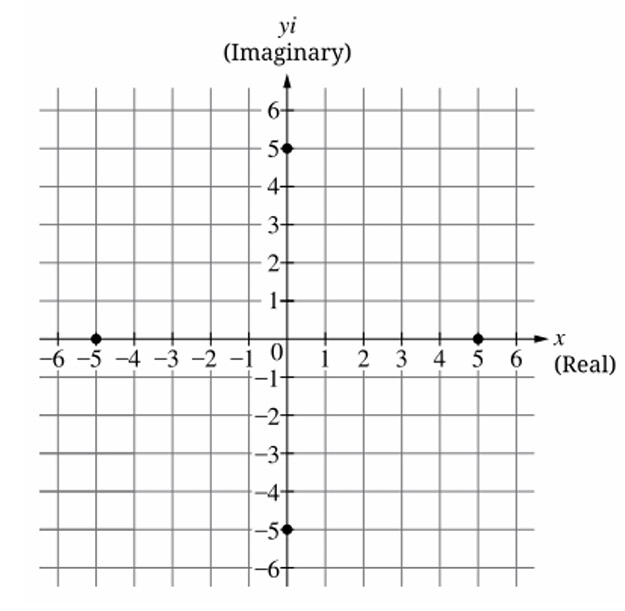
The graph indicates four points in the complex plane. Each complex number has polar coordinates \( (r, \theta) \). Which of the following completes the expression for the four points in the polar form \( (5 \cos \theta) + i(5 \sin \theta) \)?
(A) \( \theta = \frac{\pi}{4} + \left( \frac{\pi}{4} \right)k \), where \( k = 1, 2, 3, 4 \)
(B) \( \theta = \frac{\pi}{4} + \left( \frac{\pi}{2} \right)k \), where \( k = 1, 2, 3, 4 \)
(C) \( \theta = \frac{\pi}{2} + \left( \frac{\pi}{2} \right)k \), where \( k = 1, 2, 3, 4 \)
(D) \( \theta = \frac{\pi}{2} + \pi k \), where \( k = 1, 2, 3, 4 \)
▶️ Answer/Explanation
Detailed solution

The four points are at \( (5,0), (0,5), (-5,0), (0,-5) \) in rectangular coordinates, corresponding to angles \( 0, \frac{\pi}{2}, \pi, \frac{3\pi}{2} \).
In polar form \( r = 5 \), the angles are spaced \( \frac{\pi}{2} \) apart starting at \( 0 \). Option (C) starts at \( \frac{\pi}{2} \) and adds \( \frac{\pi}{2}k \) for \( k = 0,1,2,3 \), yielding \( \frac{\pi}{2}, \pi, \frac{3\pi}{2}, 2\pi \) — but the given list starts from \( k=1 \) to \( k=4 \), which would give \( \pi, \frac{3\pi}{2}, 2\pi, \frac{5\pi}{2} \) (mod \( 2\pi \)), equivalent to \( \pi, \frac{3\pi}{2}, 0, \frac{\pi}{2} \) — the same four angles.
Thus (C) correctly generates the set of angles for the four points.
Answer: (C)

Question


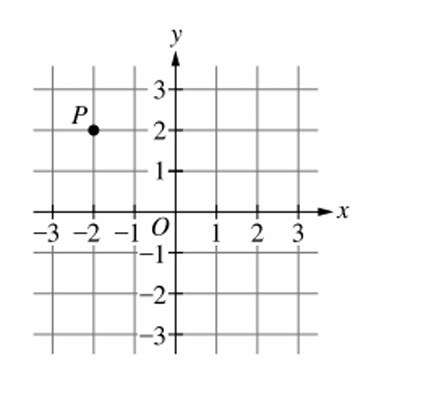
The graph of point \( P \) is given in the \( xy \)-plane. Which of the following are possible polar coordinates of point \( P \)?
(A) \( (2, \frac{\pi}{4}) \)
(B) \( (2, \frac{3\pi}{4}) \)
(C) \( (2\sqrt{2}, \frac{\pi}{4}) \)
(D) \( (2\sqrt{2}, \frac{3\pi}{4}) \)
▶️ Answer/Explanation
Detailed solution

From the graph, \( P \) is in Quadrant II with rectangular coordinates \( (-2, 2) \).
– Distance from origin: \( r = \sqrt{(-2)^2 + 2^2} = \sqrt{8} = 2\sqrt{2} \)
– Reference angle: \( \arctan\left(\frac{2}{|-2|}\right) = \arctan(1) = \frac{\pi}{4} \)
In Quadrant II, \( \theta = \pi – \frac{\pi}{4} = \frac{3\pi}{4} \).
Thus polar coordinates: \( (2\sqrt{2}, \frac{3\pi}{4}) \).
Answer: (D)

Question 

In the polar coordinate system, the point \( A \) has polar coordinates \( (5, \frac{\pi}{4}) \). Which of the following also gives the location of point \( A \) in polar coordinates?
(A) \((-5, \frac{3\pi}{4})\)
(B) \((-5, \frac{5\pi}{4})\)
(C) \((-5, \frac{7\pi}{4})\)
(D) \((-5, \frac{9\pi}{4})\)
▶️ Answer/Explanation
Detailed solution

For a point in polar coordinates \( (r, \theta) \), the same location can be represented as \( (-r, \theta + \pi) \) (or adding odd multiples of \( \pi \) to \( \theta \) while negating \( r \)).
Here, \( r = 5, \theta = \frac{\pi}{4} \).
Using \( \theta + \pi = \frac{\pi}{4} + \pi = \frac{5\pi}{4} \), we get \( (-5, \frac{5\pi}{4}) \).
Answer: (B)

Question 


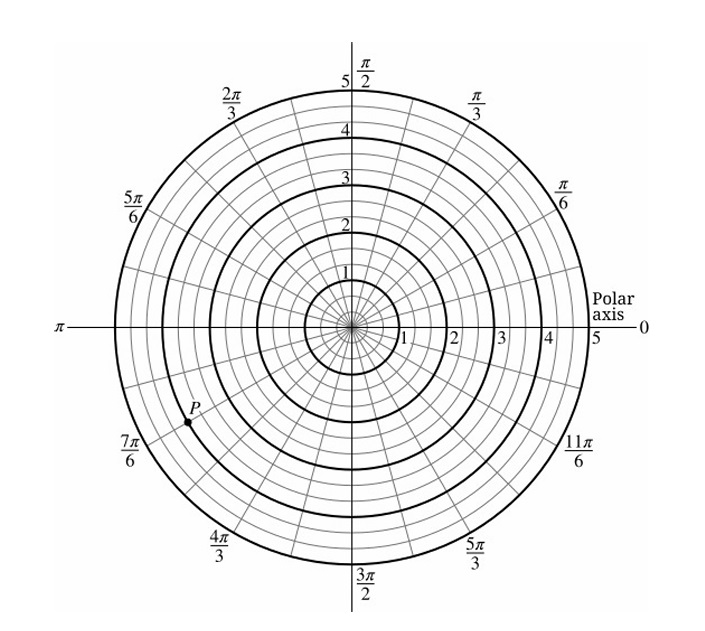
The figure shows the polar coordinate system with point \( P \) labeled. Point \( P \) is rotated an angle of measure \( \frac{\pi}{2} \) clockwise about the origin. The image of this transformation is at the location \( K \) (not shown). What are the rectangular coordinates of \( K \)?
(A) \((-2, 2\sqrt{3})\)
(B) \((-2\sqrt{3}, 2)\)
(C) \((2, -2\sqrt{3})\)
(D) \((2\sqrt{3}, -2)\)
▶️ Answer/Explanation
Detailed solution

From the diagram: \( P \) is at \( (4, \frac{7\pi}{6}) \).
Clockwise rotation by \( \frac{\pi}{2} \) subtracts from the angle: \( \theta_K = \frac{7\pi}{6} – \frac{\pi}{2} = \frac{7\pi}{6} – \frac{3\pi}{6} = \frac{4\pi}{6} = \frac{2\pi}{3} \).
Polar coordinates of \( K \): \( (4, \frac{2\pi}{3}) \).
Convert to rectangular:
\( x = 4\cos\frac{2\pi}{3} = 4 \cdot \left(-\frac{1}{2}\right) = -2 \)
\( y = 4\sin\frac{2\pi}{3} = 4 \cdot \frac{\sqrt{3}}{2} = 2\sqrt{3} \)
Thus \( K = (-2, 2\sqrt{3}) \).
Answer: (A)

Question 

Which of the following expresses the complex number \( 10 + 10i \) using polar coordinates in the form \( (r \cos \theta) + i(r \sin \theta) \)?
(A) \( \left( \frac{1}{10} \cos\left(\frac{\pi}{4}\right) \right) + i\left( \frac{1}{10} \sin\left(\frac{\pi}{4}\right) \right) \)
(B) \( (10 \cos 0) + i(10 \sin\left(\frac{\pi}{2}\right)) \)
(C) \( (10 \cos\left(\frac{\pi}{4}\right)) + i(10 \sin\left(\frac{\pi}{4}\right)) \)
(D) \( \left( 10\sqrt{2} \cos\left(\frac{\pi}{4}\right) \right) + i\left( 10\sqrt{2} \sin\left(\frac{\pi}{4}\right) \right) \)
▶️ Answer/Explanation
Detailed solution

For \( z = 10 + 10i \), we have \( x = 10, y = 10 \).
\( r = \sqrt{10^2 + 10^2} = \sqrt{200} = 10\sqrt{2} \)
\( \theta = \arctan\left(\frac{10}{10}\right) = \arctan(1) = \frac{\pi}{4} \) (Quadrant I)
Thus polar form: \( r(\cos\theta + i\sin\theta) = 10\sqrt{2}\left(\cos\frac{\pi}{4} + i\sin\frac{\pi}{4}\right) \), which matches option (D).
Answer: (D)

Question

The point \( P \) has polar coordinates \( \left( 10, \frac{5\pi}{6} \right) \). Which of the following is the location of point \( P \) in rectangular coordinates?
(A) \( \left( -5\sqrt{3}, 5 \right) \)
(B) \( \left( -5, 5\sqrt{3} \right) \)
(C) \( \left( 5\sqrt{3}, 5 \right) \)
(D) \( \left( 5\sqrt{3}, -5 \right) \)
▶️ Answer/Explanation
Detailed solution

Convert from polar \((r,\theta)\) to rectangular \((x,y)\) using:
\( x = r \cos \theta \), \( y = r \sin \theta \).
Here \( r = 10 \) and \( \theta = \frac{5\pi}{6} \).
\( \cos \frac{5\pi}{6} = -\frac{\sqrt{3}}{2} \), \( \sin \frac{5\pi}{6} = \frac{1}{2} \).
Thus \( x = 10 \cdot \left(-\frac{\sqrt{3}}{2}\right) = -5\sqrt{3} \),
\( y = 10 \cdot \frac{1}{2} = 5 \).
Answer: (A)

Question 

The location of point X in polar coordinates \((r, \theta)\) is \((1,\frac{5\pi}{6})\). Which of the following describes the location of point X in rectangular coordinates \((x,y)\)?
(A) \((-\frac{\sqrt{3}}{2},\frac{1}{2})\)
(B) \((\frac{\sqrt{3}}{2},\frac{1}{2})\)
(C) \((\frac{1}{2},-\frac{\sqrt{3}}{2})\)
(D) \((\frac{1}{2},\frac{\sqrt{3}}{2})\)
▶️ Answer/Explanation
Detailed solution

1. Convert to Rectangular:
\(x = r\cos\theta = 1 \cdot \cos(\frac{5\pi}{6}) = -\frac{\sqrt{3}}{2}\)
\(y = r\sin\theta = 1 \cdot \sin(\frac{5\pi}{6}) = \frac{1}{2}\)

2. Match Coordinate Pair:
\((-\frac{\sqrt{3}}{2}, \frac{1}{2})\)
(Note: Option A matches the calculation in the provided answer key).

Answer: (A)

Question 

The table gives polar coordinates \((r, \theta)\) for four selected points. Which of the points lies in Quadrant II of the \(xy\)-plane?
PointABCD
\(r\)22-2-2
\(\theta\)\(-\frac{\pi}{4}\)\(-\frac{3\pi}{4}\)\(\frac{5\pi}{4}\)\(\frac{7\pi}{4}\)
(A) A, because from the positive y-axis, \(\frac{\pi}{4}\) counterclockwise is in Quadrant II, and the radius is positive.
(B) B, because from the positive x-axis, clockwise is in Quadrant II, and the radius is positive.
(C) C, because from the positive x-axis, \(\frac{5\pi}{4}\) counterclockwise is in Quadrant III, and the negative radius indicates a reflection over the x-axis.
(D) D, because from the positive x-axis, \(\frac{7\pi}{4}\) counterclockwise is in Quadrant IV, and the negative radius indicates the opposite direction of the angle from the origin.
▶️ Answer/Explanation
Detailed solution

1. Analyze Point D:
Point D has coordinates \((-2, \frac{7\pi}{4})\).
First, locate the angle \(\theta = \frac{7\pi}{4}\). This angle is in Quadrant IV (between \(\frac{3\pi}{2}\) and \(2\pi\)).

2. Apply the Negative Radius:
A negative radius (\(r = -2\)) means we reflect the point through the origin to the opposite quadrant.
The quadrant opposite to Quadrant IV is Quadrant II.

3. Evaluate Other Points:
A: \((2, -\frac{\pi}{4})\) is in QIV.
B: \((2, -\frac{3\pi}{4})\) is in QIII.
C: \((-2, \frac{5\pi}{4})\) \(\to\) Angle is QIII \(\to\) Reflect to QI.

Answer: (D)

Question 

A complex number is represented by a point in the complex plane. The complex number has the rectangular coordinates \((3, 3)\). Which of the following is one way to express the complex number using its polar coordinates \( (r, \theta) \)?
(A) \( 3\sqrt{2} \cos\left(\frac{\pi}{4}\right) + i\left(3\sqrt{2} \sin\left(\frac{\pi}{4}\right)\right) \)
(B) \( 3\cos\left(\frac{\pi}{4}\right) + i\left(3\sin\left(\frac{\pi}{4}\right)\right) \)
(C) \( 3\sqrt{2} \cos\left(-\frac{\pi}{4}\right) + i\left(3\sqrt{2} \sin\left(-\frac{\pi}{4}\right)\right) \)
(D) \( 3\cos\left(-\frac{\pi}{4}\right) + i\left(3\sin\left(-\frac{\pi}{4}\right)\right) \)
▶️ Answer/Explanation
Detailed solution

Rectangular coordinates \((3,3)\) correspond to complex number \( z = 3 + 3i \).
Polar coordinates:
\[ r = \sqrt{3^2 + 3^2} = \sqrt{18} = 3\sqrt{2} \]
\[ \theta = \arctan\left(\frac{3}{3}\right) = \arctan(1) = \frac{\pi}{4} \quad (\text{in first quadrant}) \]
Polar form: \( z = r(\cos \theta + i\sin \theta) = 3\sqrt{2} \cos\left(\frac{\pi}{4}\right) + i \cdot 3\sqrt{2} \sin\left(\frac{\pi}{4}\right) \).
This matches option (A).
Answer: (A)

Question 

Given the rectangular coordinate $\left( -\frac{3\sqrt{3}}{2}, \frac{3}{2} \right)$, what is the equivalent polar coordinate point given $0 \le \theta < 2\pi$ and $r < 0$?
a. $\left( -3, \frac{5\pi}{6} \right)$
b. $\left( -3, \frac{11\pi}{6} \right)$
c. $\left( -3, \frac{\pi}{6} \right)$
d. $\left( -3, \frac{7\pi}{6} \right)$
▶️ Answer/Explanation
Detailed solution

First, calculate the radius $r$ using $r = \sqrt{x^2 + y^2} = \sqrt{(-\frac{3\sqrt{3}}{2})^2 + (\frac{3}{2})^2} = 3$.
The point is in Quadrant II since $x < 0$ and $y > 0$.
Find the standard angle: $\tan \theta = \frac{y}{x} = \frac{3/2}{-3\sqrt{3}/2} = -\frac{1}{\sqrt{3}}$, which gives $\theta = \frac{5\pi}{6}$.
The problem requires $r < 0$, so we use $r = -3$.
To keep the same location with a negative radius, add $\pi$ to the angle: $\frac{5\pi}{6} + \pi = \frac{11\pi}{6}$.
The resulting polar coordinate is $\left( -3, \frac{11\pi}{6} \right)$.
Therefore, the correct option is b.

Question 

A complex number is represented by a point in the complex plane. The complex number has the rectangular coordinates \( (3, 3) \). Which of the following is one way to express the complex number using its polar coordinates \( (r, \theta) \)?
(A) \( \left(3\sqrt{2} \cos \left(\frac{\pi}{4}\right)\right) + i \left(3\sqrt{2} \sin \left(\frac{\pi}{4}\right)\right) \)
(B) \( \left(3 \cos \left(\frac{\pi}{4}\right)\right) + \left(i \left(\frac{\pi}{4}\right)\right) \)
(C) \( \left(3\sqrt{2} \cos \left(-\frac{\pi}{4}\right)\right) + i \left(3\sqrt{2} \sin \left(-\frac{\pi}{4}\right)\right) \)
(D) \( \left(3 \cos \left(-\frac{\pi}{4}\right)\right) + i \left(3 \sin \left(-\frac{\pi}{4}\right)\right) \)
▶️ Answer/Explanation
Detailed solution

The correct option is (A).

To convert rectangular coordinates \( (x, y) = (3, 3) \) to polar form, we must find the modulus \( r \) and the argument \( \theta \).
1. Calculate the modulus \( r \) using the formula \( r = \sqrt{x^2 + y^2} \).
2. Substitute the given values: \( r = \sqrt{3^2 + 3^2} = \sqrt{9 + 9} = \sqrt{18} \).
3. Simplify the radical: \( \sqrt{18} = \sqrt{9 \cdot 2} = 3\sqrt{2} \).
4. Calculate the angle \( \theta \) using \( \tan(\theta) = \frac{y}{x} \).
5. Substitute values: \( \tan(\theta) = \frac{3}{3} = 1 \). Since the point is in the first quadrant, \( \theta = \frac{\pi}{4} \).
6. The polar form of a complex number is \( z = r \cos(\theta) + i (r \sin(\theta)) \).
7. Substituting \( r = 3\sqrt{2} \) and \( \theta = \frac{\pi}{4} \), we get: \( \left(3\sqrt{2} \cos \left(\frac{\pi}{4}\right)\right) + i \left(3\sqrt{2} \sin \left(\frac{\pi}{4}\right)\right) \).

Question 

The location of point \(X\) in polar coordinates \((r, \theta)\) is \(\left(1, \frac{5\pi}{6}\right)\). Which of the following describes the location of point \(X\) in rectangular coordinates \((x, y)\)?
(A) \(\left(-\frac{\sqrt{3}}{2}, \frac{1}{2}\right)\)
(B) \(\left(\frac{\sqrt{3}}{2}, \frac{1}{2}\right)\)
(C) \(\left(\frac{1}{2}, \frac{\sqrt{3}}{2}\right)\)
▶️ Answer/Explanation
Detailed solution

To convert from polar coordinates \((r, \theta)\) to rectangular coordinates \((x, y)\), we use the formulas \(x = r \cos \theta\) and \(y = r \sin \theta\).
Given the point \(\left(1, \frac{5\pi}{6}\right)\), substitute \(r = 1\) and \(\theta = \frac{5\pi}{6}\) into the equations.
First, find the \(x\)-coordinate: \(x = 1 \cdot \cos\left(\frac{5\pi}{6}\right) = -\frac{\sqrt{3}}{2}\).
Next, find the \(y\)-coordinate: \(y = 1 \cdot \sin\left(\frac{5\pi}{6}\right) = \frac{1}{2}\).
Combining these values gives the rectangular coordinates \(\left(-\frac{\sqrt{3}}{2}, \frac{1}{2}\right)\).
Therefore, the correct option corresponds to (A).

Question 

A complex number has the rectangular coordinates \((1, -\sqrt{3})\). Which of the following is one way to express the complex number using its polar coordinates \((r, \theta)\)?
(A) \(\left(2 \cos\left(-\frac{\pi}{6}\right)\right) + i\left(2 \sin\left(-\frac{\pi}{6}\right)\right)\)
(B) \(\left(2 \cos\left(-\frac{\pi}{3}\right)\right) + i\left(2 \sin\left(-\frac{\pi}{3}\right)\right)\)
(C) \(\left(2 \cos\left(\frac{\pi}{6}\right)\right) + i\left(2 \sin\left(\frac{\pi}{6}\right)\right)\)
(D) \(\left(2 \cos\left(\frac{\pi}{3}\right)\right) + i\left(2 \sin\left(\frac{\pi}{3}\right)\right)\)
▶️ Answer/Explanation
Detailed solution

The correct option is (B).

The rectangular coordinates are given as \((x, y) = (1, -\sqrt{3})\).
First, calculate the modulus \(r\) using the formula \(r = \sqrt{x^2 + y^2}\).
Substituting the values: \(r = \sqrt{1^2 + (-\sqrt{3})^2} = \sqrt{1 + 3} = \sqrt{4} = 2\).
Next, determine the argument \(\theta\) using \(\tan(\theta) = \frac{y}{x} = \frac{-\sqrt{3}}{1} = -\sqrt{3}\).
Since \(x\) is positive and \(y\) is negative, the point lies in the fourth quadrant.
The reference angle is \(\frac{\pi}{3}\), so the angle in the fourth quadrant corresponds to \(\theta = -\frac{\pi}{3}\).
Thus, the polar form is \(r(\cos \theta + i \sin \theta) = 2\left(\cos\left(-\frac{\pi}{3}\right) + i \sin\left(-\frac{\pi}{3}\right)\right)\).

Question 

The equation of a circle in the \(xy\)-plane is given by \(x^2 + y^2 – 6x + 8y = 56\). What is the radius of the circle?
(A) \(7\)
(B) \(9\)
(C) \(56\)
(D) \(81\)
▶️ Answer/Explanation
Detailed solution

To find the radius, we must convert the given general equation to the standard form \((x-h)^2 + (y-k)^2 = r^2\) by completing the square.

Group the \(x\) and \(y\) terms: \((x^2 – 6x) + (y^2 + 8y) = 56\).

Add \((\frac{-6}{2})^2 = 9\) and \((\frac{8}{2})^2 = 16\) to both sides to complete the squares: \((x^2 – 6x + 9) + (y^2 + 8y + 16) = 56 + 9 + 16\).

Factor the perfect square trinomials: \((x – 3)^2 + (y + 4)^2 = 81\).

Identify \(r^2\) from the right side of the equation: \(r^2 = 81\).

Take the square root to find the radius: \(r = \sqrt{81} = 9\).

Therefore, the radius of the circle is \(9\), which corresponds to option (B).

Question 

Consider a circle centered at the origin in the $xy$-plane. An angle of measure $\frac{\pi}{4}$ radians in standard position has a terminal ray that intersects the circle at point $P$. The angle is subtended by an arc of the circle in Quadrant I with length $40$ units. What is the radius of the circle?
(A) $5\pi$
(B) $10\pi$
(C) $\frac{80}{\pi}$
(D) $\frac{160}{\pi}$
▶️ Answer/Explanation
Detailed solution

The relationship between arc length $s$, radius $r$, and angle $\theta$ (in radians) is given by $s = r\theta$.
In this problem, the arc length $s$ is given as $40$.
The angle $\theta$ is given as $\frac{\pi}{4}$ radians.
Substitute the values into the formula: $40 = r \cdot \frac{\pi}{4}$.
Solve for $r$ by multiplying both sides by $4$: $160 = r\pi$.
Divide by $\pi$ to isolate the radius: $r = \frac{160}{\pi}$.
The correct option is (D).

Question 

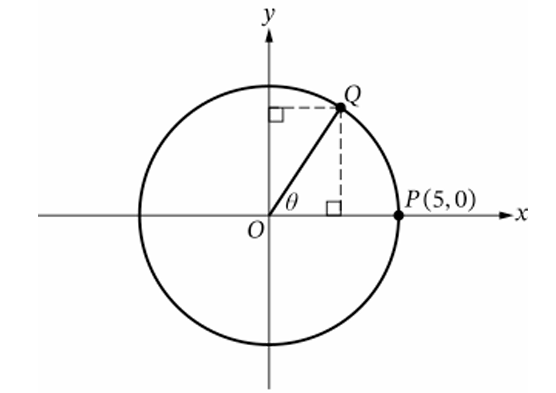
The figure shows a circle centered at the origin with an angle of measure $\theta$ radians in standard position and point $P$ on the circle. The terminal ray of the angle intersects the circle at point $Q$. The length of arc $\small \text{PQ}$ is $6$ units. Which of the following gives the distance of point $Q$ from the $y$-axis?
(A) $\cos\left(\frac{6}{5}\right)$
(B) $\sin\left(\frac{6}{5}\right)$
(C) $5 \cos\left(\frac{6}{5}\right)$
(D) $5 \sin\left(\frac{6}{5}\right)$
▶️ Answer/Explanation
Detailed solution

The radius of the circle is $r = 5$, as seen from point $P(5,0)$.
The arc length $s$ is given by the formula $s = r\theta$.
Substituting the given values, $6 = 5\theta$, which means $\theta = \frac{6}{5}$ radians.
The coordinates of point $Q$ on a circle are $(r \cos\theta, r \sin\theta)$.
The distance of a point from the $y$-axis is the absolute value of its $x$-coordinate.
Therefore, the distance is $|5 \cos(\frac{6}{5})|$.
Since $\frac{6}{5}$ radians is in the first quadrant, the distance is $5 \cos\left(\frac{6}{5}\right)$.
Correct Option: (C)
Question  (Calc allowed)

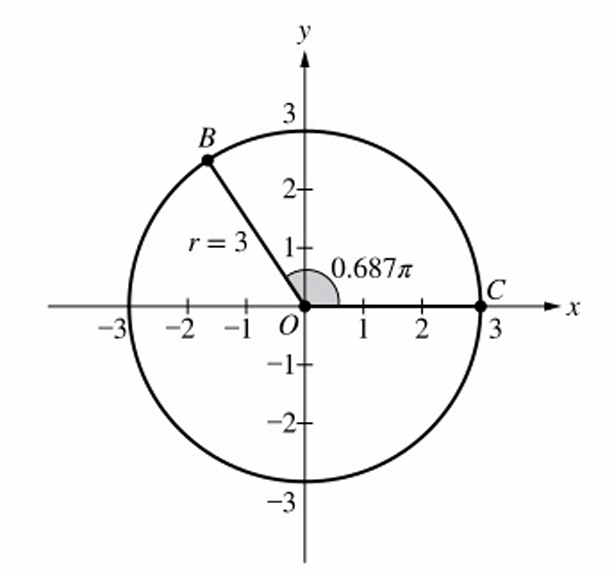
The figure gives an angle in standard position with measure $0.687\pi$ and a circle with radius $3$ in the $xy$-plane. What is the length of the minor arc of the circle from point $C$ to point $B$, the arc subtended by the angle?
(A) $0.719$
(B) $2.158$
(C) $6.475$
(D) $9.712$
▶️ Answer/Explanation
Detailed solution

The formula for the arc length $s$ is given by $s = r\theta$, where $\theta$ is in radians.
The radius of the circle is given as $r = 3$.
The central angle subtending the arc is given as $\theta = 0.687\pi$.
Substitute the values into the formula: $s = 3 \times (0.687\pi)$.
Calculate the product: $s = 2.061\pi$.
Using the approximation $\pi \approx 3.14159$, the length is $s \approx 6.4748…$
Rounding to three decimal places, the arc length is $6.475$.
The correct option is (C).

Scroll to Top