AP Precalculus -3.13 Trigonometry and Polar Coordinates- MCQ Exam Style Questions - Effective Fall 2023
AP Precalculus -3.13 Trigonometry and Polar Coordinates- MCQ Exam Style Questions – Effective Fall 2023
AP Precalculus -3.13 Trigonometry and Polar Coordinates- MCQ Exam Style Questions – AP Precalculus- per latest AP Precalculus Syllabus.
Question
(B) \( \left( 3\cos\left(\frac{\pi}{4}\right) + i\left(3\sin\left(\frac{\pi}{4}\right)\right) \right) \)
(C) \( \left( 3\sqrt{2}\cos\left(-\frac{\pi}{4}\right) + i\left(3\sqrt{2}\sin\left(-\frac{\pi}{4}\right)\right) \right) \)
(D) \( \left( 3\cos\left(-\frac{\pi}{4}\right) + i\left(3\sin\left(-\frac{\pi}{4}\right)\right) \right) \)
▶️ Answer/Explanation
The polar form of a complex number is \( r(\cos \theta + i \sin \theta) \). For the point \((3,3)\):
\( r = \sqrt{3^2 + 3^2} = \sqrt{18} = 3\sqrt{2} \)
\( \theta = \arctan\left(\frac{3}{3}\right) = \arctan(1) = \frac{\pi}{4} \)
Thus, the polar form is \( 3\sqrt{2}\left( \cos\frac{\pi}{4} + i \sin\frac{\pi}{4} \right) \), which matches option (A).
✅ Answer: (A)
Question
(B) \( \theta = \frac{\pi}{4} + \left( \frac{\pi}{2} \right)k \), where \( k = 1, 2, 3, 4 \)
(C) \( \theta = \frac{\pi}{2} + \left( \frac{\pi}{2} \right)k \), where \( k = 1, 2, 3, 4 \)
(D) \( \theta = \frac{\pi}{2} + \pi k \), where \( k = 1, 2, 3, 4 \)
▶️ Answer/Explanation
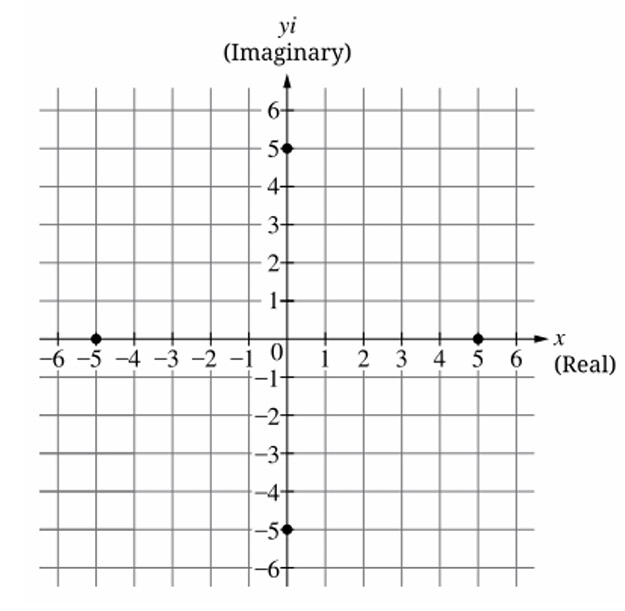
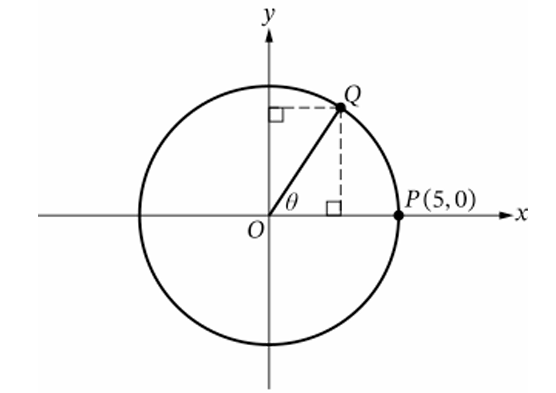
The four points are at \( (5,0), (0,5), (-5,0), (0,-5) \) in rectangular coordinates, corresponding to angles \( 0, \frac{\pi}{2}, \pi, \frac{3\pi}{2} \).
In polar form \( r = 5 \), the angles are spaced \( \frac{\pi}{2} \) apart starting at \( 0 \). Option (C) starts at \( \frac{\pi}{2} \) and adds \( \frac{\pi}{2}k \) for \( k = 0,1,2,3 \), yielding \( \frac{\pi}{2}, \pi, \frac{3\pi}{2}, 2\pi \) — but the given list starts from \( k=1 \) to \( k=4 \), which would give \( \pi, \frac{3\pi}{2}, 2\pi, \frac{5\pi}{2} \) (mod \( 2\pi \)), equivalent to \( \pi, \frac{3\pi}{2}, 0, \frac{\pi}{2} \) — the same four angles.
Thus (C) correctly generates the set of angles for the four points.
✅ Answer: (C)
Question
▶️ Answer/Explanation
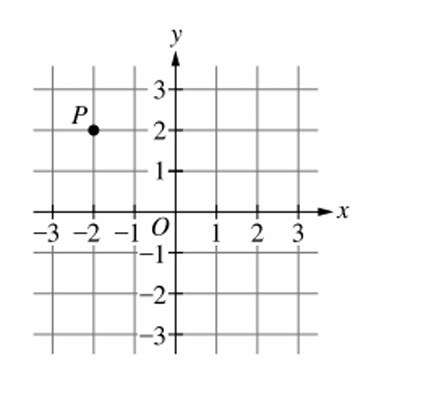
From the graph, \( P \) is in Quadrant II with rectangular coordinates \( (-2, 2) \).
– Distance from origin: \( r = \sqrt{(-2)^2 + 2^2} = \sqrt{8} = 2\sqrt{2} \)
– Reference angle: \( \arctan\left(\frac{2}{|-2|}\right) = \arctan(1) = \frac{\pi}{4} \)
In Quadrant II, \( \theta = \pi – \frac{\pi}{4} = \frac{3\pi}{4} \).
Thus polar coordinates: \( (2\sqrt{2}, \frac{3\pi}{4}) \).
✅ Answer: (D)
Question
(B) \((-5, \frac{5\pi}{4})\)
(C) \((-5, \frac{7\pi}{4})\)
(D) \((-5, \frac{9\pi}{4})\)
▶️ Answer/Explanation
For a point in polar coordinates \( (r, \theta) \), the same location can be represented as \( (-r, \theta + \pi) \) (or adding odd multiples of \( \pi \) to \( \theta \) while negating \( r \)).
Here, \( r = 5, \theta = \frac{\pi}{4} \).
Using \( \theta + \pi = \frac{\pi}{4} + \pi = \frac{5\pi}{4} \), we get \( (-5, \frac{5\pi}{4}) \).
✅ Answer: (B)
Question
(B) \((-2\sqrt{3}, 2)\)
(C) \((2, -2\sqrt{3})\)
(D) \((2\sqrt{3}, -2)\)
▶️ Answer/Explanation
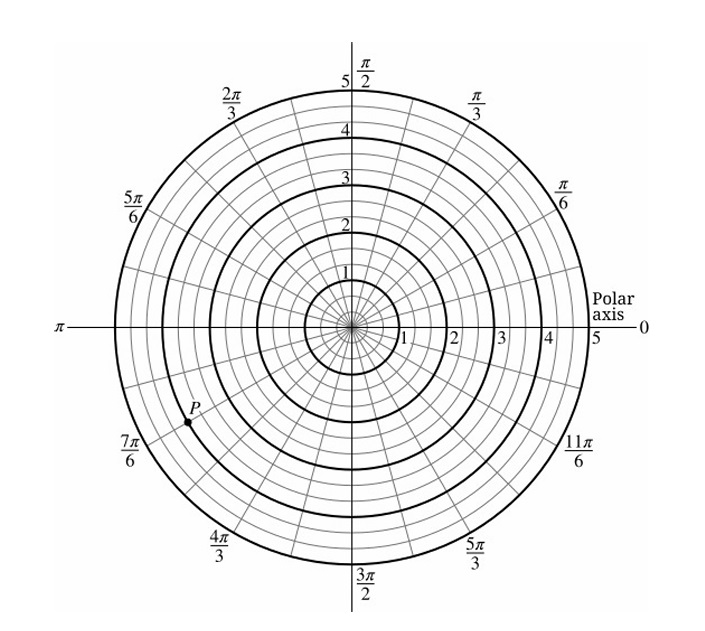
From the diagram: \( P \) is at \( (4, \frac{7\pi}{6}) \).
Clockwise rotation by \( \frac{\pi}{2} \) subtracts from the angle: \( \theta_K = \frac{7\pi}{6} – \frac{\pi}{2} = \frac{7\pi}{6} – \frac{3\pi}{6} = \frac{4\pi}{6} = \frac{2\pi}{3} \).
Polar coordinates of \( K \): \( (4, \frac{2\pi}{3}) \).
Convert to rectangular:
\( x = 4\cos\frac{2\pi}{3} = 4 \cdot \left(-\frac{1}{2}\right) = -2 \)
\( y = 4\sin\frac{2\pi}{3} = 4 \cdot \frac{\sqrt{3}}{2} = 2\sqrt{3} \)
Thus \( K = (-2, 2\sqrt{3}) \).
✅ Answer: (A)
Question
(B) \( (10 \cos 0) + i(10 \sin\left(\frac{\pi}{2}\right)) \)
(C) \( (10 \cos\left(\frac{\pi}{4}\right)) + i(10 \sin\left(\frac{\pi}{4}\right)) \)
(D) \( \left( 10\sqrt{2} \cos\left(\frac{\pi}{4}\right) \right) + i\left( 10\sqrt{2} \sin\left(\frac{\pi}{4}\right) \right) \)
▶️ Answer/Explanation
For \( z = 10 + 10i \), we have \( x = 10, y = 10 \).
\( r = \sqrt{10^2 + 10^2} = \sqrt{200} = 10\sqrt{2} \)
\( \theta = \arctan\left(\frac{10}{10}\right) = \arctan(1) = \frac{\pi}{4} \) (Quadrant I)
Thus polar form: \( r(\cos\theta + i\sin\theta) = 10\sqrt{2}\left(\cos\frac{\pi}{4} + i\sin\frac{\pi}{4}\right) \), which matches option (D).
✅ Answer: (D)
Question
(B) \( \left( -5, 5\sqrt{3} \right) \)
(C) \( \left( 5\sqrt{3}, 5 \right) \)
(D) \( \left( 5\sqrt{3}, -5 \right) \)
▶️ Answer/Explanation
Convert from polar \((r,\theta)\) to rectangular \((x,y)\) using:
\( x = r \cos \theta \), \( y = r \sin \theta \).
Here \( r = 10 \) and \( \theta = \frac{5\pi}{6} \).
\( \cos \frac{5\pi}{6} = -\frac{\sqrt{3}}{2} \), \( \sin \frac{5\pi}{6} = \frac{1}{2} \).
Thus \( x = 10 \cdot \left(-\frac{\sqrt{3}}{2}\right) = -5\sqrt{3} \),
\( y = 10 \cdot \frac{1}{2} = 5 \).
✅ Answer: (A)
Question
(B) \((\frac{\sqrt{3}}{2},\frac{1}{2})\)
(C) \((\frac{1}{2},-\frac{\sqrt{3}}{2})\)
(D) \((\frac{1}{2},\frac{\sqrt{3}}{2})\)
▶️ Answer/Explanation
1. Convert to Rectangular:
\(x = r\cos\theta = 1 \cdot \cos(\frac{5\pi}{6}) = -\frac{\sqrt{3}}{2}\)
\(y = r\sin\theta = 1 \cdot \sin(\frac{5\pi}{6}) = \frac{1}{2}\)
2. Match Coordinate Pair:
\((-\frac{\sqrt{3}}{2}, \frac{1}{2})\)
(Note: Option A matches the calculation in the provided answer key).
✅ Answer: (A)
Question
| Point | A | B | C | D |
|---|---|---|---|---|
| \(r\) | 2 | 2 | -2 | -2 |
| \(\theta\) | \(-\frac{\pi}{4}\) | \(-\frac{3\pi}{4}\) | \(\frac{5\pi}{4}\) | \(\frac{7\pi}{4}\) |
(B) B, because from the positive x-axis, clockwise is in Quadrant II, and the radius is positive.
(C) C, because from the positive x-axis, \(\frac{5\pi}{4}\) counterclockwise is in Quadrant III, and the negative radius indicates a reflection over the x-axis.
(D) D, because from the positive x-axis, \(\frac{7\pi}{4}\) counterclockwise is in Quadrant IV, and the negative radius indicates the opposite direction of the angle from the origin.
▶️ Answer/Explanation
1. Analyze Point D:
Point D has coordinates \((-2, \frac{7\pi}{4})\).
First, locate the angle \(\theta = \frac{7\pi}{4}\). This angle is in Quadrant IV (between \(\frac{3\pi}{2}\) and \(2\pi\)).
2. Apply the Negative Radius:
A negative radius (\(r = -2\)) means we reflect the point through the origin to the opposite quadrant.
The quadrant opposite to Quadrant IV is Quadrant II.
3. Evaluate Other Points:
A: \((2, -\frac{\pi}{4})\) is in QIV.
B: \((2, -\frac{3\pi}{4})\) is in QIII.
C: \((-2, \frac{5\pi}{4})\) \(\to\) Angle is QIII \(\to\) Reflect to QI.
✅ Answer: (D)
Question
(B) \( 3\cos\left(\frac{\pi}{4}\right) + i\left(3\sin\left(\frac{\pi}{4}\right)\right) \)
(C) \( 3\sqrt{2} \cos\left(-\frac{\pi}{4}\right) + i\left(3\sqrt{2} \sin\left(-\frac{\pi}{4}\right)\right) \)
(D) \( 3\cos\left(-\frac{\pi}{4}\right) + i\left(3\sin\left(-\frac{\pi}{4}\right)\right) \)
▶️ Answer/Explanation
Rectangular coordinates \((3,3)\) correspond to complex number \( z = 3 + 3i \).
Polar coordinates:
\[ r = \sqrt{3^2 + 3^2} = \sqrt{18} = 3\sqrt{2} \]
\[ \theta = \arctan\left(\frac{3}{3}\right) = \arctan(1) = \frac{\pi}{4} \quad (\text{in first quadrant}) \]
Polar form: \( z = r(\cos \theta + i\sin \theta) = 3\sqrt{2} \cos\left(\frac{\pi}{4}\right) + i \cdot 3\sqrt{2} \sin\left(\frac{\pi}{4}\right) \).
This matches option (A).
✅ Answer: (A)
Question
b. $\left( -3, \frac{11\pi}{6} \right)$
c. $\left( -3, \frac{\pi}{6} \right)$
d. $\left( -3, \frac{7\pi}{6} \right)$
▶️ Answer/Explanation
First, calculate the radius $r$ using $r = \sqrt{x^2 + y^2} = \sqrt{(-\frac{3\sqrt{3}}{2})^2 + (\frac{3}{2})^2} = 3$.
The point is in Quadrant II since $x < 0$ and $y > 0$.
Find the standard angle: $\tan \theta = \frac{y}{x} = \frac{3/2}{-3\sqrt{3}/2} = -\frac{1}{\sqrt{3}}$, which gives $\theta = \frac{5\pi}{6}$.
The problem requires $r < 0$, so we use $r = -3$.
To keep the same location with a negative radius, add $\pi$ to the angle: $\frac{5\pi}{6} + \pi = \frac{11\pi}{6}$.
The resulting polar coordinate is $\left( -3, \frac{11\pi}{6} \right)$.
Therefore, the correct option is b.