
Polar Coordinate System
The polar coordinate system describes the location of a point in the plane using a distance from the origin and an angle of rotation from the positive x-axis.
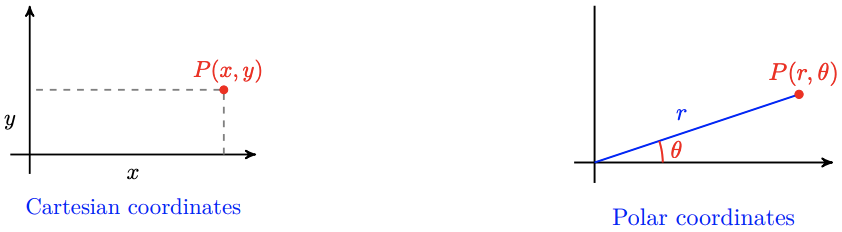
It is based on:
circles centered at the origin
lines through the origin at various angles
A point in polar coordinates is written as an ordered pair
\( (r, \theta) \)
where:
\( |r| \) represents the distance from the origin to the point
\( \theta \) represents the measure of an angle in standard position whose terminal ray passes through the point
Because angles can differ by full rotations and the radius can be negative, the same point can be represented in many different ways in polar coordinates.
For example, the representations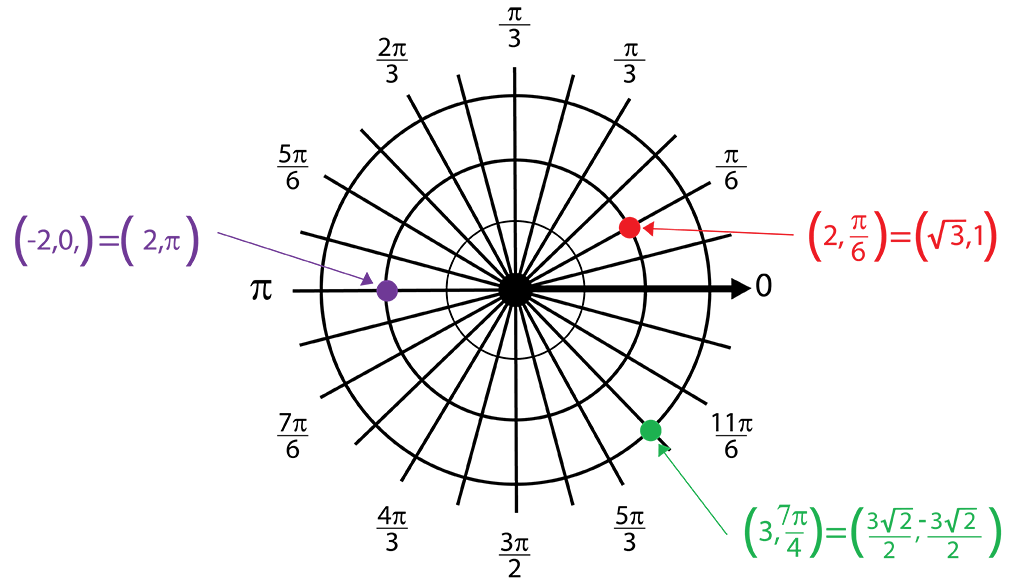
\( (r, \theta) \)
\( (r, \theta + 2\pi k) \)
\( (-r, \theta + \pi) \)
all describe the same point, where \( k \) is any integer.
Example:
Give two different polar coordinate representations of the point \( (3, \dfrac{\pi}{4}) \).
▶️ Answer/Explanation
Adding a full rotation of \( 2\pi \):
\( (3, \dfrac{\pi}{4} + 2\pi) = (3, \dfrac{9\pi}{4}) \)
Using a negative radius and shifting the angle by \( \pi \):
\( (-3, \dfrac{\pi}{4} + \pi) = (-3, \dfrac{5\pi}{4}) \)
Conclusion: All three coordinates represent the same point.
Example:
Explain why the points \( (4, \dfrac{\pi}{3}) \) and \( (-4, \dfrac{4\pi}{3}) \) represent the same location.
▶️ Answer/Explanation
A negative radius reflects the point across the origin.
Adding \( \pi \) to the angle accounts for this reflection.
Since
\( \dfrac{\pi}{3} + \pi = \dfrac{4\pi}{3} \)
the two coordinate pairs describe the same point.
Converting Polar Coordinates to Rectangular Coordinates
A point given in the polar coordinate system as \( (r, \theta) \) can be converted to the rectangular (Cartesian) coordinate system \( (x, y) \) by using trigonometric relationships.
The conversion formulas are:
\( x = r \cos \theta \)
\( y = r \sin \theta \)
These formulas come from the fact that \( \cos \theta \) gives the horizontal component of the radius \( r \), and \( \sin \theta \) gives the vertical component.
Using these relationships allows points described by distance and direction to be represented using standard x–y coordinates.
Example:
Convert the polar coordinate \( \left(4, \dfrac{\pi}{6}\right) \) to rectangular coordinates.
▶️ Answer/Explanation
Use the conversion formulas.
\( x = 4\cos\!\left(\dfrac{\pi}{6}\right) = 4 \cdot \dfrac{\sqrt{3}}{2} = 2\sqrt{3} \)
\( y = 4\sin\!\left(\dfrac{\pi}{6}\right) = 4 \cdot \dfrac{1}{2} = 2 \)
Final answer: The rectangular coordinates are \( (2\sqrt{3}, 2) \).
Example:
Convert the polar coordinate \( \left( -3, \dfrac{2\pi}{3} \right) \) to rectangular coordinates.
▶️ Answer/Explanation
Apply the conversion formulas.
\( x = -3\cos\!\left(\dfrac{2\pi}{3}\right) = -3 \cdot \left(-\dfrac{1}{2}\right) = \dfrac{3}{2} \)
\( y = -3\sin\!\left(\dfrac{2\pi}{3}\right) = -3 \cdot \dfrac{\sqrt{3}}{2} = -\dfrac{3\sqrt{3}}{2} \)
Final answer: The rectangular coordinates are \( \left(\dfrac{3}{2}, -\dfrac{3\sqrt{3}}{2}\right) \).
Converting Rectangular Coordinates to Polar Coordinates
A point given in the rectangular coordinate system as \( (x, y) \) can be converted to the polar coordinate system \( (r, \theta) \) using distance and angle relationships.
The distance from the origin to the point is given by
\( r = \sqrt{x^2 + y^2} \)
The angle \( \theta \) is determined using the inverse tangent function, with attention to the quadrant in which the point lies.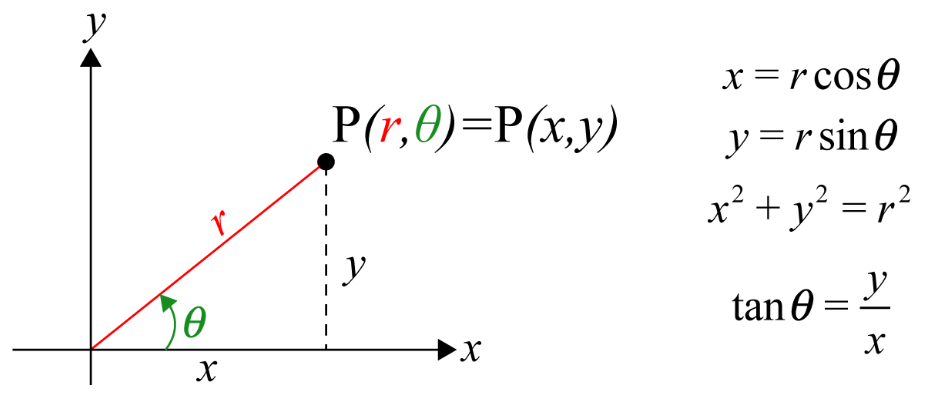
Angle Determination
If \( x > 0 \), then
\( \theta = \arctan\!\left(\dfrac{y}{x}\right) \)
If \( x < 0 \), then
\( \theta = \arctan\!\left(\dfrac{y}{x}\right) + \pi \)
This adjustment ensures that the angle \( \theta \) is measured in the correct quadrant.
Special care is required when \( x = 0 \), since \( \arctan\!\left(\dfrac{y}{x}\right) \) is undefined in that case.
Example:
Convert the rectangular coordinates \( (3, 3) \) to polar coordinates.
▶️ Answer/Explanation
First, compute \( r \):
\( r = \sqrt{3^2 + 3^2} = \sqrt{18} = 3\sqrt{2} \)
Since \( x > 0 \), use
\( \theta = \arctan\!\left(\dfrac{3}{3}\right) = \arctan(1) = \dfrac{\pi}{4} \)
Final answer: \( \left(3\sqrt{2}, \dfrac{\pi}{4}\right) \)
Example:
Convert the rectangular coordinates \( (-2, 2) \) to polar coordinates.
▶️ Answer/Explanation
First, compute \( r \):
\( r = \sqrt{(-2)^2 + 2^2} = \sqrt{8} = 2\sqrt{2} \)
Since \( x < 0 \), adjust the angle:
\( \theta = \arctan\!\left(\dfrac{2}{-2}\right) + \pi = \arctan(-1) + \pi = -\dfrac{\pi}{4} + \pi = \dfrac{3\pi}{4} \)
Final answer: \( \left(2\sqrt{2}, \dfrac{3\pi}{4}\right) \)
Complex Numbers in Rectangular and Polar Form
A complex number can be represented as a point in the complex plane, where the horizontal axis represents the real part and the vertical axis represents the imaginary part.
Rectangular (Standard) Form
If a complex number has rectangular coordinates \( (a, b) \), it is written in rectangular form as

\( z = a + bi \)
where:
\( a \) is the real part
\( b \) is the imaginary part
Polar Form
If the same complex number is described using polar coordinates \( (r, \theta) \), it can be written in polar form as
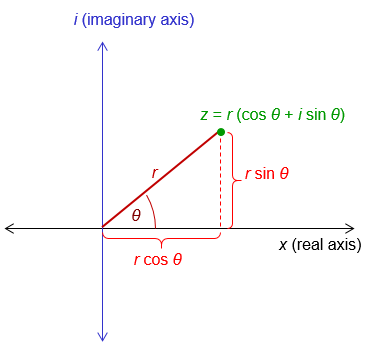
\( z = r(\cos \theta) + i(r \sin \theta) \)
where:
\( r \) is the distance from the origin, called the modulus
\( \theta \) is the angle from the positive real axis, called the argument
These two forms represent the same complex number but highlight different geometric properties.
Example:
Write the complex number with rectangular coordinates \( (3, 4) \) in rectangular and polar form.
▶️ Answer/Explanation
Rectangular form
\( z = 3 + 4i \)
Polar form
\( r = \sqrt{3^2 + 4^2} = 5 \)
\( \theta = \arctan\!\left(\dfrac{4}{3}\right) \)
\( z = 5(\cos \theta) + i(5\sin \theta) \)
Example:
Express the complex number \( z = 2(\cos \dfrac{\pi}{3}) + i\bigl(2\sin \dfrac{\pi}{3}\bigr) \) in rectangular form.
▶️ Answer/Explanation
Compute the trigonometric values:
\( \cos \dfrac{\pi}{3} = \dfrac{1}{2} \)
\( \sin \dfrac{\pi}{3} = \dfrac{\sqrt{3}}{2} \)
Substitute:
\( z = 2\left(\dfrac{1}{2}\right) + i\left(2 \cdot \dfrac{\sqrt{3}}{2}\right) \)
\( z = 1 + i\sqrt{3} \)
Final answer: \( z = 1 + i\sqrt{3} \)