
▶️ Answer/Explanation
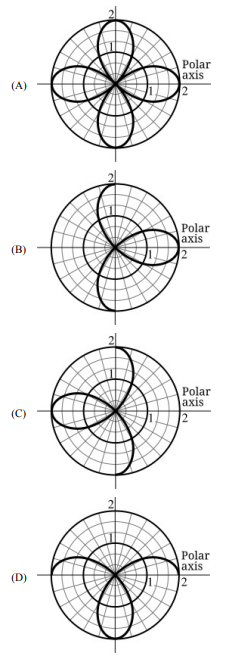
The equation \( r = 2\cos(2\theta) \) represents a rose curve with 4 petals (since the coefficient of \(\theta\) is even, the number of petals is \(2n = 4\)). Over the domain \(-\frac{\pi}{2} \leq \theta \leq \frac{\pi}{2}\), the curve completes two full petals (one in the right half-plane and one in the upper/lower quadrants depending on \(\theta\)), and the graph shown in option (B) matches the correctly restricted portion of the 4-petaled rose.
✅ Answer: (B)
▶️ Answer/Explanation
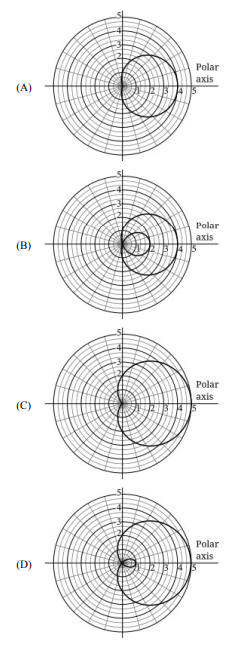
\( f(\theta) = 3\cos\theta + 2 \):
– At \( \theta = 0 \): \( r = 3(1) + 2 = 5 \) (max).
– At \( \theta = \pi/2 \): \( r = 3(0) + 2 = 2 \).
– At \( \theta = \pi \): \( r = 3(-1) + 2 = -1 \), which plots as \( r = 1 \) in opposite direction (point at (1, π) in polar).
– At \( \theta = 3\pi/2 \): \( r = 2 \).
– At \( \theta = 2\pi \): back to 5.
Shape: Symmetric about polar axis. Inner loop when \( r < 0 \) for \( \pi/2 < \theta < 3\pi/2 \), but here \( r \) becomes negative only between the two zeros of \( 3\cos\theta + 2 = 0 \), i.e., \( \cos\theta = -2/3 \) → two angles where \( r = 0 \), giving a limaçon with an inner loop because \( 2 < 3 \) (since \( a = 3, b = 2 \), \( a > b \)).
✅ Answer: (D)
▶️ Answer/Explanation
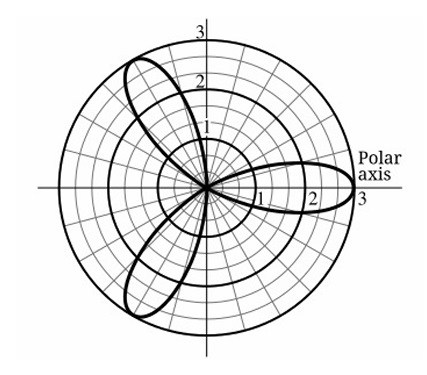
The graph has 3 petals (rose curve) and max radius 3.
General form for a 3-petal rose: \( r = a \cos(3\theta) \) or \( r = a \sin(3\theta) \).
From the graph, at \( \theta = 0 \), \( r = 3 \), which matches \( 3\cos(3\cdot 0) = 3 \).
If it were \( 3\sin(3\theta) \), at \( \theta = 0 \), \( r = 0 \), so not match.
Also, \( 3 + \cos(3\theta) \) ranges from 2 to 4, not 0 to 3 symmetrically.
Thus correct form is \( r = 3\cos(3\theta) \).
✅ Answer: (B)
▶️ Answer/Explanation
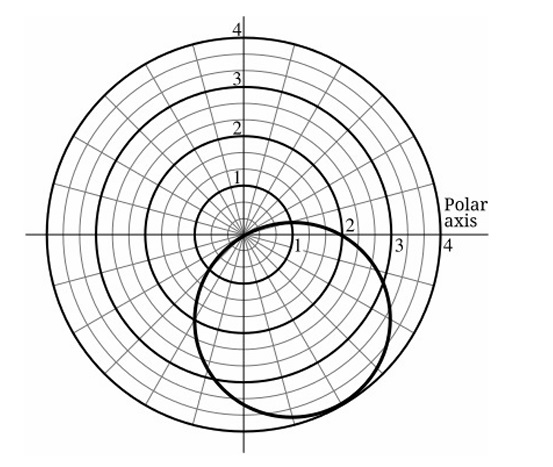
\( r = 4\cos\left( \theta + \frac{\pi}{3} \right) \).
Test interval \( \frac{\pi}{2} < \theta < \pi \):
Let \( \theta = \frac{2\pi}{3} \) (midpoint). Then \( \theta + \frac{\pi}{3} = \pi \), \( r = 4\cos\pi = -4 \), negative.
Plotting: angle = \( 2\pi/3 \) (Quadrant II), but negative radius → point in opposite direction: Quadrant IV.
Check another: \( \theta = \frac{3\pi}{4} \), then \( \theta + \frac{\pi}{3} = \frac{13\pi}{12} \) > \( \pi \), cosine negative, radius negative → direction same as terminal ray angle \( 3\pi/4 \) (Quadrant II)? Wait: negative radius flips to opposite quadrant: Quadrant IV again.
Thus for this entire \( \theta \) range, points lie in Quadrant IV.
✅ Answer: (D)
▶️ Answer/Explanation
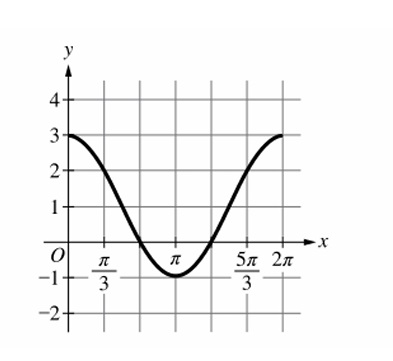
The Cartesian graph given is of \( y = 2\cos x + 1 \).
In polar form, \( r = 2\cos\theta + 1 \).
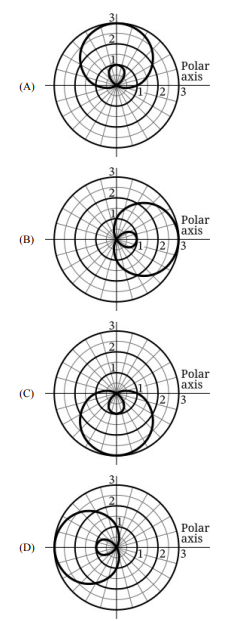
Key points: at \( \theta = 0 \), \( r = 3 \); at \( \theta = \frac{2\pi}{3} \), \( r = 2\cos\frac{2\pi}{3} + 1 = 2(-\frac12) + 1 = 0 \); at \( \theta = \pi \), \( r = 2(-1)+1 = -1 \) (plots as \( r=1\) in opposite direction, i.e., at \( \theta=\pi \)); at \( \theta = \frac{4\pi}{3} \), \( r = 2\cos\frac{4\pi}{3} + 1 = 2(-\frac12) + 1 = 0 \); at \( \theta = 2\pi \), back to 3.
The polar graph is symmetric about polar axis, has a loop (since \( a=2, b=1, a > b \)), and passes through origin at two angles.
Matching this shape to options, the correct polar graph is option B.
✅ Answer: (B)
▶️ Answer/Explanation
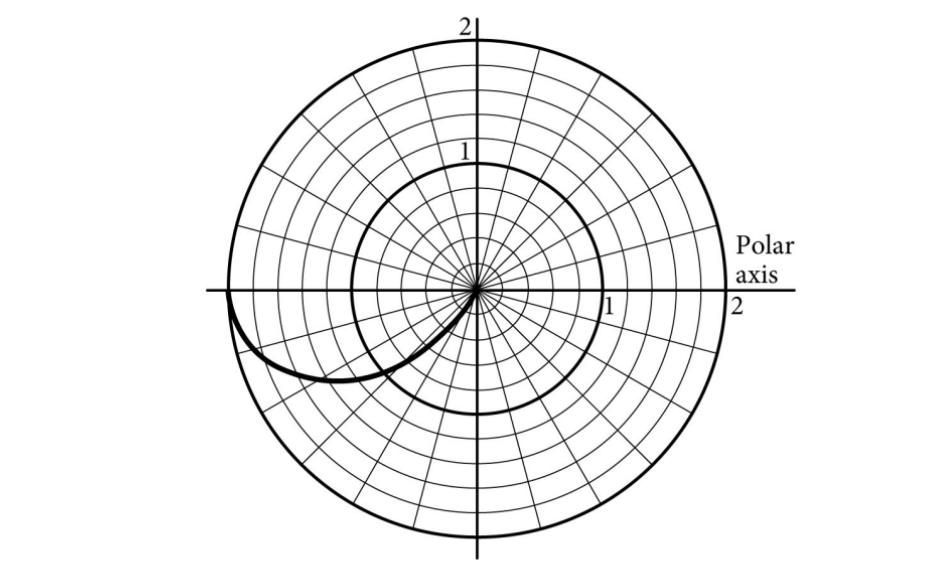
1. Analyze the Start Point (\(\theta = 0\)):
\(f(0) = 2 – 4\cos(0) = 2 – 4 = -2\).
The graph starts at radius -2 (on the negative x-axis).
2. Find where the graph passes through the Pole (\(r=0\)):
\(2 – 4\cos\theta = 0 \implies \cos\theta = \frac{1}{2}\).
The angles where \(\cos\theta = \frac{1}{2}\) are \(\theta = \frac{\pi}{3}\) and \(\theta = \frac{5\pi}{3}\).
3. Determine the Interval:
The loop typically shown for this limaçon goes from the minimum radius to the pole. The interval starting at 0 and ending at the first pole crossing is \(0 \le \theta \le \frac{\pi}{3}\).
✅ Answer: (A)
▶️ Answer/Explanation
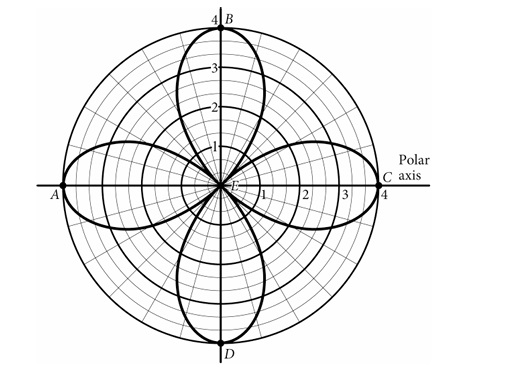
The polar function \( r = 4\cos(2\theta) \) for \( 0 \leq \theta \leq \frac{\pi}{2} \) corresponds to two “petals” of the four-leaved rose.
One petal lies in Quadrant I (from \( C \) to \( E \)). The other petal for this domain lies in Quadrant III, because when \( \theta \) increases from 0 to \( \pi/2 \), \( r \) becomes negative for certain intervals, plotting points in the opposite direction (Quadrant III).
From the answer key, the other piece is the portion in Quadrant III from \( E \) to \( D \).
✅ Answer: (D)
▶️ Answer/Explanation
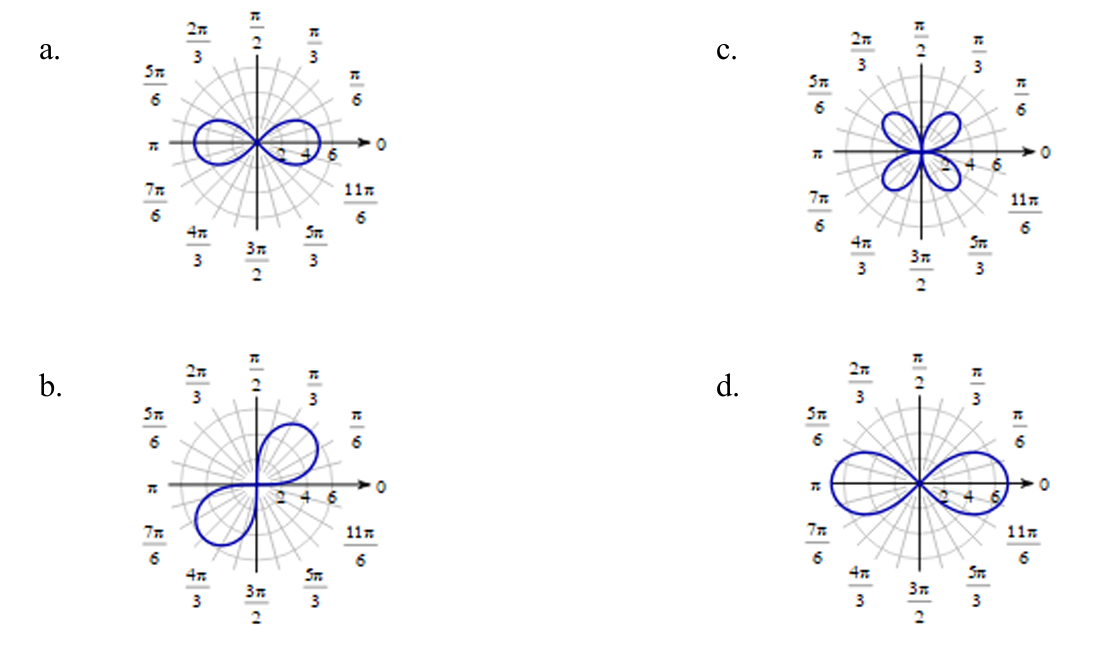
The equation $r^2 = 25 \cos 2\theta$ represents a lemniscate curve.
When $\theta = 0$, $r^2 = 25 \cos(0) = 25$, so $r = \pm 5$, indicating intercepts on the polar axis.
The maximum value of $r$ is $5$, which occurs at $\theta = 0$ and $\theta = \pi$.
The graph is symmetric with respect to the pole, the polar axis, and the line $\theta = \frac{\pi}{2}$.
The loops exist only where $\cos 2\theta \ge 0$, which occurs in the intervals $[-\frac{\pi}{4}, \frac{\pi}{4}]$ and $[\frac{3\pi}{4}, \frac{5\pi}{4}]$.
Comparing the given options, graph d correctly shows the horizontal lemniscate with a maximum radius of $5$.
Correct Option: d
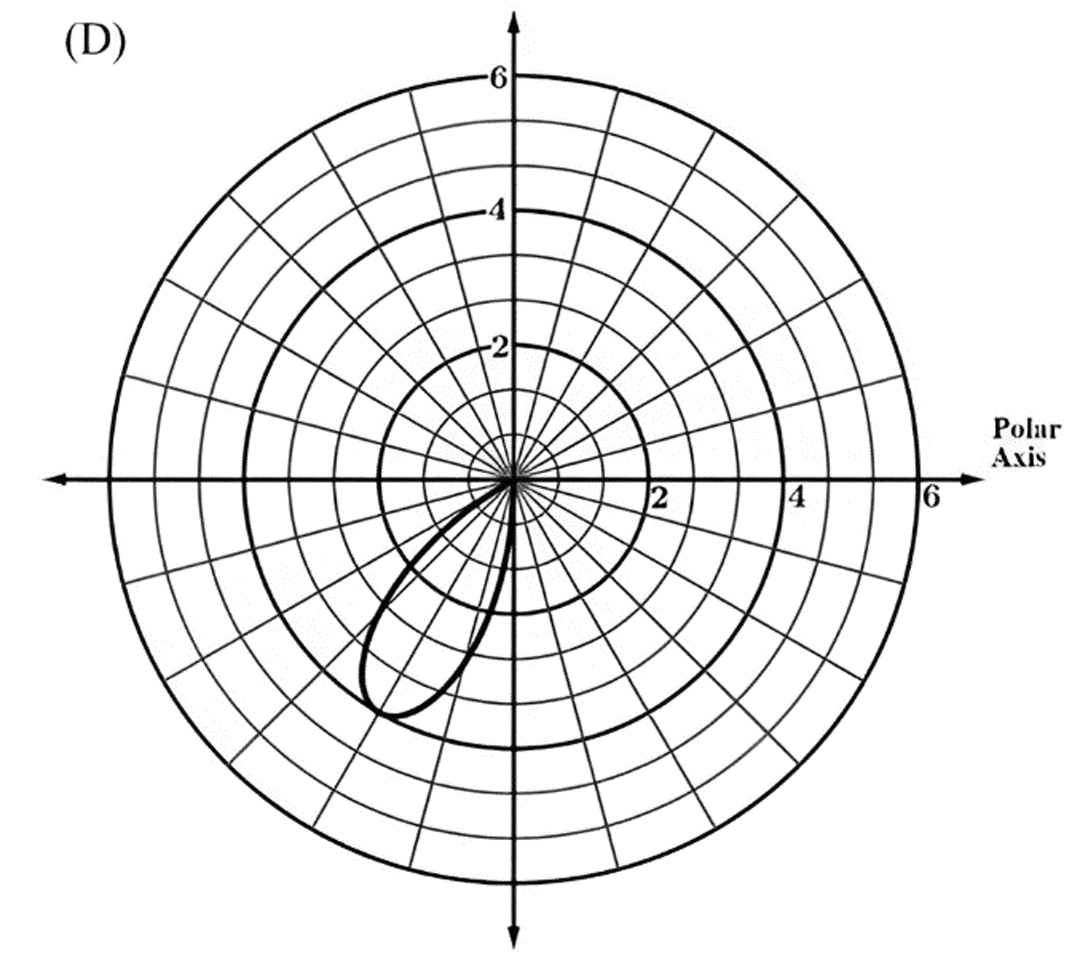
▶️ Answer/Explanation
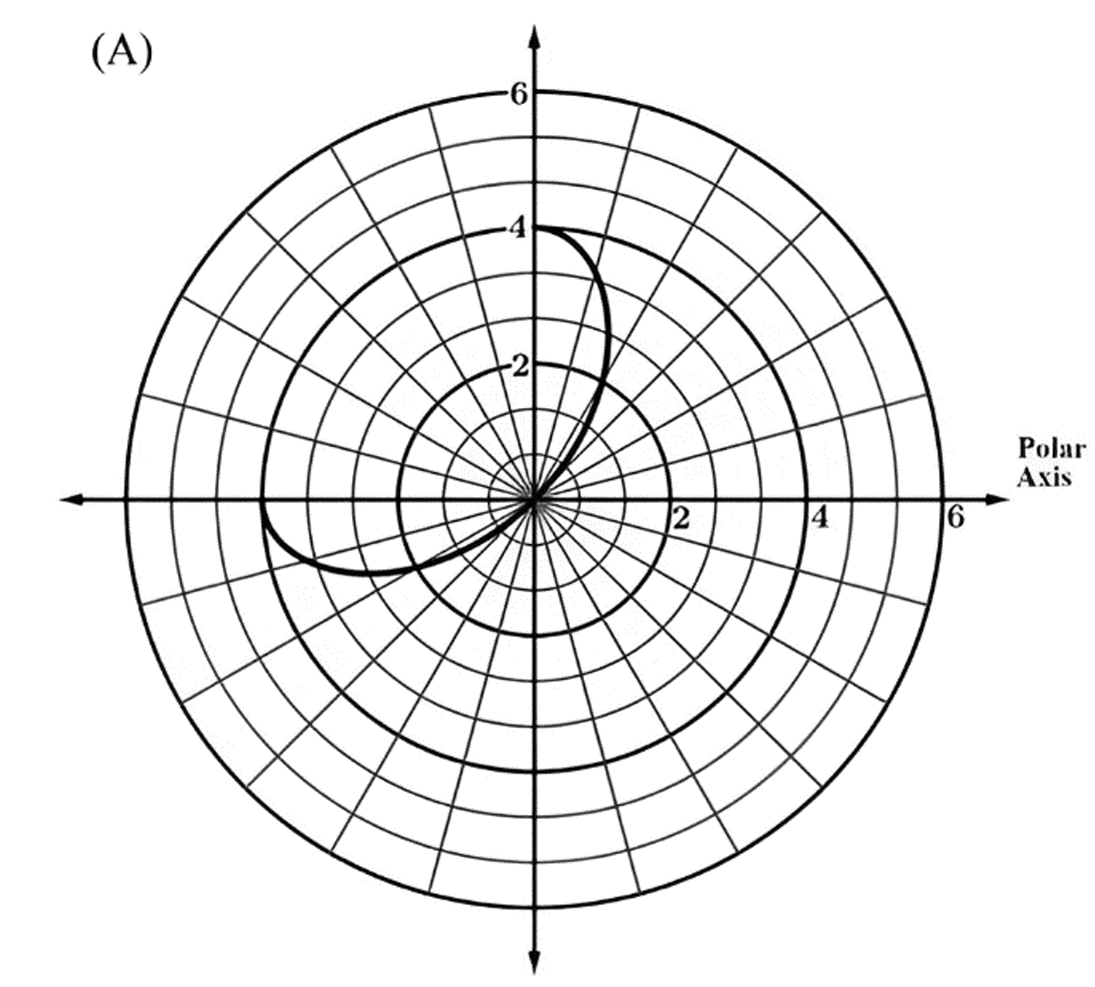
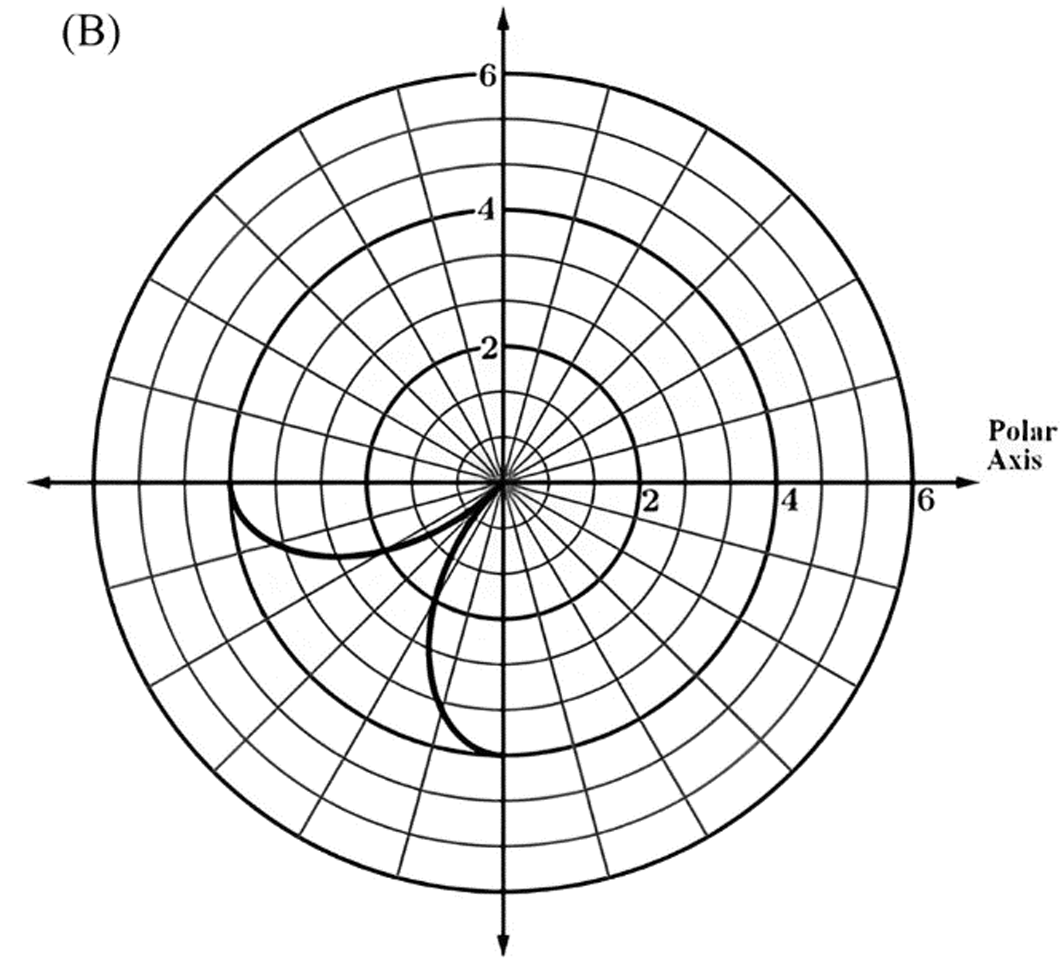
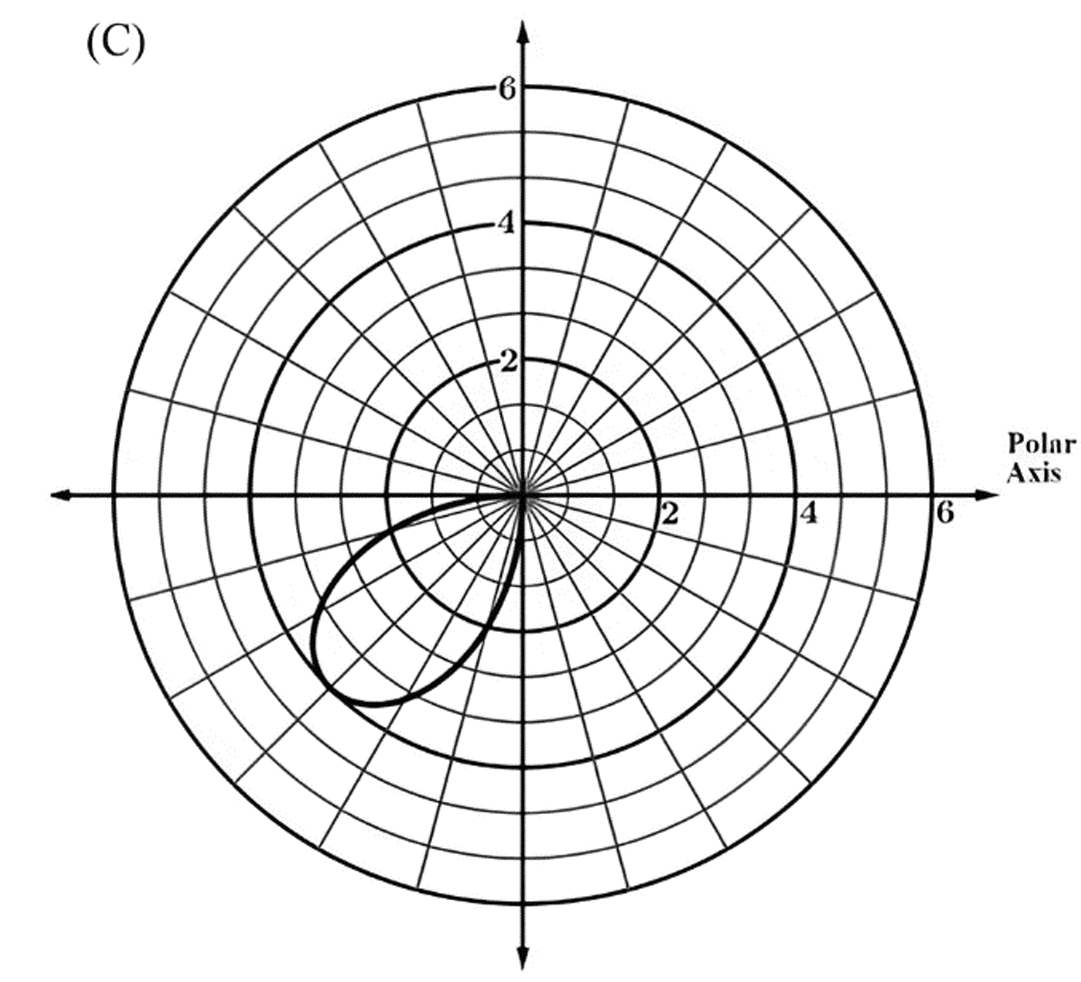
The correct graph corresponds to option (B).
To determine the correct graph, we evaluate the function \(r = 4 \cos(2\theta)\) at the starting value of the given interval, \(\theta = \pi\).
Substitute \(\theta = \pi\) into the equation:
\(r = 4 \cos(2(\pi)) = 4 \cos(2\pi)\)
Since \(\cos(2\pi) = 1\), we have:
\(r = 4(1) = 4\)
This corresponds to the polar point \((4, \pi)\). In the polar coordinate system, this point is located 4 units away from the pole (origin) along the ray \(\theta = \pi\), which lies on the negative x-axis.
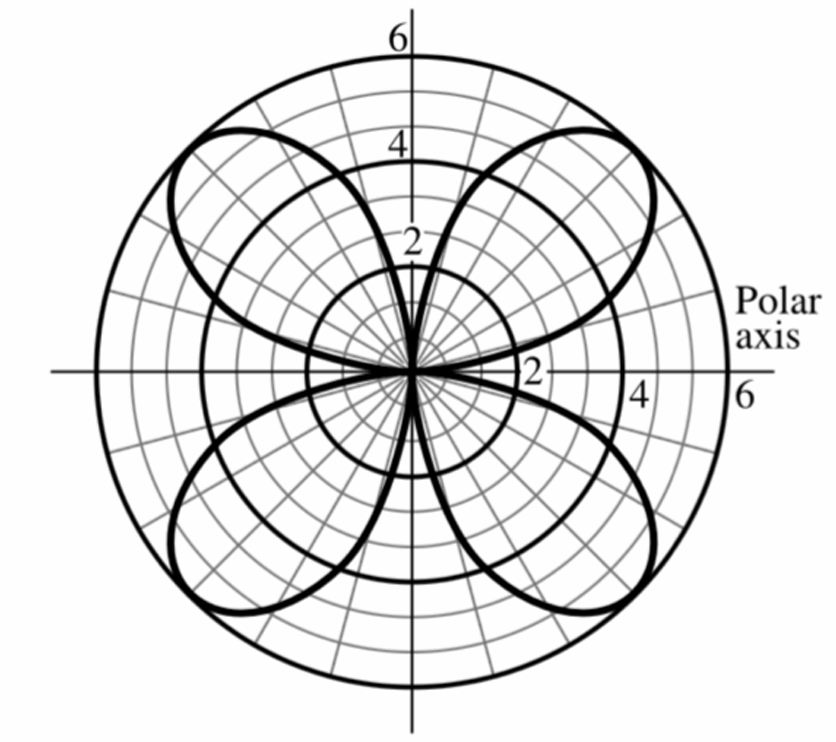
▶️ Answer/Explanation
The graph is a rose curve with $n = 4$ petals and a maximum radius of $6$.
For a rose curve $r = a \sin(n\theta)$ or $r = a \cos(n\theta)$, if $n$ is even, there are $2n$ petals.
Since there are $4$ petals, we have $2n = 4$, which means $n = 2$.
The maximum radius is $6$, so the coefficient $a = 6$.
The petals are located in the quadrants (e.g., at $\theta = \frac{\pi}{4}$) rather than on the axes.
For $r = 6 \cos(2\theta)$, petals would be centered on the polar axis ($\theta = 0$).
For $r = 6 \sin(2\theta)$, the first maximum occurs at $2\theta = \frac{\pi}{2}$, or $\theta = \frac{\pi}{4}$.
Thus, the correct expression is $f(\theta) = 6 \sin(2\theta)$.
Correct Option: (D)
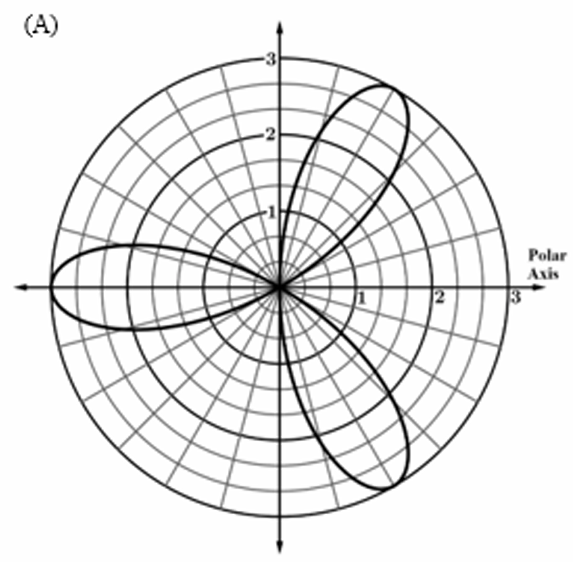
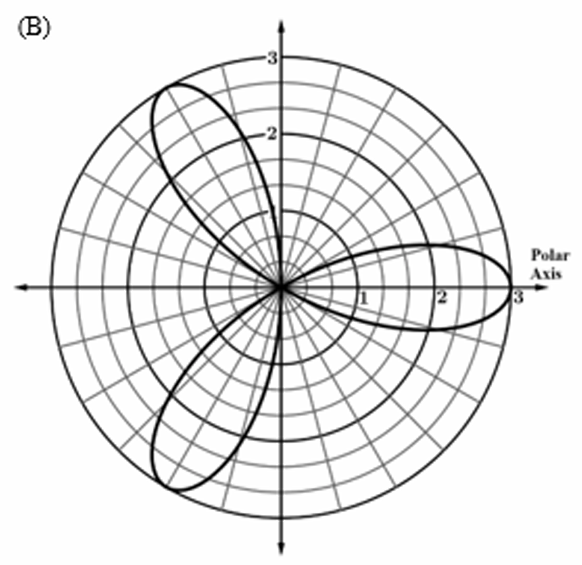
▶️ Answer/Explanation
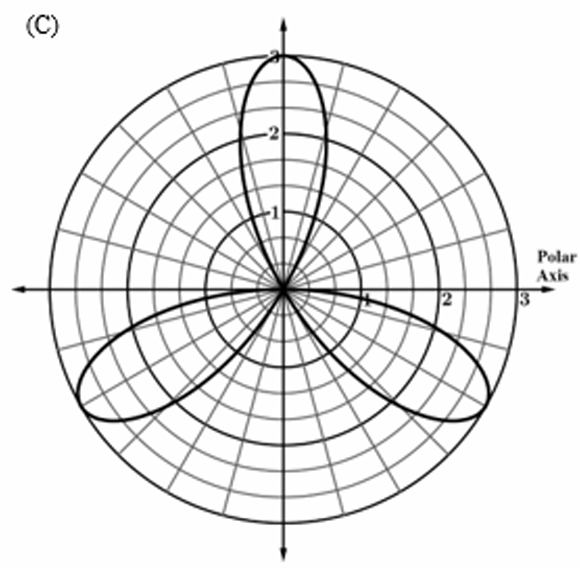
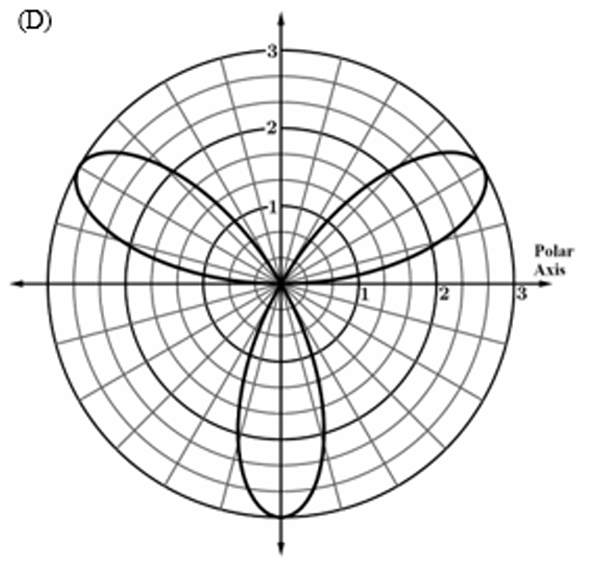
The function $r = -3 \sin(3\theta)$ represents a three-petaled rose because $n = 3$ is odd.
The maximum magnitude of $r$ is $|-3| = 3$, meaning the petals extend to a radius of $3$.
Since it is a sine function, the petals are not centered on the polar axis ($0^\circ$).
For $f(\theta)$ to reach its first extremum, $3\theta = \frac{\pi}{2}$ or $3\theta = \frac{3\pi}{2}$.
At $\theta = \frac{\pi}{6}$, $r = -3 \sin(\frac{\pi}{2}) = -3$, plotting a point at radius $3$ in the direction $\theta = \frac{7\pi}{6}$.
At $\theta = \frac{\pi}{2}$, $r = -3 \sin(\frac{3\pi}{2}) = 3$, plotting a petal tip directly on the positive y-axis.
Comparing this to the choices, Graph (C) is the only one with a petal tip at $(r, \theta) = (3, \frac{\pi}{2})$.
Therefore, the correct choice is (C).