
AP Precalculus -3.15 Rates of Change in Polar Functions- MCQ Exam Style Questions - Effective Fall 2023
AP Precalculus -3.15 Rates of Change in Polar Functions- MCQ Exam Style Questions – Effective Fall 2023
AP Precalculus -3.15 Rates of Change in Polar Functions- MCQ Exam Style Questions – AP Precalculus- per latest AP Precalculus Syllabus.
Question
(B) For the input values \( \theta = \frac{\pi}{4}, \frac{3\pi}{4}, \frac{5\pi}{4}, \frac{7\pi}{4} \), the function \( r = f(\theta) \) has extrema. However, only the points corresponding to \( \theta = \frac{\pi}{4} \) and \( \theta = \frac{5\pi}{4} \) are farthest from the origin.
(C) For the input values \( \theta = \frac{\pi}{2} \) and \( \theta = \frac{3\pi}{2} \), the function \( r = f(\theta) \) has extrema that correspond to points that are farthest from the origin.
(D) For the input values \( \theta = \frac{\pi}{2} \) and \( \theta = \frac{3\pi}{2} \), the function \( r = f(\theta) \) has extrema. However, only the point corresponding to \( \theta = \frac{\pi}{2} \) is farthest from the origin.
▶️ Answer/Explanation
For \( r = 4\sin(2\theta) \), the extrema occur where \( \sin(2\theta) = \pm 1 \).
This happens when \( 2\theta = \frac{\pi}{2}, \frac{3\pi}{2}, \frac{5\pi}{2}, \frac{7\pi}{2} \), so \( \theta = \frac{\pi}{4}, \frac{3\pi}{4}, \frac{5\pi}{4}, \frac{7\pi}{4} \).
At these angles, \( r = 4 \) or \( r = -4 \), but the distance from the origin is \( |r| = 4 \) in all four cases, so they are all farthest from the origin.
✅ Answer: (A)
Question
(B) The distance is increasing for \( \frac{3\pi}{2} \leq \theta \leq \frac{11\pi}{6} \), because \( f(\theta) \) is negative and increasing on the interval.
(C) The distance is decreasing for \( 0 \leq \theta \leq \frac{\pi}{2} \), because \( f(\theta) \) is positive and decreasing on the interval.
(D) The distance is decreasing for \( \frac{3\pi}{2} \leq \theta \leq \frac{11\pi}{6} \), because \( f(\theta) \) is negative and decreasing on the interval.
▶️ Answer/Explanation
In polar coordinates, the distance from the origin is given by \( r = f(\theta) \). However, distance must be non-negative. When \( f(\theta) \) is negative, the point is plotted \( |f(\theta)| \) units in the opposite direction, but the distance from the origin is \( |f(\theta)| \).
We check each option:
- On \( 0 \leq \theta \leq \frac{\pi}{2} \): \( f'(\theta) = 2 \cos \theta > 0 \) (increasing), and \( f(\theta) > 0 \), so distance \( = f(\theta) \) is increasing. ✅ (A) is correct.
- On \( \frac{3\pi}{2} \leq \theta \leq \frac{11\pi}{6} \): \( f(\theta) = 1 + 2 \sin \theta \). For \( \theta = \frac{3\pi}{2} \), \( f(\theta) = -1 \); for \( \theta = \frac{11\pi}{6} \), \( f(\theta) = 0 \). Since \( f(\theta) \) is negative and increasing toward 0, \( |f(\theta)| \) is decreasing. So the distance is decreasing, not increasing. (B) is false.
- (C) contradicts (A), so false.
- (D) states “because \( f(\theta) \) is negative and decreasing” — but \( f(\theta) \) is increasing here, not decreasing, so false.
✅ Answer: (A)
Question
(B) The points on the graph are above the \(x\)-axis and are getting farther from the origin.
(C) The points on the graph are below the \(x\)-axis and are getting closer to the origin.
(D) The points on the graph are below the \(x\)-axis and are getting farther from the origin.
▶️ Answer/Explanation
For \(0 < \theta < \frac{\pi}{2}\), \(\sin \theta\) increases from 0 to 1.
Thus \(f(\theta) = -1 + \sin \theta\) increases from \(-1\) to \(0\).
Since \(f(\theta)\) is negative, points are in the direction opposite to terminal ray \(\theta\); i.e., for \(0 < \theta < \frac{\pi}{2}\), the corresponding Cartesian points lie in Quadrant IV (below the \(x\)-axis).
The distance from origin is \( |f(\theta)| = 1 – \sin \theta\), which decreases as \(\theta\) increases.
✅ Answer: (C)
Question
(B) On the interval \( 2 < \theta < 2.1 \), the distance between \( (f(\theta), \theta) \) and the origin is decreasing because the values of \( f(\theta) \) are negative and decreasing.
(C) On the interval \( 2 < \theta < 2.1 \), the distance between \( (f(\theta), \theta) \) and the origin is increasing because the values of \( f(\theta) \) are negative and increasing.
(D) On the interval \( 2 < \theta < 2.1 \), the distance between \( (f(\theta), \theta) \) and the origin is decreasing because the values of \( f(\theta) \) are negative and increasing.
▶️ Answer/Explanation
For \( 2 < \theta < 2.1 \):
\( \theta > 0 \), \( \theta – 2 > 0 \), \( \theta – 4 < 0 \) ⇒ \( f(\theta) = \theta(\theta-2)(\theta-4) < 0 \).
Check derivative: \( f'(\theta) = (\theta-2)(\theta-4) + \theta(\theta-4) + \theta(\theta-2) \).
At \( \theta = 2 \), \( f'(2) = -4 < 0 \), so \( f \) is decreasing near \( \theta = 2 \).
Thus on \( 2 < \theta < 2.1 \), \( f(\theta) \) is negative and decreasing.
Distance from origin = \( |f(\theta)| = -f(\theta) \).
Since \( f \) is decreasing (more negative), \( |f| \) is increasing.
Therefore, distance is increasing.
✅ Answer: (A)
Question
(B) As \( \theta \) increases from 0 to \( \frac{\pi}{6} \), the polar function \( r = f(\theta) \) is increasing, and the distance between the point \( (f(\theta), \theta) \) on the curve and the origin is decreasing.
(C) As \( \theta \) increases from 0 to \( \frac{\pi}{6} \), the polar function \( r = f(\theta) \) is decreasing, and the distance between the point \( (f(\theta), \theta) \) on the curve and the origin is increasing.
(D) As \( \theta \) increases from 0 to \( \frac{\pi}{6} \), the polar function \( r = f(\theta) \) is decreasing, and the distance between the point \( (f(\theta), \theta) \) on the curve and the origin is decreasing.
▶️ Answer/Explanation
On \( 0 \leq \theta \leq \frac{\pi}{6} \):
\( f(\theta) = 2\sin\theta – 1 \).
Since \( \sin\theta \) increases from 0 to \( \frac12 \), \( f(\theta) \) increases from \( -1 \) to \( 0 \).
So \( f \) is increasing.
Also \( f(\theta) \) is negative (or zero at \( \theta = \frac{\pi}{6} \)).
Distance from origin = \( |f(\theta)| = 1 – 2\sin\theta \).
As \( \theta \) increases, \( 1 – 2\sin\theta \) decreases.
Thus the distance is decreasing.
Conclusion: \( f(\theta) \) is increasing, distance is decreasing.
✅ Answer: (B)
Question
(B) \((2.094,4.189)\)
(C) \((0,2.094)\) and \((3.142,4.189)\)
(D) \((2.094,3.142)\) and \((4.189,6.283)\)
▶️ Answer/Explanation
1. Define the distance:
The distance from the origin is given by \(|r| = |1+2\cos\theta|\). The distance decreases when \(r\) moves towards 0.
2. Find where \(r=0\):
\(1+2\cos\theta = 0 \implies \cos\theta = -0.5\).
\(\theta \approx 2.094\) (\(\frac{2\pi}{3}\)) and \(\theta \approx 4.189\) (\(\frac{4\pi}{3}\)).
3. Analyze the intervals:
• Interval \((0, 2.094)\): \(r\) decreases from \(3\) to \(0\). (Distance decreases).
• Interval \((3.142, 4.189)\) (which is \(\pi\) to \(\frac{4\pi}{3}\)): \(r\) increases from \(-1\) to \(0\). Since \(r\) is negative and approaching 0, the absolute value (distance) is decreasing.
✅ Answer: (C)
Question
(B) The distance is increasing for \( \frac{3\pi}{2} \leq \theta \leq \frac{11\pi}{6} \), because \( f(\theta) \) is negative and increasing on the interval.
(C) The distance is decreasing for \( 0 \leq \theta \leq \frac{\pi}{2} \), because \( f(\theta) \) is positive and decreasing on the interval.
(D) The distance is decreasing for \( \frac{3\pi}{2} \leq \theta \leq \frac{11\pi}{6} \), because \( f(\theta) \) is negative and decreasing on the interval.
▶️ Answer/Explanation
Distance from origin = \( |r| = |f(\theta)| \).
On \( 0 \leq \theta \leq \frac{\pi}{2} \):
\( f(\theta) = 1 + 2\sin\theta \) is positive (since \(\sin\theta \ge 0\)) and increasing (since \(\sin\theta\) increases). So \( |f(\theta)| = f(\theta) \) increases ⇒ distance increases.
Thus (A) is true.
Check others:
On \( \frac{3\pi}{2} \leq \theta \leq \frac{11\pi}{6} \): \( \sin\theta \) increases from -1 to -0.5, so \( f(\theta) = 1+2\sin\theta \) increases from -1 to 0, but it’s negative, so \( |f(\theta)| \) decreases (from 1 to 0) ⇒ distance decreases, not increases. (B) false.
(C) and (D) contradict sign/monotonicity analysis.
✅ Answer: (A)
Question
b. $r = 5$
c. $r = 1$
d. $r = -1$
▶️ Answer/Explanation
Given $f\left(\frac{\pi}{4}\right) = 2$, $f’\left(\frac{\pi}{4}\right) = -3$, and $f”(\theta) = 2$.
Let $\Delta \theta = \frac{\pi}{3} – \frac{\pi}{4} = \frac{\pi}{12} \approx 0.2618$.
Using the Taylor expansion: $f(\theta) \approx f(a) + f'(a)(\Delta \theta) + \frac{1}{2}f”(a)(\Delta \theta)^2$.
Substitute the values: $f\left(\frac{\pi}{3}\right) \approx 2 + (-3)\left(\frac{\pi}{12}\right) + \frac{1}{2}(2)\left(\frac{\pi}{12}\right)^2$.
$f\left(\frac{\pi}{3}\right) \approx 2 – 0.7854 + 0.0685$.
$f\left(\frac{\pi}{3}\right) \approx 1.2831$.
Among the given choices, $r = 1$ is the closest possible value.
Correct Option: c
Question
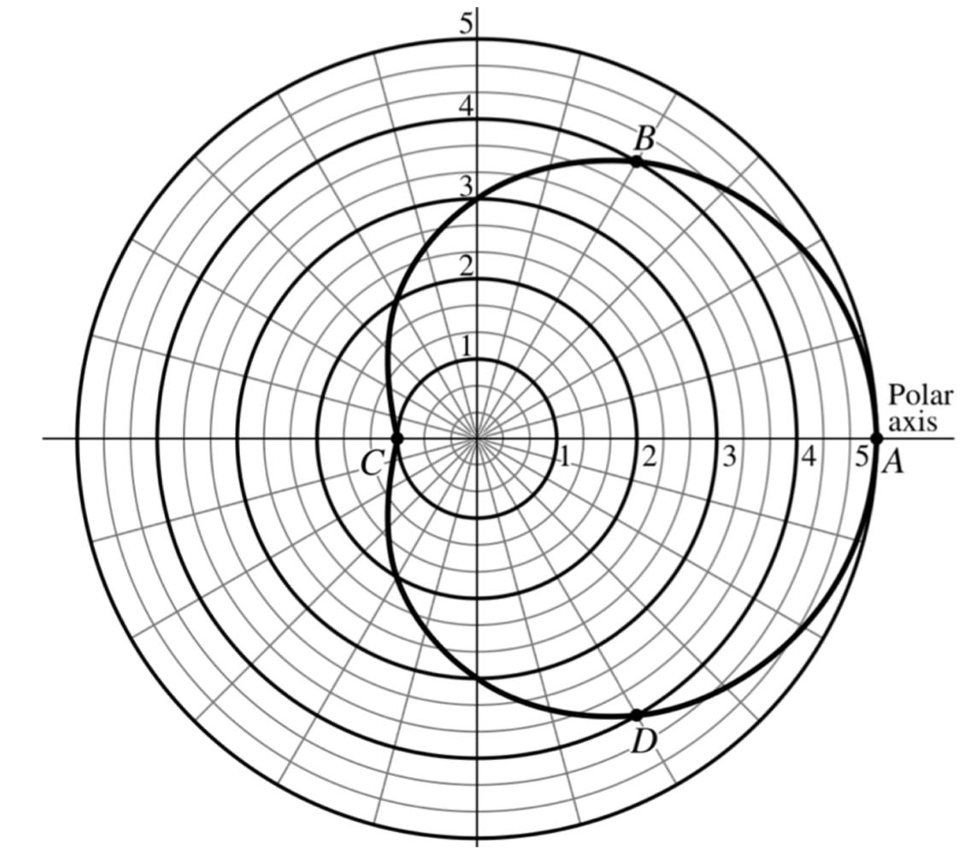
▶️ Answer/Explanation
The average rate of change of $r$ with respect to $\theta$ is given by the ratio: $$\frac{\Delta r}{\Delta \theta} = \frac{r_{final} – r_{initial}}{\theta_{final} – \theta_{initial}}$$
Based on the grid, we can estimate the radius $r$ at each point:
• A: $r = 5$
• B: $r \approx 4$
• C: $r = 1$
• D: $r \approx 4$
For intervals (A) From $A$ to $C$ and (B) From $B$ to $C$, the radius $r$ decreases ($5 \to 1$ and $4 \to 1$), so the rate of change is negative.
For interval (C) From $B$ to $D$, the radius starts at $r \approx 4$ and returns to $r \approx 4$, meaning the net change $\Delta r$ is near zero, so the rate is approximately zero.
For interval (D) From $C$ to $D$, the radius increases from $r = 1$ to $r \approx 4$. Since $\Delta r > 0$ and $\Delta \theta > 0$, the rate of change is positive.
Since a positive value is greater than zero or a negative value, the greatest average rate of change occurs on the interval from $C$ to $D$.
Question
▶️ Answer/Explanation
The correct answer is (C).
The distance from the origin to a polar point \((r, \theta)\) is given by \(|r| = |f(\theta)|\).
On the interval \(\pi \leq \theta \leq \frac{3\pi}{2}\), we are given that \(f(\theta) < 0\), so the distance is \(d(\theta) = -f(\theta)\).
We are also given that \(f(\theta)\) is decreasing, which implies its derivative is negative: \(f'(\theta) < 0\).
To find how the distance changes, we differentiate \(d(\theta)\) with respect to \(\theta\): \(d'(\theta) = -f'(\theta)\).
Since \(f'(\theta)\) is negative, \(-f'(\theta)\) must be positive, meaning \(d'(\theta) > 0\).
A positive derivative indicates an increasing function, so the distance is increasing on this interval.
Question
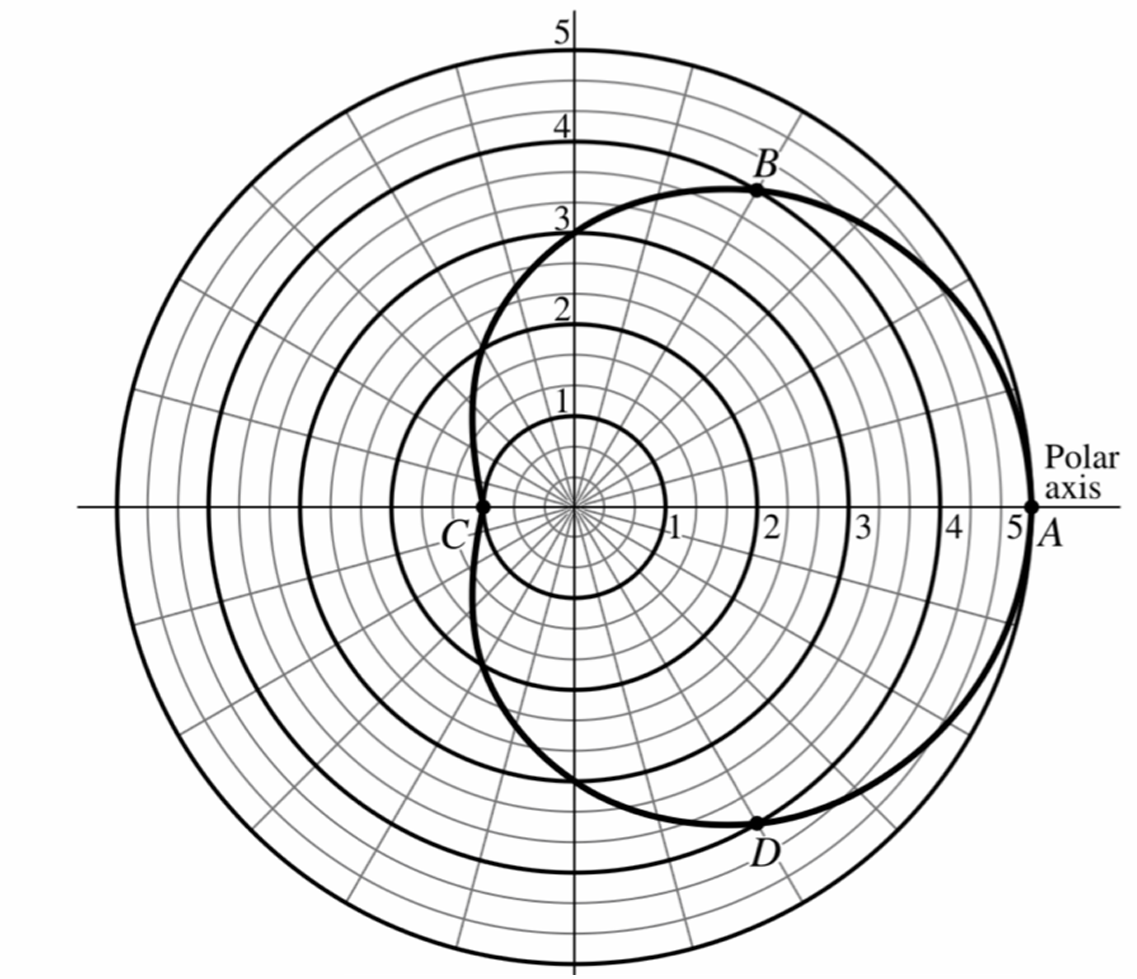
(B) From $B$ to $C$
(C) From $B$ to $D$
(D) From $C$ to $D$
▶️ Answer/Explanation
The average rate of change of $r$ with respect to $\theta$ is given by the formula $\frac{\Delta r}{\Delta \theta} = \frac{r_2 – r_1}{\theta_2 – \theta_1}$.
Point $C$ is at the smallest radius ($r \approx 1$) and point $D$ is at a much larger radius ($r \approx 4.5$).
From $C$ to $D$, the value of $r$ increases significantly over a relatively small change in angle $\Delta \theta$.
In intervals (A) and (B), the radius $r$ is decreasing, resulting in a negative average rate of change.
In interval (C), the radius increases from $B$ ($r \approx 3.5$) to $D$ ($r \approx 4.5$), but over a much larger $\Delta \theta$.
Therefore, the steep positive increase in radius per radian occurs from $C$ to $D$.
The average rate of change is greatest on the interval from $C$ to $D$.
Correct Option: (D)