
▶️ Answer/Explanation
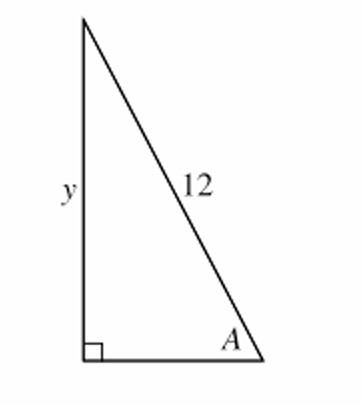
In a right triangle, the sine of angle \( A \) is the ratio of the opposite side \( y \) to the hypotenuse. From the figure, the hypotenuse is 12, so \( \sin A = \frac{y}{12} \).
To express \( A \) as a function of \( y \), we take the inverse sine: \( A = \sin^{-1}\left(\frac{y}{12}\right) \).
Thus, \( f(y) = \sin^{-1}\left(\frac{y}{12}\right) \).
✅ Answer: (D)
▶️ Answer/Explanation
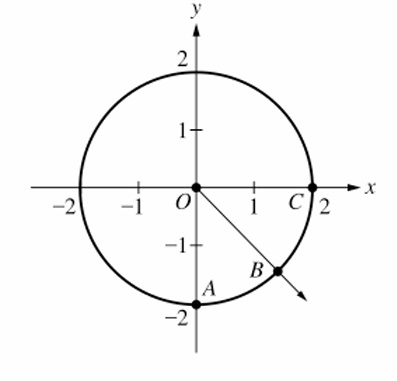
From the figure (assuming standard positions):
– Angle \( AOB \) is measured from positive x-axis to ray \( OB \).
– Given \( \angle COB = \angle AOB \), and likely \( A \) is on positive x-axis, \( C \) is on positive y-axis or similar.
– If \( OA \) is along positive x-axis, \( OC \) along positive y-axis, then \( \angle AOB = \angle COB \) implies \( OB \) bisects the quadrant.
For Quadrant IV: \( OB \) at \( \frac{7\pi}{4} \) (if starting from +x, rotating clockwise to match symmetry).
Radius is 2, so coordinates: \( (2\cos\frac{7\pi}{4}, 2\sin\frac{7\pi}{4}) \).
✅ Answer: (C)
▶️ Answer/Explanation
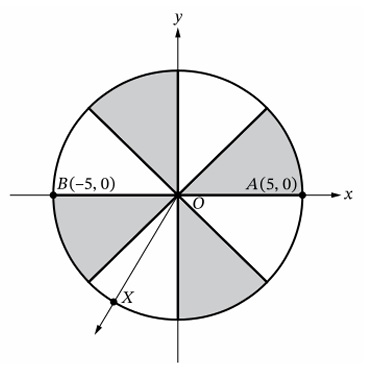
Given \( X = \left(-\frac{5}{2}, -\frac{5\sqrt{3}}{2}\right) \).
Radius \( r = \sqrt{\left(\frac{5}{2}\right)^2 + \left(\frac{5\sqrt{3}}{2}\right)^2} = \sqrt{\frac{25}{4}+\frac{75}{4}} = \sqrt{25} = 5 \).
The coordinates match \( \left(5\cdot\left(-\frac12\right), 5\cdot\left(-\frac{\sqrt{3}}{2}\right)\right) \), so \( \cos\theta = -\frac12, \sin\theta = -\frac{\sqrt{3}}{2} \).
That’s \( \theta = \frac{4\pi}{3} \) (Quadrant III).
\( B \) is at angle \( \pi \) (since it’s at \((-5,0)\)).
Angle \( XOB \) = \( \theta_X – \theta_B = \frac{4\pi}{3} – \pi = \frac{\pi}{3} \).
✅ Answer: (B)
▶️ Answer/Explanation
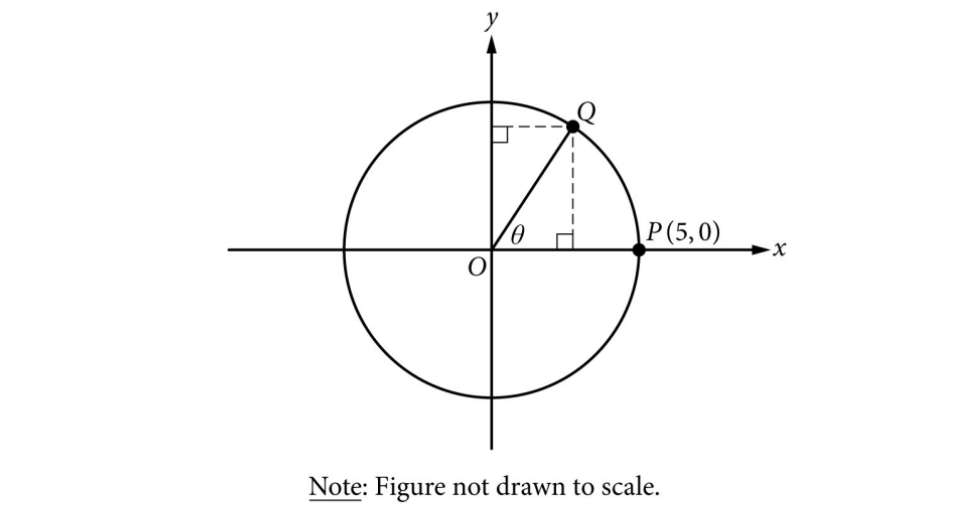
1. Determine the Radius:
Point \(P\) is at \((5,0)\) and is on the circle. Thus, the radius \(r = 5\).
2. Determine the Angle \(\theta\):
The arc length formula is \(s = r\theta\).
Given \(s = 6\) and \(r = 5\), we have \(6 = 5\theta\), so \(\theta = \frac{6}{5}\) radians.
3. Find the Distance from the Y-axis:
The distance of a point \((x, y)\) from the y-axis is \(|x|\).
The x-coordinate of point \(Q\) is \(x = r\cos\theta = 5\cos(\frac{6}{5})\).
Therefore, the distance is \(5\cos(\frac{6}{5})\).
✅ Answer: (C)
▶️ Answer/Explanation
1. Definition:
Slope \(m\) of terminal ray = \(\tan\theta\).
2. Calculation:
Given \(\tan\theta = -\frac{3}{4}\).
Slope \(m = -\frac{3}{4}\).
✅ Answer: (C)
▶️ Answer/Explanation
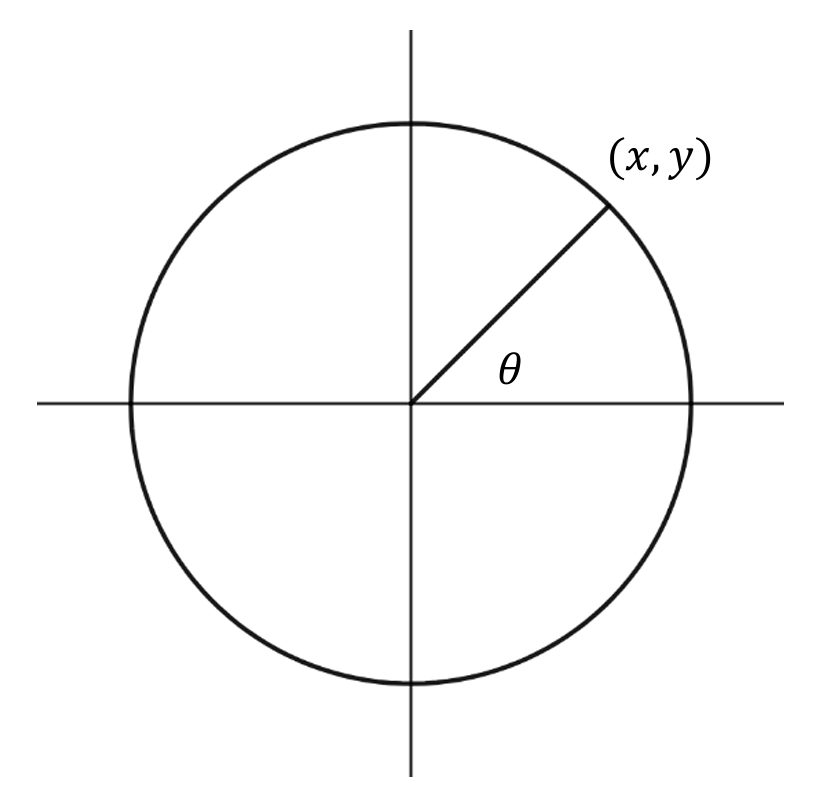
The slope of the radial line from the origin $(0,0)$ to the terminal point is $m_{radius} = \tan(\theta)$.
Substituting the given angle, the radial slope is $m_{radius} = \tan\left(\frac{\pi}{5}\right) \approx 0.7265$.
A tangent line to a circle is perpendicular to the radius at the point of contact.
Perpendicular slopes are negative reciprocals: $m_{tangent} = -\frac{1}{m_{radius}}$.
Thus, $m_{tangent} = -\frac{1}{\tan(\pi/5)} = -\cot\left(\frac{\pi}{5}\right)$.
Calculating the value: $-\frac{1}{0.7265} \approx -1.376$.
Rounding to two decimal places, the slope is $-1.38$.
The correct option is b.
▶️ Answer/Explanation
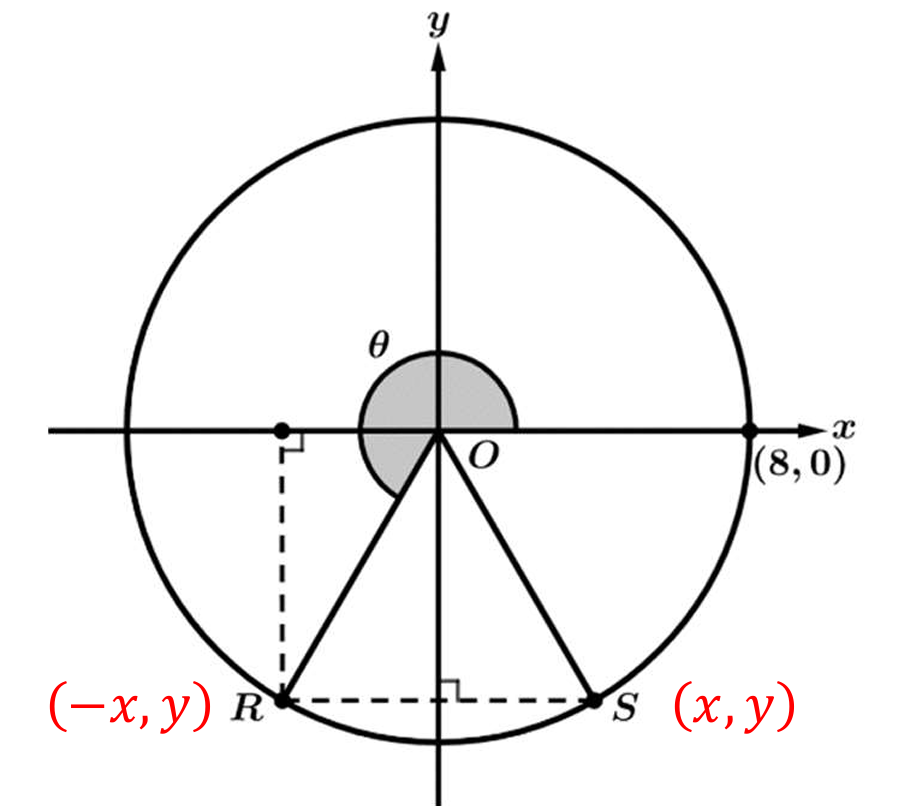
The circle intersects the positive x-axis at the point \((8, 0)\), indicating that the radius of the circle is \(r = 8\).
By definition, for any angle \(\theta\) in standard position, the cosine is the ratio of the x-coordinate of the point on the terminal ray to the radius (\(\cos \theta = \frac{X}{r}\)).
The terminal ray of angle \(\theta\) intersects the circle at point \(R\), which has the coordinates \((-x, y)\).
The x-coordinate of \(R\) is \(-x\), which represents the horizontal displacement of the point from the y-axis.
Substituting these values into the cosine definition gives \(\cos \theta = \frac{-x}{8}\).
Therefore, the correct statement is that \(\cos \theta = \frac{-x}{8}\) because it relates the horizontal displacement of \(R\) to the radius.
▶️ Answer/Explanation
The correct answer is (C).
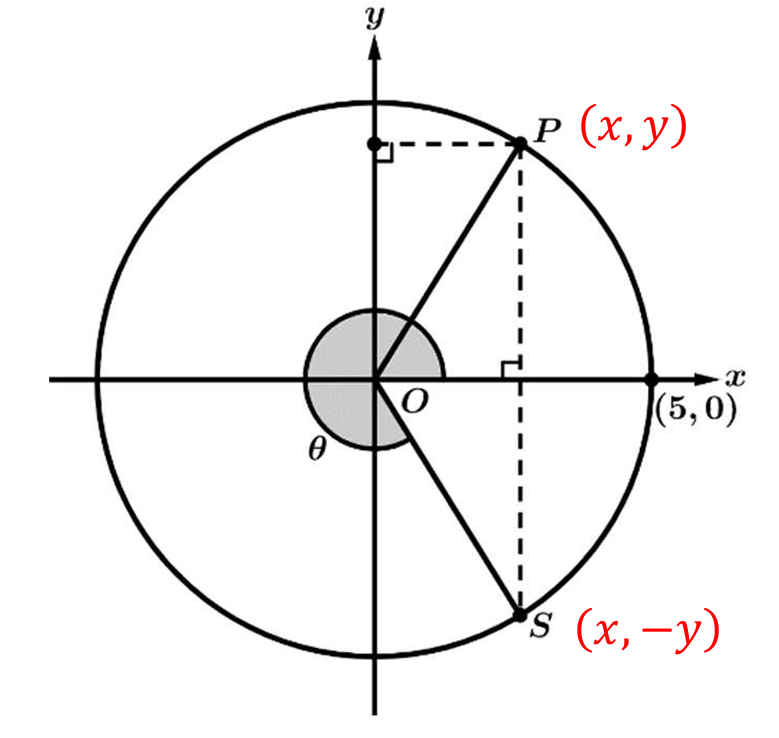
1. By definition, for any point \((X, Y)\) on the terminal ray of an angle \(\theta\) in standard position, \(\sin \theta = \frac{Y}{r}\), where \(r\) is the distance from the origin.
2. The terminal ray of angle \(\theta\) intersects the circle at point \(S\), which has the coordinates \((x, -y)\).
3. The circle intersects the positive \(x\)-axis at \((5,0)\), which implies the radius of the circle is \(r = 5\).
4. The vertical displacement of point \(S\) from the \(x\)-axis corresponds to its \(y\)-coordinate, which is \(-y\).
5. Substituting these values into the sine definition gives \(\sin \theta = \frac{-y}{5}\).
6. This matches option (C), which correctly identifies the ratio as the vertical displacement of \(S\) divided by the distance to the origin.
▶️ Answer/Explanation
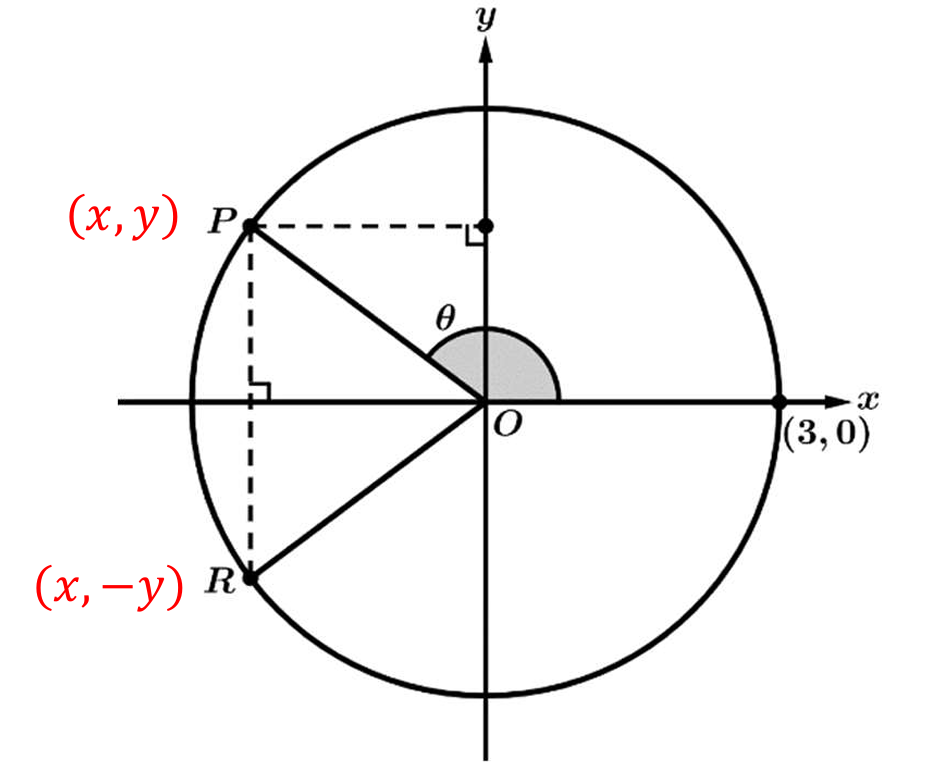
The tangent of an angle \(\theta\) in standard position is defined by the coordinates of a point on its terminal ray.
In this figure, the point \(P(x, y)\) lies specifically on the terminal ray of the angle \(\theta\).
By definition, \(\tan \theta = \frac{\text{ordinate}}{\text{abscissa}} = \frac{y}{x}\).
The coordinate \(y\) corresponds to the vertical displacement of the point \(P\) from the x-axis.
The coordinate \(x\) corresponds to the horizontal displacement of the point \(P\) from the y-axis (origin).
Therefore, \(\tan \theta\) is correctly described as the ratio of the vertical displacement of \(P\) to the horizontal displacement of \(P\).
Point \(R\) lies on a different ray (corresponding to angle \(-\theta\)), so its coordinates define \(\tan(-\theta)\), not \(\tan(\theta)\).
Thus, the correct statement corresponds to option (A).
▶️ Answer/Explanation
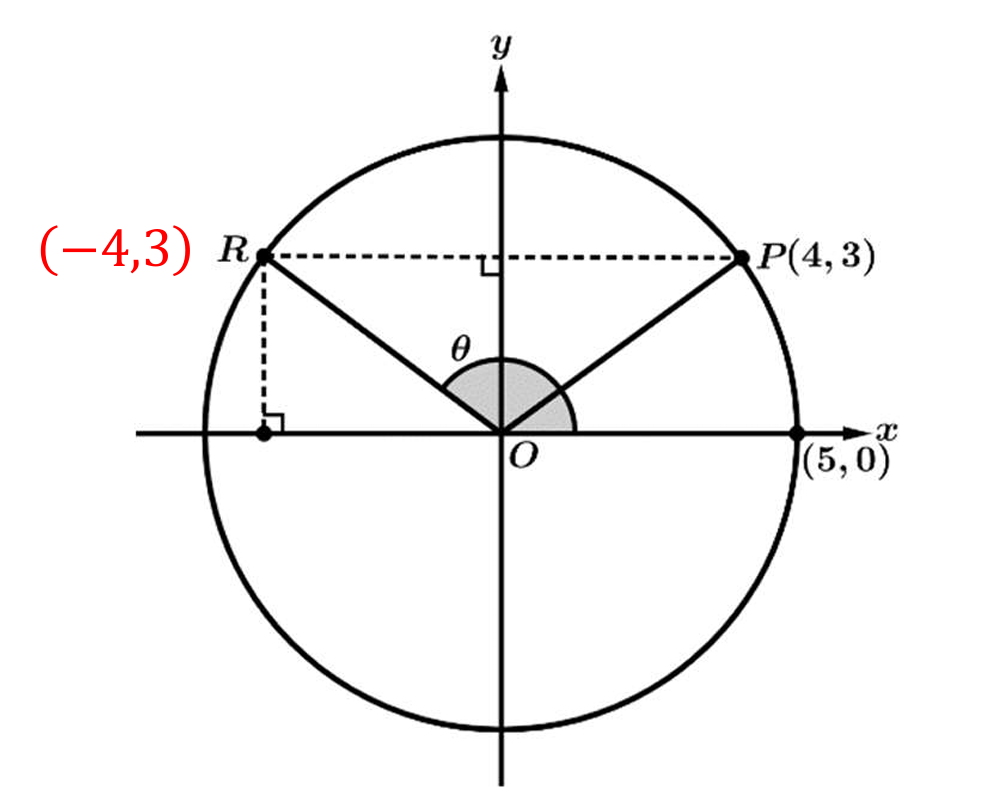
The dashed horizontal line connecting \(R\) and \(P\) indicates they have the same \(y\)-coordinate. Since \(P\) is \((4, 3)\), then \(y_R = 3\).
Point \(R\) lies on the circle defined by \(x^2 + y^2 = r^2\). With \(r=5\) and \(y=3\), we solve for \(x_R\).
\(x_R^2 + 3^2 = 5^2 \Rightarrow x_R^2 + 9 = 25 \Rightarrow x_R^2 = 16\).
Since \(R\) is in the second quadrant, its \(x\)-coordinate must be negative, so \(x_R = -4\). Thus, \(R = (-4, 3)\).
The definition of the tangent function for a point \((x, y)\) on the terminal ray is \(\tan \theta = \frac{y}{x}\).
Substituting the coordinates of \(R\): \(\tan \theta = \frac{3}{-4}\).
Therefore, \(\tan \theta = -\frac{3}{4}\).
Correct Option: (A)
▶️ Answer/Explanation
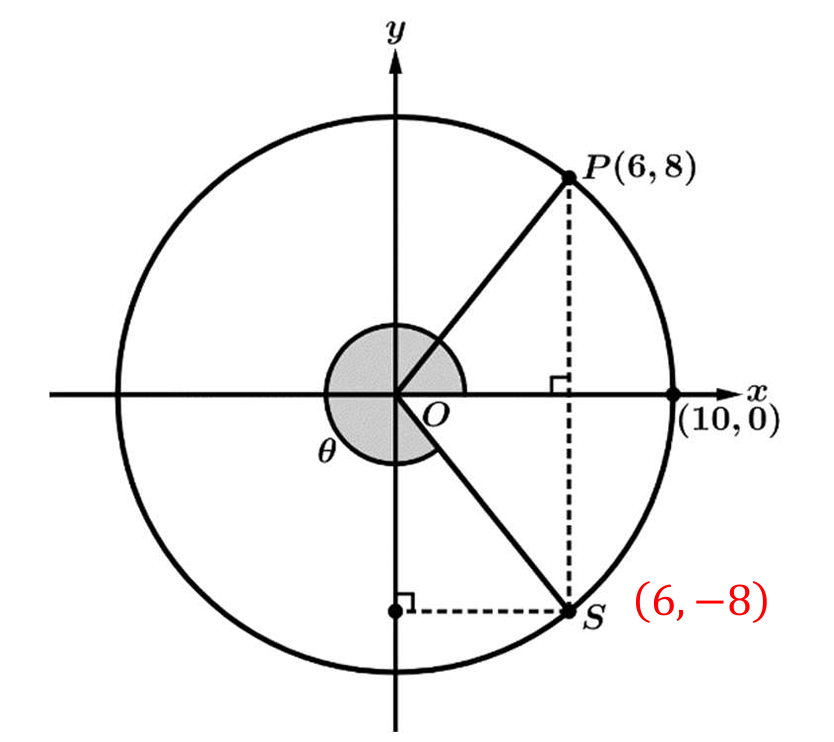
From the figure, point \( S \) shares the same x-coordinate as point \( P(6, 8) \), so \( x_S = 6 \).
Since \( S \) lies on the circle in the fourth quadrant, its y-coordinate is negative.
Using the circle equation \( x^2 + y^2 = r^2 \) with \( r=10 \), we get \( 6^2 + y^2 = 10^2 \), which yields \( y = -8 \).
The definition of sine for an angle in standard position is \( \sin \theta = \frac{y}{r} \).
Substituting the values for point \( S \): \( y = -8 \) and \( r = 10 \).
Thus, \( \sin \theta = \frac{-8}{10} = -\frac{4}{5} \).
Correct Option: (A)
▶️ Answer/Explanation
The correct option is (D).
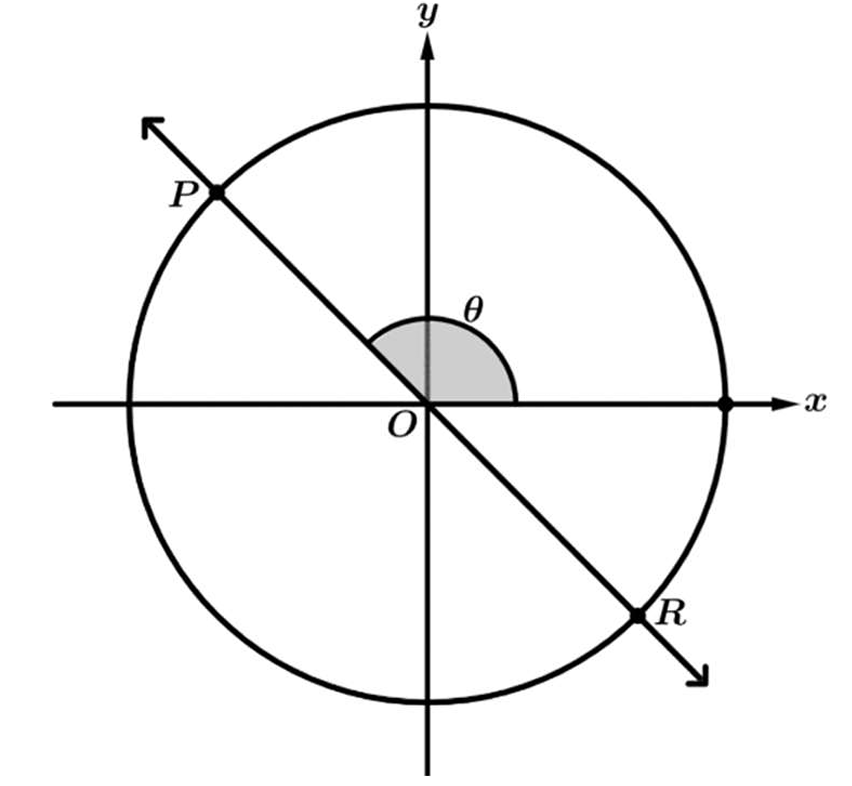
• The terminal ray of angle \(\theta\) lies on the line given by the equation \(y = -\frac{4}{3}x\).
• The slope of a line passing through the origin is given by \(m\) in the equation \(y = mx\). Here, the slope \(m = -\frac{4}{3}\).
• By definition, the tangent of an angle \(\theta\) in standard position is equal to the slope of its terminal ray.
• Therefore, \(\tan \theta = -\frac{4}{3}\).
• To check other values: Since the ray is in Quadrant II, let \(x = -3\) and \(y = 4\). The radius \(r = \sqrt{(-3)^2 + 4^2} = 5\).
• Calculating cosine: \(\cos \theta = \frac{x}{r} = -\frac{3}{5}\). This confirms options (A) and (B) are incorrect.
▶️ Answer/Explanation
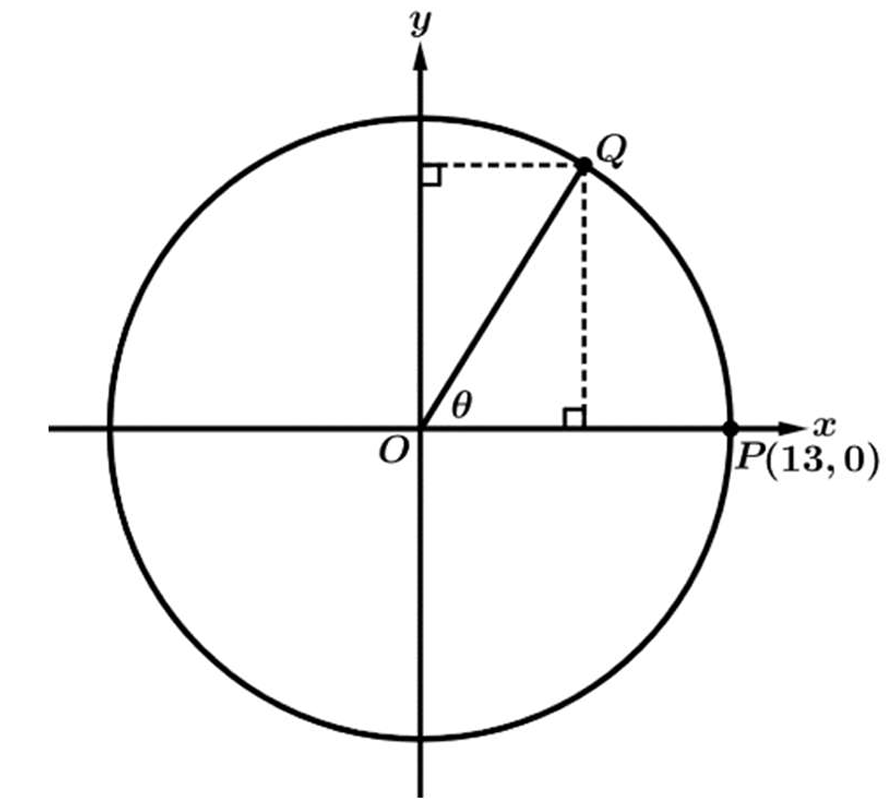
Step 1: Identify the radius of the circle. Since point \(P(13, 0)\) lies on the circle centered at the origin \((0,0)\), the radius is \(r = 13\).
Step 2: Calculate the angle \(\theta\). The length of the intercepted arc \(PQ\) is given as \(s = 15\). Using the formula \(s = r\theta\), we determine that \(\theta = \frac{s}{r} = \frac{15}{13}\) radians.
Step 3: Determine the coordinates of point \(Q\). For a circle with radius \(r\) and angle \(\theta\), the coordinates of a point on the circle are \((x, y) = (r\cos\theta, r\sin\theta)\).
Step 4: Find the distance from the \(x\)-axis. The distance of point \(Q\) from the \(x\)-axis is the vertical distance, which corresponds to the \(y\)-coordinate.
Step 5: Substitute the known values. The \(y\)-coordinate is \(13\sin(\theta)\). Substituting \(\theta = \frac{15}{13}\), we get \(13\sin\left(\frac{15}{13}\right)\), which matches option (D).
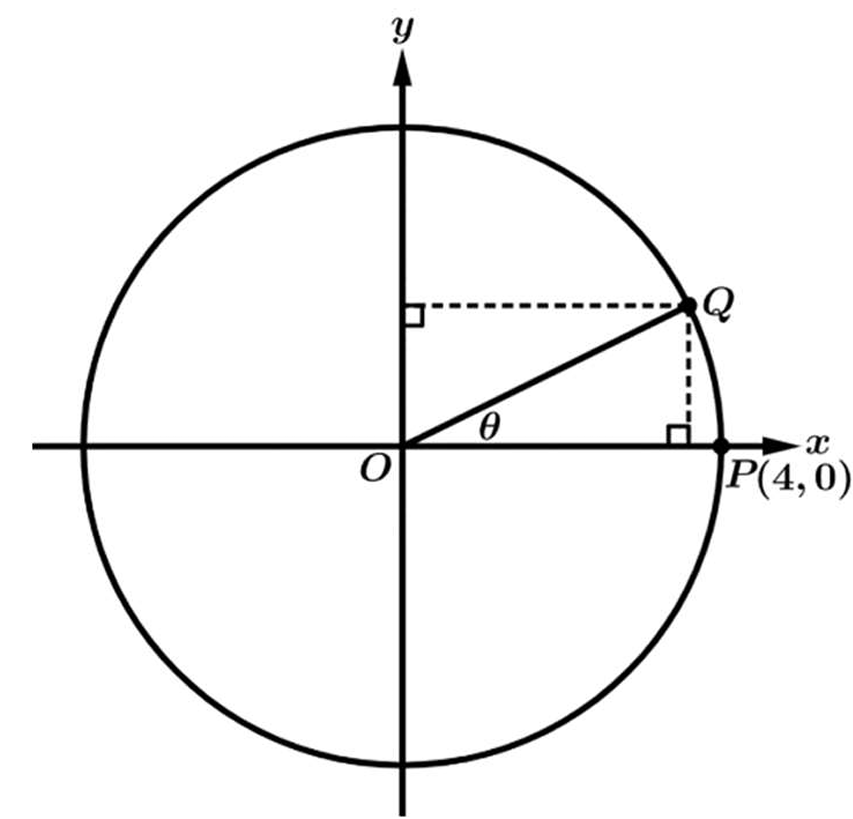
▶️ Answer/Explanation
The correct answer is (C).
Since point \(P(4, 0)\) lies on the circle centered at the origin, the radius of the circle is \(r = 4\).
Using the arc length formula \(s = r\theta\), where \(s=3\) and \(r=4\), we find the angle: \(3 = 4\theta \Rightarrow \theta = \frac{3}{4}\) radians.
The coordinates of point \(Q\) on the circle are determined by \((x, y) = (r \cos \theta, r \sin \theta)\).
Substituting our values, the coordinates for \(Q\) become \(\left(4 \cos \left(\frac{3}{4}\right), 4 \sin \left(\frac{3}{4}\right)\right)\).
The distance of any point from the \(y\)-axis is represented by the absolute value of its \(x\)-coordinate.
Therefore, the distance of point \(Q\) from the \(y\)-axis is \(4 \cos\left(\frac{3}{4}\right)\).
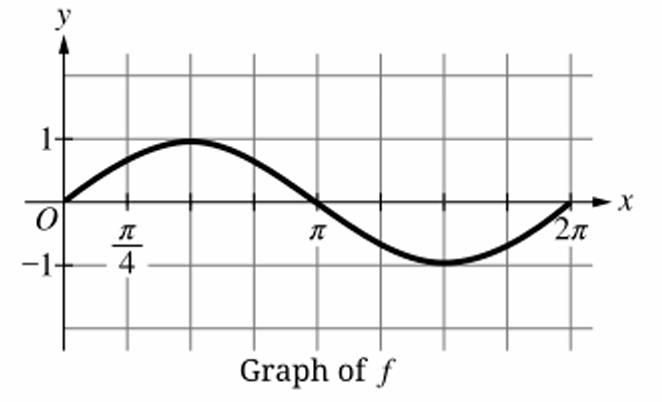
▶️ Answer/Explanation
The graph starts at $(0,0)$ and follows the shape of $y = \sin(x)$.
On a unit circle, the coordinates of point $P$ are $(\cos\theta, \sin\theta)$.
The $y$-coordinate, $\sin\theta$, represents the vertical displacement from the $x$-axis.
“Displacement” is used instead of “distance” because the function $f$ has negative values.
Distance is always non-negative, whereas $f$ is negative on the interval $(\pi, 2\pi)$.
Therefore, $f$ represents the vertical displacement of $P$ for $0 \le \theta \le 2\pi$.
The correct option is (C).
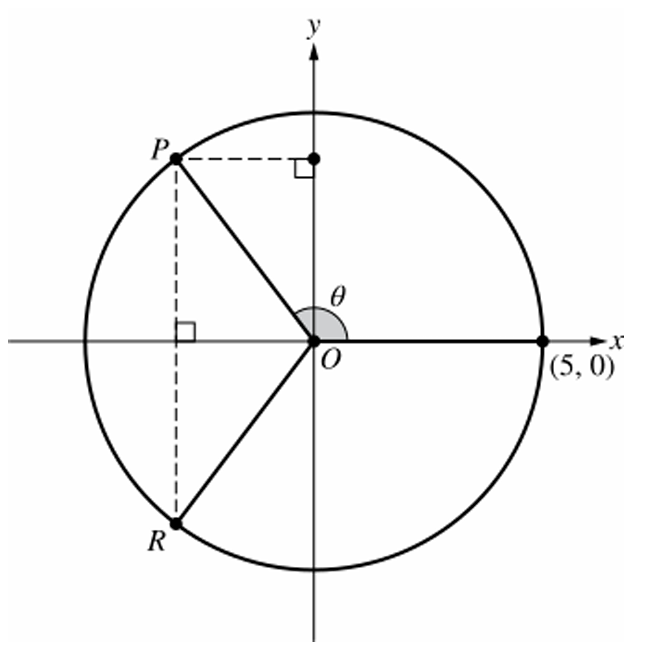
▶️ Answer/Explanation
The circle is centered at the origin $(0, 0)$ and passes through $(5, 0)$, so its radius $r$ is $5$.
Point $P(x, y)$ lies on the terminal ray of the angle $\theta$ in standard position.
By trigonometric definition on a circle, $\sin \theta$ is the ratio of the $y$-coordinate to the radius: $\sin \theta = \frac{y}{r}$.
The $y$-coordinate represents the vertical displacement of point $P$ from the $x$-axis.
The radius $r = 5$ represents the distance from the origin to point $P$.
Therefore, $\sin \theta = \frac{y}{5}$ based on the position and coordinates of point $P$.
This matches option (D).
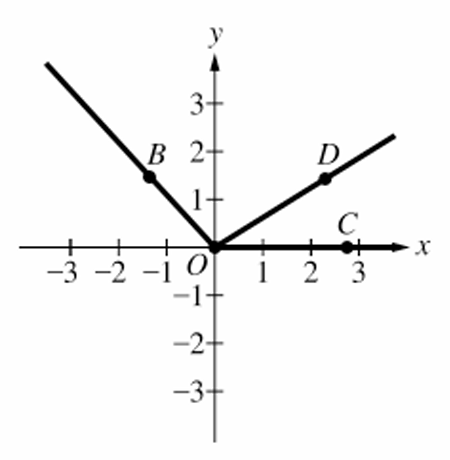
▶️ Answer/Explanation
An angle is in standard position if its vertex is at the origin $(0,0)$ and its initial ray lies on the positive $x$-axis.
In the given figure, point $C$ lies on the positive $x$-axis at $(3,0)$, making ray $OC$ the initial ray.
Angle $COB$ starts at ray $OC$ and rotates counter-clockwise to terminal ray $OB$.
Therefore, angle $COB$ is in standard position with initial ray $OC$ and terminal ray $OB$.
Options (C) and (D) are incorrect because the initial ray for standard position must be $OC$, not $OB$ or $OD$.
Option (A) is incorrect because it swaps the definitions of the initial and terminal rays.
The correct statement is (B).
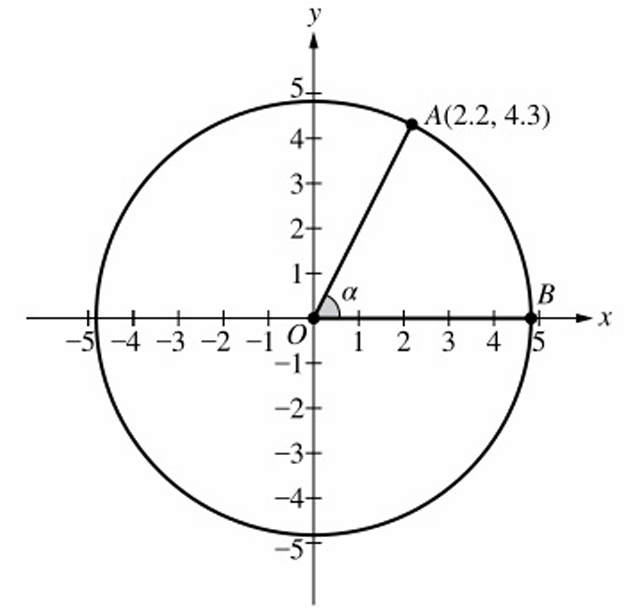
▶️ Answer/Explanation
Point $A$ lies on the circle with coordinates $(x, y) = (2.2, 4.3)$.
The radius of the circle is given as $r = 4.8$.
For an angle $\alpha$ in standard position, the sine is defined as $\sin \alpha = \frac{y}{r}$.
Substitute the $y$-coordinate of point $A$, which is $4.3$.
Substitute the radius value, which is $4.8$.
Therefore, $\sin \alpha = \frac{4.3}{4.8}$.
The correct option is (B).
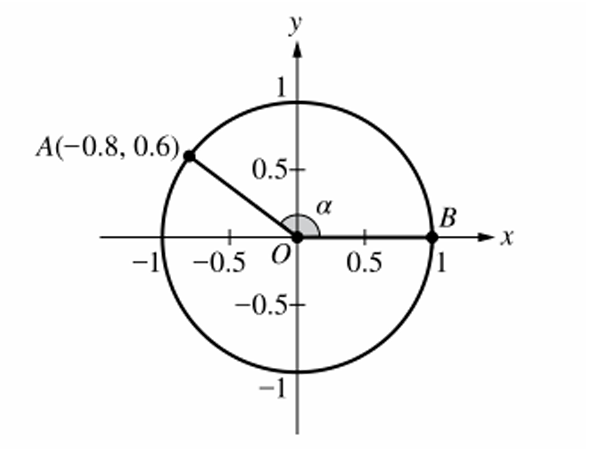
▶️ Answer/Explanation
The terminal side of angle $\alpha$ intersects the unit circle at point $A(-0.8, 0.6)$.
By definition, for any point $(x, y)$ on a unit circle, $x = \cos \alpha$ and $y = \sin \alpha$.
The $x$-coordinate of point $A$ is given as $-0.8$.
Therefore, $\cos \alpha = -0.8$.
The correct option is (A).