Home / AP® Exam / AP® PreCalculus / AP® Precalculus

AP Precalculus -3.3 Sine and Cosine Values- FRQ Exam Style Questions - Effective Fall 2023

AP Precalculus -3.3 Sine and Cosine Values- FRQ Exam Style Questions – Effective Fall 2023

AP Precalculus -3.3 Sine and Cosine Values- FRQ Exam Style Questions – AP Precalculus- per latest AP Precalculus Syllabus.

AP Precalculus – FRQ Exam Style Questions- All Topics

Question

A dog food bowl has a certain number of dog food pellets. A dog eats a fraction of the remaining food per minute. At \(t = 1\) minute, 145 pellets are left; at \(t = 2\) minutes, 115 pellets are left. The situation is modeled by \(P(t) = ae^{bt}\), where \(P(t)\) is the number of pellets left after \(t\) minutes.
(A) Find an exponential function that models this situation.
(B) (i) Find the average rate of change from \(t = 0\) to \(t = 4\). Explain its meaning.
(ii) Will the average rate of change from \(t = 4\) to \(t = t_a\) (with \(t_a > 4\)) be greater or less than that from \(t = 0\) to \(t = 4\)? Justify.
(C) As \(t \to \infty\), does the model make sense contextually? Why or why not?

Most-appropriate topic codes (AP Precalculus CED):

2.5: Exponential Function Context and Data Modeling – part (A), part (C)
1.2: Rates of Change – part (B)(i), (B)(ii)
2.3: Exponential Functions – part (B)(ii)
3.2: Apply numerical results in a given mathematical or applied context – part (B)(i), (C)
3.3: Support conclusions or choices with a logical rationale or appropriate data – part (B)(ii), (C)
▶️ Answer/Explanation
Detailed solution

(A) Exponential model \(P(t) = ae^{bt}\)

  • Given: \(P(1) = 145\), \(P(2) = 115\).
  • Divide the equations: \(\frac{P(2)}{P(1)} = \frac{115}{145} = \frac{23}{29} \approx 0.7931 = e^{b(2-1)} = e^b\).
  • So \(b = \ln\left(\frac{23}{29}\right) \approx \ln(0.7931) \approx -0.2318\).
  • Use \(P(1) = ae^{b\cdot1} = 145\): \(a = 145 \cdot e^{-b} = 145 \cdot \frac{29}{23} \approx 145 \cdot 1.2609 \approx 182.83\).
  • Alternatively, compute directly: \(a = P(1) e^{-b} = 145 \cdot \frac{29}{23} = \frac{145 \cdot 29}{23} = \frac{4205}{23} \approx 182.826\).
  • Thus, \(P(t) \approx 182.826 e^{-0.2318 t}\).

(B) i. Average rate of change from \(t = 0\) to \(t = 4\)

  • \(P(0) = a \approx 182.826\).
  • \(P(4) = 182.826 e^{-0.2318 \cdot 4} \approx 182.826 e^{-0.9272} \approx 182.826 \cdot 0.3956 \approx 72.34\).
  • Average rate = \(\frac{P(4) – P(0)}{4 – 0} \approx \frac{72.34 – 182.826}{4} = \frac{-110.486}{4} \approx -27.622\) pellets per minute.
  • Meaning: On average over the first 4 minutes, the dog ate about 27.6 pellets per minute.

(B) ii. Comparison of average rates

  • For an exponential decay \(P(t) = ae^{bt}\) with \(b < 0\), the function is decreasing and concave up (since \(P”(t) = ab^2 e^{bt} > 0\)).
  • In a concave up decreasing function, the average rate of change over an interval decreases in magnitude (becomes less negative) as the interval moves to the right.
  • Thus, the average rate from \(t = 4\) to \(t = t_a\) will be greater (less negative) than that from \(t = 0\) to \(t = 4\).
  • Reason: The instantaneous rate (derivative) is negative but increasing (becoming less negative), so later intervals have a smaller rate of loss.

(C) Limit as \(t \to \infty\)

  • \(\lim_{t \to \infty} P(t) = \lim_{t \to \infty} ae^{bt} = 0\) because \(b < 0\).
  • Context: The model predicts the pellets approach zero but never actually reach it. In reality, the dog will finish all pellets in finite time, so the model is not perfectly accurate for very large \(t\). However, it is a good approximation for the decay process while pellets remain.
  • Thus, the model does not fully make sense as \(t \to \infty\) because it predicts the dog never finishes, while in reality the bowl becomes empty at some finite time.

Question

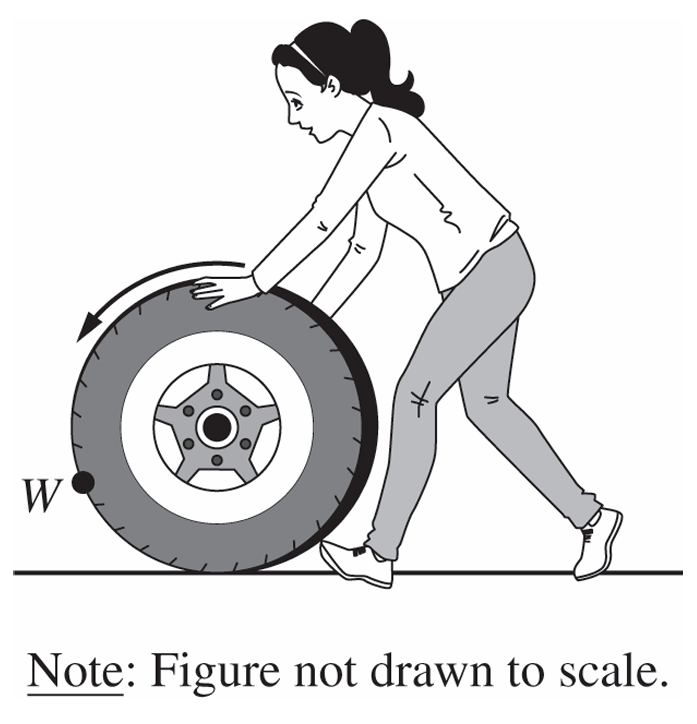
The tire of a car has a radius of \(9\) inches, and a person rolls the tire forward at a constant rate on level ground, as shown in the figure. Point \(W\) on the edge of the tire touches the ground at time \(t=\frac{1}{2}\) second. The tire completes a full rotation, and the next time \(W\) touches the ground is at time \(t=\frac{5}{2}\) seconds. The maximum height of \(W\) above the ground is \(18\) inches. As the tire rolls, the height of \(W\) above the ground periodically increases and decreases.
The sinusoidal function \(h\) models the height of point \(W\) above the ground, in inches, as a function of time \(t\), in seconds.
 
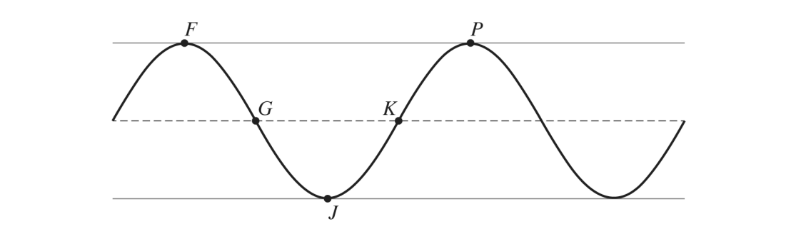
(A) The graph of \(h\) and its dashed midline for two full cycles is shown. Five points, \(F\), \(G\), \(J\), \(K\), and \(P\), are labeled on the graph. No scale is indicated, and no axes are presented. Determine possible coordinates \((t,h(t))\) for the five points: \(F\), \(G\), \(J\), \(K\), and \(P\).
(B) The function \(h\) can be written in the form \(h(t)=a\sin(b(t+c))+d\). Find values of constants \(a\), \(b\), \(c\), and \(d\).
(C) Refer to the graph of \(h\) in part (A). The \(t\)-coordinate of \(K\) is \(t_1\), and the \(t\)-coordinate of \(P\) is \(t_2\).
(i) On the interval \((t_1,t_2)\), which of the following is true about \(h\)?
  1. \(h\) is positive and increasing.
  2. \(h\) is positive and decreasing.
  3. \(h\) is negative and increasing.
  4. \(h\) is negative and decreasing.
(ii) Describe how the rate of change of \(h\) is changing on the interval \((t_1,t_2)\).

Most-appropriate topic codes (CED):

TOPIC 3.5: Sinusoidal Graphs — part (A)
TOPIC 3.6: Sinusoidal Models — part (B)
TOPIC 3.3: Rates of Change — part (C)
▶️ Answer/Explanation
Concise solution

(A)
Radius \(=9\Rightarrow\) minimum height \(=0\), maximum height \(=18\).
Midline \(=\frac{18+0}{2}=9\).
Ground contacts at \(t=\frac{1}{2}\) and \(t=\frac{5}{2}\Rightarrow\) period \(=2\).
One valid set of points (consistent with the graph):
\(F\!\left(1,18\right)\), \(G\!\left(\frac{3}{2},9\right)\), \(J\!\left(2,0\right)\), \(K\!\left(\frac{5}{2},9\right)\), \(P\!\left(3,18\right)\).

(B)
Amplitude \(a=9\).
Period \(=2\Rightarrow b=\frac{2\pi}{2}=\pi\).
Midline \(d=9\).
Minimum at \(t=\frac{1}{2}\Rightarrow c=-\frac{1}{2}\).
\(h(t)=9\sin\!\left(\pi\left(t-\frac{1}{2}\right)\right)+9\).

(C)
(i) On \((t_1,t_2)\), \(h\) is positive and increasing \(\Rightarrow\) choice (a).
(ii) As the graph approaches a maximum, the slope decreases; the rate of change is decreasing.

Scroll to Top