
▶️ Answer/Explanation
On the unit circle, \( \cos z \) gives the \( x \)-coordinate.
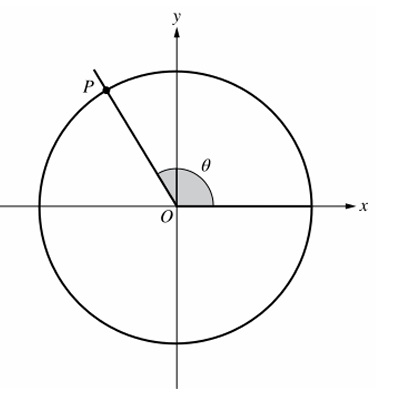
From the diagram, \( \theta \) is in Quadrant I (\( 0 < \theta < \frac{\pi}{2} \)) since \( P \) is in Quadrant I.
If \( \theta < \omega < \pi \), then \( \omega \) is in Quadrant II.
Cosine decreases from 1 to -1 as the angle goes from 0 to \( \pi \), so for \( \omega > \theta \), \( \cos\omega < \cos\theta \).
Thus \( g(\omega) < g(\theta) \).
✅ Answer: (A)
▶️ Answer/Explanation
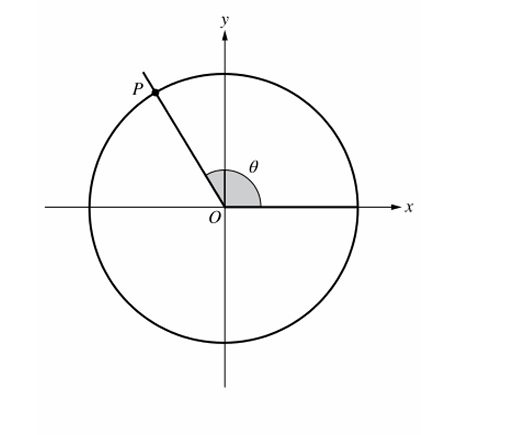
From the diagram, \( \theta \) is in Quadrant I and \( \theta > \frac{\pi}{2} \) ? Actually given \( \frac{\pi}{2} < \beta < \theta \), so \( \theta \) is > \( \frac{\pi}{2} \) as well, but since \( \theta \) is in Quadrant II from the figure (based on answer key reasoning). In Quadrant II, sine decreases as angle increases toward \( \pi \).
If \( \frac{\pi}{2} < \beta < \theta \), then \( \beta \) is closer to \( \frac{\pi}{2} \) where sine = 1, and \( \theta \) is farther from \( \frac{\pi}{2} \) so sine is smaller. Thus \( \sin\beta > \sin\theta \), so \( f(\beta) > f(\theta) \).
✅ Answer: (B)

▶️ Answer/Explanation
Step 1: Geometry of the triangle
Triangle \(ABO\) is equilateral with side length \(10\).
Hence,
\(OA = OB = AB = 10\)
and
\(\angle AOB = 60^\circ.\)
Step 2: Orientation in the coordinate plane
Segment \(AB\) is perpendicular to the \(x\)-axis, so \(A\) and \(B\) have the same
\(x\)-coordinate and are symmetric about the \(x\)-axis.
Thus, the bisector of \(\angle AOB\) lies along the negative \(x\)-axis.
Step 3: Determine the angle \(\theta\)
Since \(\angle AOB = 60^\circ\), the ray \(OB\) makes an angle of
\(\theta = 180^\circ – 30^\circ = 150^\circ\)
with the positive \(x\)-axis.
Step 4: Compute \(10\sin\theta\)
\(\sin 150^\circ = \frac{1}{2}\)
\(10\sin\theta = 10 \cdot \frac{1}{2} = 5\)
\(\boxed{5}\)
\textbf{Correct answer: (D)}
▶️ Answer/Explanation
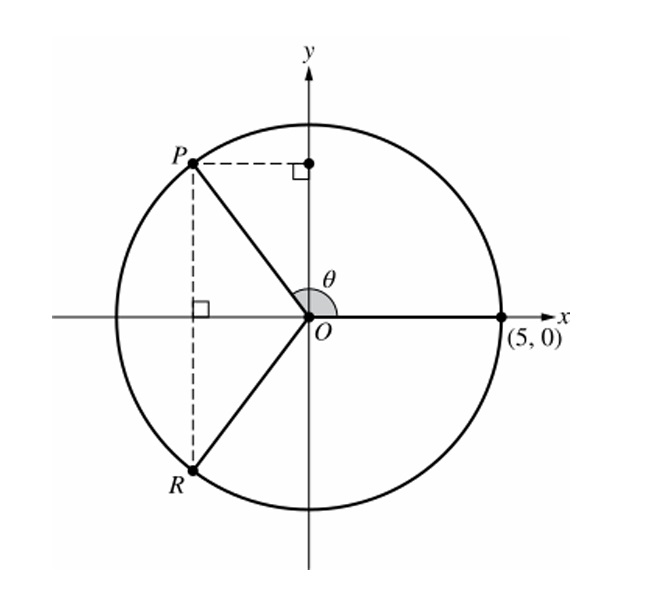
By definition on the unit circle (scaled by radius 5):
\( \sin\theta = \frac{\text{vertical displacement of }P}{ \text{distance from origin}} = \frac{y}{5} \).
✅ Answer: (D)
▶️ Answer/Explanation
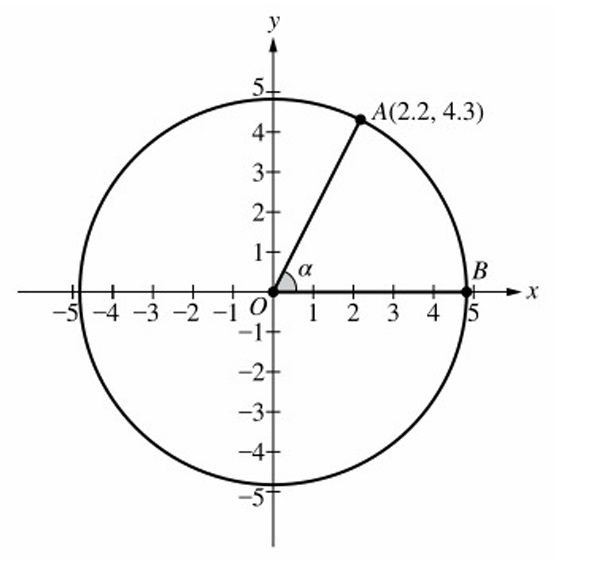
Sine is vertical displacement / radius.
From the figure (described in PDF), the vertical coordinate is 4.3.
Thus \( \sin\alpha = \frac{4.3}{4.8} \).
✅ Answer: (B)
▶️ Answer/Explanation
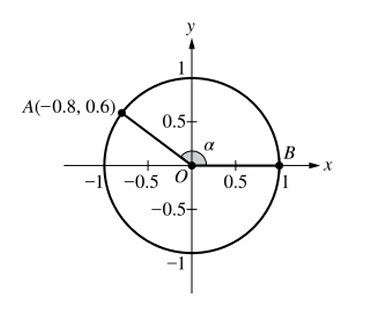
On unit circle, \( \cos\alpha \) = \(x\)-coordinate of intersection point = \(-0.8\).
✅ Answer: (A)
▶️ Answer/Explanation
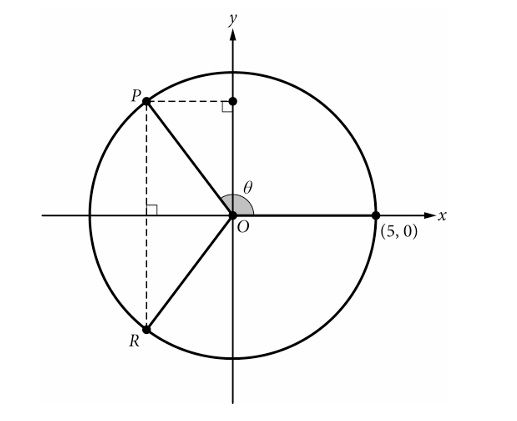
Point \(P\) is on the terminal ray of angle \(\theta\). By definition, for a circle centered at the origin with radius \(r\) (in the figure, radius = 5),
\[ \sin \theta = \frac{\text{vertical displacement of }P}{r} = \frac{y}{5} \]
Horizontal displacement gives cosine, not sine. \(R\) is symmetric across the x-axis, so its vertical displacement is \(-y\), giving \(\sin(-\theta) = -\frac{y}{5}\), not \(\sin \theta\).
Thus correct statement is: \(\sin \theta = \frac{y}{5}\), because it’s the ratio of the vertical displacement of \(P\) from the x-axis to the distance between the origin and \(P\).
✅ Answer: (D)
▶️ Answer/Explanation
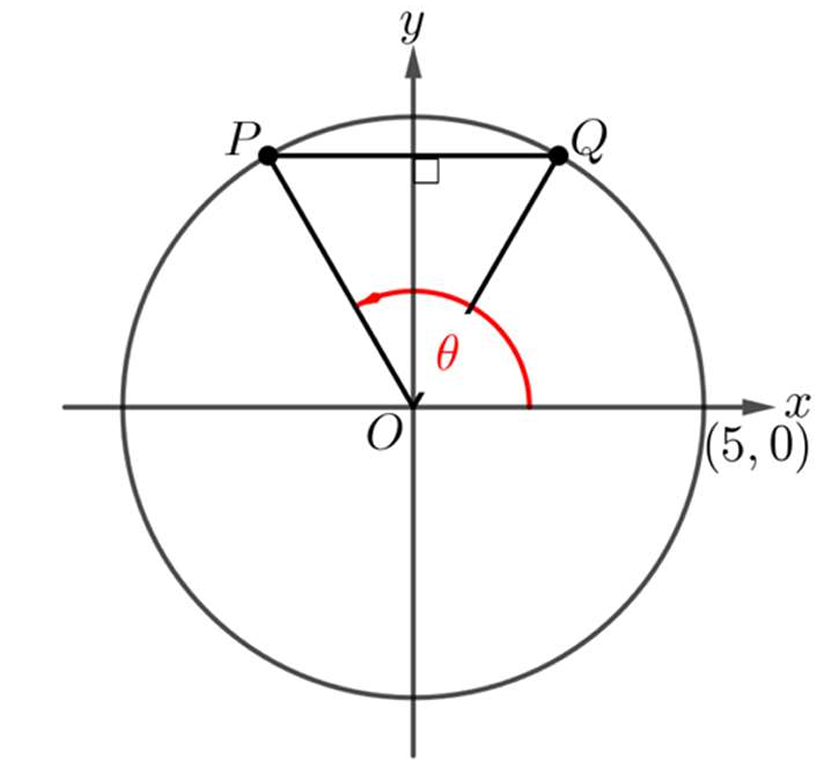
The coordinates of any point on a circle of radius \(r\) are given by \((r \cos \theta, r \sin \theta)\), where \(\theta\) is the angle from the positive x-axis. Here, \(r=5\).
Since triangle \(PQO\) is equilateral, the central angle \(\angle POQ = \frac{\pi}{3}\) (which is \(60^\circ\)).
The triangle is symmetric about the y-axis, meaning the y-axis bisects \(\angle POQ\). Thus, the angle between the positive y-axis and \(OP\) is \(\frac{1}{2} \cdot \frac{\pi}{3} = \frac{\pi}{6}\).
The positive y-axis itself is at an angle of \(\frac{\pi}{2}\) relative to the positive x-axis.
Therefore, the total angle \(\theta\) for point \(P\) is the sum: \(\theta = \frac{\pi}{2} + \frac{\pi}{6}\).
Calculating the sum: \(\theta = \frac{3\pi}{6} + \frac{\pi}{6} = \frac{4\pi}{6} = \frac{2\pi}{3}\).
Hence, the coordinates of point \(P\) are \(\left( 5 \cos \frac{2\pi}{3}, 5 \sin \frac{2\pi}{3} \right)\).
▶️ Answer/Explanation
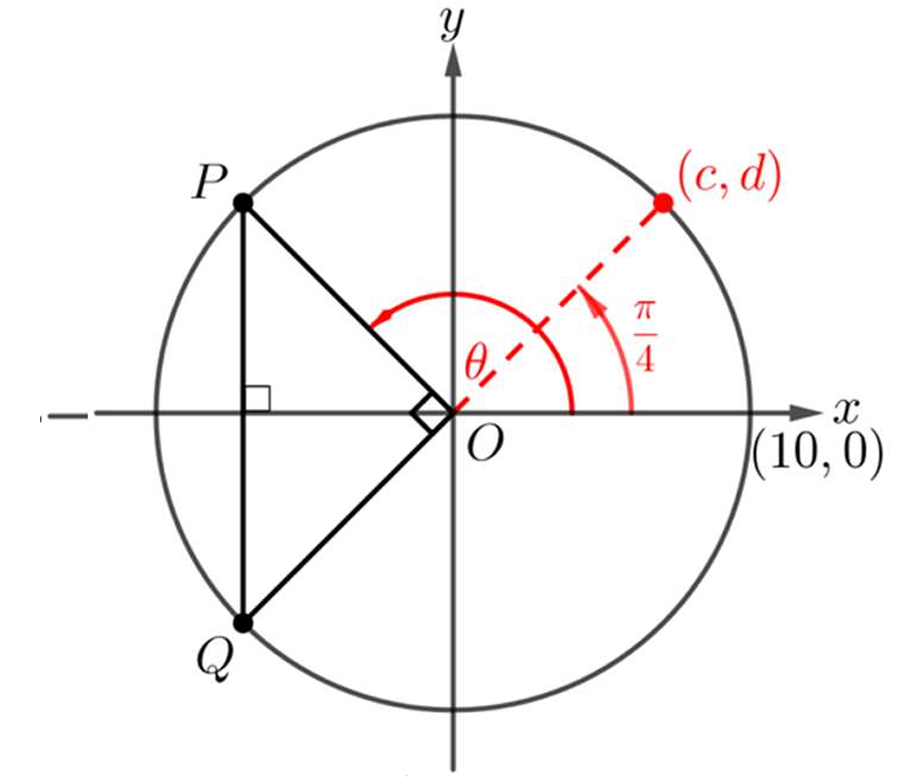
The point \(P\) lies in the second quadrant where the x-coordinate is negative and the y-coordinate is positive.
Based on the symmetry shown in the diagram, point \(P\) makes an angle of \(\frac{3\pi}{4}\) with the positive x-axis, or has a reference angle of \(\frac{\pi}{4}\) with the negative x-axis.
Using the reference angle \(\frac{\pi}{4}\), the magnitude of the x-coordinate is \(10\cos\frac{\pi}{4}\) and the y-coordinate is \(10\sin\frac{\pi}{4}\).
Applying the signs for the second quadrant, the coordinates become \((-10\cos\frac{\pi}{4}, 10\sin\frac{\pi}{4})\).
Alternatively, checking the options: Option (C) is the only choice with a negative x-value and positive y-value, consistent with the second quadrant.
Therefore, the correct coordinates are given by choice (C).
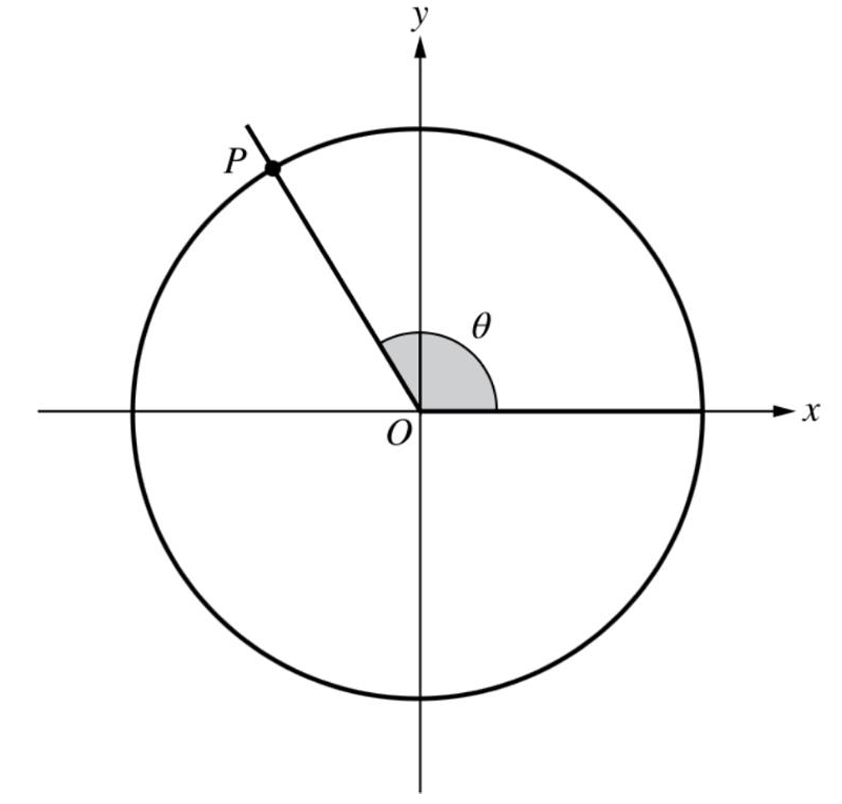
▶️ Answer/Explanation
The correct answer is (C).
1. From the figure, the terminal ray of \(\theta\) lies in the second quadrant. Thus, \(\frac{\pi}{2} < \theta < \pi\).
2. The problem states that \(\theta < \alpha < \pi\). This implies that \(\alpha\) is also in the second quadrant but represents a larger rotation than \(\theta\).
3. The function is defined as \(f(k) = \cos k\). In the unit circle, the cosine of an angle corresponds to the \(x\)-coordinate of the point on the circle.
4. In the interval \((0, \pi)\), the cosine function is strictly decreasing. This means as the angle increases, the \(x\)-coordinate moves to the left (becomes more negative).
5. Since \(\theta < \alpha\), the \(x\)-coordinate for angle \(\alpha\) will be less than the \(x\)-coordinate for angle \(\theta\).
6. Therefore, \(\cos \theta > \cos \alpha\), which means \(f(\theta) > f(\alpha)\).
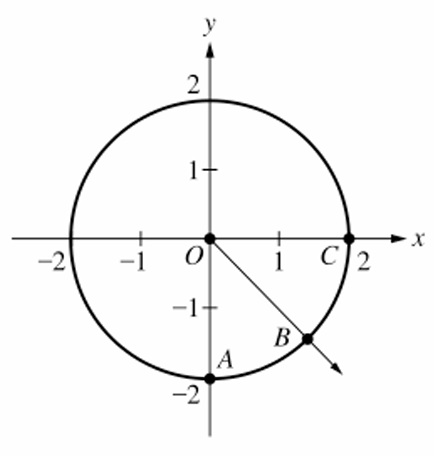
▶️ Answer/Explanation
The circle has a radius $r = 2$.
Point $C$ is at $0$ radians and point $A$ is at $\frac{3\pi}{2}$ radians (or $-\frac{\pi}{2}$).
Since angle $COB$ equals angle $AOB$, $B$ is the midpoint of the arc between $0$ and $\frac{3\pi}{2}$ in the clockwise direction.
The angle $\theta$ for point $B$ in standard position is $2\pi – \frac{\pi}{4} = \frac{7\pi}{4}$ radians.
The coordinates of any point on a circle are given by $(r\cos\theta, r\sin\theta)$.
Substituting the values, the coordinates of $B$ are $\left( 2\cos\left( \frac{7\pi}{4} \right), 2\sin\left( \frac{7\pi}{4} \right) \right)$.
Therefore, the correct option is (C).
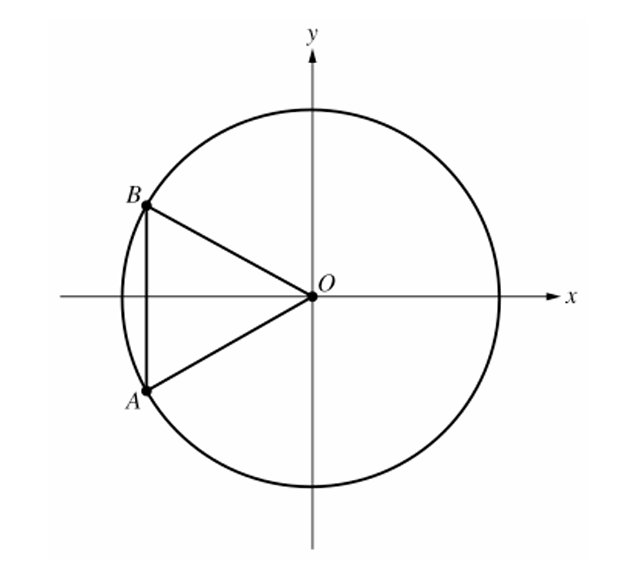
▶️ Answer/Explanation
Since $\triangle ABO$ is equilateral with side length $10$, we have $OA = OB = AB = 10$.
Segment $AB$ is vertical and bisected by the $x$-axis due to the symmetry of the equilateral triangle centered at the origin horizontally.
The $y$-coordinate of point $B$ is half the length of side $AB$, which is $\frac{10}{2} = 5$.
Point $B$ lies on a circle centered at the origin with radius $r = OB = 10$.
In trigonometry, for any point $(x, y)$ on the terminal side of an angle $\theta$, $\sin \theta = \frac{y}{r}$.
Substituting the known values, we get $\sin \theta = \frac{5}{10} = \frac{1}{2}$.
The value of $10 \sin \theta$ is $10 \left( \frac{1}{2} \right) = 5$.
Therefore, the correct option is (D).
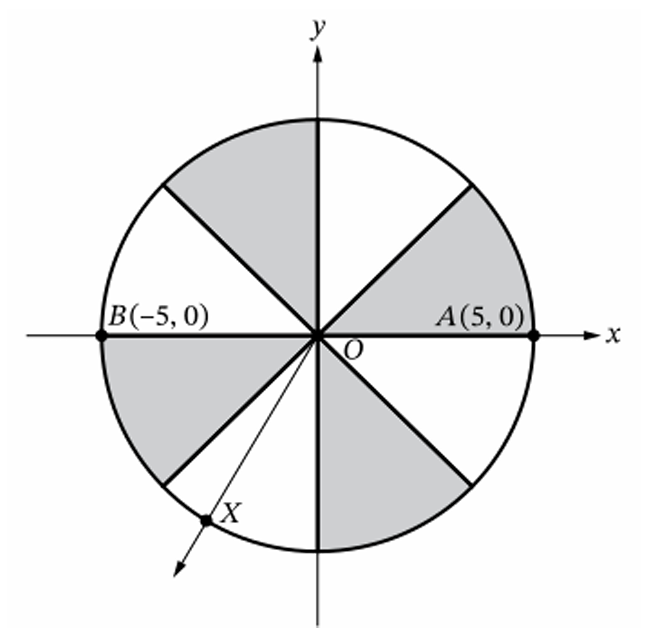
▶️ Answer/Explanation
Point $B$ is on the negative $x$-axis, so its position corresponds to an angle of $\pi$ radians.
Point $X$ has coordinates $x = -\frac{5}{2}$ and $y = -\frac{5\sqrt{3}}{2}$ in Quadrant III.
The reference angle $\theta$ for $X$ is found using $\tan(\theta) = \left| \frac{y}{x} \right| = \left| \frac{-5\sqrt{3}/2}{-5/2} \right| = \sqrt{3}$.
This gives a reference angle of $\frac{\pi}{3}$ measured from the negative $x$-axis.
Since angle $XOB$ is the angle between the ray $OX$ and the ray $OB$ (the negative $x$-axis), the measure is simply the reference angle.
Therefore, the measure of angle $XOB$ is $\frac{\pi}{3}$.
The correct option is (B).
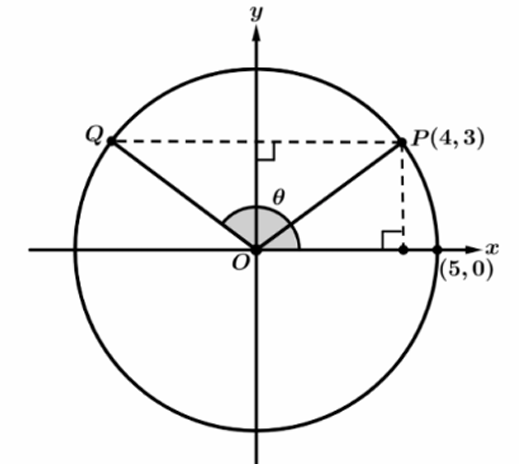
▶️ Answer/Explanation
Point $P$ has coordinates $(4, 3)$, representing a horizontal distance of $4$ and a vertical distance of $3$.
Point $Q$ is the reflection of point $P$ across the $y$-axis, as shown by the dashed horizontal line.
The $x$-coordinate of $Q$ is the negative of the $x$-coordinate of $P$, so $Q = (-4, 3)$.
For any point $(x, y)$ on a circle of radius $r$, the cosine of the angle is defined as $\cos \theta = \frac{x}{r}$.
Given the radius $r = 5$ and the $x$-coordinate of $Q$ is $-4$.
Substituting these values gives $\cos \theta = \frac{-4}{5}$.
Therefore, the correct option is (A).