
Coordinates of a Point on a Circle
Consider an angle of measure \( \theta \) in standard position and a circle of radius \( r \) centered at the origin.
The terminal ray of the angle intersects the circle at a point \( P \).
The coordinates of point \( P \) are determined using the cosine and sine of the angle.
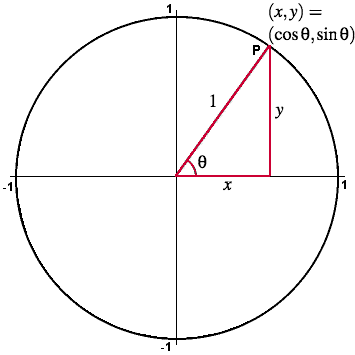
\( P = (r \cos \theta,\; r \sin \theta) \)
Here:
\( r \cos \theta \) represents the horizontal displacement from the y-axis
\( r \sin \theta \) represents the vertical displacement from the x-axis
Unit Circle Case
If \( r = 1 \), the circle is a unit circle.
In this case, the coordinates simplify to
\( P = (\cos \theta,\; \sin \theta) \)
This relationship connects trigonometric values directly to points in the coordinate plane.
Example:
An angle \( \theta = \dfrac{\pi}{6} \) is in standard position. Find the coordinates of the point where the terminal ray intersects a circle of radius 4.
▶️ Answer/Explanation
Use the coordinate formula:
\( P = (r \cos \theta,\; r \sin \theta) \)
Substitute \( r = 4 \) and \( \theta = \dfrac{\pi}{6} \):
\( P = \left(4 \cdot \dfrac{\sqrt{3}}{2},\; 4 \cdot \dfrac{1}{2}\right) \)
Simplify:
\( P = (2\sqrt{3},\; 2) \)
Final answer: The coordinates are \( (2\sqrt{3},\; 2) \).
Example:
A point on a circle centered at the origin has coordinates \( (-3,\; 3\sqrt{3}) \). Find the radius of the circle and one possible angle \( \theta \).
▶️ Answer/Explanation
Find the radius
The radius is the distance from the origin to the point:
\( r = \sqrt{(-3)^2 + (3\sqrt{3})^2} = \sqrt{9 + 27} = \sqrt{36} = 6 \)
Find the angle
Compute cosine and sine:
\( \cos \theta = \dfrac{-3}{6} = -\dfrac{1}{2} \)
\( \sin \theta = \dfrac{3\sqrt{3}}{6} = \dfrac{\sqrt{3}}{2} \)
This corresponds to \( \theta = \dfrac{2\pi}{3} \).
Final answer: Radius \( 6 \), angle \( \theta = \dfrac{2\pi}{3} \).
Exact Trigonometric Values Using Special Triangles
The geometry of isosceles right triangles and equilateral triangles can be used to find exact values of sine and cosine for angles that are multiples of \( \dfrac{\pi}{4} \) and \( \dfrac{\pi}{6} \).
These reference triangles are placed on the unit circle, and the signs of the trigonometric values are determined by the quadrant in which the terminal ray lies.
Key Reference Triangles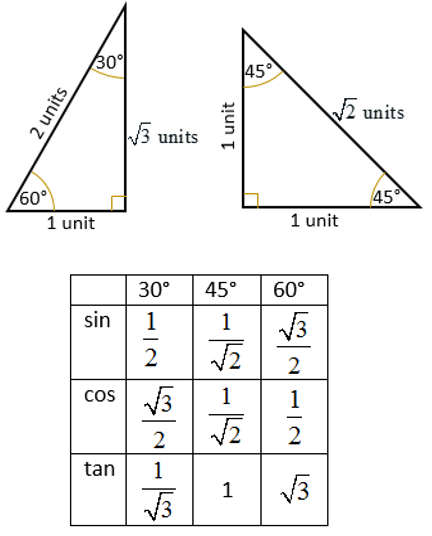
Isosceles right triangle ( \( 45^\circ \) or \( \dfrac{\pi}{4} \) )
Side ratios: \( 1 : 1 : \sqrt{2} \)
On the unit circle:
\( \sin \dfrac{\pi}{4} = \dfrac{\sqrt{2}}{2}, \quad \cos \dfrac{\pi}{4} = \dfrac{\sqrt{2}}{2} \)
Equilateral triangle ( \( 30^\circ \) and \( 60^\circ \), or \( \dfrac{\pi}{6} \) and \( \dfrac{\pi}{3} \) )
Side ratios: \( 1 : \sqrt{3} : 2 \)
On the unit circle:
\( \sin \dfrac{\pi}{6} = \dfrac{1}{2}, \quad \cos \dfrac{\pi}{6} = \dfrac{\sqrt{3}}{2} \)
Quadrant Signs
The reference triangle gives the magnitude of sine and cosine. The sign depends on the quadrant:

Quadrant I: sine positive, cosine positive
Quadrant II: sine positive, cosine negative
Quadrant III: sine negative, cosine negative
Quadrant IV: sine negative, cosine positive
Example:
Find the exact values of \( \sin \dfrac{3\pi}{4} \) and \( \cos \dfrac{3\pi}{4} \).
▶️ Answer/Explanation
The angle \( \dfrac{3\pi}{4} \) lies in Quadrant II.
The reference angle is \( \dfrac{\pi}{4} \).
Using the isosceles right triangle:
\( \sin \dfrac{\pi}{4} = \dfrac{\sqrt{2}}{2}, \quad \cos \dfrac{\pi}{4} = \dfrac{\sqrt{2}}{2} \)
Apply quadrant signs:
\( \sin \dfrac{3\pi}{4} = \dfrac{\sqrt{2}}{2} \)
\( \cos \dfrac{3\pi}{4} = -\dfrac{\sqrt{2}}{2} \)
Example:
Find the exact values of \( \sin \dfrac{5\pi}{6} \) and \( \cos \dfrac{5\pi}{6} \).
▶️ Answer/Explanation
The angle \( \dfrac{5\pi}{6} \) lies in Quadrant II.
The reference angle is \( \dfrac{\pi}{6} \).
Using the equilateral triangle:
\( \sin \dfrac{\pi}{6} = \dfrac{1}{2}, \quad \cos \dfrac{\pi}{6} = \dfrac{\sqrt{3}}{2} \)
Apply quadrant signs:
\( \sin \dfrac{5\pi}{6} = \dfrac{1}{2} \)
\( \cos \dfrac{5\pi}{6} = -\dfrac{\sqrt{3}}{2} \)