
The Sine Function
Consider an angle of measure \( \theta \) in standard position and a unit circle centered at the origin.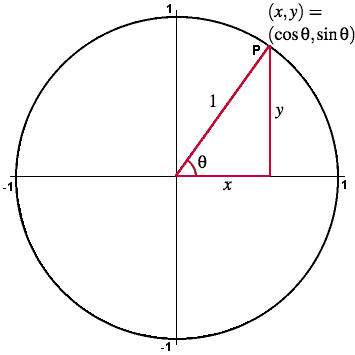
The terminal ray of the angle intersects the unit circle at a point \( P \).
The sine function is defined by
\( f(\theta) = \sin \theta \)
For a unit circle, the sine of an angle equals the y-coordinate of point \( P \), which represents the vertical displacement from the x-axis.
If \( P = (x, y) \), then \( \sin \theta = y \)
Because an angle can rotate indefinitely in either direction, the domain of the sine function is all real numbers.
Domain of \( \sin \theta \): \( (-\infty, \infty) \)
As \( \theta \) increases, the sine function produces a repeating (periodic) pattern of vertical values.
Example:
An angle \( \theta \) intersects the unit circle at the point \( P = \left(-\dfrac{1}{2}, \dfrac{\sqrt{3}}{2}\right) \). Find \( \sin \theta \).
▶️ Answer/Explanation
On the unit circle, the sine of the angle equals the y-coordinate of point \( P \).
\( \sin \theta = \dfrac{\sqrt{3}}{2} \)
Final answer: \( \sin \theta = \dfrac{\sqrt{3}}{2} \).
Example:
Evaluate \( \sin(-\dfrac{\pi}{3}) \).
▶️ Answer/Explanation
The angle \( -\dfrac{\pi}{3} \) corresponds to a clockwise rotation.
The reference angle is \( \dfrac{\pi}{3} \), and the sine value is \( \dfrac{\sqrt{3}}{2} \).
Since the angle lies in Quadrant IV, sine is negative.
\( \sin\!\left(-\dfrac{\pi}{3}\right) = -\dfrac{\sqrt{3}}{2} \)
Final answer: \( -\dfrac{\sqrt{3}}{2} \).
Behavior and Range of the Sine Function
The sine function describes the vertical motion of points on the unit circle as the angle measure increases.
As the input values, or angle measures \( \theta \), increase, the output values of the sine function oscillate between −1 and 1.
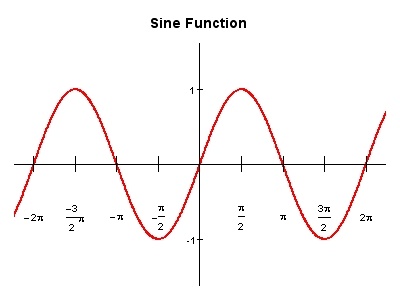
This oscillation occurs because sine tracks the vertical distance of a point on the unit circle from the x-axis.
\( -1 \le \sin \theta \le 1 \)
As the angle rotates around the unit circle, the y-coordinate of the corresponding point takes on every value between −1 and 1.
Range of the Sine Function
The set of all possible output values of the sine function is called its range.
Range of \( \sin \theta \): \( [-1, 1] \)
This repeating pattern continues indefinitely as \( \theta \) increases or decreases.
Example:
Explain why \( \sin \theta \) can never be greater than 1 or less than −1.
▶️ Answer/Explanation
On the unit circle, sine represents the y-coordinate of a point.
The highest possible y-coordinate on the unit circle is 1, and the lowest is −1.
Therefore, \( \sin \theta \) must always lie between −1 and 1.
Example:
Determine whether the equation \( \sin \theta = 1.3 \) has a solution.
▶️ Answer/Explanation
The range of the sine function is \( [-1, 1] \).
Since \( 1.3 \) is greater than 1, it lies outside the range.
Conclusion: The equation has no solution.
The Cosine Function
Consider an angle of measure \( \theta \) in standard position and a unit circle centered at the origin.
The terminal ray of the angle intersects the unit circle at a point \( P \).
The cosine function is defined by
\( f(\theta) = \cos \theta \)
For a unit circle, the cosine of an angle equals the x-coordinate of point \( P \), which represents the horizontal displacement from the y-axis.
If \( P = (x, y) \), then \( \cos \theta = x \)
Because an angle can rotate indefinitely in either direction, the domain of the cosine function is all real numbers.
Domain of \( \cos \theta \): \( (-\infty, \infty) \)
As \( \theta \) increases, the cosine function produces a repeating (periodic) pattern of horizontal values.
Example:
An angle \( \theta \) intersects the unit circle at the point \( P = \left(-\dfrac{\sqrt{3}}{2}, -\dfrac{1}{2}\right) \). Find \( \cos \theta \).
▶️ Answer/Explanation
On the unit circle, the cosine of the angle equals the x-coordinate of point \( P \).
\( \cos \theta = -\dfrac{\sqrt{3}}{2} \)
Final answer: \( \cos \theta = -\dfrac{\sqrt{3}}{2} \).
Example:
Evaluate \( \cos(-\dfrac{2\pi}{3}) \).
▶️ Answer/Explanation
The angle \( -\dfrac{2\pi}{3} \) corresponds to a clockwise rotation.
Cosine is an even function, so
\( \cos(-\theta) = \cos \theta \)
\( \cos \dfrac{2\pi}{3} = -\dfrac{1}{2} \).
Final answer: \( \cos\!\left(-\dfrac{2\pi}{3}\right) = -\dfrac{1}{2} \).
Behavior and Range of the Cosine Function
The cosine function describes the horizontal motion of points on the unit circle as the angle measure increases.
As the input values, or angle measures \( \theta \), increase, the output values of the cosine function oscillate between −1 and 1.
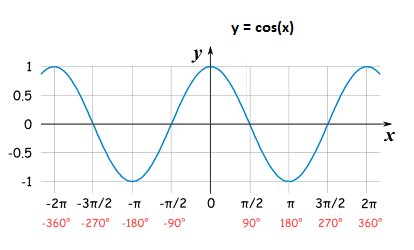
This oscillation occurs because cosine tracks the horizontal distance of a point on the unit circle from the y-axis.
\( -1 \le \cos \theta \le 1 \)
As the angle rotates around the unit circle, the x-coordinate of the corresponding point takes on every value between −1 and 1.
Range of the Cosine Function
The set of all possible output values of the cosine function is called its range.
Range of \( \cos \theta \): \( [-1, 1] \)
This repeating pattern continues indefinitely as \( \theta \) increases or decreases.
Example:
Explain why \( \cos \theta \) can never be greater than 1 or less than −1.
▶️ Answer/Explanation
On the unit circle, cosine represents the x-coordinate of a point.
The largest possible x-coordinate is 1 and the smallest is −1.
Therefore, \( \cos \theta \) must always lie between −1 and 1.
Example:
Determine whether the equation \( \cos \theta = -1.4 \) has a solution.
▶️ Answer/Explanation
The range of the cosine function is \( [-1, 1] \).
Since −1.4 is less than −1, it lies outside the range.
Conclusion: The equation has no solution.