
▶️ Answer/Explanation
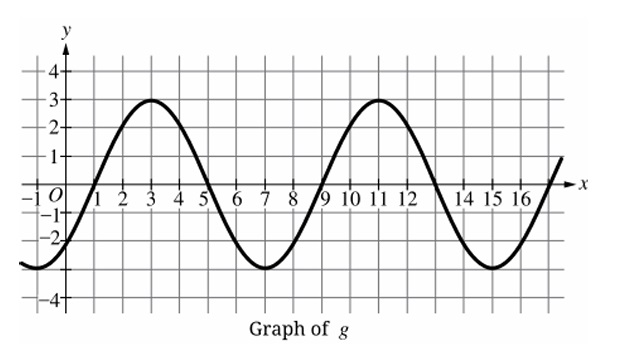
From the graph:
– Maximum \( g_{\text{max}} = 3 \), Minimum \( g_{\text{min}} = -3 \)
– Amplitude = \( \frac{g_{\text{max}} – g_{\text{min}}}{2} = \frac{3 – (-3)}{2} = 3 \)
– Consecutive maxima occur at \( x = 3 \) and \( x = 11 \), so period = \( 11 – 3 = 8 \)
– Consecutive minima occur at \( x = -1 \) and \( x = 7 \), also giving period = \( 7 – (-1) = 8 \)
✅ Answer: (B)
▶️ Answer/Explanation
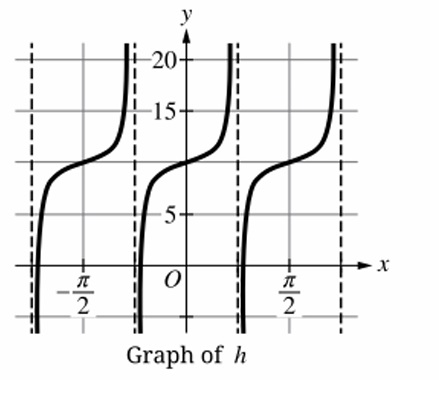
From the graph:
– The standard tangent curve increases through its midline; here it also increases (no vertical reflection), so \( a > 0 \).
– The period of \( h \) is shorter than \( \pi \) (the period of \( \tan x \)). Since period = \( \frac{\pi}{b} \), we have \( \frac{\pi}{b} < \pi \) → \( b > 1 \).
Thus \( a > 0 \) and \( b > 1 \).
✅ Answer: (A)
▶️ Answer/Explanation
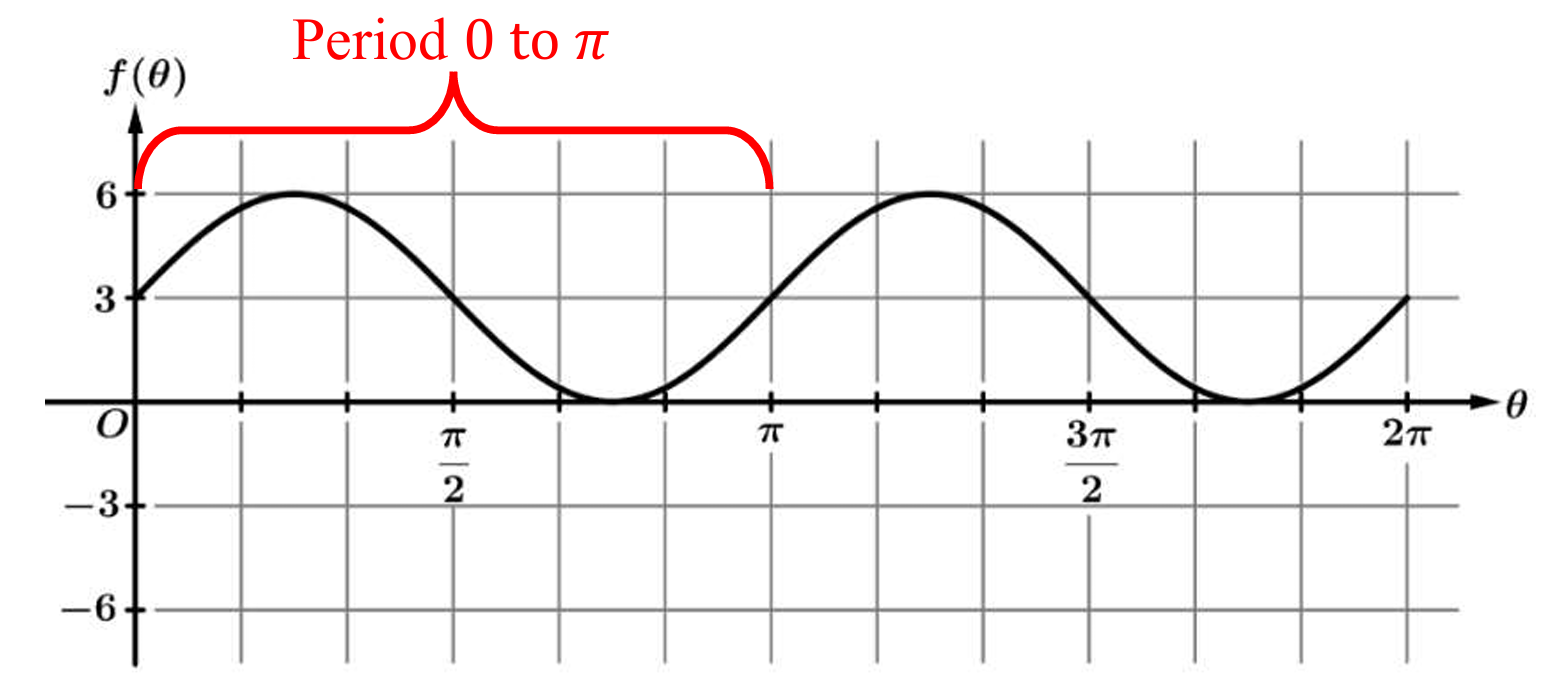
The period of a sinusoidal function is defined as the horizontal length of one complete cycle of the graph.
To determine this, identify a starting point on the graph, such as the y-intercept at \( \theta = 0 \).
At \( \theta = 0 \), the graph is at the midline \( y=3 \) and is sloping upwards.
Trace the graph along the horizontal axis until this pattern (midline value with upward slope) repeats.
The graph completes a full wave—reaching a maximum, crossing the midline, reaching a minimum, and returning to the midline—at \( \theta = \pi \).
Therefore, the length of the period is \( \pi – 0 = \pi \).
As highlighted by the red brace in the image, the interval from \( 0 \) to \( \pi \) represents one full period.
Correct Option: (C)
▶️ Answer/Explanation
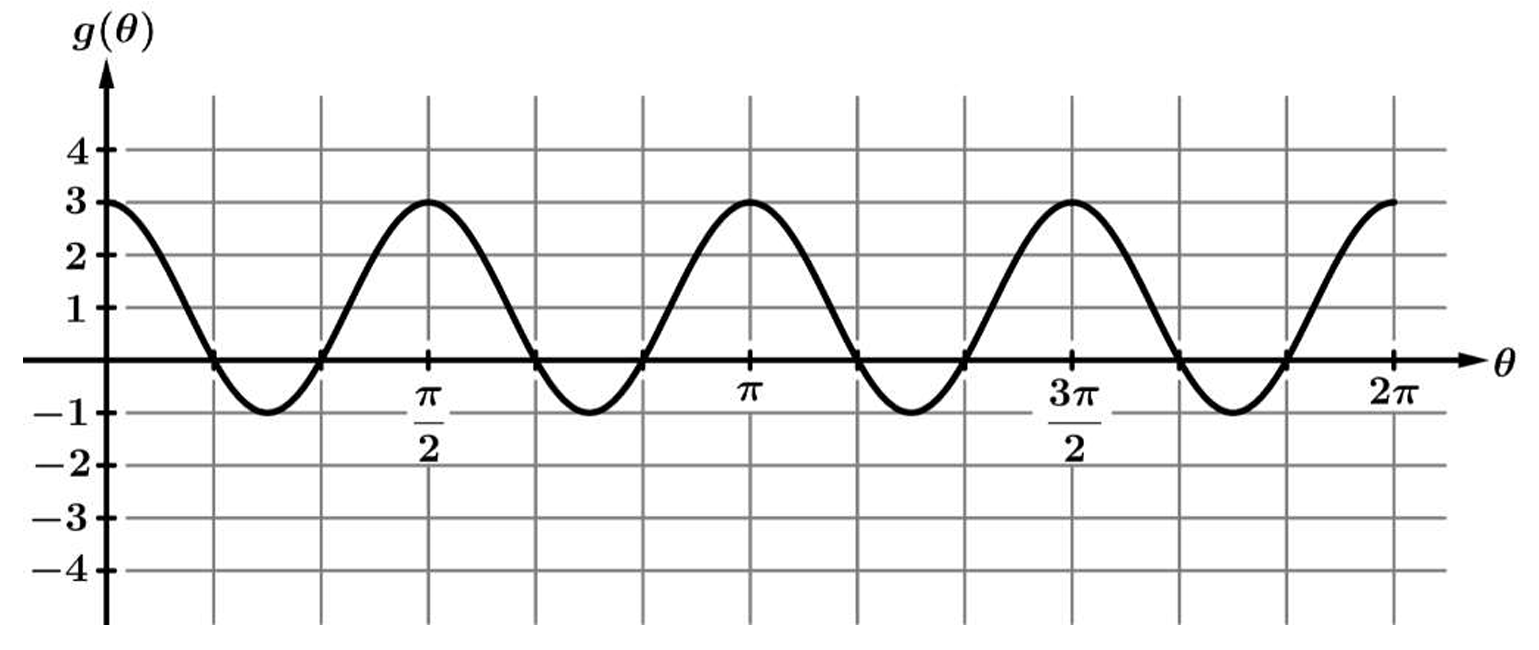
First, identify the maximum and minimum values of the function \( g(\theta) \) from the graph.
The maximum value (peak) is \( y_{\text{max}} = 3 \).
The minimum value (trough) is \( y_{\text{min}} = -1 \).
The amplitude of a sinusoidal function is half the difference between its maximum and minimum values.
Using the formula: \( \text{Amplitude} = \frac{1}{2}(\text{max} – \text{min}) \).
Substitute the values: \( \text{Amplitude} = \frac{1}{2}(3 – (-1)) = \frac{1}{2}(4) \).
Therefore, \( \text{Amplitude} = 2 \).
The correct option is (B).
▶️ Answer/Explanation
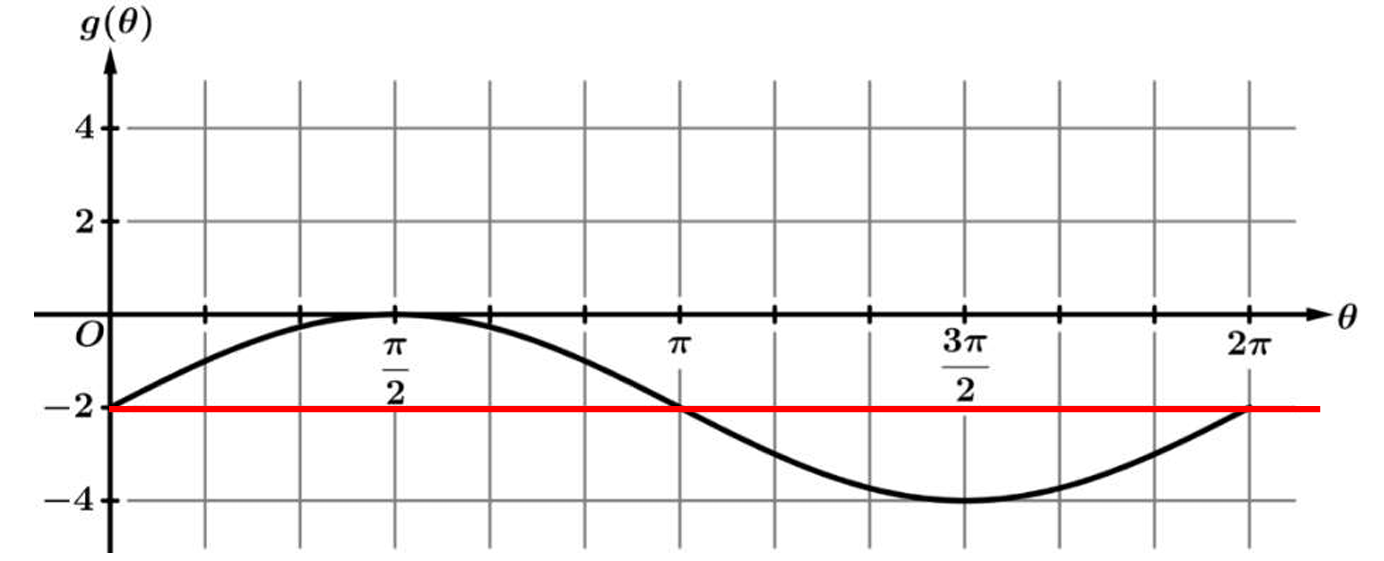
From the graph, the maximum y-value is \( 0 \) and the minimum y-value is \( -4 \).
The constant \( d \) is the midline (vertical shift), found by averaging the max and min: \( d = \frac{0 + (-4)}{2} = -2 \).
The constant \( a \) is the amplitude, found by taking half the distance between max and min: \( a = \frac{0 – (-4)}{2} = \frac{4}{2} = 2 \).
Since the graph starts at the midline and goes up (like a standard sine wave), \( a \) is positive.
Therefore, the correct values are \( a = 2 \) and \( d = -2 \).
Correct Option: (C)
▶️ Answer/Explanation
▶️ Answer/Explanation
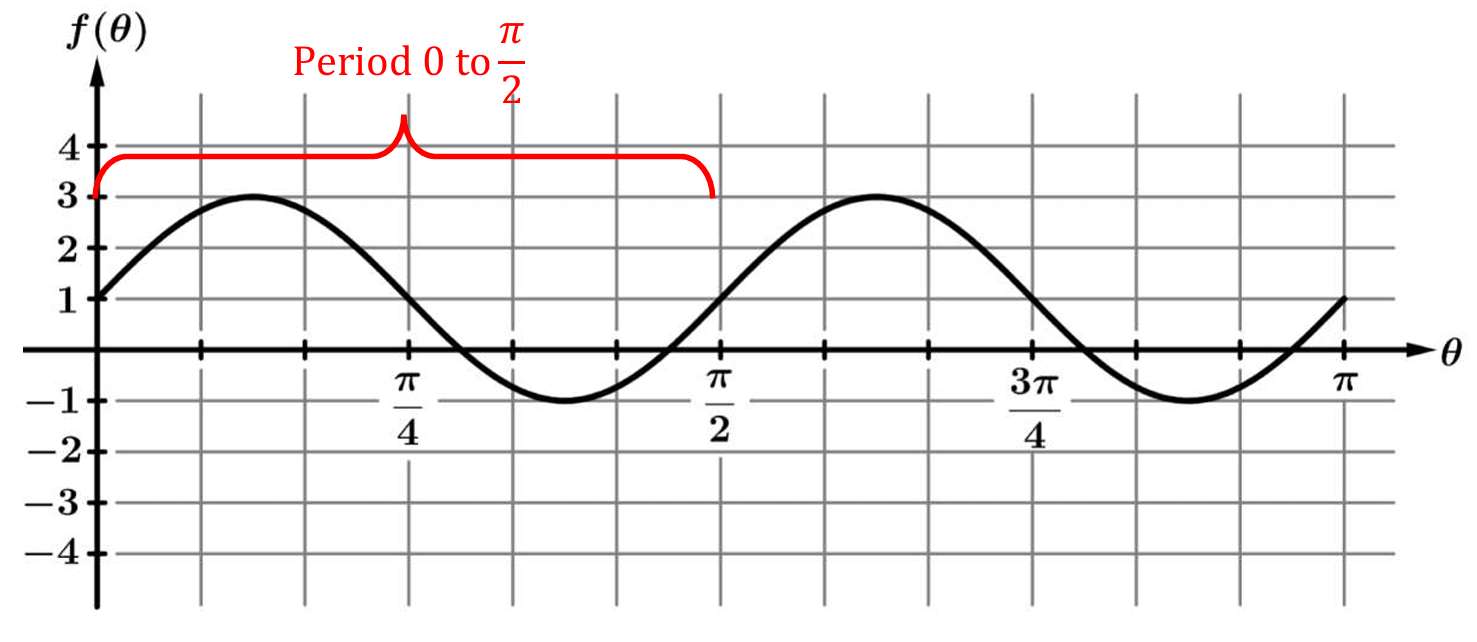
From the graph, identify the maximum value as \(3\) and the minimum value as \(-1\).
The amplitude is half the distance between the maximum and minimum values: \(\frac{1}{2}(\text{max} – \text{min})\).
Substituting the values, we get: \(\text{Amplitude} = \frac{1}{2}(3 – (-1)) = \frac{1}{2}(4) = 2\).
Next, identify the period by finding the length of one complete cycle.
The graph completes one full wave starting from \(0\) and ending at \(\frac{\pi}{2}\).
Therefore, the period is \(\frac{\pi}{2}\).
Matching these results with the options, we find the period is \(\frac{\pi}{2}\) and the amplitude is \(2\).
Correct Option: (D)
▶️ Answer/Explanation
The correct answer is (C).
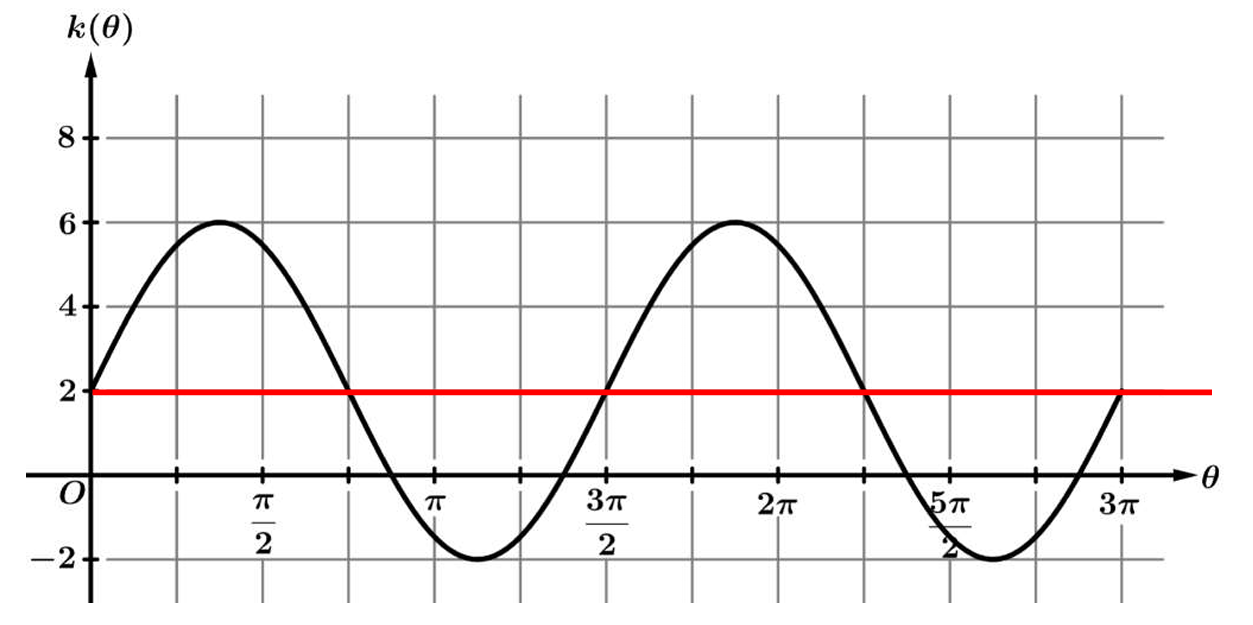
From the graph, we identify the maximum value as \( y_{\text{max}} = 6 \) and the minimum value as \( y_{\text{min}} = -2 \).
The constant \( d \) represents the midline (vertical shift), which is the average of the maximum and minimum values: \( d = \frac{6 + (-2)}{2} = \frac{4}{2} = 2 \).
The constant \( a \) represents the amplitude, which is half the distance between the maximum and minimum values: \( a = \frac{6 – (-2)}{2} = \frac{8}{2} = 4 \).
Thus, the values are \( a = 4 \) and \( d = 2 \), matching option (C).
▶️ Answer/Explanation
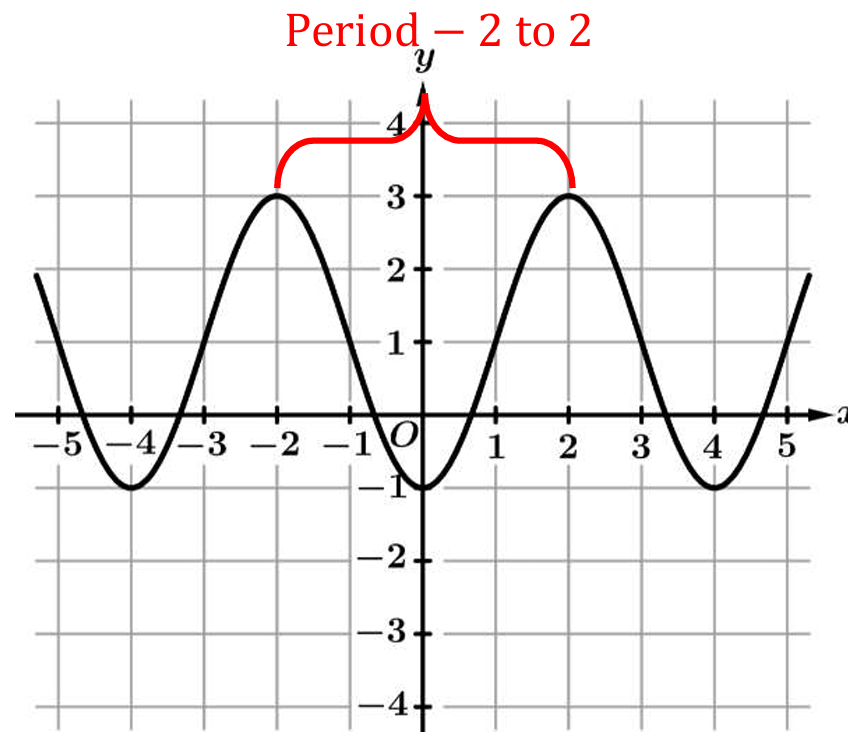
The maximum value is \(3\) and the minimum value is \(-1\).
Using the formula \(\text{Amplitude} = \frac{1}{2}(\text{max} – \text{min})\), we get \(\frac{1}{2}(3 – (-1)) = \frac{1}{2}(4) = 2\).
To find the period, we measure the horizontal distance between two consecutive peaks.
The peaks in the graph occur at \(x = -2\) and \(x = 2\).
The period is the difference: \(2 – (-2) = 4\).
Thus, the period is \(4\) and the amplitude is \(2\), corresponding to option (C).
▶️ Answer/Explanation
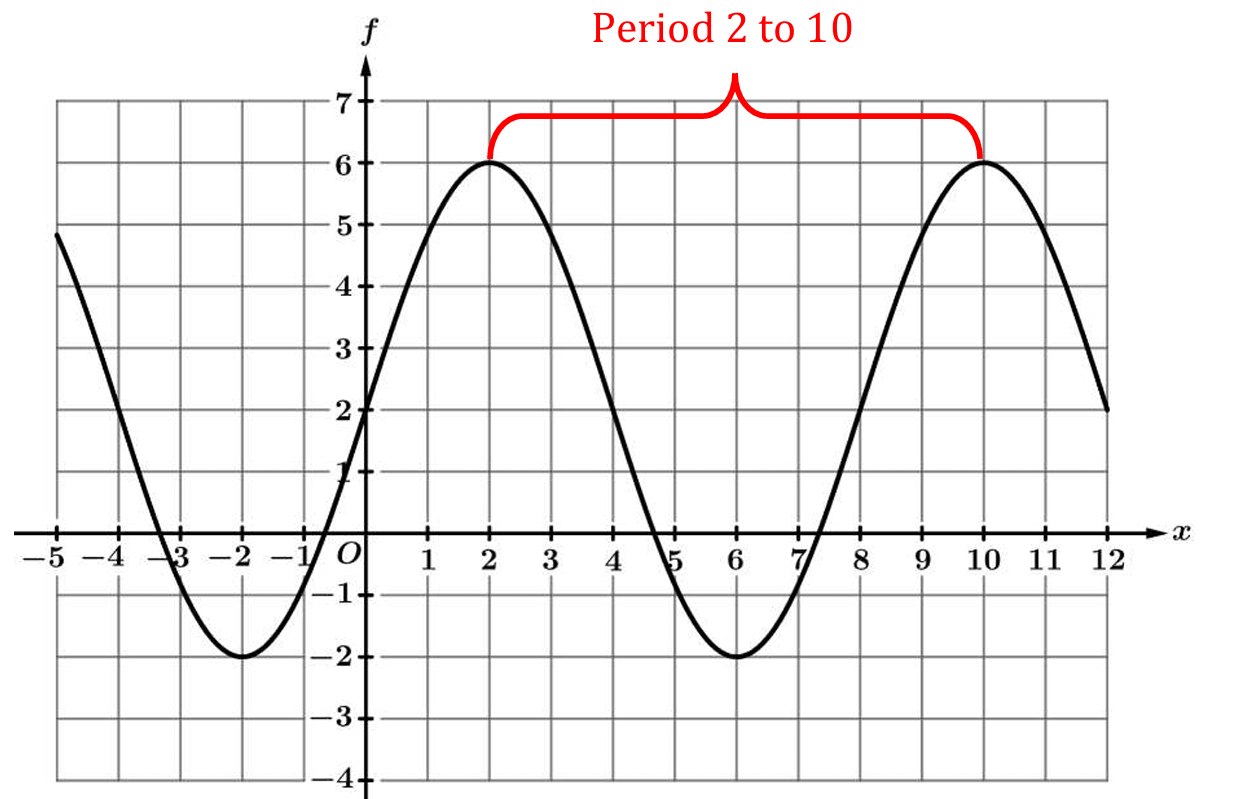
The amplitude \( a \) corresponds to the vertical stretch from the midline.
From the graph, the maximum value is \( 6 \) and the minimum value is \( -2 \).
Calculate \( a = \frac{\text{max} – \text{min}}{2} = \frac{6 – (-2)}{2} = \frac{8}{2} = 4 \).
The period is the horizontal length of one complete cycle, found between two peaks.
The peaks occur at \( x = 2 \) and \( x = 10 \), so the Period \( = 10 – 2 = 8 \).
The formula for the period of a sine function is \( \frac{2\pi}{b} \).
Set \( \frac{2\pi}{b} = 8 \) and solve for \( b \): \( b = \frac{2\pi}{8} = \frac{\pi}{4} \).
Thus, \( a = 4 \) and \( b = \frac{\pi}{4} \), which matches option (B).

▶️ Answer/Explanation
The constant \( b \) determines the frequency and is related to the period \( P \) by the formula \( b = \frac{2\pi}{P} \).
To find the period, we identify the distance between two consecutive peaks (maximum values) in the data.
The first peak occurs at \( x = 4.5 \) with \( y = 7.02 \), and the next peak is at \( x = 13.5 \) with \( y = 7.04 \).
Calculating the difference gives the period: \( P = 13.5 – 4.5 = 9 \).
Now, we substitute \( P = 9 \) into the formula for \( b \): \( b = \frac{2\pi}{9} \).
Approximating \( \pi \approx 3.14 \), we get \( b \approx \frac{6.28}{9} \approx 0.698 \).
Rounding to the nearest option, the value is approximately \( 0.7 \).