
Sinusoidal Functions
A sinusoidal function is any function that can be obtained from the basic sine function
\( f(\theta) = \sin \theta \)
by applying additive and multiplicative transformations, such as vertical stretching or shrinking, vertical shifting, horizontal shifting, or reflection.
A general sinusoidal function can be written as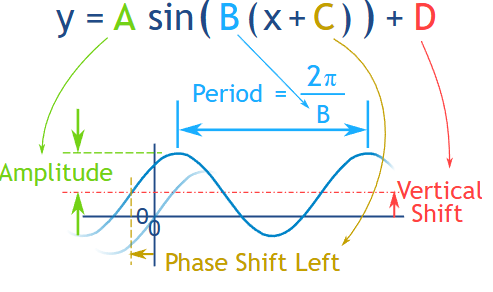
\( f(\theta) = A \sin(B\theta + C) + D \)
where:
\( A \) controls the amplitude
\( B \) affects the period
\( C \) represents a horizontal (phase) shift
\( D \) represents a vertical shift
Both the sine and cosine functions are sinusoidal functions.
In fact, the cosine function is simply a horizontal shift of the sine function:
\( \cos \theta = \sin\!\left(\theta + \dfrac{\pi}{2}\right) \)
This means sine and cosine have the same shape, amplitude, period, and range, but differ only by a phase shift.
Example:
Explain why the function \( f(\theta) = 3\sin(\theta – \pi) + 2 \) is sinusoidal.
▶️ Answer/Explanation
The function is based on \( \sin \theta \).
The factor 3 multiplies the sine function, creating a vertical stretch.
The term \( \theta – \pi \) shifts the graph horizontally.
The +2 shifts the graph upward.
Conclusion: Since it is formed from transformations of \( \sin \theta \), the function is sinusoidal.
Example:
Rewrite the cosine function \( f(\theta) = \cos \theta \) as a sine function.
▶️ Answer/Explanation
Using the sine–cosine identity,
\( \cos \theta = \sin\!\left(\theta + \dfrac{\pi}{2}\right) \)
This shows that cosine is a phase-shifted sine function.
Conclusion: The cosine function is sinusoidal because it is a transformation of \( \sin \theta \).
Period and Frequency of Sinusoidal Functions
For a sinusoidal function, the period and the frequency describe how the function repeats over time or angle measure.
The period is the length of the smallest interval over which the function completes one full cycle and begins to repeat.
The frequency is the number of complete cycles that occur in one unit of input.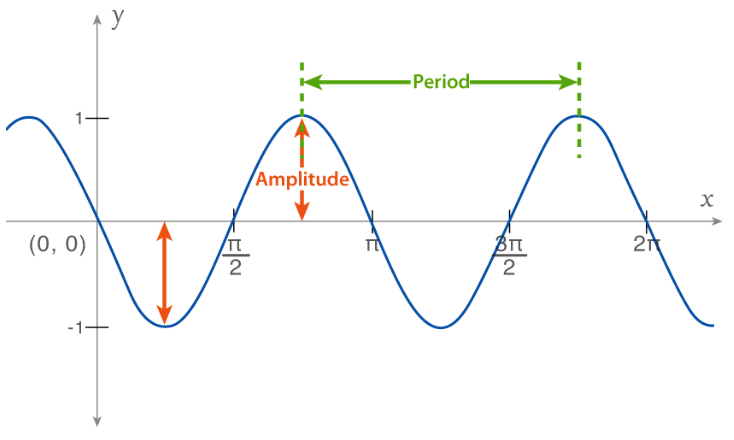
For sinusoidal functions, the period and frequency are reciprocals of each other.
\( \text{Frequency} = \dfrac{1}{\text{Period}} \)
Basic Sine and Cosine Functions
The basic sine and cosine functions are
\( f(\theta) = \sin \theta \), \( g(\theta) = \cos \theta \)
Both functions complete one full cycle as \( \theta \) increases from \( 0 \) to \( 2\pi \).
Period: \( 2\pi \)
Frequency: \( \dfrac{1}{2\pi} \)
This means the sine and cosine functions repeat once every \( 2\pi \) units and complete \( \dfrac{1}{2\pi} \) cycles per unit of input.
Example:
State the period and frequency of the function \( f(\theta) = \sin \theta \).
▶️ Answer/Explanation
The sine function completes one full cycle over an interval of length \( 2\pi \).
Period:
\( 2\pi \)
Frequency:
\( \dfrac{1}{2\pi} \)
Example:
If a sinusoidal function has a period of \( 10 \), find its frequency.
▶️ Answer/Explanation
Use the reciprocal relationship between frequency and period.
\( \text{Frequency} = \dfrac{1}{\text{Period}} = \dfrac{1}{10} \)
Final answer: The frequency is \( \dfrac{1}{10} \).
Amplitude of a Sinusoidal Function
The amplitude of a sinusoidal function measures the maximum vertical distance of the graph from its midline.
It is defined as half the difference between the maximum and minimum values of the function.
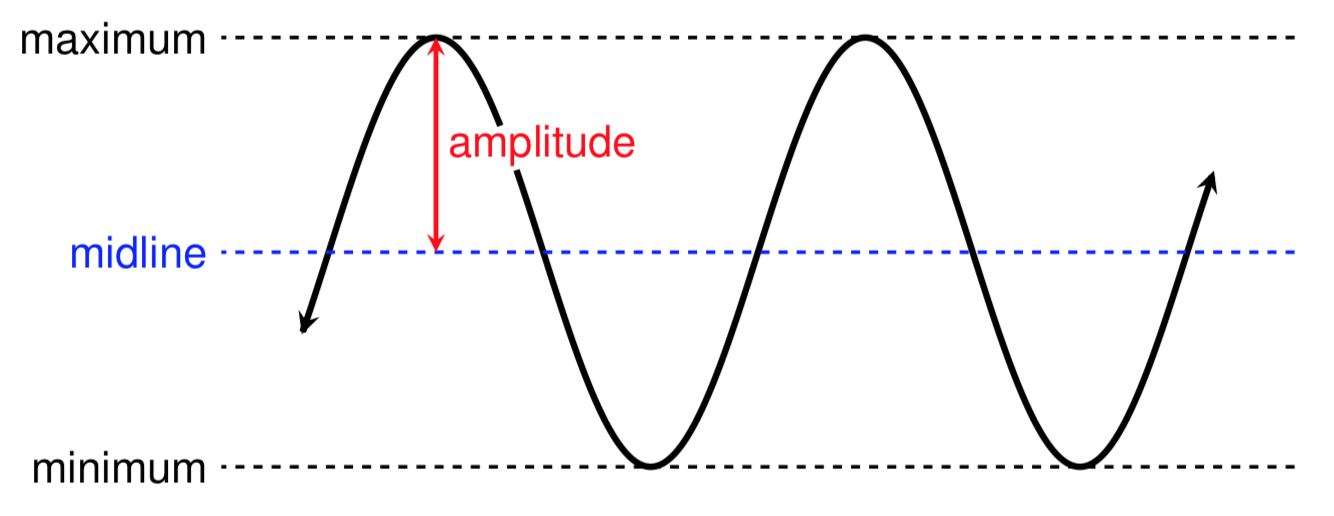
\( \text{Amplitude} = \dfrac{\text{maximum value} – \text{minimum value}}{2} \)
The amplitude describes how “tall” the wave is and does not affect the period or frequency.
Basic Sine and Cosine Functions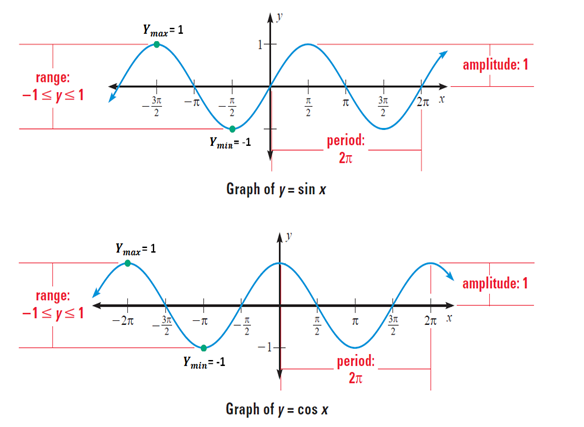
For the basic sinusoidal functions
\( f(\theta) = \sin \theta \)
\( g(\theta) = \cos \theta \)
the maximum value is \( 1 \) and the minimum value is \( -1 \).
\( \text{Amplitude} = \dfrac{1 – (-1)}{2} = 1 \)
Thus, both the sine and cosine functions have amplitude 1.
For a general sinusoidal function
\( f(\theta) = A \sin(B\theta + C) + D \)
the amplitude is
\( |A| \)
Example:
Find the amplitude of the function \( f(\theta) = 4\sin \theta \).
▶️ Answer/Explanation
The coefficient of \( \sin \theta \) is 4.
The amplitude is the absolute value of this coefficient.
\( \text{Amplitude} = |4| = 4 \)
Final answer: The amplitude is 4.
Example:
Find the amplitude of the function \( g(\theta) = -2\cos \theta + 3 \).
▶️ Answer/Explanation
The coefficient of \( \cos \theta \) is −2.
Amplitude depends only on the magnitude of this coefficient.
\( \text{Amplitude} = |-2| = 2 \)
The +3 shifts the graph vertically but does not affect the amplitude.
Final answer: The amplitude is 2.
Midline of a Sinusoidal Function
The midline of a sinusoidal function is the horizontal line that lies exactly halfway between the maximum and minimum values of the function.
It is determined by taking the average, or arithmetic mean, of the maximum and minimum values.
\( \text{Midline} = \dfrac{\text{maximum value} + \text{minimum value}}{2} \)
The graph of a sinusoidal function oscillates symmetrically above and below its midline.
Basic Sine and Cosine Functions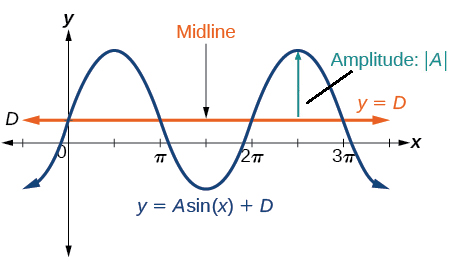
For the functions
\( y = \sin \theta \)
\( y = \cos \theta \)
the maximum value is \( 1 \) and the minimum value is \( -1 \).
\( \text{Midline} = \dfrac{1 + (-1)}{2} = 0 \)
Therefore, the midline of both graphs is
\( y = 0 \)
For a general sinusoidal function
\( y = A\sin(B\theta + C) + D \)
the midline is
\( y = D \)
Example:
Find the midline of the function \( y = 3\sin \theta – 2 \).
▶️ Answer/Explanation
The function is in the form \( y = A\sin(B\theta + C) + D \).
Here, \( D = -2 \).
Therefore, the midline is
\( y = -2 \)
Final answer: The midline is \( y = -2 \).
Example:
A sinusoidal function has a maximum value of 7 and a minimum value of −1. Find the equation of its midline.
▶️ Answer/Explanation
Use the midline formula:
\( \text{Midline} = \dfrac{7 + (-1)}{2} \)
Simplify:
\( \text{Midline} = \dfrac{6}{2} = 3 \)
Final answer: The midline is \( y = 3 \).
Concavity of Sinusoidal Functions
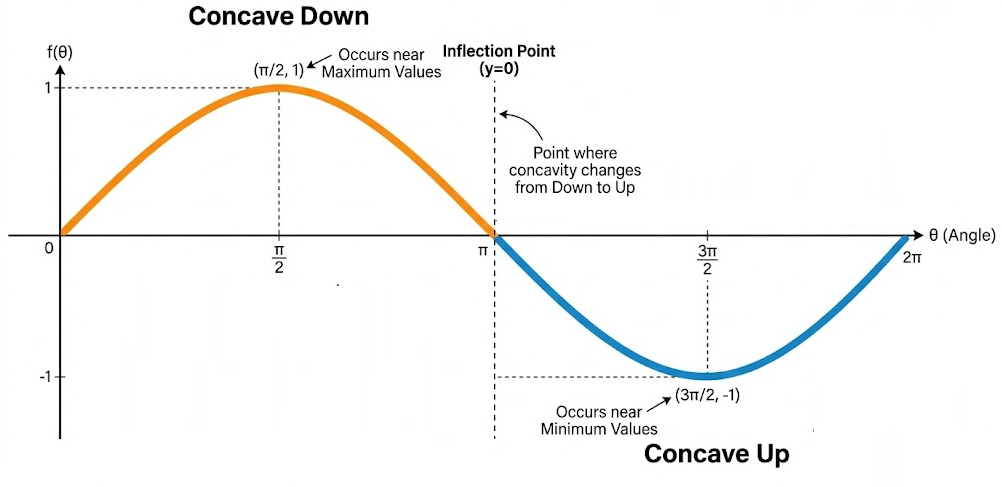
As the input values (angle measures) increase, the graphs of sinusoidal functions alternate between being concave up and concave down.
This behavior reflects how the rate of change of the function varies over each cycle.
Concave Down
A sinusoidal graph is concave down on intervals where the rate of change is decreasing.
On the graph, this occurs near the maximum values of the function.
Concave Up
A sinusoidal graph is concave up on intervals where the rate of change is increasing.
On the graph, this occurs near the minimum values of the function.
This alternating concavity repeats in every period of the sinusoidal function.
Example:
Describe the concavity of the function \( y = \sin \theta \) on one period.
▶️ Answer/Explanation
On the interval \( (0, \pi) \), the sine function reaches a maximum at \( \theta = \dfrac{\pi}{2} \).
Near this maximum, the graph is concave down.
On the interval \( (\pi, 2\pi) \), the function reaches a minimum at \( \theta = \dfrac{3\pi}{2} \).
Near this minimum, the graph is concave up.
This pattern repeats every \( 2\pi \).
Example:
Explain how concavity behaves for the function \( y = \cos \theta \).
▶️ Answer/Explanation
The cosine function starts at a maximum when \( \theta = 0 \).
Near this maximum, the graph is concave down.
Halfway through the period, the function reaches a minimum at \( \theta = \pi \), where the graph is concave up.
The concavity alternates regularly and repeats every \( 2\pi \).
Symmetry of Sine and Cosine Functions
The graphs of the sine and cosine functions exhibit important types of symmetry, which classify them as odd or even functions.
Sine Function as an Odd Function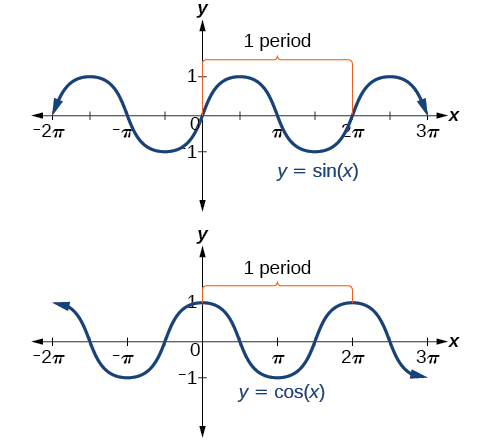
The graph of
\( y = \sin \theta \)
has rotational symmetry about the origin.
This means that rotating the graph \( 180^\circ \) about the origin leaves the graph unchanged.
Algebraically, this symmetry is expressed as
\( \sin(-\theta) = -\sin \theta \)
Because it satisfies this property, the sine function is an odd function.
Cosine Function as an Even Function
The graph of
\( y = \cos \theta \)
has reflective symmetry across the y-axis.
This means that reflecting the graph across the y-axis leaves the graph unchanged.
Algebraically, this symmetry is expressed as
\( \cos(-\theta) = \cos \theta \)
Because it satisfies this property, the cosine function is an even function.
Example:
Use symmetry to evaluate \( \sin(-\dfrac{\pi}{4}) \).
▶️ Answer/Explanation
Since sine is an odd function,
\( \sin(-\theta) = -\sin \theta \)
Thus,
\( \sin\!\left(-\dfrac{\pi}{4}\right) = -\sin\!\left(\dfrac{\pi}{4}\right) = -\dfrac{\sqrt{2}}{2} \)
Example:
Use symmetry to evaluate \( \cos(-\dfrac{2\pi}{3}) \).
▶️ Answer/Explanation
Since cosine is an even function,
\( \cos(-\theta) = \cos \theta \)
Thus,
\( \cos\!\left(-\dfrac{2\pi}{3}\right) = \cos\!\left(\dfrac{2\pi}{3}\right) = -\dfrac{1}{2} \)