Home / AP® Exam / AP® PreCalculus / AP® Precalculus

AP Precalculus -3.6 Sinusoidal Transformations- MCQ Exam Style Questions - Effective Fall 2023

AP Precalculus -3.6 Sinusoidal Transformations- MCQ Exam Style Questions – Effective Fall 2023

AP Precalculus -3.6 Sinusoidal Transformations- MCQ Exam Style Questions – AP Precalculus- per latest AP Precalculus Syllabus.

AP Precalculus – MCQ Exam Style Questions- All Topics

Question 


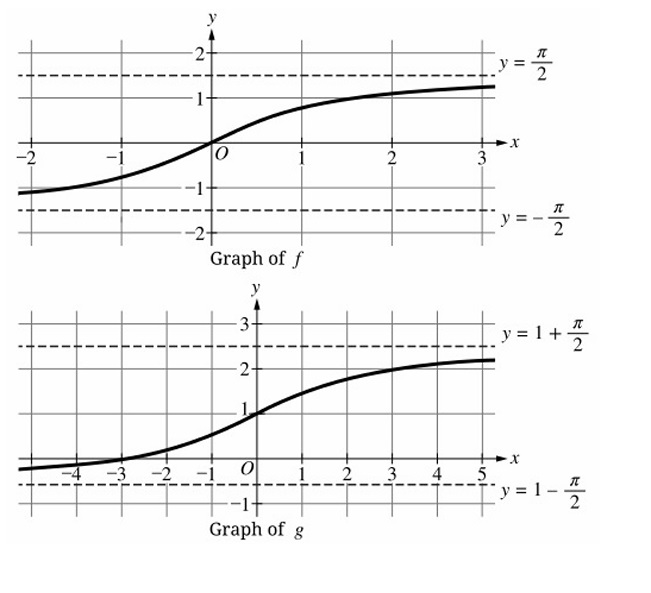
The figure gives the graphs of the functions \( f \) and \( g \) in the \( xy \)-plane. The function \( f \) is given by \( f(x) = \tan^{-1} x \). Which of the following defines \( g(x) \)?
(A) \( \tan^{-1} x + 1 \)
(B) \( \tan^{-1} x + \frac{\pi}{2} \)
(C) \( \tan^{-1} \left( \frac{x}{2} \right) + 1 \)
(D) \( \tan^{-1} \left( \frac{x}{2} \right) – \frac{\pi}{2} \)
▶️ Answer/Explanation
Detailed solution

From the graphs (described in the original question):
– \( g(x) \) appears horizontally wider than \( f(x) = \tan^{-1}x \), indicating a horizontal stretch (dilation) by a factor of 2, which corresponds to replacing \( x \) with \( \frac{x}{2} \).
– \( g(x) \) is also shifted upward by 1 unit compared to the stretched curve.
Thus, \( g(x) = \tan^{-1}\left(\frac{x}{2}\right) + 1 \).
Answer: (C)

Question 

The function \( g \) is given by \( g(\theta) = \cos(2\theta) \). The sinusoidal function \( h \) is a phase shift of the function \( g \) by \( -\frac{\pi}{3} \) units. Which of the following is true?
(A) Consecutive minima of \( h \) occur at \( \left(-\frac{5\pi}{6}, h\left(-\frac{5\pi}{6}\right)\right) \) and \( \left(\frac{\pi}{6}, h\left(\frac{\pi}{6}\right)\right) \) because consecutive minima of \( g \) occur at \( \left(-\frac{\pi}{2}, g\left(-\frac{\pi}{2}\right)\right) \) and \( \left(\frac{\pi}{2}, g\left(\frac{\pi}{2}\right)\right) \), and \( h \) is the image of \( g \) with a horizontal shift of \( \frac{\pi}{3} \) units left.
(B) Consecutive minima of \( h \) occur at \( \left(-\frac{\pi}{6}, h\left(-\frac{\pi}{6}\right)\right) \) and \( \left(\frac{5\pi}{6}, h\left(\frac{5\pi}{6}\right)\right) \) because consecutive minima of \( g \) occur at \( \left(-\frac{\pi}{2}, g\left(-\frac{\pi}{2}\right)\right) \) and \( \left(\frac{\pi}{2}, g\left(\frac{\pi}{2}\right)\right) \), and \( h \) is the image of \( g \) with a horizontal shift of \( \frac{\pi}{3} \) units right.
(C) Consecutive minima of \( h \) occur at \( \left(-\frac{4\pi}{3}, h\left(-\frac{4\pi}{3}\right)\right) \) and \( \left(\frac{2\pi}{3}, h\left(\frac{2\pi}{3}\right)\right) \) because consecutive minima of \( g \) occur at \( \left(-\pi, g(-\pi)\right) \) and \( \left(\pi, g(\pi)\right) \), and \( h \) is the image of \( g \) with a horizontal shift of \( \frac{\pi}{3} \) units left.
(D) Consecutive minima of \( h \) occur at \( \left(-\frac{2\pi}{3}, h\left(-\frac{2\pi}{3}\right)\right) \) and \( \left(\frac{4\pi}{3}, h\left(\frac{4\pi}{3}\right)\right) \) because consecutive minima of \( g \) occur at \( \left(-\pi, g(-\pi)\right) \) and \( \left(\pi, g(\pi)\right) \), and \( h \) is the image of \( g \) with a horizontal shift of \( \frac{\pi}{3} \) units right.
▶️ Answer/Explanation
Detailed solution

\( g(\theta) = \cos(2\theta) \) has period \( \pi \).
Minima of \( g \) occur when \( \cos(2\theta) = -1 \), i.e., \( 2\theta = \pi + 2\pi k \) → \( \theta = \frac{\pi}{2} + \pi k \).
Two consecutive minima: at \( \theta = -\frac{\pi}{2} \) and \( \theta = \frac{\pi}{2} \).
A phase shift of \( -\frac{\pi}{3} \) means \( h(\theta) = g\left(\theta + \frac{\pi}{3}\right) \) (shift left by \( \frac{\pi}{3} \)).
Thus minima of \( h \) occur at \( \theta + \frac{\pi}{3} = -\frac{\pi}{2} \) → \( \theta = -\frac{5\pi}{6} \), and \( \theta + \frac{\pi}{3} = \frac{\pi}{2} \) → \( \theta = \frac{\pi}{6} \).
Answer: (A)

Question 


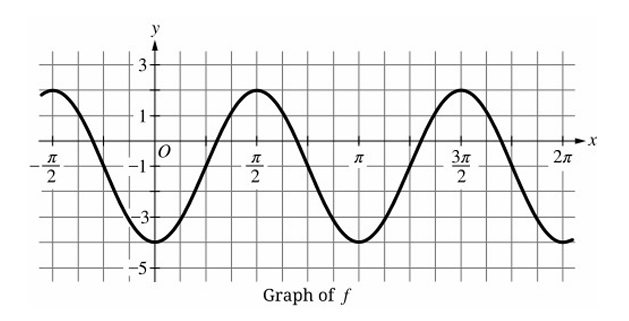
The figure shows the graph of a trigonometric function \( f \). Which of the following could be an expression for \( f(x) \)?
(A) \( 3\cos(2(x – \frac{\pi}{4})) – 1 \)
(B) \( 3\cos(2(x – \frac{\pi}{8})) – 1 \)
(C) \( 3\sin(2(x – \frac{\pi}{4})) – 1 \)
(D) \( 3\sin(2(x – \frac{\pi}{8})) – 1 \)
▶️ Answer/Explanation
Detailed solution

From the graph:
– Max = 2, Min = -4 → Amplitude = \( \frac{2 – (-4)}{2} = 3 \)
– Midline: \( y = \frac{2 + (-4)}{2} = -1 \)
– Period: distance between consecutive peaks (or troughs) = \( \pi \) → \( b = \frac{2\pi}{\pi} = 2 \)
– Shape matches a sine curve shifted right by \( \frac{\pi}{4} \) (since sine normally starts at midline going up at 0, here that occurs at \( x = \frac{\pi}{4} \))
Thus: \( f(x) = 3\sin(2(x – \frac{\pi}{4})) – 1 \).
Answer: (C)

Question 

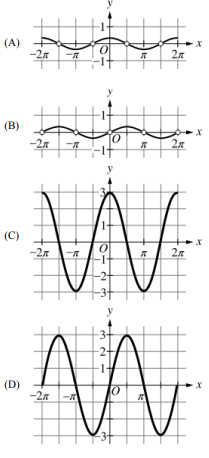
The function \( f \) is defined by \( f(x) = 3 \sec x \). The function \( g \) is defined by \( g(x) = \frac{1}{f(x)} \). Which of the following is the graph of \( g \) in the \( xy \)-plane?

▶️ Answer/Explanation
Detailed solution

\( g(x) = \frac{1}{f(x)} = \frac{1}{3\sec x} = \frac{1}{3} \cos x \).
Thus \( g \) is a cosine function with amplitude \( \frac13 \) and period \( 2\pi \).
However, \( f(x) = 3\sec x \) is undefined where \( \cos x = 0 \) (\( x = \frac{\pi}{2} + k\pi \)), so \( g \) will have holes at those \( x \)-values even though \( \cos x = 0 \) there, because \( \frac{1}{3\sec x} \) would involve division by infinity.
Graph (A) matches \( y = \frac13\cos x \) with holes at the vertical asymptotes of \( \sec x \).
Answer: (A)

Question 

The function \( f \) is given by \( f(x) = \sin x \). In the \( xy \)-plane, the graph of the function \( g \) is the image of the graph of \( f \) after a translation of \( \frac{\pi}{6} \) units to the left. Which of the following could define \( g(x) \)?
(A) \( \sin x + \frac{\pi}{6} \)
(B) \( \sin(x + \frac{\pi}{6}) \)
(C) \( \sin x – \frac{\pi}{6} \)
(D) \( \sin(x – \frac{\pi}{6}) \)
▶️ Answer/Explanation
Detailed solution

Horizontal translation of \( f(x) = \sin x \) by \( h \) units to the left is given by \( f(x + h) \).
Here \( h = \frac{\pi}{6} \), so \( g(x) = \sin\left(x + \frac{\pi}{6}\right) \).
Answer: (B)

Question 


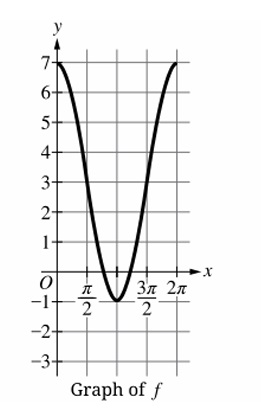
A portion of the graph of a sinusoidal function \( f \) in the \( xy \)-plane is given for \( 0 \leq x \leq 2\pi \). Which of the following could define \( f(x) \)?
From the graph: Maximum \( y = 7 \), Minimum \( y = -1 \), period \( 2\pi \), maxima at \( x = 0 \) and \( x = 2\pi \).
(A) \( 3 + 4\cos x \)
(B) \( 3 + 4\sin x \)
(C) \( 4 + 3\cos x \)
(D) \( 4 + 3\sin x \)
▶️ Answer/Explanation
Detailed solution

Amplitude \( A = \frac{7 – (-1)}{2} = 4 \).
Midline \( d = \frac{7 + (-1)}{2} = 3 \).
Since the graph has maxima at \( x = 0 \) and \( x = 2\pi \) and no horizontal shift, a cosine function (which has a maximum at \( x = 0 \)) fits best.
Thus \( f(x) = 4\cos x + 3 \) or equivalently \( 3 + 4\cos x \).
Answer: (A)

Question 

The function \(f\) is given by \(f(x)=2~cos(\pi x)+3\) The graph of \(f\) is mapped to the graph of \(g\) in the same \(xy\)-plane by a horizontal translation of the graph of \(f\) by \(\frac{\pi}{2}\) units right. Which of the following is an expression for \(g(x)\)?
(A) \(2~cos(\pi(x-\frac{1}{2}))+3\)
(B) \(2~cos(\pi(x-\frac{\pi}{2}))+3\)
(C) \(2~cos(\pi x)+3-\frac{\pi}{2}\)
(D) \(2~cos(\pi x)+3+\frac{\pi}{2}\)
▶️ Answer/Explanation
Detailed solution

1. Apply Horizontal Translation Rule:
To translate a function \(f(x)\) horizontally by \(h\) units to the right, we replace every \(x\) in the function definition with \((x – h)\).

2. Substitute the Value:
Here, the shift is \(h = \frac{\pi}{2}\) units right.
Therefore, \(g(x) = f(x – \frac{\pi}{2})\).

3. Write the Expression:
\(g(x) = 2\cos(\pi(x – \frac{\pi}{2})) + 3\).

Answer: (B)

Question 


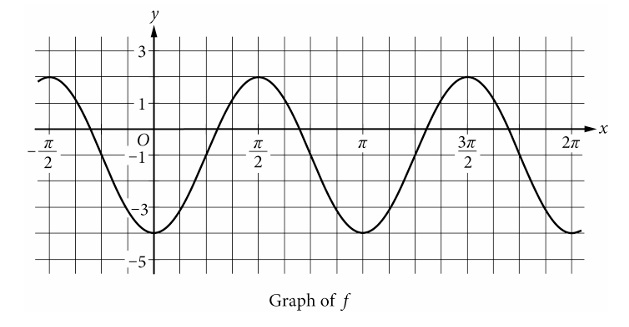
The figure shows the graph of a trigonometric function \( f \). Which of the following could be an expression for \( f(x) \)?
(A) \( 3\cos\left(2\left(x – \frac{\pi}{4}\right)\right) – 1 \)
(B) \( 3\cos\left(2\left(x – \frac{\pi}{8}\right)\right) – 1 \)
(C) \( 3\sin\left(2\left(x – \frac{\pi}{4}\right)\right) – 1 \)
(D) \( 3\sin\left(2\left(x – \frac{\pi}{8}\right)\right) – 1 \)
▶️ Answer/Explanation
Detailed solution

From the graph:
• Midline: \( y = -1 \) → vertical shift \( d = -1 \).
• Amplitude: max \(=2\), min \(=-4\), amplitude \(= \frac{2 – (-4)}{2} = 3\) → \( a = 3 \).
• Period: distance between consecutive maxima \( \frac{3\pi}{2} – \frac{\pi}{2} = \pi \) → \( \frac{2\pi}{b} = \pi \) ⇒ \( b = 2 \).
• Shape: starts increasing through midline at \( x = \frac{\pi}{4} \) (like sine shifted right \( \frac{\pi}{4} \)).

A sine function with phase shift \( \frac{\pi}{4} \) to the right:
\[ f(x) = 3\sin\left(2\left(x – \frac{\pi}{4}\right)\right) – 1 \]
This matches option (C).
Answer: (C)

Question 

The figure shows the graph of a trigonometric function \( f \). Which of the following could be an expression for \( f(x) \)?
(A) \( 3 \sin x \)
(B) \( -3 \sin x \)
(C) \( -3 \sin(2x) \)
(D) \( -3 \sin\left(\frac{1}{2}x\right) \)
▶️ Answer/Explanation
Detailed solution

1. Find the Amplitude: The graph oscillates between a maximum value of \( 3 \) and a minimum value of \( -3 \). The amplitude is half of this range: \( \frac{3 – (-3)}{2} = 3 \).
2. Determine the Sign (Reflection): The standard sine graph \( \sin(x) \) starts at 0 and goes up. This graph starts at 0 and goes down, indicating a reflection over the x-axis. Therefore, the leading coefficient is negative, so \( a = -3 \).
3. Find the Period: The graph completes one full cycle (going down, then up, and back to 0) from \( x = 0 \) to \( x = \pi \). So, the period is \( \pi \).
4. Calculate the Frequency Coefficient (\( b \)): Using the formula \( \text{Period} = \frac{2\pi}{b} \), we substitute the period: \( \pi = \frac{2\pi}{b} \). Solving for \( b \) gives \( b = 2 \).
5. Conclusion: Combining these components (\( a = -3 \) and \( b = 2 \)), the expression is \( -3 \sin(2x) \). This matches option (C).
Question 

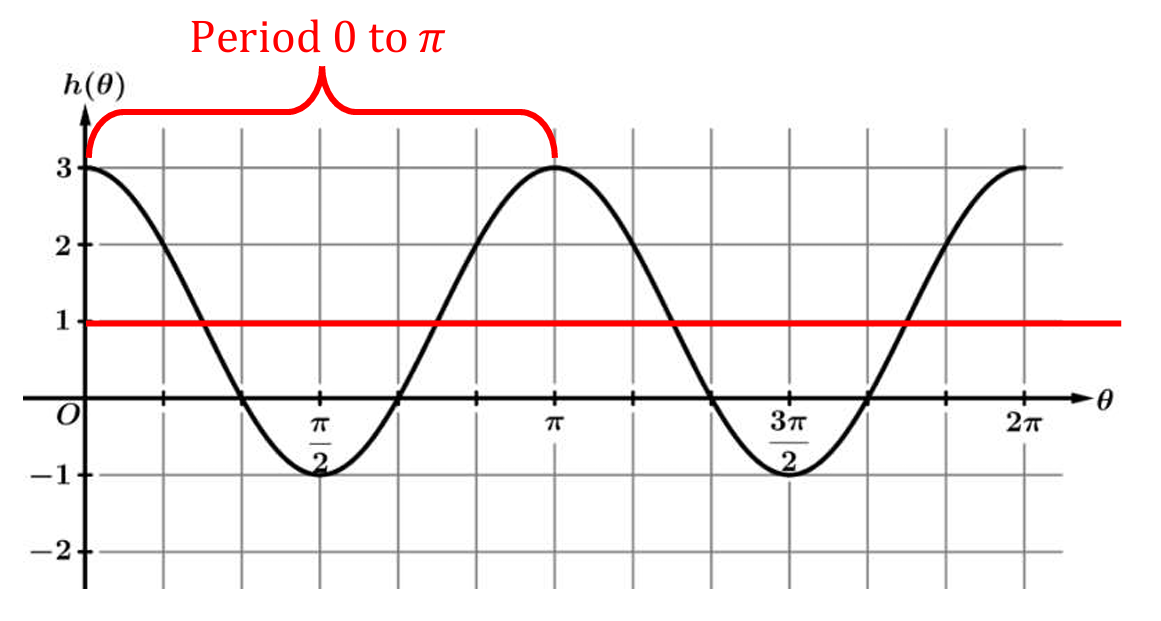
The figure shows the graph of a trigonometric function \(h\). Which of the following could be an expression for \(h(x)\)?
(A) \( 2 \cos(\pi x) + 1 \)
(B) \( 2 \cos\left(2\left(x – \frac{\pi}{2}\right)\right) + 1 \)
(C) \( -2 \cos(2(x – \pi)) + 1 \)
(D) \( -2 \cos\left(2\left(x – \frac{3\pi}{2}\right)\right) + 1 \)
▶️ Answer/Explanation
Detailed solution

The correct option is (D).

1. Determine Amplitude and Midline: The maximum value is \(3\) and the minimum is \(-1\). The midline is \(y = \frac{3 + (-1)}{2} = 1\), and the amplitude is \(\frac{3 – (-1)}{2} = 2\). All options reflect this.
2. Determine Period: The graph completes one full cycle from \(x=0\) to \(x=\pi\). Therefore, the period is \(\pi\).
3. Find Frequency Coefficient (\(b\)): Using the formula \(\text{Period} = \frac{2\pi}{b}\), we get \(\pi = \frac{2\pi}{b}\), which implies \(b = 2\). This eliminates option (A) because it has \(b=\pi\).
4. Test Points: At \(x=0\), the graph is at its maximum \(y=3\). We substitute \(x=0\) into the remaining options:
5. Option (B): \(2 \cos(2(0 – \frac{\pi}{2})) + 1 = 2 \cos(-\pi) + 1 = -1\) (Incorrect).
6. Option (C): \(-2 \cos(2(0 – \pi)) + 1 = -2 \cos(-2\pi) + 1 = -1\) (Incorrect).
7. Option (D): \(-2 \cos(2(0 – \frac{3\pi}{2})) + 1 = -2 \cos(-3\pi) + 1 = -2(-1) + 1 = 3\) (Correct).
Question 

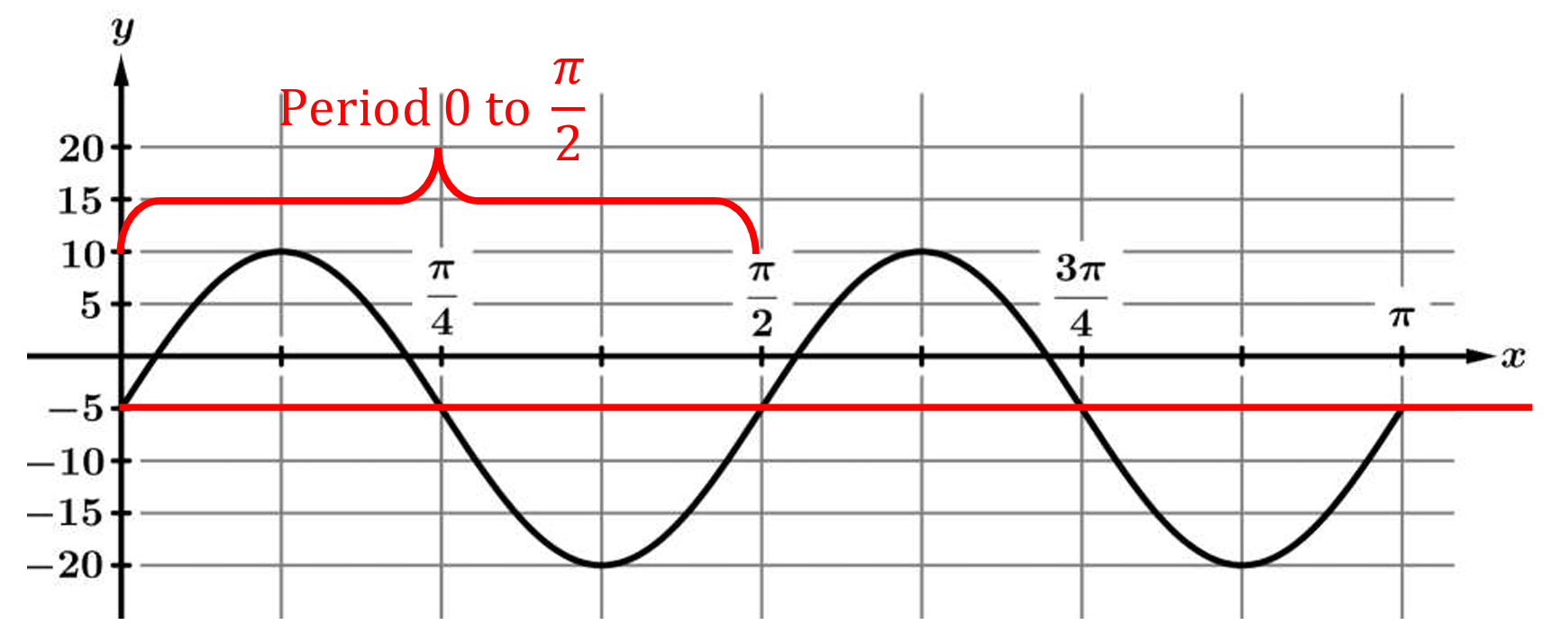
The figure shows the graph of a trigonometric function \( f \). Which of the following could be an expression for \( f(x) \)?
(A) \( 15\sin(2x) – 5 \)
(B) \( -15\sin\left(4\left(x – \frac{\pi}{4}\right)\right) – 5 \)
(C) \( -15\sin\left(4\left(x – \frac{\pi}{2}\right)\right) – 5 \)
(D) \( 15\sin\left(4\left(x – \frac{3\pi}{4}\right)\right) – 5 \)
▶️ Answer/Explanation
Detailed solution

The amplitude is half the distance between the max and min: \( \frac{10 – (-20)}{2} = 15 \).
The midline is the average of the max and min: \( y = \frac{10 + (-20)}{2} = -5 \).
The graph completes one full cycle from \( x=0 \) to \( x=\frac{\pi}{2} \), so the period is \( \frac{\pi}{2} \).
Using \( \text{Period} = \frac{2\pi}{b} \), we find \( b = \frac{2\pi}{\pi/2} = 4 \). This eliminates option (A).
To identify the correct phase shift, test the maximum point at \( x = \frac{\pi}{8} \).
Substitute \( x = \frac{\pi}{8} \) into option (B): \( -15\sin\left(4\left(\frac{\pi}{8} – \frac{\pi}{4}\right)\right) – 5 = -15\sin\left(-\frac{\pi}{2}\right) – 5 \).
Since \( \sin\left(-\frac{\pi}{2}\right) = -1 \), this yields \( -15(-1) – 5 = 10 \), which matches the graph.
Therefore, option (B) is the correct expression.
Question 

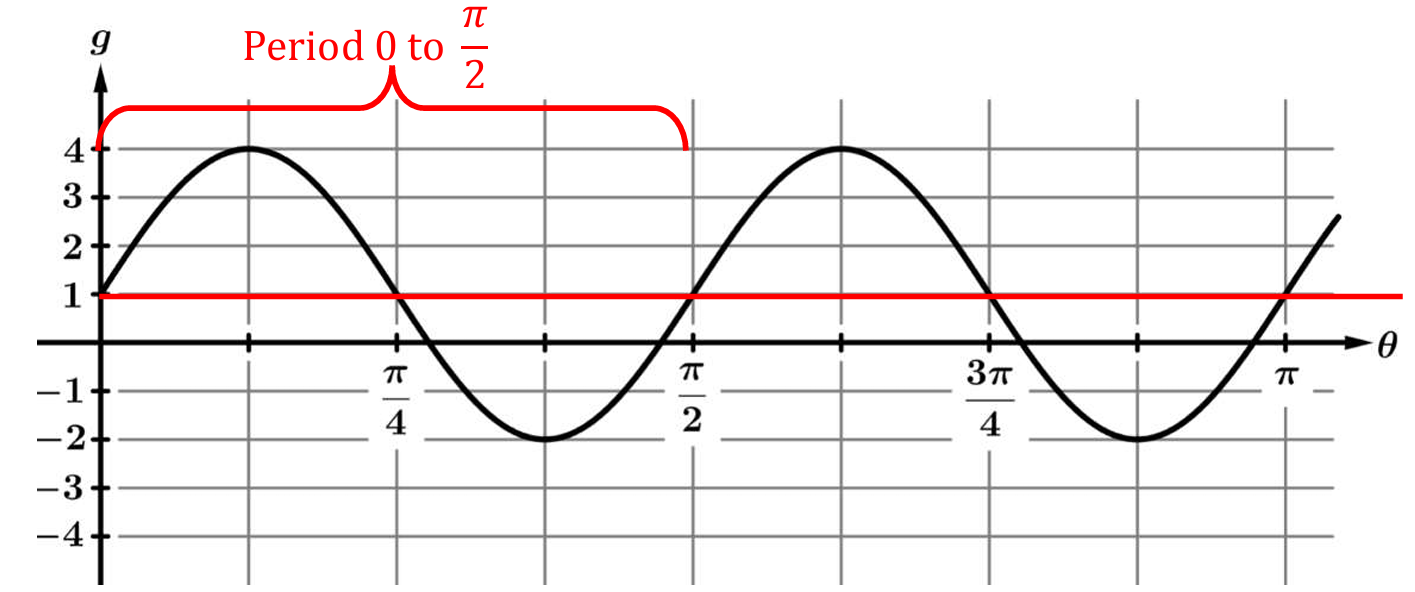
The figure shows the graph of a trigonometric function \(g\). Which of the following could be an expression for \(g(x)\)?
(A) \(3 \sin (x) + 1\)
(B) \(3 \sin (2x) + 1\)
(C) \(3 \sin (4x) + 1\)
(D) \(3 \sin \left(\frac{\pi}{2} x\right) + 1\)
▶️ Answer/Explanation
Detailed solution
First, determine the vertical shift (midline) using the maximum and minimum values: \( \text{Midline} = \frac{\text{max} + \text{min}}{2} = \frac{4 + (-2)}{2} = 1 \). So, \(d = 1\).
Next, calculate the amplitude: \( \text{Amplitude} = \frac{\text{max} – \text{min}}{2} = \frac{4 – (-2)}{2} = 3 \). So, the coefficient is \(3\).
Observe the graph to find the period. The function completes one full cycle from \(x=0\) to \(x=\frac{\pi}{2}\). Therefore, the period is \(\frac{\pi}{2}\).
Calculate the frequency coefficient \(b\) using the period formula: \( b = \frac{2\pi}{\text{Period}} = \frac{2\pi}{\pi/2} = 4 \).
Combine these values into the general sine function form \(y = a\sin(bx) + d\).
The resulting expression is \(g(x) = 3\sin(4x) + 1\).
Comparing this result with the given choices, it matches option (C).

Question 

The figure shows the graph of a trigonometric function \( k \). Which of the following could be an expression for \( k(x) \)?
(A) \( 2\sin(x) – 1 \)
(B) \( -2\sin(x – \pi) – 1 \)
(C) \( -2\sin(x + \pi) – 1 \)
(D) \( -2\sin(x + 2\pi) – 1 \)
▶️ Answer/Explanation
Detailed solution

The maximum value of the graph is \( 1 \) and the minimum is \( -3 \), so the midline is \( y = \frac{1 + (-3)}{2} = -1 \).
The amplitude is half the distance between the maximum and minimum: \( \frac{1 – (-3)}{2} = 2 \).
The graph completes one full cycle from \( x=0 \) to \( x=2\pi \), so the period is \( 2\pi \).
At \( x=0 \), the graph starts at the midline and goes downwards, which indicates a reflected sine function: \( y = -2\sin(x) – 1 \).
Looking at option (D), \( -2\sin(x + 2\pi) – 1 \) is equivalent to \( -2\sin(x) – 1 \) because the sine function has a period of \( 2\pi \).
Therefore, option (D) is the correct expression for the function \( k(x) \).
Question 

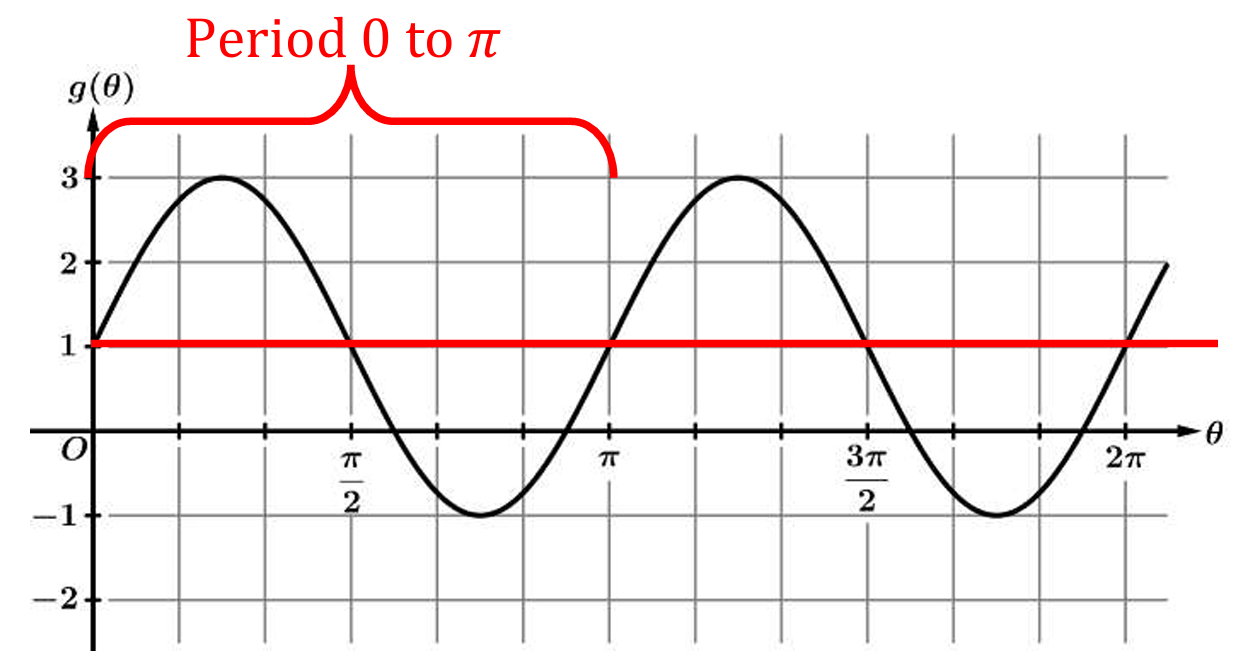
The figure shows the graph of a trigonometric function \(g\). Which of the following could be an expression for \(g(x)\)?
(A) \(-2 \sin\left( 2 \left( x – \frac{3\pi}{2} \right) \right) + 1\)
(B) \(2 \sin\left( 2 \left( x – \frac{\pi}{2} \right) \right) + 1\)
(C) \(2 \cos\left( 2 (x – \pi) \right) + 1\)
(D) \(2 \cos(2x) + 1\)
▶️ Answer/Explanation
Detailed solution

The Midline is the average of the maximum and minimum values: \(y = \frac{3 + (-1)}{2} = 1\), so the vertical shift is \(+1\).
The Amplitude is half the distance between the max and min: \(\frac{3 – (-1)}{2} = 2\).
The Period is the length of one full cycle, which is clearly \(\pi\). The frequency coefficient is \(b = \frac{2\pi}{\text{Period}} = \frac{2\pi}{\pi} = 2\).
The graph starts at the midline \((0, 1)\) and goes up, which corresponds to a standard sine function: \(y = 2\sin(2x) + 1\).
To match option (A), we verify using the identity \(\sin(\theta – 3\pi) = -\sin(\theta)\).
Expanding option (A): \(-2\sin(2x – 3\pi) + 1 = -2(-\sin(2x)) + 1 = 2\sin(2x) + 1\).
Therefore, option (A) is the correct expression equivalent to the graph.
Question 

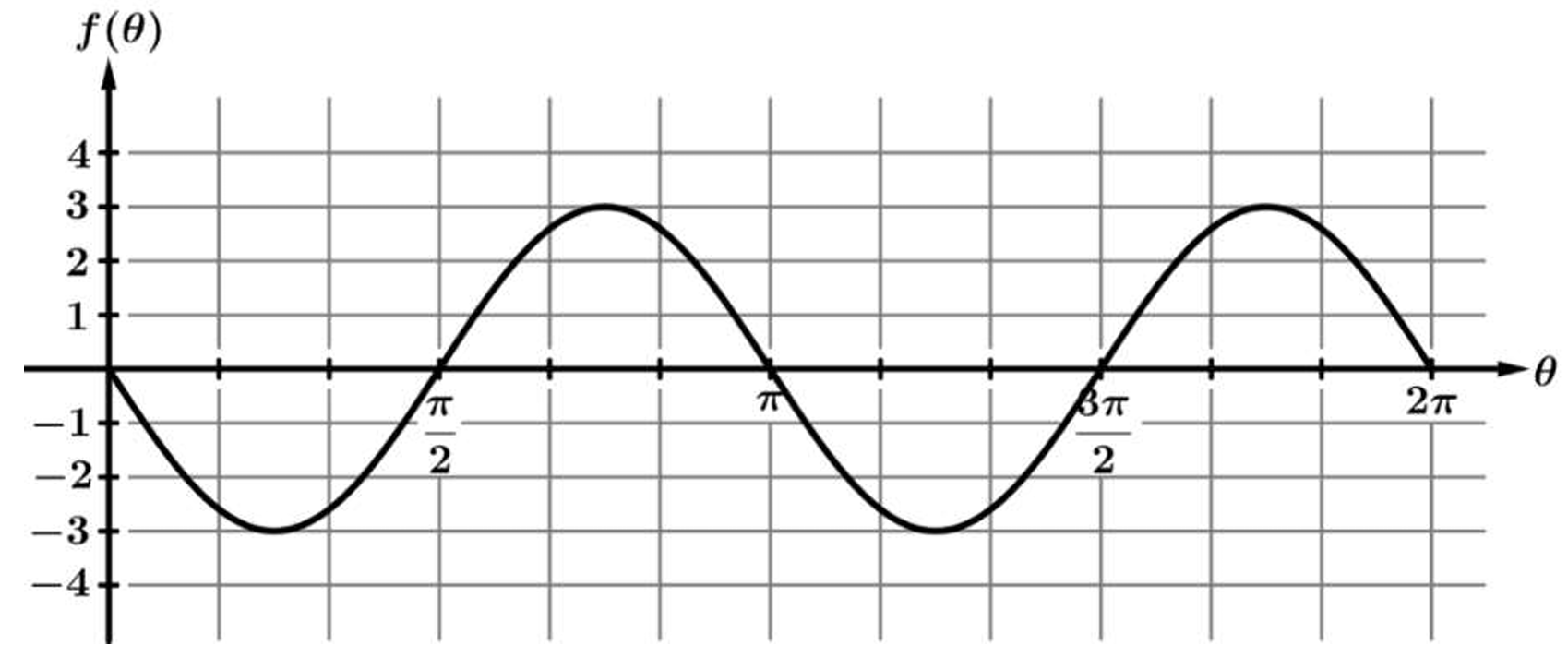
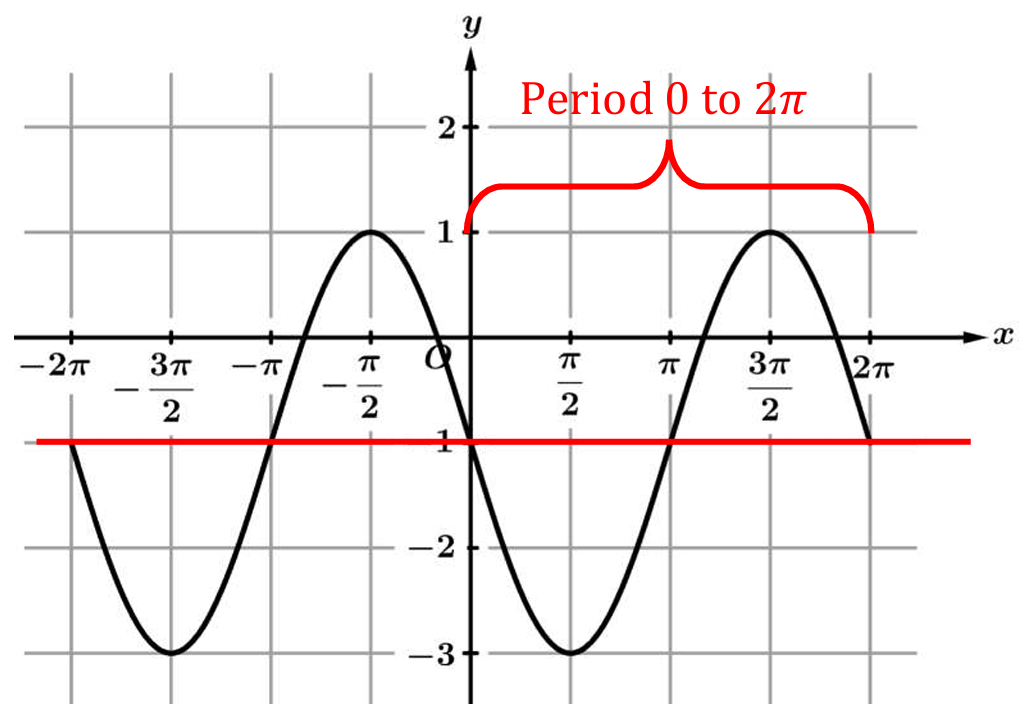
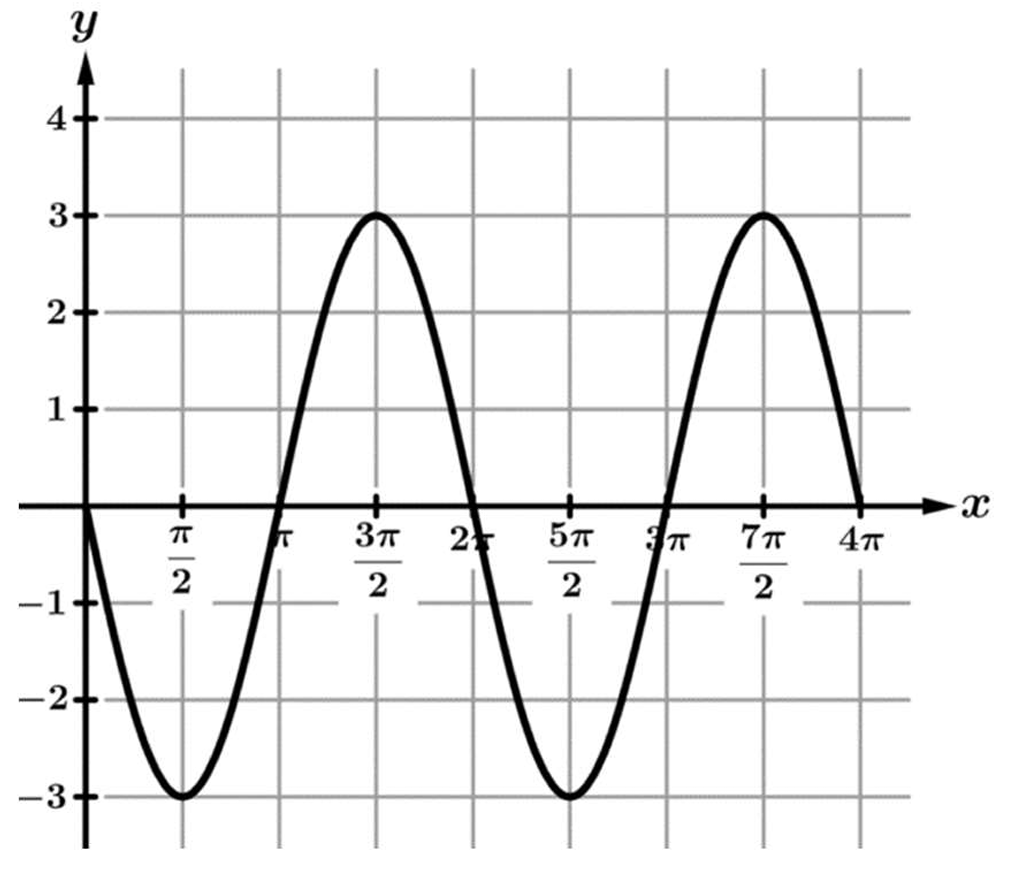
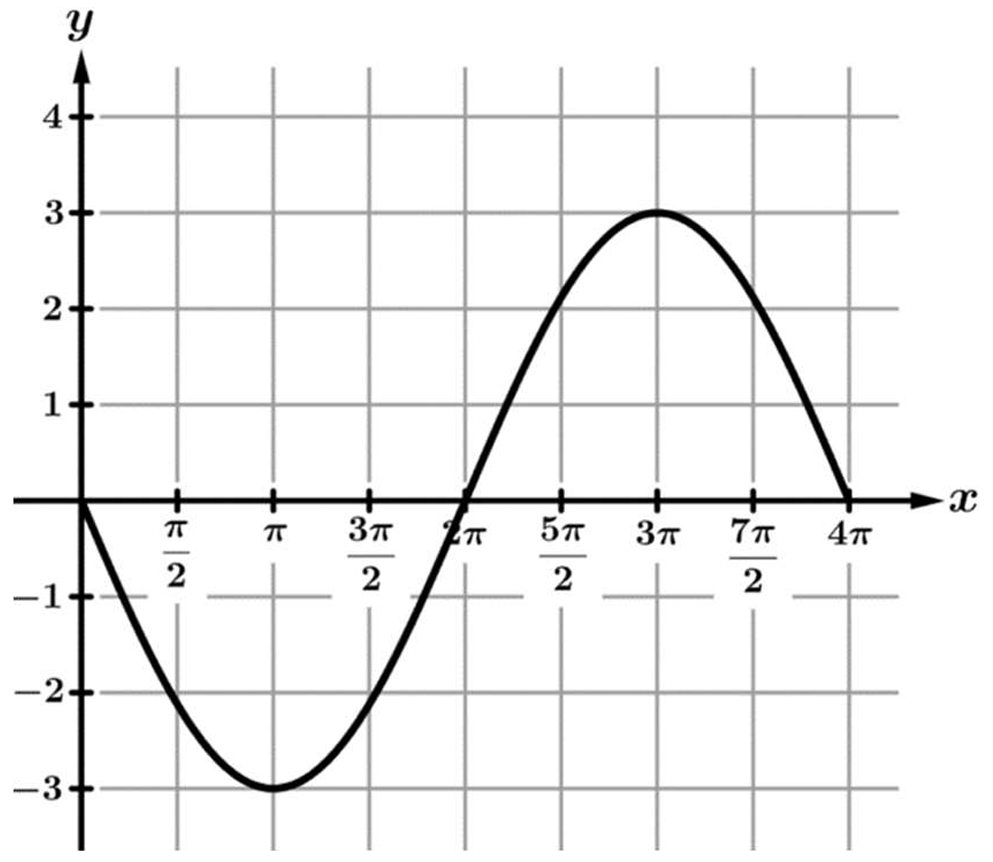
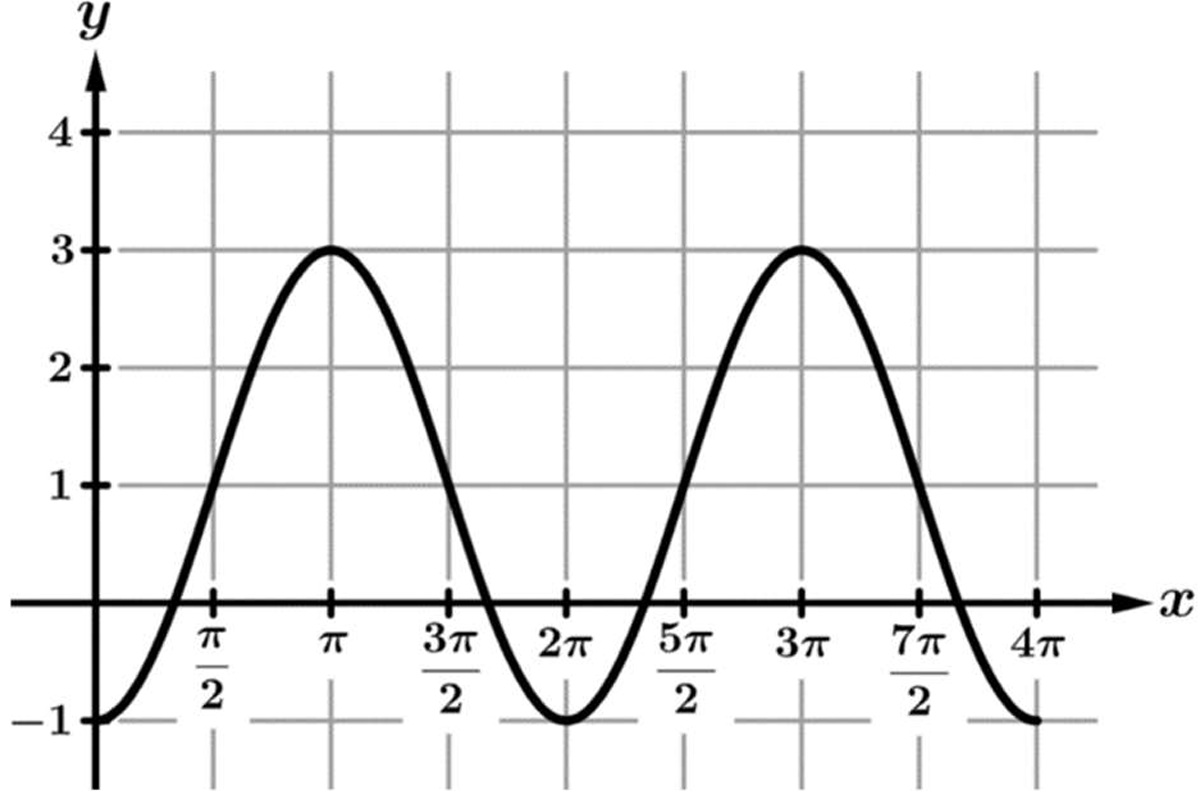
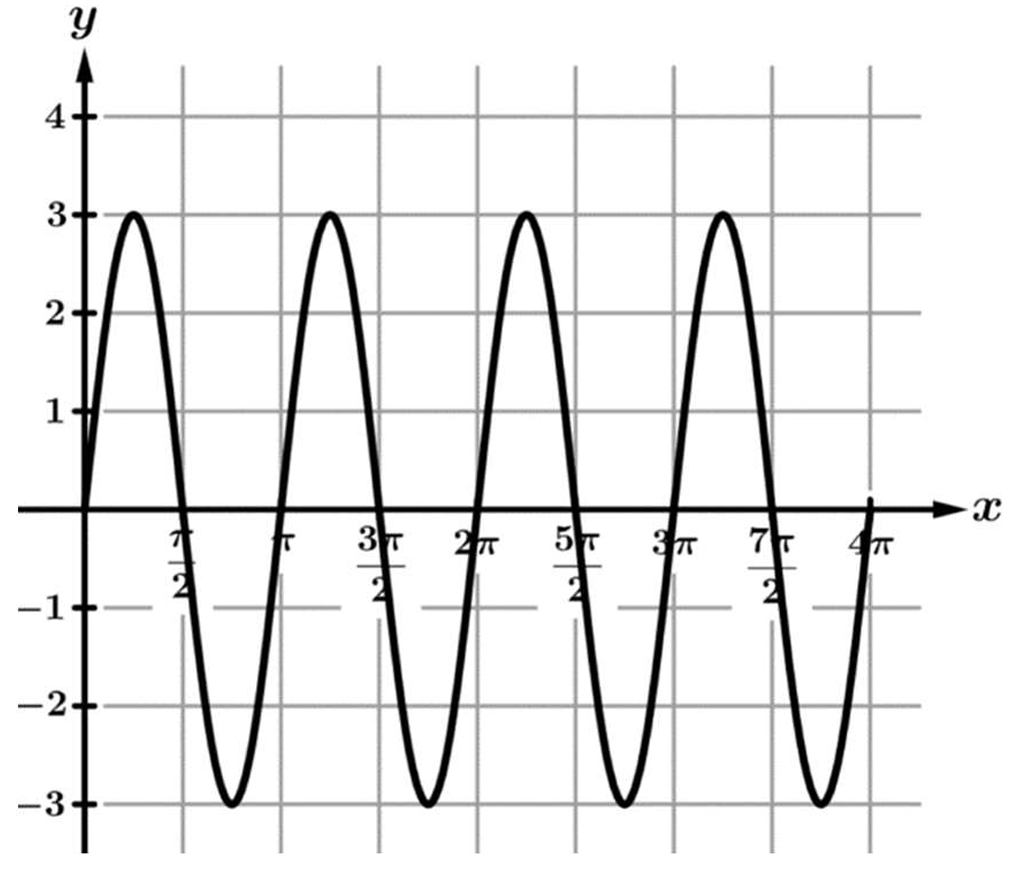
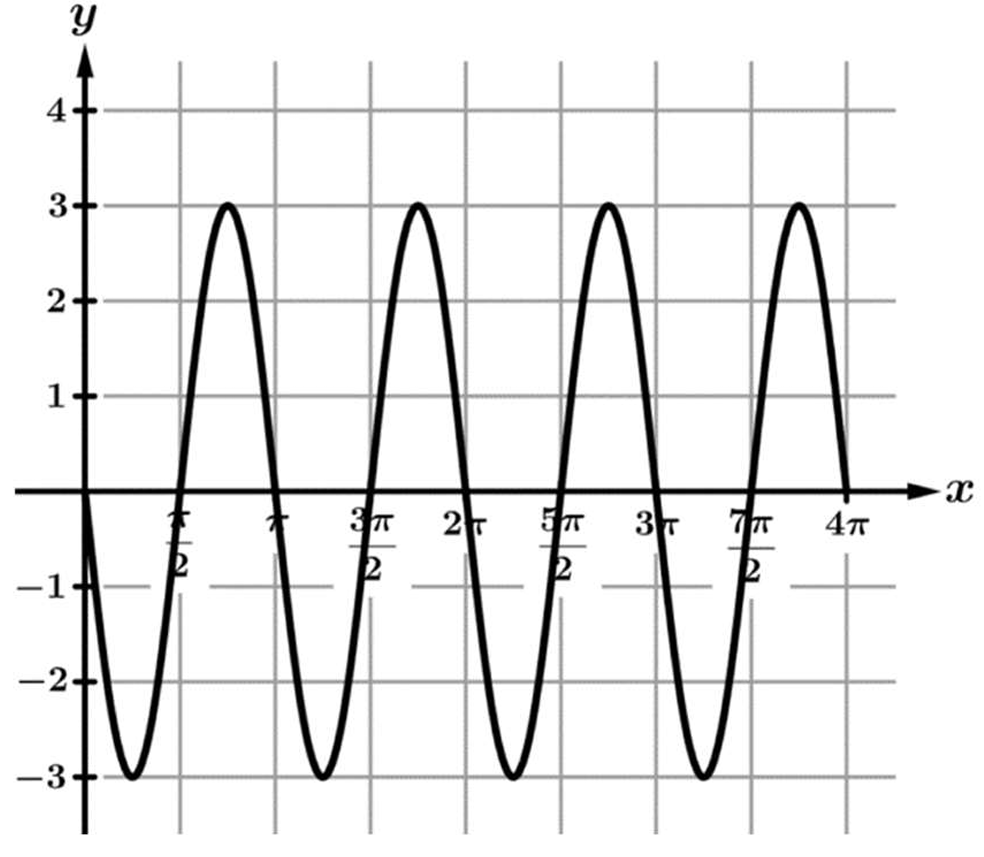
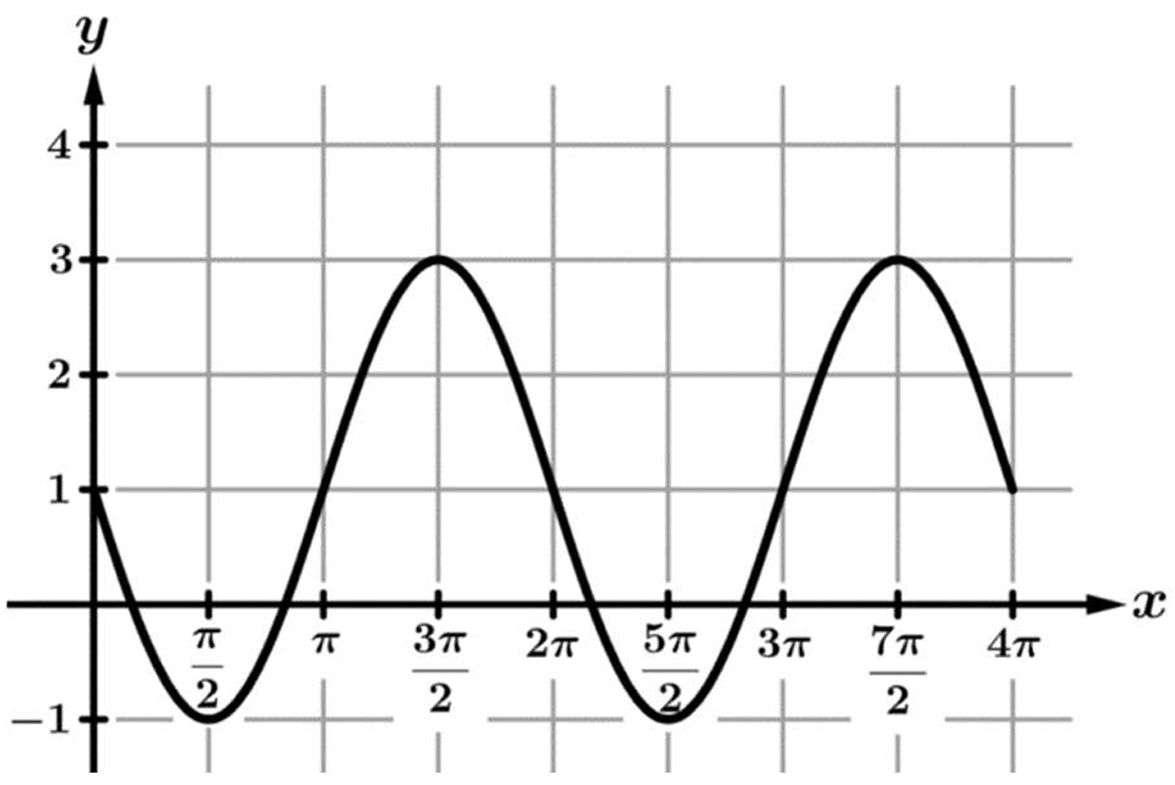
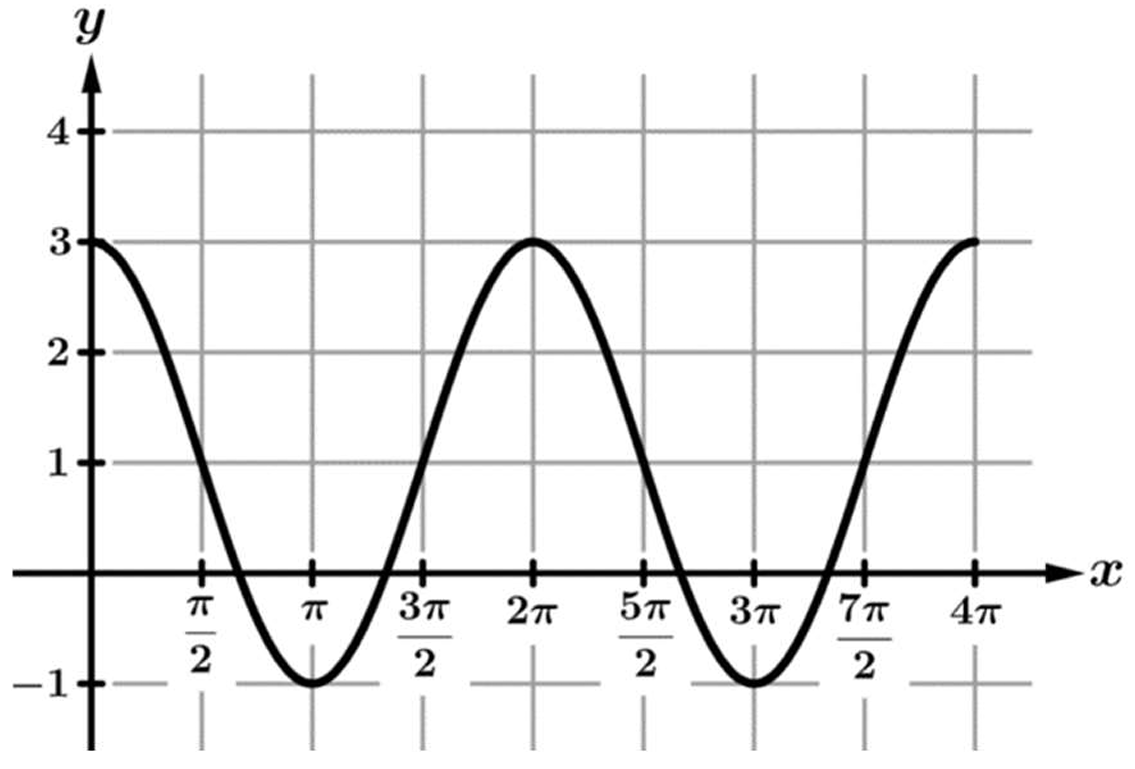
The function \( f \) is given by \( f(x) = -3\sin(2x) \). Which of the following is the graph of \( f \) for \( 0 \le x \le 4\pi \)?
(A)
(B)
(C)
(D)
▶️ Answer/Explanation
Detailed solution

The function is given by \( f(x) = -3\sin(2x) \).
The amplitude is \( |-3| = 3 \), so the graph ranges between -3 and 3.
The coefficient \( b = 2 \) determines the period: \( \text{Period} = \frac{2\pi}{b} = \frac{2\pi}{2} = \pi \).
The negative sign (\( -3 \)) indicates a reflection across the x-axis, so the graph must start at 0 and go downwards.
Graphs (C) and (D) are incorrect because they display periods of \( 2\pi \) and \( 4\pi \) respectively.
Graph (A) is incorrect because it starts by going upwards (positive sine).
Graph (B) correctly shows a period of \( \pi \) and reflects across the x-axis (starts downwards).
Therefore, the correct option is (B).
Question 

Let \( g \) be the function given by \( g(x) = \cos x \). The function \( h \) has the same period as \( g \), and the amplitude of \( h \) is twice the amplitude of \( g \). Which of the following defines \( h \) in terms of \( g \)?
(A) \( h(x) = \frac{1}{2}g(x) \)
(B) \( h(x) = 2g(x) \)
(C) \( h(x) = g\left(\frac{1}{2}x\right) \)
(D) \( h(x) = g(2x) \)
▶️ Answer/Explanation
Detailed solution

The standard cosine function \( g(x) = \cos x \) has an amplitude of \( 1 \) and a period of \( 2\pi \).
The problem states the amplitude of \( h \) is twice that of \( g \), so the new amplitude is \( 2 \times 1 = 2 \).
The period remains the same, meaning the coefficient of \( x \) inside the cosine function must remain \( 1 \).
Amplitude is controlled by the vertical stretch factor \( A \) in \( A \cdot f(x) \).
To double the amplitude, we multiply the entire function by \( 2 \), resulting in \( h(x) = 2g(x) \).
Options (C) and (D) modify the period by changing the input to \( x \), and Option (A) halves the amplitude.
Therefore, the correct function definition is \( h(x) = 2g(x) \).

Question 

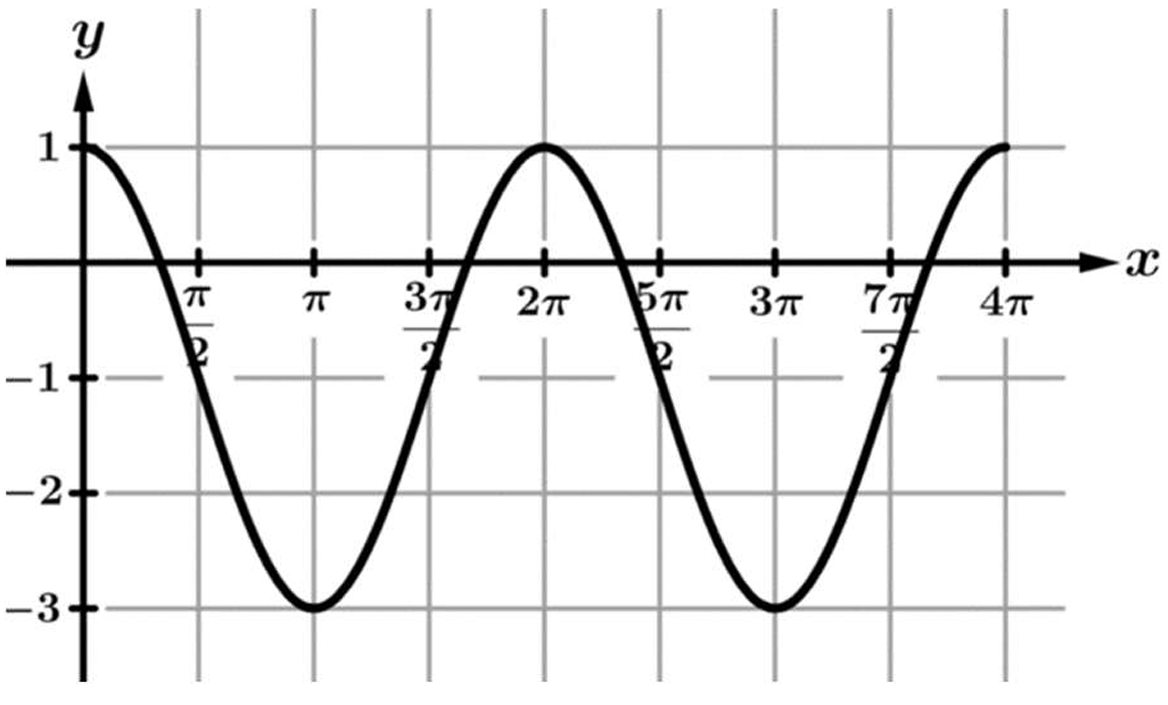
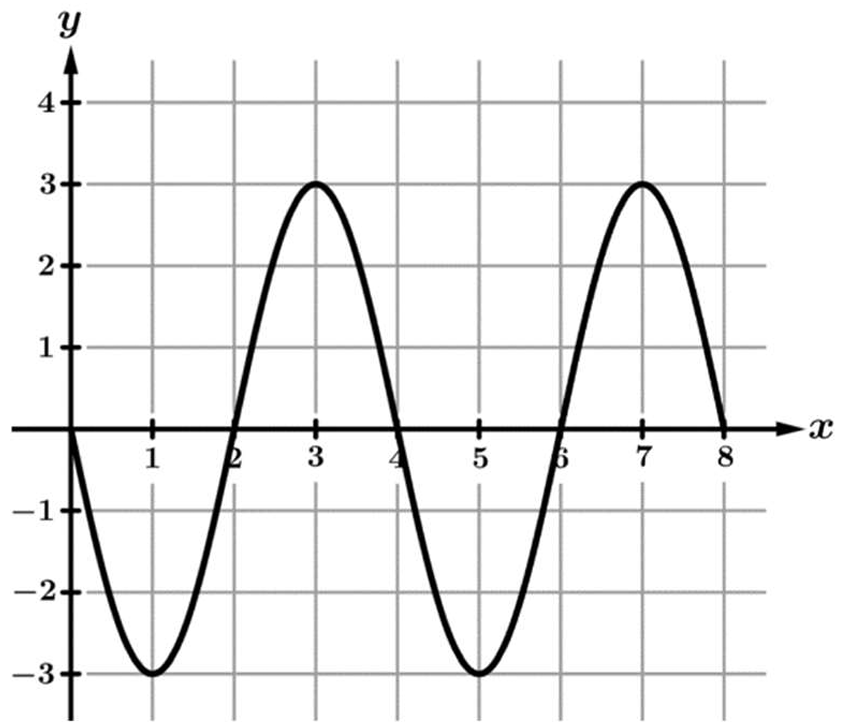
The function \( f \) is given by \( f(x) = 1 – 2\cos(x) \). Which of the following is the graph of \( f \) for \( 0 \le x \le 4\pi \)?
(A)
(B)
(C)
(D)
▶️ Answer/Explanation
Detailed solution

The function is \( f(x) = 1 – 2\cos(x) \). The constant term is \( 1 \), so the midline is \( y = 1 \). This eliminates option (D) which has a midline of \( y = -1 \).
The period is determined by \( \frac{2\pi}{1} = 2\pi \). Option (A) displays a period of \( 4\pi \), so it is incorrect.
The coefficient of the cosine term is \( -2 \). The negative sign indicates a reflection over the midline, meaning the graph starts at a minimum.
Evaluating at \( x = 0 \), we get \( f(0) = 1 – 2\cos(0) = 1 – 2(1) = -1 \). The graph must start at \( (0, -1) \).
Option (B) starts at a maximum value of \( y = 3 \), so it is incorrect.
Option (C) correctly starts at \( y = -1 \), oscillates with a period of \( 2\pi \), and has the correct midline of \( y = 1 \).
Therefore, the correct graph is (C).
Question 

Let \(h\) be the function given by \(h(x) = \sin x\). The period of function \(k\) is twice the period of function \(h\), and the graph of \(k\) is a horizontal translation of \(h\) by \(-\pi\) units. Which of the following defines \(k\) in terms of \(h\)?
(A) \(k(x)=h(2x+\pi)\)
(B) \(k(x)=h(2(x-\pi))\)
(C) \(k(x)=h\left(\frac{1}{2}x+\pi\right)\)
(D) \(k(x)=h\left(\frac{1}{2}(x+\pi)\right)\)
▶️ Answer/Explanation
Detailed solution

The correct answer is (D).
First, determine the scaling factor \(b\). The period of \(h\) is \(2\pi\), so the period of \(k\) is \(4\pi\).
Using the formula \(\text{Period} = \frac{2\pi}{b}\), we have \(4\pi = \frac{2\pi}{b} \rightarrow b = \frac{1}{2}\).
Choices (A) and (B) are immediately eliminated because they use the wrong value of \(b\) (\(b=2\)).
Next, apply the translation. A horizontal translation by \(-\pi\) replaces \(x\) with \((x – (-\pi)) = (x + \pi)\).
Combining the scaling factor and translation inside the function gives \(k(x) = h\left(\frac{1}{2}(x+\pi)\right)\).
Choice (C) represents a different shift; only (D) has the correct translation form.

Question 

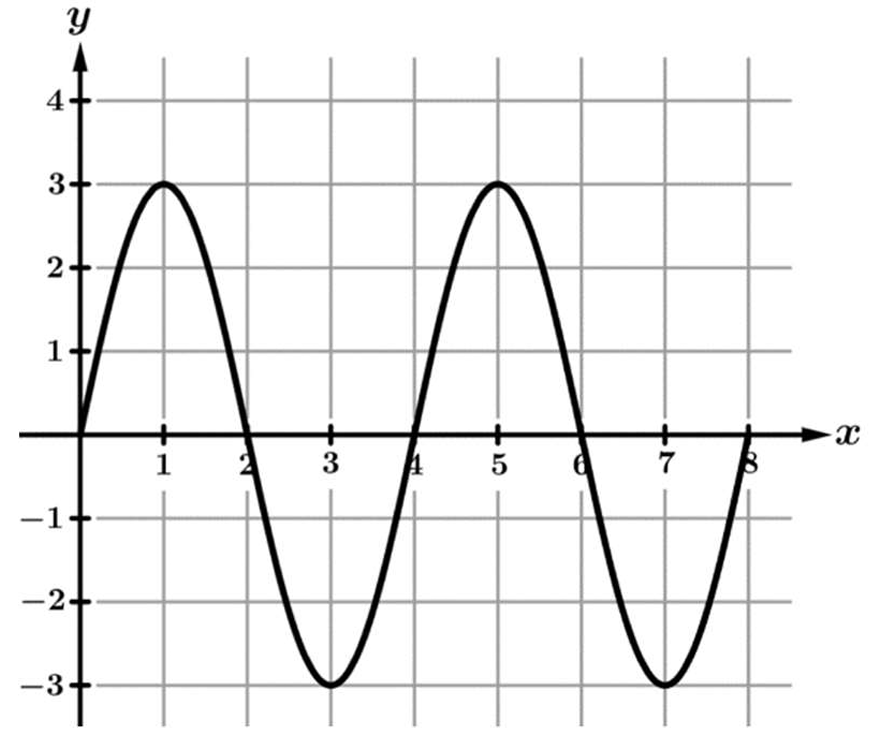
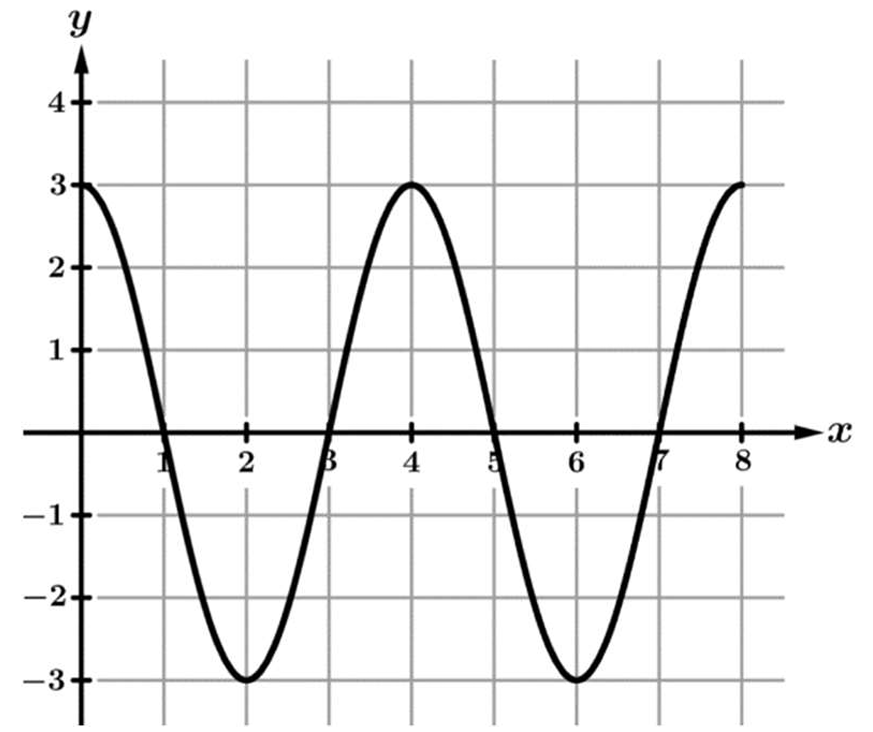
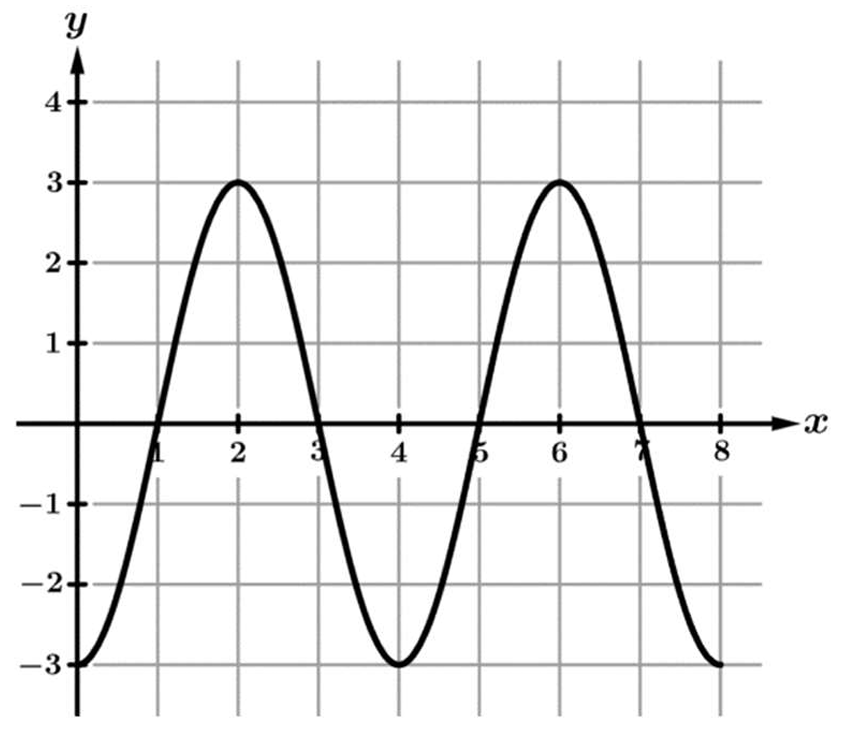
The function \( h \) is given by \( h(x) = -3 \cos \left( \frac{\pi}{2} x \right) \). Which of the following is the graph of \( h \) for \( 0 \le x \le 8 \)?
(A)
(B)
(C)
(D)
▶️ Answer/Explanation
Detailed solution

The correct choice is (B).

1. Calculate Period: Using \( b = \frac{\pi}{2} \), the period is \( \frac{2\pi}{b} = \frac{2\pi}{\pi/2} = 4 \). All options show a period of 4.
2. Identify Function Type: Graphs (A) and (C) start at \( y=0 \), which indicates sine curves. The given function is a cosine curve.
3. Check y-intercept: Evaluate \( h(x) \) at \( x=0 \). \( h(0) = -3 \cos(0) = -3(1) = -3 \). The graph must start at -3.
4. Analyze Reflection: The negative coefficient (\(-3\)) reflects the cosine graph over the line \( y=0 \) (x-axis), meaning it starts at a minimum rather than a maximum.
5. Conclusion: Graph (D) is a standard positive cosine curve (starts at 3), while Graph (B) correctly starts at -3.
Question 

Let \( f \) be the function given by \( f(x) = \cos x \). The function \( g \) is a horizontal translation of \( f \) by \( \frac{\pi}{2} \) units. Which of the following defines \( g \)?
(A) \( g(x) = \cos\left( x + \frac{\pi}{2} \right) \)
(B) \( g(x) = \cos(x) + \frac{\pi}{2} \)
(C) \( g(x) = \sin(x) \)
(D) \( g(x) = -\sin(x) \)
▶️ Answer/Explanation
Detailed solution

To find the function \( g(x) \), we apply the rules of function transformation to \( f(x) = \cos x \).
A horizontal translation by \( c \) units typically implies a shift to the right, defined as \( f(x – c) \).
Here, the translation is by \( \frac{\pi}{2} \), so \( g(x) = \cos\left( x – \frac{\pi}{2} \right) \).
Using trigonometric identities, we know that \( \cos\left( x – \frac{\pi}{2} \right) = \cos\left( \frac{\pi}{2} – x \right) = \sin(x) \).
Therefore, the correct function is \( g(x) = \sin(x) \).
Looking at the other options: Option (A) represents a shift to the left by \( \frac{\pi}{2} \).
Option (B) represents a vertical translation upwards.
Option (D) is equal to \( \cos\left( x + \frac{\pi}{2} \right) \), which corresponds to a shift to the left.

Question 

The function \( h \) is defined by \( h(x) = a \sin(b(x + c)) + d \), for constants \( a, b, c \) and \( d \). In the \( xy \)-plane, the points \( (2, 4) \) and \( (4, 10) \) represent a minimum value and a maximum value, respectively, on a graph \( h \). What is the value of \( b \)?
(A) \( b = 2 \)
(B) \( b = 4 \)
(C) \( b = \frac{\pi}{2} \)
(D) \( b = \pi \)
▶️ Answer/Explanation
Detailed solution

The horizontal distance between a minimum point and the consecutive maximum point on a sine wave represents half of the period.
Given the x-coordinates of the minimum at \( x=2 \) and the maximum at \( x=4 \), the distance is \( 4 – 2 = 2 \).
Since the half-period is \( 2 \), the full period \( T \) is \( 2 \times 2 = 4 \).
The relationship between the period \( T \) and the coefficient \( b \) is given by the formula \( T = \frac{2\pi}{b} \).
Substituting the known period: \( 4 = \frac{2\pi}{b} \).
Solving for \( b \): \( b = \frac{2\pi}{4} = \frac{\pi}{2} \).
Therefore, the correct option is (C).

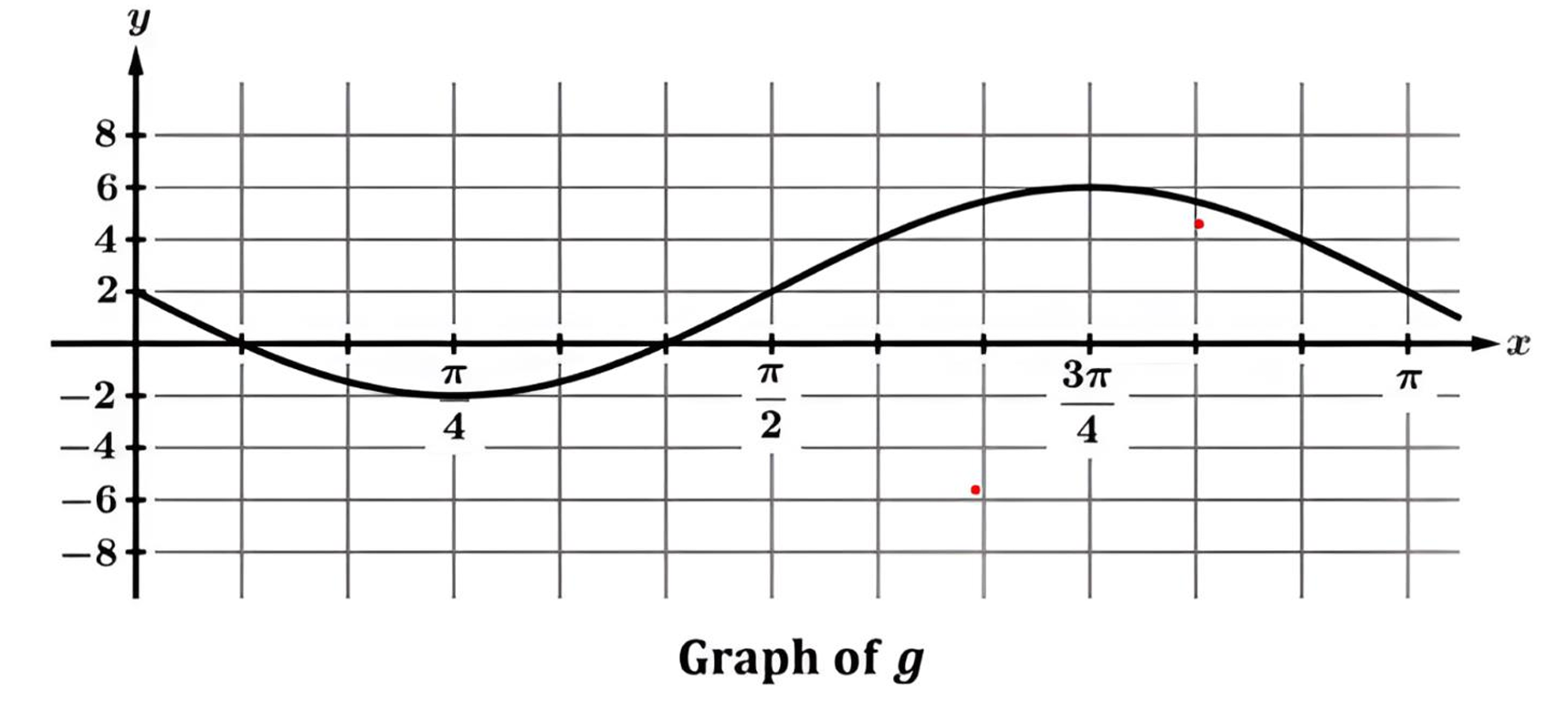
Question 

The figure shows the graph of a trigonometric function \( g \). Which of the following could be an expression for \( g(x) \)?
(A) \( 4 \sin(2x) + 2 \)
(B) \( 4 \cos\left(2\left(x – \frac{\pi}{4}\right)\right) + 2 \)
(C) \( -4 \sin\left(2\left(x – \frac{\pi}{2}\right)\right) + 2 \)
(D) \( 4 \cos\left(2\left(x – \frac{3\pi}{4}\right)\right) + 2 \)
▶️ Answer/Explanation
Detailed solution

Analyze the graph to determine the parameters for the general form \( g(x) = A \cos(b(x – h)) + k \):

  • Midline (\( k \)): The vertical center between the max (\( 6 \)) and min (\( -2 \)) is \( \frac{6 + (-2)}{2} = 2 \).
  • Amplitude (\( A \)): The distance from the midline to a peak is \( 6 – 2 = 4 \).
  • Period and Frequency (\( b \)): The distance from the minimum (\( \frac{\pi}{4} \)) to the maximum (\( \frac{3\pi}{4} \)) is half the period (\( \frac{\pi}{2} \)). Thus, the full period is \( \pi \), making \( b = \frac{2\pi}{\pi} = 2 \).
  • Phase Shift (\( h \)): A positive cosine graph peaks at its phase shift. The graph shows a maximum at \( x = \frac{3\pi}{4} \).

Substituting these values gives: \( g(x) = 4 \cos\left(2\left(x – \frac{3\pi}{4}\right)\right) + 2 \).

This corresponds to Option (D).

Question 

The function \(f\) is defined by \(f(x) = a \cos(b(x+c)) + d\), for constants \(a, b, c\) and \(d\). In the \(xy\)-plane, the points \((\pi, 6)\) and \((2\pi, 10)\) represent a minimum value and a maximum value, respectively, on the graph of \(f\). What are the values of \(b\) and \(d\)?
(A) \(b = 2\pi\) and \(d = 2\)
(B) \(b = 1\) and \(d = 2\)
(C) \(b = 2\pi\) and \(d = 4\)
(D) \(b = 1\) and \(d = 4\)
▶️ Answer/Explanation
Detailed solution

The horizontal distance between the minimum at \(x=\pi\) and the maximum at \(x=2\pi\) is \(\pi\), which represents half of the period (\(\frac{T}{2}\)).
Therefore, the full period is \(T = 2\pi\). Using the formula \(T = \frac{2\pi}{b}\), we solve \(2\pi = \frac{2\pi}{b}\) to find that \(b = 1\).
The vertical shift \(d\) is the midpoint (average) of the maximum and minimum values: \(d = \frac{\text{Max} + \text{Min}}{2}\).
Using the printed values, \(d = \frac{10 + 6}{2} = 8\). However, this does not match any option, suggesting a typo in the question text.
If the minimum value was intended to be \(-6\) (missing negative sign), then \(d = \frac{10 + (-6)}{2} = 2\).
Since \(b=1\) is definite, and \(d=2\) matches option (B) under the assumption of a sign error, (B) is the intended answer.

Question 

The table gives ordered pairs for seven points from a larger data set. The larger data set can be modeled by a sinusoidal function \(f\) with a period of 6.
38. Which of the following best defines \(f(x)\) for the larger data set?
(A) \(-4 \cos(12\pi x) + 1\)
(B) \(-4 \cos\left(\frac{\pi}{3} x\right) + 1\)
(C) \(-5 \cos(12\pi x) + 1\)
(D) \(-5 \cos\left(\frac{\pi}{3} x\right) + 1\)
▶️ Answer/Explanation
Detailed solution

The midline is the average of the maximum (\(6\)) and minimum (\(-4\)) values: \(\frac{6 + (-4)}{2} = 1\).
The amplitude is the difference between the maximum value and the midline: \(6 – 1 = 5\).
The period is given as \(6\). Using the formula \(\text{Period} = \frac{2\pi}{b}\), we get \(6 = \frac{2\pi}{b}\), solving for \(b\) gives \(b = \frac{\pi}{3}\).
At \(x = 0\), the function value is the minimum (\(-4\)), which indicates a reflected cosine function (negative coefficient).
Therefore, the function is modeled by \(f(x) = -5 \cos\left(\frac{\pi}{3}x\right) + 1\).
Comparing this with the given options, it matches option (D).
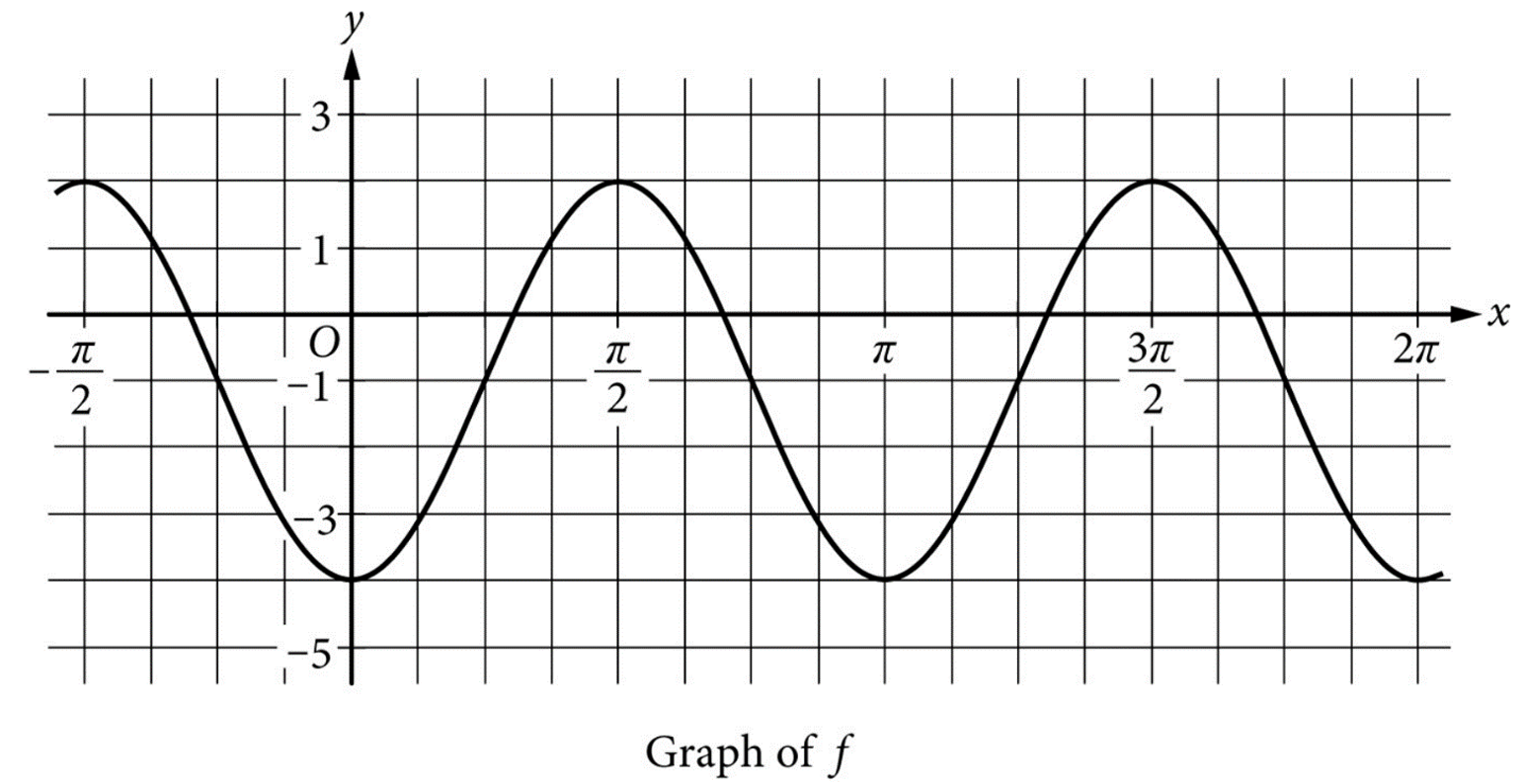
Question 

The figure shows the graph of a trigonometric function (f). Which of the following could be an expression of (f(x))?
(A) (3 \cos\left(2\left(x – \frac{\pi}{4}\right)\right) – 1)
(B) (3 \cos\left(2\left(x – \frac{\pi}{8}\right)\right) – 1)
(C) (3 \sin\left(2\left(x – \frac{\pi}{4}\right)\right) – 1)
(D) (3 \sin\left(2\left(x – \frac{\pi}{8}\right)\right) – 1)
▶️ Answer/Explanation
Detailed solution

Correct Option: (D)

The midline is (y = -1) because the maximum is (2) and the minimum is (-4), averaging to (\frac{2 + (-4)}{2} = -1).

The amplitude is (3), calculated as the distance from the midline (-1) to the maximum (2).

The period is (\pi), as the distance between peaks (e.g., from (\approx 0.375\pi) to (\approx 1.375\pi)) corresponds to (\pi). This implies the coefficient (B = \frac{2\pi}{\pi} = 2).

The graph crosses the midline (y=-1) going upwards at (x = \frac{\pi}{8}). Since a standard sine function starts this way at (x=0), this indicates a phase shift of (\frac{\pi}{8}) to the right.

Combining these, the function is (f(x) = 3 \sin\left(2\left(x – \frac{\pi}{8}\right)\right) – 1).
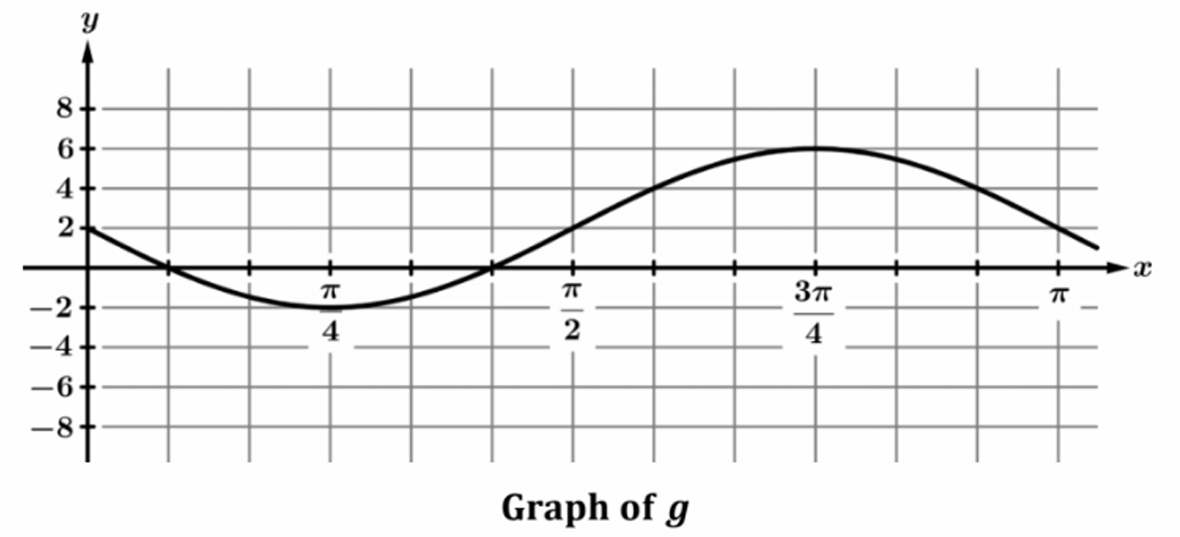
Question 

The number of people waiting in a line to enter a stadium can be modeled by the function \(b\) defined by \(b(t) = 42 \cos\left(\frac{\pi}{30}t\right) + 45\) for \(0 \le t \le 60\), where \(t\) is the time, in minutes, since the stadium opened. Based on the graph of the model, which of the following is true?
(A) The number of people in line is never equal to \(0\) because the midline vertical shift is greater than the amplitude.
(B) The number of people in line is never equal to \(0\) because the amplitude is greater than the midline vertical shift.
(C) The number of people in line reaches \(0\) because the midline vertical shift is greater than the amplitude.
(D) The number of people in line reaches \(0\) because the amplitude is greater than the midline vertical shift.
▶️ Answer/Explanation
Detailed solution

The function is given by \(b(t) = 42 \cos\left(\frac{\pi}{30}t\right) + 45\).
The value \(45\) represents the midline vertical shift (vertical displacement).
The value \(42\) represents the amplitude of the cosine wave.
The minimum value of a cosine function is \(-1\), so the minimum value of \(b(t)\) is \(45 + 42(-1) = 45 – 42 = 3\).
Since the minimum value is \(3\), the number of people in line is always at least \(3\) and never reaches \(0\).
This occurs because the midline vertical shift (\(45\)) is greater than the amplitude (\(42\)).
Therefore, option (A) is the correct statement.

Question 

Let \( f \) be the function given by \( f(x) = \sin x \). The function \( g \) has the same amplitude as \( f \), and the period of \( g \) is \( \frac{1}{2} \) of the period of \( f \). Which of the following defines \( g \) in terms of \( f \)?
(A) \( g(x) = f(\frac{1}{2}x) \)
(B) \( g(x) = \frac{1}{2}f(x) \)
(C) \( g(x) = f(2x) \)
(D) \( g(x) = 2f(x) \)
▶️ Answer/Explanation
Detailed solution

The correct answer is (C).

1. The function \( f(x) = \sin x \) has an amplitude of \( 1 \) and a period of \( 2\pi \).
2. The function \( g \) maintains the same amplitude (\( 1 \)), so there is no vertical stretch or compression (coefficient remains \( 1 \)).
3. The period of \( g \) is \( \frac{1}{2} \) of the period of \( f \), meaning the new period is \( \frac{1}{2}(2\pi) = \pi \).
4. A sinusoidal function with period \( P \) takes the form \( \sin(bx) \), where \( |b| = \frac{2\pi}{P} \).
5. Substituting the new period, we solve for \( b \): \( b = \frac{2\pi}{\pi} = 2 \).
6. Therefore, \( g(x) = \sin(2x) \). In function notation, this is equivalent to substituting \( 2x \) into \( f(x) \), resulting in \( f(2x) \).

Question 

A circular clock face on a wall has hours marked with integers from \(1\) to \(12\) and the hour hand that rotates as time passes. The hour hand points to the number \(12\) at midnight. The height above the floor, in inches, of the tip of the hour hand at \(t\) hours after midnight is modeled by the periodic function \(y\). Values of \(y(t)\) at selected values of \(t\) are given in the table. For \(t \geq 0\), which of the following could be an expression for \(y(t)\)?
\(t\)
hours
\(0\)\(3\)\(6\)\(9\)\(12\)
\(y(t)\)
inches
\(78\)\(70\)\(62\)\(70\)\(78\)
(A) \(-8 \sin\left(\frac{\pi}{12}(t-3)\right) + 70\)
(B) \(-8 \sin\left(\frac{\pi}{6}(t-3)\right) + 70\)
(C) \(8 \cos\left(\frac{\pi}{12}(t-3)\right) + 70\)
(D) \(8 \cos\left(\frac{\pi}{6}(t-3)\right) + 70\)
▶️ Answer/Explanation
Detailed solution

The maximum height is \(78\) and the minimum is \(62\), so the vertical shift (midline) is \(\frac{78 + 62}{2} = 70\) and amplitude is \(78 – 70 = 8\).
The function repeats its values from \(t=0\) to \(t=12\), so the period is \(12\).
The coefficient \(B\) is calculated as \(\frac{2\pi}{\text{Period}} = \frac{2\pi}{12} = \frac{\pi}{6}\). This eliminates options (A) and (C).
We test the point \(t=0\) (where \(y=78\)) on the remaining options to find the correct expression.
For option (D): \(8 \cos\left(\frac{\pi}{6}(0-3)\right) + 70 = 8 \cos\left(-\frac{\pi}{2}\right) + 70 = 0 + 70 = 70\) (Incorrect).
For option (B): \(-8 \sin\left(\frac{\pi}{6}(0-3)\right) + 70 = -8 \sin\left(-\frac{\pi}{2}\right) + 70 = -8(-1) + 70 = 78\) (Correct).
Therefore, the correct expression is (B).

Question 

The figure shows the graph of a trigonometric function $g$. Which of the following could be an expression for $g(x)$?
(A) $4 \sin(2x) + 2$
(B) $4 \cos\left(2\left(x – \frac{\pi}{4}\right)\right) + 2$
(C) $-4 \sin\left(2\left(x – \frac{\pi}{2}\right)\right) + 2$
(D) $4 \cos\left(2\left(x – \frac{3\pi}{4}\right)\right) + 2$
▶️ Answer/Explanation
Detailed solution

The midline of the graph is $y = 2$ and the amplitude is $4$, so the form is $g(x) = 4f(b(x-h)) + 2$.
The period is $\pi$ (from $x = -\frac{\pi}{4}$ to $x = \frac{3\pi}{4}$), so $b = \frac{2\pi}{\text{period}} = \frac{2\pi}{\pi} = 2$.
A maximum occurs at $x = \frac{3\pi}{4}$, which matches the peak of a standard cosine function shifted right.
Substituting into the cosine form $A \cos(b(x-h)) + k$, we get $4 \cos(2(x – \frac{3\pi}{4})) + 2$.
Checking point $(0, 2)$: $4 \cos(2(0 – \frac{3\pi}{4})) + 2 = 4 \cos(-\frac{3\pi}{2}) + 2 = 4(0) + 2 = 2$, which is correct.
Therefore, the expression in option (D) correctly represents the graph.

Question 

The figure shows a robotic arm rotating in a circular counterclockwise direction that completes one rotation every $2$ seconds. Point $S$ is on the tip of the arm, and point $X$ does not move. As the arm rotates at a constant speed, the height of $S$ above $X$ periodically increases and decreases. At time $t = 0$ seconds, $S$ is at its lowest position, $6$ inches directly below $X$. At its highest position, $S$ is $20$ inches directly above $X$.
The sinusoidal function $h$ models the height of $S$ above $X$, in inches, as a function of time $t$, in seconds. A positive value of $h(t)$ indicates $S$ is above $X$; a negative value of $h(t)$ indicates $S$ is below $X$.
Part A
The graph of $h$ and its dashed midline for two full cycles is shown. Five points, $F, G, J, K,$ and $P$, are labeled on the graph. Determine possible coordinates $(t, h(t))$ for the five points.
Part B
The function $h$ can be written in the form $h(t) = a \cos(b(t + c)) + d$. Find values of constants $a, b, c,$ and $d$.
Part C
Refer to the graph of $h$ in part (A). The $t$-coordinate of $K$ is $t_1$, and the $t$-coordinate of $P$ is $t_2$.
(i) On the interval $(t_1, t_2)$, which of the following is true about $h$?
      a. $h$ is positive and increasing.
      b. $h$ is positive and decreasing.
      c. $h$ is negative and increasing.
      d. $h$ is negative and decreasing.
(ii) Describe how the rate of change of $h$ is changing on the interval $(t_1, t_2)$.
▶️ Answer/Explanation
Detailed solution

Part A: Coordinates of Points

At $t = 0$, $S$ is at its minimum height $-6$ (below $X$).
The maximum height is $20$.
The midline $d = \frac{20 + (-6)}{2} = 7$.
The period is $2$ seconds.
The graph starts at a minimum at $t = 0$, reaches midline at $t = 0.5$, maximum at $t = 1$, midline at $t = 1.5$, and minimum at $t = 2$.
Based on the visual positions in the provided graph:
$F$ (first maximum): $(1, 20)$
$G$ (midline, decreasing): $(1.5, 7)$
$J$ (minimum): $(2, -6)$
$K$ (midline, increasing): $(2.5, 7)$
$P$ (second maximum): $(3, 20)$

Part B: Finding Constants

$a$ (Amplitude) $= \frac{20 – (-6)}{2} = 13$. Since we use $\cos$ and start at a minimum, $a = -13$ (or use a phase shift).
$d$ (Vertical shift/Midline) $= 7$.
$b$ (Frequency factor) $= \frac{2\pi}{\text{period}} = \frac{2\pi}{2} = \pi$.
$c$ (Phase shift): For $h(t) = a \cos(b(t+c)) + d$, if $a = -13$, then at $t=0$, $-13\cos(b(0+c))+7 = -6 \implies \cos(bc)=1 \implies c = 0$.
Final values: $a = -13, b = \pi, c = 0, d = 7$.

Part C: Interval Analysis

(i) At $K$, $h(t)=7$ and is increasing. At $P$, $h(t)=20$ (maximum).
On $(t_1, t_2)$, the height is between $7$ and $20$, so it is positive.
The graph is moving from the midline up to the peak, so it is increasing.
Correct Option: a

(ii) On the interval $(t_1, t_2)$, the graph is concave down as it approaches the maximum.
Therefore, the rate of change of $h$ (the slope) is decreasing.
It starts at its maximum positive value at $K$ and decreases toward zero at $P$.

Question 

A windshield wiper blade on a car window rotates back and forth. When the wiper blade is farthest to the left or farthest to the right, the measure of the angle formed by the wiper blade and the vertical centerline (see figure) is (0.75) radians.
At time (t=0) seconds, the wiper blade is farthest to the left. The wiper blade then rotates to the right and passes the vertical centerline. At time (t=1) seconds, the wiper blade is farthest to the right for the first time. Then, the wiper blade rotates left, passes the vertical centerline, and is farthest to the left again at time (t=2) seconds. As the wiper blade rotates, the measure of the angle formed by the wiper blade and the vertical centerline periodically increases and decreases.
The sinusoidal function (h) models the measure of the angle, in radians, formed by the wiper blade and the vertical centerline as a function of time (t), in seconds. A negative value of (h(t)) indicates the wiper blade is to the left of the vertical centerline; a positive value of (h(t)) indicates the wiper blade is to the right of the vertical centerline.
(A) The graph of (h) and its dashed midline for two full cycles is shown. Five points, (F, G, J, K), and (P) are labeled on the graph. No scale is indicated, and no axes are presented. Determine possible coordinates ((t, h(t))) for the five points (F, G, J, K), and (P).
(B) The function (h) can be written in the form (h(t) = a\sin(b(t+c)) + d). Find values of the constants (a, b, c), and (d).
(C) Refer to the graph of (h) in part (A). The (t)-coordinate of (G) is (t_1), and the (t)-coordinate of (J) is (t_2).
(i) On the interval ((t_1, t_2)), which of the following is true about (h)?
  • a. (h) is positive and increasing.
  • b. (h) is positive and decreasing.
  • c. (h) is negative and increasing.
  • d. (h) is negative and decreasing.
(ii) Describe how the rate of change of (h) is changing on the interval ((t_1, t_2)).
▶️ Answer/Explanation
Detailed solution

(A) Coordinates for the points (F, G, J, K), and (P)

First, we analyze the motion to establish the timeline:

  • At (t = 0), the blade is farthest left, so (h(0) = -0.75). This is a minimum value.
  • At (t = 1), the blade is farthest right, so (h(1) = 0.75). This is a maximum value.
  • At (t = 2), the blade is farthest left again, so (h(2) = -0.75). This is the next minimum.

The graph shows a sinusoidal wave. Let’s map the points based on this cycle:

  • Point (F): This is the first maximum peak shown. Since the motion starts at a minimum at (t=0), the first maximum occurs at (t=1).
    Coordinate: (F(1, 0.75))
  • Point (G): This point is on the midline (where (h(t)=0)) as the graph goes downwards from a maximum to a minimum. This occurs exactly halfway between the maximum at (t=1) and the minimum at (t=2).
    (t = \frac{1+2}{2} = 1.5).
    Coordinate: (G(1.5, 0))
  • Point (J): This is the minimum trough. We know the minimum occurs at (t=2).
    Coordinate: (J(2, -0.75))
  • Point (K): This point is on the midline as the graph goes upwards from a minimum to the next maximum. This occurs halfway between the minimum at (t=2) and the next maximum at (t=3).
    (t = \frac{2+3}{2} = 2.5).
    Coordinate: (K(2.5, 0))
  • Point (P): This is the next maximum peak. The period is (2) seconds (from (t=1) to (t=3)).
    Coordinate: (P(3, 0.75))

(B) Finding constants (a, b, c), and (d)

We are fitting the function (h(t) = a\sin(b(t+c)) + d).

  • Amplitude ((a)): Half the distance between max and min.
    (a = \frac{0.75 – (-0.75)}{2} = 0.75).
  • Vertical Shift ((d)): The average of max and min.
    (d = \frac{0.75 + (-0.75)}{2} = 0).
  • Period ((T)) and Frequency ((b)): The wiper completes a full cycle (left-right-left) in (2) seconds.
    (T = 2).
    The formula for period is (T = \frac{2\pi}{b}).
    (2 = \frac{2\pi}{b} \Rightarrow b = \pi).
  • Phase Shift ((c)):
    We know the function starts at a minimum at (t=0). A standard positive sine wave starts at 0 and goes up. A sine wave shifted to match this graph must cross the midline going upwards at (t=0.5) (halfway between min at (0) and max at (1)).
    So, we need the argument of the sine function, (b(t+c)), to be (0) when (t=0.5).
    (\pi(0.5 + c) = 0 \Rightarrow c = -0.5).
    Alternatively, using (c=1.5) is also valid, but (-0.5) is the simplest magnitude.

Values:
(a = 0.75)
(b = \pi)
(c = -0.5)
(d = 0)


(C) Analysis of interval ((t_1, t_2))

From part (A), (t_1) (point (G)) is (1.5) and (t_2) (point (J)) is (2). The interval is ((1.5, 2)).

(i) Which statement is true?
Looking at the graph between point (G) and point (J):
The graph is below the midline, meaning the values of (h) are negative.
The graph is moving downwards towards the minimum, meaning (h) is decreasing.
Answer: d. (h) is negative and decreasing.

(ii) Rate of change of (h)
The “rate of change of (h)” refers to the derivative, (h'(t)) (the slope of the tangent line).
On the interval ((1.5, 2)), the graph is concave up (it is shaped like a cup).
Mathematically:
– At (G) ((t=1.5)), the slope is at its steepest negative value.
– At (J) ((t=2)), the slope is zero (horizontal tangent at the minimum).
– As the slope goes from a negative number (e.g., (-2)) to (0), the value of the slope is increasing.

Answer: The rate of change of (h) is increasing on the interval ((t_1, t_2)).

Question 

The blades of an electric fan rotate in a clockwise direction and complete $5$ rotations every second. Point $B$ is on the tip of one of the fan blades and is located directly above the center of the fan at time $t = 0$ seconds. Point $B$ is $6$ inches from the center of the fan. The center of the fan is $20$ inches above a level table. The sinusoidal function $h$ models the distance between $B$ and the surface of the table in inches as a function of time $t$ in seconds.
(A) The graph of ℎ and its dashed midline for two full cycles is shown. Five points, 𝐹, 𝐺, 𝐽, 𝐾, and 𝑃 are labeled on the graph. No scale is indicated, and no axes are presented. 
Determine the possible coordinates $(t, h(t))$ for the $5$ points: $F, G, J, K,$ and $P$.
(B) The function $h$ can be written in the form $h(t) = a \sin(b(t + c)) + d$. Find values of constants $a, b, c,$ and $d$.
(C) Refer to the graph of $h$ in part (A). The $t$-coordinate of $K$ is $t_1$, and the $t$-coordinate of $P$ is $t_2$.
(i) On the interval $(t_1, t_2)$, which of the following is true about $h$?
      (A) $h$ is positive and increasing
     (B) $h$ is positive and decreasing
     (C) $h$ is negative and increasing
     (D) $h$ is negative and decreasing
(ii) Describe how the rate of change of $h$ is changing on the interval $(t_1, t_2)$.
▶️ Answer/Explanation
Detailed solution

(A)

The center of the fan is $d = 20$ inches above the table. The radius of the fan blade is $r = 6$ inches, which is the amplitude $a$. The maximum height is $20 + 6 = 26$ inches and the minimum height is $20 – 6 = 14$ inches. The fan completes $5$ rotations per second, so the period is $T = \frac{1}{5} = 0.2$ seconds. Point $B$ starts at the maximum height at $t = 0$, so point $F$ is $(0, 26)$. Point $G$ is at the midline after $\frac{1}{4}$ of a period: $(\frac{0.2}{4}, 20) = (0.05, 20)$. Point $J$ is at the minimum after $\frac{1}{2}$ of a period: $(\frac{0.2}{2}, 14) = (0.1, 14)$. Point $K$ is at the midline after $\frac{3}{4}$ of a period: $(\frac{3 \times 0.2}{4}, 20) = (0.15, 20)$. Point $P$ is at the maximum after $1$ full period: $(0.2, 26)$. The coordinates are: $F(0, 26)$, $G(0.05, 20)$, $J(0.1, 14)$, $K(0.15, 20)$, and $P(0.2, 26)$.

(B)

The amplitude is $a = 6$. The vertical shift (midline) is $d = 20$. The period is $T = 0.2$, so the frequency constant is $b = \frac{2\pi}{0.2} = 10\pi$. Since the function starts at a maximum at $t=0$, it follows $h(t) = 6 \cos(10\pi t) + 20$. To write this as a sine function $h(t) = 6 \sin(10\pi(t + c)) + 20$, we use the identity $\cos(\theta) = \sin(\theta + \frac{\pi}{2})$. Setting $10\pi(t + c) = 10\pi t + \frac{\pi}{2}$, we find $10\pi c = \frac{\pi}{2}$, which gives $c = \frac{1}{20} = 0.05$. Thus, $a = 6$, $b = 10\pi$, $c = 0.05$, and $d = 20$.

(C)

(i) On the interval $(t_1, t_2)$, which is $(0.15, 0.2)$, the graph moves from the midline (point $K$) up to the maximum (point $P$). Throughout this interval, $h(t)$ is between $20$ and $26$, so it is positive. The function is moving upwards, so it is increasing. The correct option is (A) $h$ is positive and increasing.
(ii) On the interval $(t_1, t_2)$, the graph is concave down as it levels off toward the maximum. The slope (rate of change) is positive because the function is increasing. However, the slope is becoming less steep as it approaches the horizontal tangent at point $P$. Therefore, the rate of change of $h$ is decreasing on the interval $(t_1, t_2)$.

Scroll to Top