
▶️ Answer/Explanation
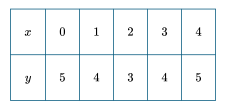
From the table:
Max value \(y=5\) at \(x=0,4\) (multiples of 4)
Min value \(y=3\) at \(x=2\)
Midline: \( \frac{5+3}{2} = 4 \)
Amplitude: \( \frac{5-3}{2} = 1 \)
Period = 4 → \( \frac{2\pi}{b} = 4 \) → \( b = \frac{\pi}{2} \)
Using cosine with max at \(x=0\): \( f(x) = 1\cdot \cos\left(\frac{\pi}{2}x\right) + 4 \)
✅ Answer: (A)
▶️ Answer/Explanation
Step 1: Identify key features of the data
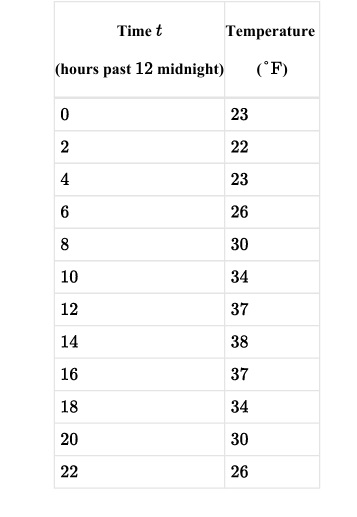
From the table, the maximum temperature is \(38^\circ\mathrm{F}\) at \(t = 14\),
and the minimum temperature is \(22^\circ\mathrm{F}\) at \(t = 2\).
Step 2: Interpret the sinusoidal model
The model is \(F(t) = 8\cos\left(\dfrac{\pi}{12}(t + c)\right) + 30\).
The amplitude is \(8\), the midline is \(30\), and the period is
\(\dfrac{2\pi}{\pi/12} = 24\) hours, which matches a daily temperature cycle.
Step 3: Use the cosine maximum
A cosine function reaches its maximum when its argument is \(0\).
Thus, the maximum of \(F\) occurs when
\(\dfrac{\pi}{12}(t + c) = 0\), which gives \(t + c = 0\).
Step 4: Align the maximum of the model with the data
The data show a maximum temperature at \(t = 14\).
Substituting gives \(14 + c = 0\), so \(c = -14\).
Since cosine is periodic, a phase shift of \(-14\) is equivalent to \(14\).
Thus, \(c = 14\).
Step 5: Interpret the meaning of \(c\)
The constant \(c\) appears inside the cosine function, so it represents a
phase shift. The value \(c = 14\) aligns a maximum of the model with a
maximum of the data.
\(\boxed{\text{Correct answer: (C)}}\)
▶️ Answer/Explanation
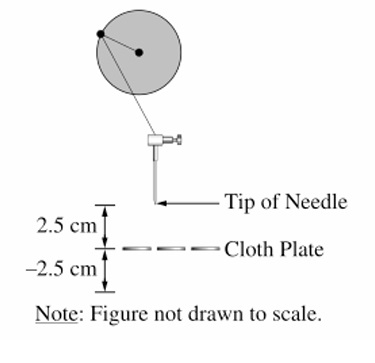
From the table: at \( t = 0 \), displacement = \( 2.5 \) cm (maximum); at \( t = \frac{1}{24} \) s, displacement = \( -2.5 \) cm (minimum).
Amplitude \( A = \frac{2.5 – (-2.5)}{2} = 2.5 \) cm.
The time from a maximum to the next minimum is half the period, so \( T/2 = \frac{1}{24} \) ⇒ \( T = \frac{1}{12} \) seconds.
For \( d(t) = A\cos(bt) \), the period is \( T = \frac{2\pi}{b} \).
Set \( \frac{2\pi}{b} = \frac{1}{12} \) ⇒ \( b = 24\pi \).
Thus \( d(t) = 2.5\cos(24\pi t) \), which matches choice (C).
✅ Answer: (C)
▶️ Answer/Explanation
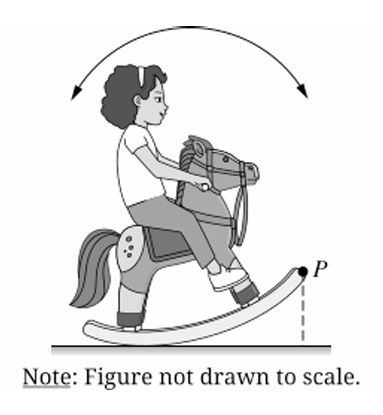
Ground level corresponds to \( h(t) = 0 \).
The minimum of \( h(t) \) occurs when \( \cos\left(\frac{\pi}{3}t\right) = -1 \), giving \( h_{\min} = 6 + 6(-1) = 0 \).
Thus \( P \) touches ground once per period when \(\cos = -1\).
Period \( T = \frac{2\pi}{\pi/3} = 6 \) seconds.
Number of periods in 300 seconds: \( \frac{300}{6} = 50 \).
So \( P \) touches ground 50 times.
✅ Answer: (B)
▶️ Answer/Explanation
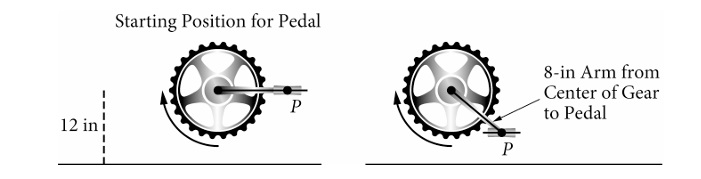
The pedal moves in a circle with radius \(8\) inches, so the amplitude is \(8\).
At time \(t = 0\), the pedal is \(12\) inches above the ground, so the midline is \(12\).
Thus, the height function has the form
\(h(t) = 12 \pm 8(\text{trigonometric function})\).
The patient pedals \(1\) revolution per second, so the period is \(1\) second.
This corresponds to an angular frequency of \(2\pi\).
Therefore, the function must involve \(\sin(2\pi t)\).
At \(t = 0\), the pedal height is \(12\).
Since \(\sin 0 = 0\),
\(h(0) = 12 – 8\sin(2\pi \cdot 0) = 12\),
which matches the given condition.
\(\boxed{\text{Correct answer: (D)}}\)
\(h(t) = 12 – 8\sin(2\pi t)\)
▶️ Answer/Explanation
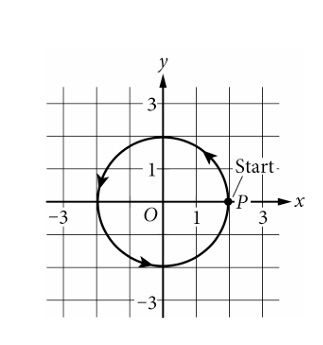
Given: 120 rotations in 20 minutes ⇒ frequency = \( \frac{120}{20} = 6 \) rotations per minute.
Period = \( \frac{1}{\text{frequency}} = \frac{1}{6} \) minute.
Sinusoidal model for y-coordinate: \( f(t) = a\sin(bt) \) with amplitude \( a = 2 \) (radius).
Period formula: \( \frac{2\pi}{b} = \frac{1}{6} \) ⇒ \( b = 12\pi \).
Thus, \( f(t) = 2\sin(12\pi t) \).
Check: At \( t = 0 \), \( f(0) = 0 \) (assuming start at y=0). After \( t = 1/6 \) minute, one full cycle occurs.
✅ Answer: (D)
▶️ Answer/Explanation
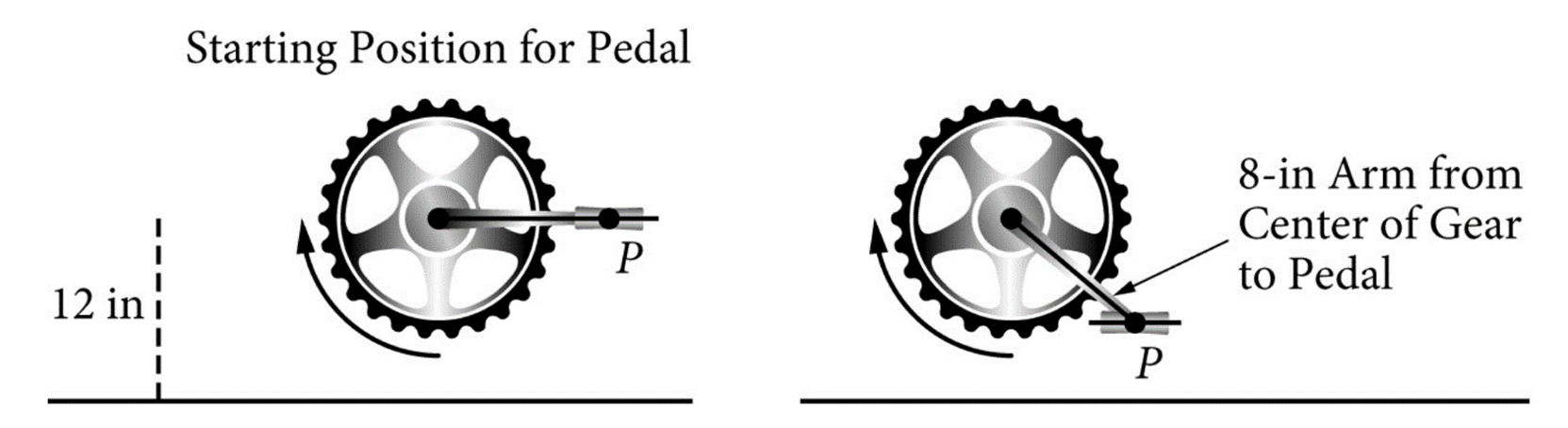
The center of the gear is 12 inches above the ground, so the vertical midline of the function is 12.
The length of the pedal arm is 8 inches, which determines the amplitude of the motion, so amplitude = 8.
The pedal completes 1 revolution per second, meaning the period \(T = 1\).
The coefficient of \(t\) inside the function is determined by \(\frac{2\pi}{T} = \frac{2\pi}{1} = 2\pi\).
At \(t=0\), the pedal starts at the midline (12 in) and moves clockwise (downwards first).
A sine function starts at the midline; since it moves down first, it must be a negative sine function.
Combining these components gives the expression: \(h(t) = 12 – 8 \sin(2\pi t)\).
Correct Option: (D)
▶️ Answer/Explanation
The correct answer is (C).
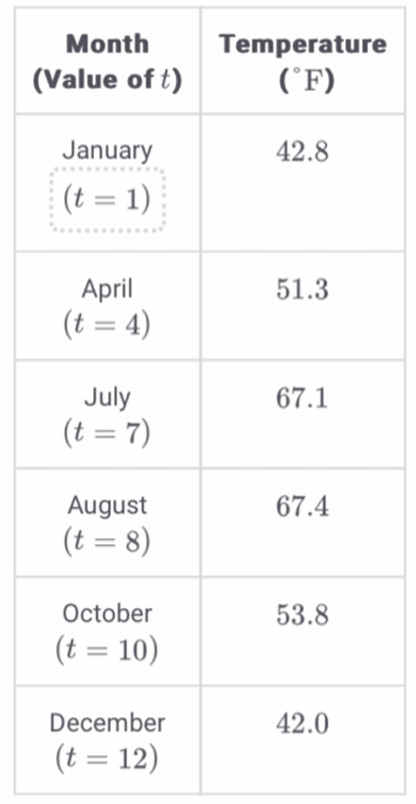
Input the given $(t, \text{Temp})$ pairs into a graphing calculator’s sinusoidal regression ($SinReg$) tool.
The resulting model is approximately $y = 12.87\sin(0.50t – 2.19) + 54.89$.
Substitute $t = 6$ into the regression equation to find the temperature for June.
Ensure the calculator is in Radian mode for the calculation.
The predicted temperature is $54.89 + 12.87\sin(0.50(6) – 2.19) \approx 64.88$.
Rounding to the nearest tenth gives $64.9^\circ\text{F}$.