
AP Precalculus -3.8 The Tangent Function- MCQ Exam Style Questions - Effective Fall 2023
AP Precalculus -3.8 The Tangent Function- MCQ Exam Style Questions – Effective Fall 2023
AP Precalculus -3.8 The Tangent Function- MCQ Exam Style Questions – AP Precalculus- per latest AP Precalculus Syllabus.
Question
(B) The graph has vertical asymptotes at \( x = \frac{\pi}{2} + n\pi \), where \( k \) is any integer, and the function is decreasing on all intervals in its domain.
(C) The graph has vertical asymptotes at \( x = \pi + n\pi \), where \( k \) is any integer, and the function is increasing on all intervals in its domain.
(D) The graph has vertical asymptotes at \( x = \pi + n\pi \), where \( k \) is any integer, and the function is decreasing on all intervals in its domain.
▶️ Answer/Explanation
\( f(x) = \cot x = \frac{\cos x}{\sin x} \).
Vertical asymptotes occur where \( \sin x = 0 \) → \( x = 0 + n\pi = n\pi \) (or \( x = \pi + n\pi \) is same as \( x = n\pi \) if \( n \) starts from 0). In list form: \( x = k\pi \) for integer \( k \). Option (D) says \( x = \pi + n\pi \), which is equivalent if \( n \) ranges over all integers.
Cotangent is decreasing on each interval \( (k\pi, (k+1)\pi) \).
Thus (D) matches: asymptotes at \( x = \pi + n\pi \) (i.e., \( k\pi \)) and decreasing.
✅ Answer: (D)
Question
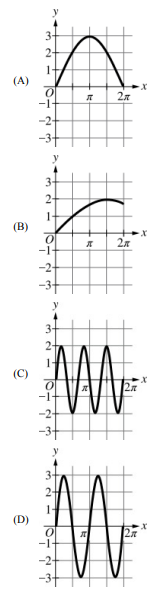
Amplitude = 3, Period = \( \frac{2\pi}{2} = \pi \).
Graph passes through origin, oscillates between \( y = 3 \) and \( y = -3 \), completes one full cycle from \( x = 0 \) to \( x = \pi \).
▶️ Answer/Explanation
\( f(x) = 3\sin(2x) \) has:
Amplitude \( = 3 \), period \( = \frac{2\pi}{2} = \pi \).
The graph starts at \( (0,0) \), increases to a maximum at \( x = \frac{\pi}{4} \), returns to 0 at \( x = \frac{\pi}{2} \), reaches a minimum at \( x = \frac{3\pi}{4} \), and returns to 0 at \( x = \pi \).
Among the options, the correct graph shows this behavior with amplitude 3 and period \( \pi \).
✅ Answer: (D)
Question
(B) The vertical asymptotes occur at \( \theta = \frac{1}{4} + \frac{1}{2}k \), where \( k \) is an integer.
(C) The vertical asymptotes occur at \( \theta = \frac{1}{4} + k \), where \( k \) is an integer.
(D) The vertical asymptotes occur at \( \theta = \frac{1}{2} + 2k \), where \( k \) is an integer.
▶️ Answer/Explanation
For \( g(\theta) = \tan(2\pi\theta) \), the period is \( \frac{\pi}{2\pi} = \frac{1}{2} \).
Vertical asymptotes occur where \( \cos(2\pi\theta) = 0 \), i.e., where \( 2\pi\theta = \frac{\pi}{2} + \pi k \).
Solving: \( \theta = \frac{1}{4} + \frac{1}{2}k \), where \( k \) is an integer.
✅ Answer: (B)
Question
▶️ Answer/Explanation
The standard tangent function, \(y = \tan(\theta)\), has vertical asymptotes when \(\theta = \frac{\pi}{2} + \pi k\), where \(k\) is an integer.
For the given function \(j(x) = 8 – 7 \tan\left(\frac{x}{4}\right)\), the argument of the tangent is \(\frac{x}{4}\).
To find the vertical asymptotes, we set the argument equal to the asymptotic values: \(\frac{x}{4} = \frac{\pi}{2} + \pi k\).
Now, solve for \(x\) by multiplying both sides of the equation by \(4\).
\(x = 4\left(\frac{\pi}{2}\right) + 4(\pi k)\)
Simplifying the expression gives \(x = 2\pi + 4\pi k\).
Therefore, the vertical asymptotes occur at \(x = 2\pi + 4\pi k\), where \(k\) is an integer.
Correct Option: (C)
Question
▶️ Answer/Explanation
The correct option is (C).
The period of a tangent function is determined by the horizontal distance between consecutive vertical asymptotes.
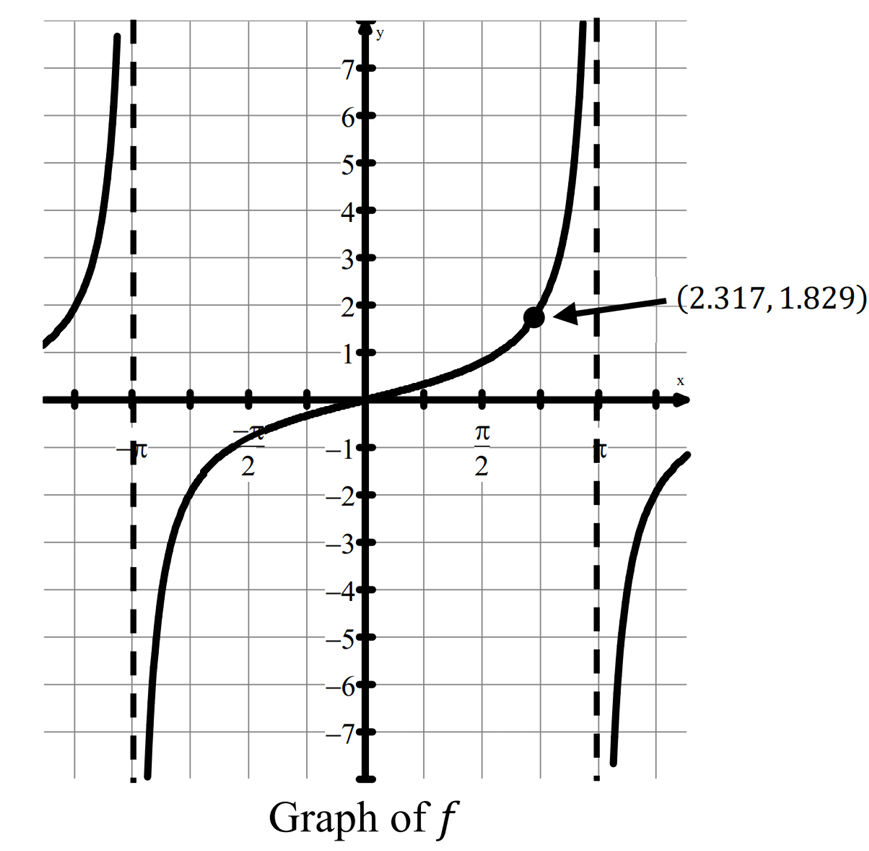
From the given graph, the vertical asymptotes are located at \( x = -\pi \) and \( x = \pi \).
Therefore, the period of the function \( f(x) \) is the difference: \( \pi – (-\pi) = 2\pi \).
We are given a specific point on the curve where \( f(2.317) = 1.829 \), meaning \( x = 2.317 \) is one valid solution.
Since the tangent function is periodic, the values of \( f(x) \) repeat every period.
Thus, the general solution for \( f(x) = 1.829 \) is the initial x-value plus integer multiples of the period.
This gives the expression: \( x = 2.317 + 2\pi k \), where \( k \) is any integer.
Question
▶️ Answer/Explanation
The standard tangent function, \( y = \tan(x) \), has vertical asymptotes where the function is undefined, which is at \( x = \frac{\pi}{2} + \pi k \) for any integer \( k \).
For the function \( h(\theta) = \tan(3\theta) + 1 \), the argument is \( 3\theta \).
We set the argument equal to the asymptotic condition: \( 3\theta = \frac{\pi}{2} + \pi k \).
Solving for \( \theta \), we divide the entire equation by 3: \( \theta = \frac{1}{3}(\frac{\pi}{2} + \pi k) \).
This simplifies to \( \theta = \frac{\pi}{6} + \frac{\pi}{3}k \).
Comparing this result with the given options, it corresponds to statement (B).
Question
(B) The tangent of angle $BAC$ is $-\frac{4}{9}$, and the slope of ray $AC$ is $-\frac{9}{4}$.
(C) The tangent of angle $BAC$ is $-\frac{9}{4}$, and the slope of ray $AC$ is $-\frac{9}{4}$.
(D) The tangent of angle $BAC$ is $-\frac{9}{4}$, and the slope of ray $AC$ is $\frac{4}{9}$.
▶️ Answer/Explanation
The terminal ray $AC$ passes through the origin $(0,0)$ and the point $(0.4, -0.9)$.
The slope of ray $AC$ is calculated as $m = \frac{y_2 – y_1}{x_2 – x_1} = \frac{-0.9 – 0}{0.4 – 0} = -\frac{0.9}{0.4}$.
Simplifying the slope gives $m = -\frac{9}{4}$.
For an angle $\theta$ in standard position, $\tan(\theta) = \frac{y}{x}$ where $(x, y)$ is a point on the terminal ray.
Thus, $\tan(BAC) = \frac{-0.9}{0.4} = -\frac{9}{4}$.
Both the tangent of the angle and the slope of the ray are equal to $-\frac{9}{4}$.
Therefore, the correct description is given in option (C).
Question
(B) There are values of $\theta$ on $0 \le \theta \le 2\pi$ for which $\tan \theta = 1$ in Quadrants I and III only.
(C) There are values of $\theta$ on $0 \le \theta \le 2\pi$ for which $\tan \theta = 1$ in all four Quadrants.
(D) There is no value of $\theta$ on $0 \le \theta \le 2\pi$ for which $\tan \theta = 1$.
▶️ Answer/Explanation
The correct option is (B).
The tangent function is defined as $\tan \theta = \frac{y}{x}$ in the Cartesian plane.
For $\tan \theta = 1$, the values of $x$ and $y$ must have the same sign and magnitude.
In Quadrant I, both $x > 0$ and $y > 0$, so $\tan \theta = \frac{+}{+} = 1$ at $\theta = \frac{\pi}{4}$.
In Quadrant III, both $x < 0$ and $y < 0$, so $\tan \theta = \frac{-}{-} = 1$ at $\theta = \frac{5\pi}{4}$.
In Quadrants II and IV, $x$ and $y$ have opposite signs, making $\tan \theta$ negative.
Thus, there are exactly two solutions in the interval $[0, 2\pi]$, located in Quadrants I and III.
Question
▶️ Answer/Explanation
The function is given by \(j(x) = 8 – 7\tan\left(\frac{x}{4}\right)\).
Vertical asymptotes for the tangent function, \(\tan(\theta)\), occur where the function is undefined, which is when the argument \(\theta = \frac{\pi}{2} + \pi k\) for any integer \(k\).
In this function, the argument of the tangent is \(\frac{x}{4}\).
Set the argument equal to the condition for vertical asymptotes: \(\frac{x}{4} = \frac{\pi}{2} + \pi k\).
Solve for \(x\) by multiplying both sides of the equation by \(4\).
\(x = 4\left(\frac{\pi}{2}\right) + 4(\pi k)\).
Simplifying the expression results in: \(x = 2\pi + 4\pi k\).
Therefore, the correct option is (C).