
Tangent Function and Slope of the Terminal Ray
Given an angle of measure \( \theta \) in standard position and a unit circle centered at the origin, the terminal ray of the angle intersects the circle at a point \( P \).
The tangent function is defined as
\( f(\theta) = \tan \theta \)
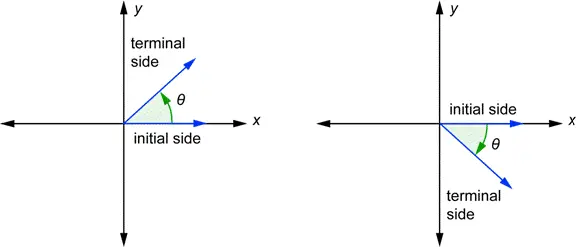
The value of \( \tan \theta \) represents the slope of the terminal ray of the angle \( \theta \), provided the slope exists.
Since slope is defined as the ratio of vertical change to horizontal change, the tangent function can be written as
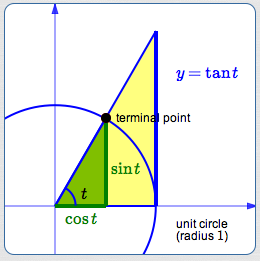
\( \tan \theta = \dfrac{\sin \theta}{\cos \theta} \)
On the unit circle, this is equivalent to the ratio of the y-coordinate to the x-coordinate of point \( P \).
The tangent function is undefined when \( \cos \theta = 0 \), which occurs when the terminal ray is vertical.
Example:
Find the value of \( \tan\!\left(\dfrac{\pi}{4}\right) \) and interpret it as a slope.
▶️ Answer/Explanation
On the unit circle,
\( \sin\!\left(\dfrac{\pi}{4}\right) = \dfrac{\sqrt{2}}{2} \)
\( \cos\!\left(\dfrac{\pi}{4}\right) = \dfrac{\sqrt{2}}{2} \)
Thus,
\( \tan\!\left(\dfrac{\pi}{4}\right) = \dfrac{\frac{\sqrt{2}}{2}}{\frac{\sqrt{2}}{2}} = 1 \)
Interpretation: The terminal ray has slope 1.
Example:
Explain why \( \tan\!\left(\dfrac{\pi}{2}\right) \) is undefined.
▶️ Answer/Explanation
At \( \theta = \dfrac{\pi}{2} \), the terminal ray is vertical.
On the unit circle,
\( \cos\!\left(\dfrac{\pi}{2}\right) = 0 \)
Since
\( \tan \theta = \dfrac{\sin \theta}{\cos \theta} \)
division by zero is undefined.
Conclusion: The tangent function is undefined when the terminal ray is vertical.
Tangent as a Ratio of Sine and Cosine
For an angle \( \theta \) in standard position, the slope of the terminal ray is defined as the ratio of the change in the \( y \)-values to the change in the \( x \)-values between any two points on the ray.
On the unit circle, the point where the terminal ray intersects the circle has coordinates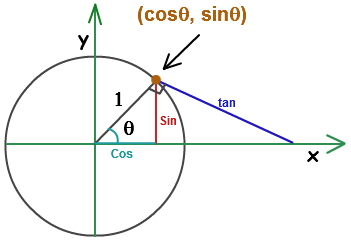
\( (\cos \theta, \sin \theta) \)
Therefore, the slope of the terminal ray is given by
\( \dfrac{\text{change in } y}{\text{change in } x} = \dfrac{\sin \theta}{\cos \theta} \)
This leads to the identity
\( \tan \theta = \dfrac{\sin \theta}{\cos \theta} \)
The tangent function is defined only when \( \cos \theta \ne 0 \), because division by zero is undefined.
This relationship connects all three primary trigonometric functions and explains why the tangent function represents the slope of the terminal ray.
Example:
Evaluate \( \tan\!\left(\dfrac{\pi}{6}\right) \) using sine and cosine.
▶️ Answer/Explanation
Using unit circle values,
\( \sin\!\left(\dfrac{\pi}{6}\right) = \dfrac{1}{2} \)
\( \cos\!\left(\dfrac{\pi}{6}\right) = \dfrac{\sqrt{3}}{2} \)
Substitute into the tangent ratio:
\( \tan\!\left(\dfrac{\pi}{6}\right) = \dfrac{\frac{1}{2}}{\frac{\sqrt{3}}{2}} = \dfrac{1}{\sqrt{3}} = \dfrac{\sqrt{3}}{3} \)
Example:
Explain why \( \tan \theta \) is undefined when \( \theta = \dfrac{\pi}{2} \).
▶️ Answer/Explanation
Using the identity
\( \tan \theta = \dfrac{\sin \theta}{\cos \theta} \)
At \( \theta = \dfrac{\pi}{2} \),
\( \cos\!\left(\dfrac{\pi}{2}\right) = 0 \)
Since division by zero is undefined, the tangent function does not exist at this angle.
Conclusion: \( \tan \theta \) is undefined whenever \( \cos \theta = 0 \).
Period of the Tangent Function
The tangent function is defined as the slope of the terminal ray for an angle \( \theta \) in standard position.
As an angle rotates around the unit circle, the slope values of the terminal ray repeat every one-half revolution.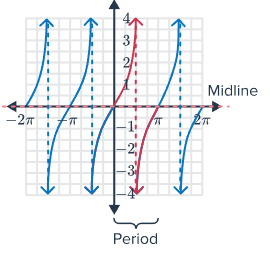
One-half revolution corresponds to an angle of
\( \pi \) radians
Therefore, the tangent function is periodic with period \( \pi \).
\( \tan(\theta + \pi) = \tan \theta \)
This means the graph of \( y = \tan \theta \) repeats its shape every \( \pi \) units along the horizontal axis.
The period of the tangent function is half the period of the sine and cosine functions, which have period \( 2\pi \).
Example:
Verify that the tangent function has period \( \pi \) by evaluating
\( \tan\!\left(\dfrac{\pi}{6}\right) \) and \( \tan\!\left(\dfrac{\pi}{6} + \pi\right) \)
▶️ Answer/Explanation
Using known values,
\( \tan\!\left(\dfrac{\pi}{6}\right) = \dfrac{\sqrt{3}}{3} \)
Now evaluate
\( \tan\!\left(\dfrac{\pi}{6} + \pi\right) = \tan\!\left(\dfrac{7\pi}{6}\right) \)
The slope of the terminal ray at both angles is the same, so
\( \tan\!\left(\dfrac{7\pi}{6}\right) = \dfrac{\sqrt{3}}{3} \)
Conclusion: The tangent function repeats every \( \pi \).
Example:
Find the period of the function
\( y = \tan(2\theta) \)
▶️ Answer/Explanation
The period of \( y = \tan \theta \) is \( \pi \).
For \( y = \tan(b\theta) \), the period is
\( \dfrac{\pi}{|b|} \)
Here, \( b = 2 \).
\( \text{Period} = \dfrac{\pi}{2} \)
Final answer: The period is \( \dfrac{\pi}{2} \).
Asymptotic Behavior of the Tangent Function
The tangent function
\( f(\theta) = \tan \theta \)
exhibits periodic asymptotic behavior, meaning the graph approaches but never touches certain vertical lines.
These vertical asymptotes occur at input values where the cosine function equals zero.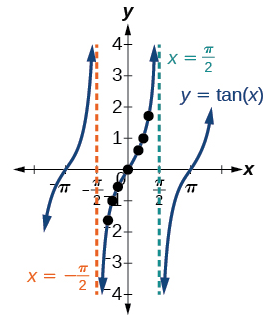
\( \cos \theta = 0 \)
This happens at angles of the form
\( \theta = \dfrac{\pi}{2} + k\pi \), where \( k \) is any integer
Because
\( \tan \theta = \dfrac{\sin \theta}{\cos \theta} \)
the tangent function is undefined when \( \cos \theta = 0 \), resulting in vertical asymptotes at these values.
Between consecutive asymptotes, the tangent graph increases continuously and repeats this behavior every period of \( \pi \).
Example:
State the vertical asymptotes of the function \( y = \tan \theta \).
▶️ Answer/Explanation
Vertical asymptotes occur where \( \cos \theta = 0 \).
\( \theta = \dfrac{\pi}{2} + k\pi \)
for all integers \( k \).
Final answer: The vertical asymptotes are at \( \theta = \dfrac{\pi}{2} + k\pi \).
Example:
Explain why the function \( y = \tan \theta \) is undefined at \( \theta = \dfrac{3\pi}{2} \).
▶️ Answer/Explanation
Evaluate the cosine at this angle:
\( \cos\!\left(\dfrac{3\pi}{2}\right) = 0 \)
Since
\( \tan \theta = \dfrac{\sin \theta}{\cos \theta} \)
division by zero is undefined.
Conclusion: The tangent function is undefined at \( \theta = \dfrac{3\pi}{2} \), producing a vertical asymptote.
Behavior and Concavity of the Tangent Function
Between any two consecutive vertical asymptotes, the tangent function
\( f(\theta) = \tan \theta \)
is increasing over its entire interval of definition.

As \( \theta \) approaches a vertical asymptote from the left, the output values decrease without bound, and as \( \theta \) approaches the asymptote from the right, the output values increase without bound.
Within each interval between consecutive asymptotes, the graph of the tangent function also changes concavity.
Specifically, the graph is concave down on part of the interval and then becomes concave up, with the change in concavity occurring near the center of the interval.
This increasing behavior and alternating concavity repeat regularly due to the periodic nature of the tangent function.
Example:
Describe the behavior of \( y = \tan \theta \) on the interval
\( \left(-\dfrac{\pi}{2}, \dfrac{\pi}{2}\right) \)
▶️ Answer/Explanation
There are no vertical asymptotes inside this interval.
The tangent function increases continuously from negative infinity to positive infinity.
The graph is concave down on the left side of the interval and concave up on the right side.
Conclusion: \( y = \tan \theta \) is increasing and changes from concave down to concave up on this interval.
Example:
Explain how the concavity of \( y = \tan \theta \) behaves between the asymptotes
\( \theta = -\dfrac{\pi}{2} \) and \( \theta = \dfrac{\pi}{2} \).
▶️ Answer/Explanation
Near \( \theta = -\dfrac{\pi}{2} \), the graph bends downward, so it is concave down.
As \( \theta \) increases toward 0, the concavity changes.
Near \( \theta = \dfrac{\pi}{2} \), the graph bends upward, so it is concave up.
Conclusion: The tangent graph changes from concave down to concave up between consecutive asymptotes.
Transformations of the Tangent Function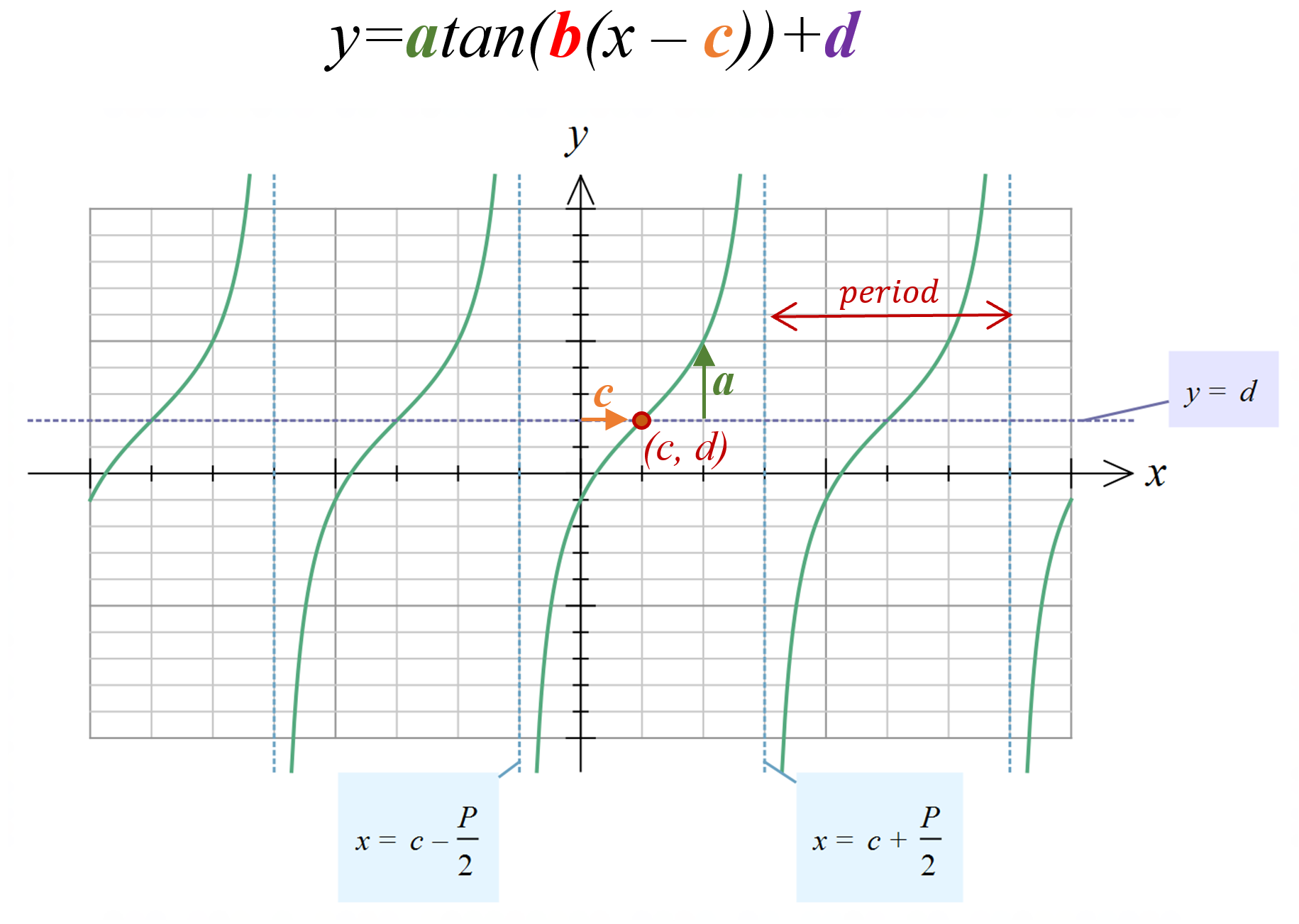
The tangent function
\( f(\theta) = \tan \theta \)
can undergo additive transformations that result in vertical or horizontal translations of its graph.
Vertical (Additive) Transformation
The function
\( g(\theta) = \tan \theta + d \)
is a vertical translation of the graph of \( f(\theta) = \tan \theta \) by \( d \) units.
If \( d > 0 \), the graph shifts upward. If \( d < 0 \), the graph shifts downward.
This transformation moves the entire graph, including the line containing the points of inflection, by \( d \) units.
The locations of the vertical asymptotes and the period remain unchanged.
Horizontal (Phase) Transformation
The function
\( g(\theta) = \tan(\theta + c) \)
is a horizontal translation, or phase shift, of the graph of \( f(\theta) = \tan \theta \) by \( -c \) units.
If \( c > 0 \), the graph shifts left by \( c \) units. If \( c < 0 \), the graph shifts right by \( |c| \) units.
This transformation shifts the positions of the vertical asymptotes and points of inflection horizontally, but does not change the shape or period of the graph.
Example:
Describe the transformation of the graph of \( y = \tan \theta \) to obtain
\( y = \tan \theta – 2 \)
▶️ Answer/Explanation
The constant \( d = -2 \) represents a vertical translation.
The graph shifts downward by 2 units.
The vertical asymptotes stay at \( \theta = \dfrac{\pi}{2} + k\pi \).
Conclusion: The graph is shifted down by 2 units.
Example:
Identify the phase shift of the function
\( y = \tan(\theta + \dfrac{\pi}{4}) \)
▶️ Answer/Explanation
The function is in the form \( \tan(\theta + c) \) with \( c = \dfrac{\pi}{4} \).
The phase shift is \( -c = -\dfrac{\pi}{4} \).
Conclusion: The graph shifts left by \( \dfrac{\pi}{4} \).
Key Features of a General Tangent Function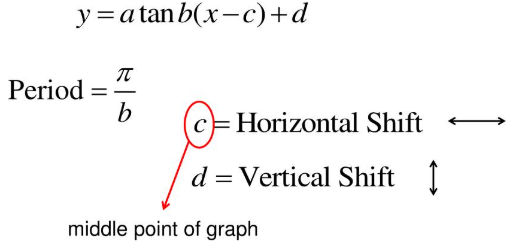
Consider the tangent function
\( y = f(\theta) = a\tan(b(\theta + c)) + d \)
This function is a transformation of the basic tangent function
\( y = \tan \theta \)
and its graph can be described using the parameters \( a \), \( b \), \( c \), and \( d \).
Vertical Dilation
The factor \( |a| \) vertically stretches or compresses the graph.
Vertical dilation factor: \( |a| \)
If \( a < 0 \), the graph is also reflected across the x-axis.
Period
The period of the tangent function changes due to the factor \( b \).
Period: \( \left| \dfrac{1}{b} \right| \pi = \dfrac{\pi}{|b|} \)
Vertical Shift (Inflection Line)
The basic tangent graph has points of inflection along the line
\( y = 0 \)
The constant \( d \) shifts this line vertically.
Line of inflection becomes: \( y = d \)
Phase Shift
The constant \( c \) causes a horizontal translation of the graph.
Phase shift: \( -c \)
If \( c > 0 \), the graph shifts left. If \( c < 0 \), the graph shifts right.
Example:
Identify the key features of the function
\( y = 2\tan\!\left(3(\theta – \dfrac{\pi}{6})\right) + 1 \)
▶️ Answer/Explanation
Vertical dilation:
\( |a| = 2 \)
Period:
\( \dfrac{\pi}{3} \)
Phase shift:
Right \( \dfrac{\pi}{6} \)
Line of inflection:
\( y = 1 \)
Example:
Find the period and describe the transformations of the function
\( y = -\tan\!\left(\dfrac{1}{2}(\theta + \pi)\right) – 3 \)
▶️ Answer/Explanation
Vertical dilation:
\( |a| = 1 \) with reflection across the x-axis
Period:
\( \dfrac{\pi}{\frac{1}{2}} = 2\pi \)
Phase shift:
Left \( \pi \)
Line of inflection:
\( y = -3 \)