AP Precalculus -3.9 Inverse Trigonometric Functions- MCQ Exam Style Questions - Effective Fall 2023
AP Precalculus -3.9 Inverse Trigonometric Functions- MCQ Exam Style Questions – Effective Fall 2023
AP Precalculus -3.9 Inverse Trigonometric Functions- MCQ Exam Style Questions – AP Precalculus- per latest AP Precalculus Syllabus.
Question
(B) Domain: \([-1, 1]\), Range: \([-\frac{\pi}{2}, \frac{\pi}{2}]\)
(C) Domain: \([-\frac{\pi}{2}, \frac{\pi}{2}]\), Range: \([-\frac{1}{2}, \frac{1}{2}]\)
(D) Domain: \([-\frac{\pi}{2}, \frac{\pi}{2}]\), Range: \([-1, 1]\)
▶️ Answer/Explanation
For the original function \( f(x) = \frac{1}{2}\sin x \) on \( -\frac{\pi}{2} \leq x \leq \frac{\pi}{2} \):
– Domain of \( f \): \( [-\frac{\pi}{2}, \frac{\pi}{2}] \)
– Range of \( f \): Since \(\sin x\) ranges from \(-1\) to \(1\) over this interval, \( \frac{1}{2}\sin x \) ranges from \(-\frac{1}{2}\) to \(\frac{1}{2}\).
For the inverse function \( f^{-1} \), the domain and range swap:
– Domain of \( f^{-1} \) = Range of \( f \) = \([-\frac{1}{2}, \frac{1}{2}]\)
– Range of \( f^{-1} \) = Domain of \( f \) = \([-\frac{\pi}{2}, \frac{\pi}{2}]\)
✅ Answer: (A)
Question
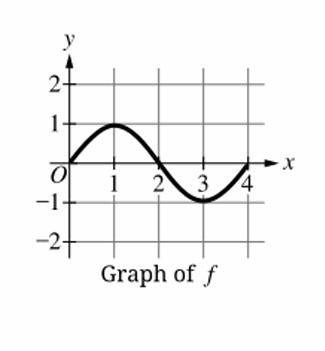
▶️ Answer/Explanation
For a sinusoidal function to be invertible, it must be one-to-one on an interval. The longest such interval on a sine or cosine wave is half a period where the function is strictly increasing or decreasing.
From the graph (described in the PDF), the period is 4, so half-period is 2. This gives the longest interval for an inverse.
✅ Answer: (B)
Question
(B) \(t=2.029\)
(C) \(t=5.165\)
(D) \(t=6.623\)
▶️ Answer/Explanation
1. Set up the equation:
Person number 4000 corresponds to 4 thousand people. So, set \(h(t) = 4\).
\(4 = 4.217\tan^{-1}(0.7t-0.026)\)
2. Solve for \(t\) using a calculator:
\(\frac{4}{4.217} = \tan^{-1}(0.7t-0.026)\)
\(\tan(\frac{4}{4.217}) = 0.7t – 0.026\)
\(1.398 \approx 0.7t – 0.026\)
\(1.424 \approx 0.7t\)
\(t \approx 2.03\)
✅ Answer: (B)
Question
▶️ Answer/Explanation
The expression is $\sec^{-1}(\csc(-\frac{\pi}{4}))$.
First, evaluate the inner function: $\csc(-\frac{\pi}{4}) = \frac{1}{\sin(-\frac{\pi}{4})}$.
Since $\sin(-\frac{\pi}{4}) = -\frac{\sqrt{2}}{2}$, then $\csc(-\frac{\pi}{4}) = -\frac{2}{\sqrt{2}} = -\sqrt{2}$.
The expression simplifies to $\sec^{-1}(-\sqrt{2})$.
Recall the range of $y = \sec^{-1}(x)$ is $[0, \pi], y \neq \frac{\pi}{2}$.
We need an angle $\theta$ such that $\sec(\theta) = -\sqrt{2}$, which means $\cos(\theta) = -\frac{1}{\sqrt{2}}$.
In the second quadrant, the angle that satisfies this is $\theta = \frac{3\pi}{4}$.
Therefore, the exact value is $\frac{3\pi}{4}$, which corresponds to option b.
Question
Directions:
- Unless otherwise specified, the domain of a function \( f \) is assumed to be the set of all real numbers \( x \) for which \( f(x) \) is a real number. Angle measures for trigonometric functions are assumed to be in radians.
- Solutions to equations must be real numbers. Determine the exact value of any expression that can be obtained without a calculator. For example, \( \log_2 8 \), \( \cos(\frac{\pi}{2}) \), and \( \sin^{-1}(1) \) can be evaluated without a calculator.
- Unless otherwise specified, combine terms using algebraic methods and rules for exponents and logarithms, where applicable. For example, \( 2x + 3x \), \( 5^2 \cdot 5^3 \), \( \frac{x^5}{x^2} \), and \( \ln 3 + \ln 5 \) should be rewritten in equivalent forms.
- For each part of the question, show the work that leads to your answers.
Part A
The functions \( g \) and \( h \) are given by
\( h(x) = \sin^{-1}(8x) \)
Part B
The functions \( j \) and \( k \) are given by
\( k(x) = \frac{(16^{3x}) \cdot 4^x}{2} \)
Part C
The function \( m \) is given by
▶️ Answer/Explanation
Part A
(i) Solve \( g(x) = 3 \)
Start with the given equation:
\( \log_5(4x – 2) = 3 \)
Convert the logarithmic equation to exponential form (\( y = \log_b x \iff x = b^y \)):
\( 4x – 2 = 5^3 \)
Evaluate the exponent:
\( 4x – 2 = 125 \)
Add 2 to both sides:
\( 4x = 127 \)
Divide by 4:
\( x = \frac{127}{4} \)
(ii) Solve \( h(x) = \frac{\pi}{4} \)
Start with the given equation:
\( \sin^{-1}(8x) = \frac{\pi}{4} \)
Take the sine of both sides to isolate the argument:
\( 8x = \sin\left(\frac{\pi}{4}\right) \)
Substitute the exact value of \( \sin\left(\frac{\pi}{4}\right) \):
\( 8x = \frac{\sqrt{2}}{2} \)
Divide by 8:
\( x = \frac{\sqrt{2}}{16} \)
Part B
(i) Rewrite \( j(x) \)
Start with the function definition:
\( j(x) = (\sec x)(\cot x) \)
Substitute the reciprocal and quotient identities (\( \sec x = \frac{1}{\cos x} \) and \( \cot x = \frac{\cos x}{\sin x} \)):
\( j(x) = \left(\frac{1}{\cos x}\right) \left(\frac{\cos x}{\sin x}\right) \)
Cancel the \( \cos x \) terms:
\( j(x) = \frac{1}{\sin x} \)
(ii) Rewrite \( k(x) \)
Start with the function definition:
\( k(x) = \frac{(16^{3x}) \cdot 4^x}{2} \)
To write in the form \( 4^{(ax+b)} \), convert bases 16 and 2 to base 4.
Since \( 16 = 4^2 \) and \( 2 = \sqrt{4} = 4^{1/2} = 4^{0.5} \):
\( k(x) = \frac{(4^2)^{3x} \cdot 4^x}{4^{0.5}} \)
Apply the power of a power rule (\( (a^m)^n = a^{mn} \)):
\( k(x) = \frac{4^{6x} \cdot 4^x}{4^{0.5}} \)
Apply the product rule for exponents (\( a^m \cdot a^n = a^{m+n} \)) in the numerator:
\( k(x) = \frac{4^{6x + x}}{4^{0.5}} = \frac{4^{7x}}{4^{0.5}} \)
Apply the quotient rule for exponents (\( \frac{a^m}{a^n} = a^{m-n} \)):
\( k(x) = 4^{7x – 0.5} \) (or \( 4^{7x – \frac{1}{2}} \))
Thus, \( a = 7 \) and \( b = -0.5 \).
Part C
Find values where \( m(x) = 1 \)
Set the function equal to 1:
\( \sqrt{3}\tan\left(x + \frac{\pi}{2}\right) = 1 \)
Isolate the tangent function by dividing by \( \sqrt{3} \):
\( \tan\left(x + \frac{\pi}{2}\right) = \frac{1}{\sqrt{3}} \)
Determine the reference angle. We know that \( \tan\left(\frac{\pi}{6}\right) = \frac{1}{\sqrt{3}} \).
Set up the general solution for tangent (\( \theta = \text{ref} + n\pi \)):
\( x + \frac{\pi}{2} = \frac{\pi}{6} + n\pi \), where \( n \) is any integer.
Solve for \( x \) by subtracting \( \frac{\pi}{2} \) from both sides:
\( x = \frac{\pi}{6} – \frac{\pi}{2} + n\pi \)
Find a common denominator (6) to combine fractions:
\( x = \frac{\pi}{6} – \frac{3\pi}{6} + n\pi \)
\( x = -\frac{2\pi}{6} + n\pi \)
Simplify the fraction:
\( x = -\frac{\pi}{3} + n\pi \)

