Home / AP® Exam / AP® PreCalculus / AP® Precalculus

AP Precalculus -3.9 Inverse Trigonometric Functions- MCQ Exam Style Questions - Effective Fall 2023

AP Precalculus -3.9 Inverse Trigonometric Functions- MCQ Exam Style Questions – Effective Fall 2023

AP Precalculus -3.9 Inverse Trigonometric Functions- MCQ Exam Style Questions – AP Precalculus- per latest AP Precalculus Syllabus.

AP Precalculus – MCQ Exam Style Questions- All Topics

Question 

The function \( f \) is given by \( f(x) = \frac{1}{2} \sin x \) for \( -\frac{\pi}{2} \leq x \leq \frac{\pi}{2} \). What are the domain and range of the inverse function of \( f \)?
(A) Domain: \([-\frac{1}{2}, \frac{1}{2}]\), Range: \([-\frac{\pi}{2}, \frac{\pi}{2}]\)
(B) Domain: \([-1, 1]\), Range: \([-\frac{\pi}{2}, \frac{\pi}{2}]\)
(C) Domain: \([-\frac{\pi}{2}, \frac{\pi}{2}]\), Range: \([-\frac{1}{2}, \frac{1}{2}]\)
(D) Domain: \([-\frac{\pi}{2}, \frac{\pi}{2}]\), Range: \([-1, 1]\)
▶️ Answer/Explanation
Detailed solution

For the original function \( f(x) = \frac{1}{2}\sin x \) on \( -\frac{\pi}{2} \leq x \leq \frac{\pi}{2} \):
– Domain of \( f \): \( [-\frac{\pi}{2}, \frac{\pi}{2}] \)
– Range of \( f \): Since \(\sin x\) ranges from \(-1\) to \(1\) over this interval, \( \frac{1}{2}\sin x \) ranges from \(-\frac{1}{2}\) to \(\frac{1}{2}\).
For the inverse function \( f^{-1} \), the domain and range swap:
– Domain of \( f^{-1} \) = Range of \( f \) = \([-\frac{1}{2}, \frac{1}{2}]\)
– Range of \( f^{-1} \) = Domain of \( f \) = \([-\frac{\pi}{2}, \frac{\pi}{2}]\)
Answer: (A)

Question 


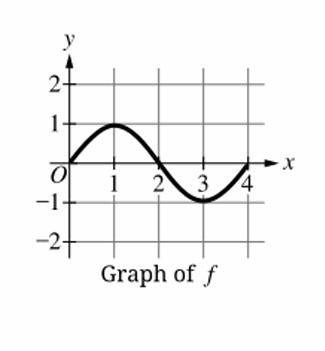
The graph of a sinusoidal function \( f \) is given. What is the length of the largest interval of input values of \( f \) on which an inverse function of \( f \) can be constructed?
(A) 1
(B) 2
(C) 4
(D) There is no interval larger than a single point on which \( f \) is invertible.
▶️ Answer/Explanation
Detailed solution

For a sinusoidal function to be invertible, it must be one-to-one on an interval. The longest such interval on a sine or cosine wave is half a period where the function is strictly increasing or decreasing.
From the graph (described in the PDF), the period is 4, so half-period is 2. This gives the longest interval for an inverse.
Answer: (B)

Question 

On a given day, the number of people, in thousands, that have entered a museum is modeled by the function \(h\) given by \(h(t)=4.217\tan^{-1}(0.7t-0.026)\), where \(t\) is measured in hours and \(0\le t\le8\) Based on the model, at what time \(t\) did person number 4000 enter the museum?
(A) \(t=1.121\)
(B) \(t=2.029\)
(C) \(t=5.165\)
(D) \(t=6.623\)
▶️ Answer/Explanation
Detailed solution

1. Set up the equation:
Person number 4000 corresponds to 4 thousand people. So, set \(h(t) = 4\).
\(4 = 4.217\tan^{-1}(0.7t-0.026)\)

2. Solve for \(t\) using a calculator:
\(\frac{4}{4.217} = \tan^{-1}(0.7t-0.026)\)
\(\tan(\frac{4}{4.217}) = 0.7t – 0.026\)
\(1.398 \approx 0.7t – 0.026\)
\(1.424 \approx 0.7t\)
\(t \approx 2.03\)

Answer: (B)

Question 

Evaluate $\sec^{-1}(\csc(-\frac{\pi}{4}))$ for the exact value.
a. $\frac{\pi}{2}$
b. $\frac{3\pi}{4}$
c. $\pi$
d. $\frac{\pi}{4}$
▶️ Answer/Explanation
Detailed solution

The expression is $\sec^{-1}(\csc(-\frac{\pi}{4}))$.
First, evaluate the inner function: $\csc(-\frac{\pi}{4}) = \frac{1}{\sin(-\frac{\pi}{4})}$.
Since $\sin(-\frac{\pi}{4}) = -\frac{\sqrt{2}}{2}$, then $\csc(-\frac{\pi}{4}) = -\frac{2}{\sqrt{2}} = -\sqrt{2}$.
The expression simplifies to $\sec^{-1}(-\sqrt{2})$.
Recall the range of $y = \sec^{-1}(x)$ is $[0, \pi], y \neq \frac{\pi}{2}$.
We need an angle $\theta$ such that $\sec(\theta) = -\sqrt{2}$, which means $\cos(\theta) = -\frac{1}{\sqrt{2}}$.
In the second quadrant, the angle that satisfies this is $\theta = \frac{3\pi}{4}$.
Therefore, the exact value is $\frac{3\pi}{4}$, which corresponds to option b.

Scroll to Top